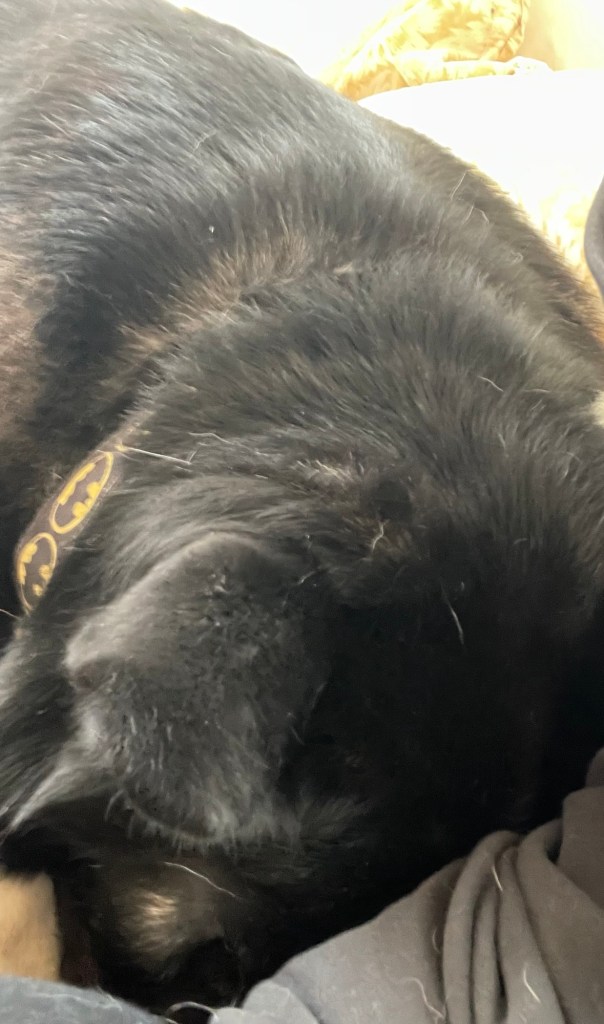
He’s sound asleep and snoring with his nose buried in the small of my back. It’s very warm and tickly, but so sweet. And of course, I can’t move.
He’s sound asleep and snoring with his nose buried in the small of my back. It’s very warm and tickly, but so sweet. And of course, I can’t move.
Welcome to my new followers from “Morning Shots”. Funny how one mention leads to so many new visitors. It’s been fun to watch.
This newsletter is not very much like that one. In contrast, this is a politics-free zone. It’s not because we don’t care or don’t have views, but because we all need a respite from the “hamster wheel of crazy”. I relish the civility and kindness of my readers, and I know they enjoy the calm.
I am a novelist and essayist, (you can find and order my books wherever you like to shop) but I use this newsletter to warm up for my day’s work. The topics are whatever catches my attention, and even I don’t always know what will happen when I sit down to write. Recent posts have been about day to day life: writing, friendship, making sauerbraten, animals—we have lots of turkeys—and the regular appearance of gratuitous dog photos.
I don’t write about the momentous. I write about the small beauties that enrich our days. In a world of celebrity culture, I turn away from red carpets and controversy, and focus on the richness of ordinary observations; the ephemeral moments of joy, love, and creativity. Daily life is filled with extraordinary gifts far surpassing the rush, flash and pop that are just distractions from what matters.
Those small things are the momentous ones.
I hope you will browse here and find something that interests you. I enjoy and look forward to your comments.
–JFR
***
And now for your gratuitous dog photos:


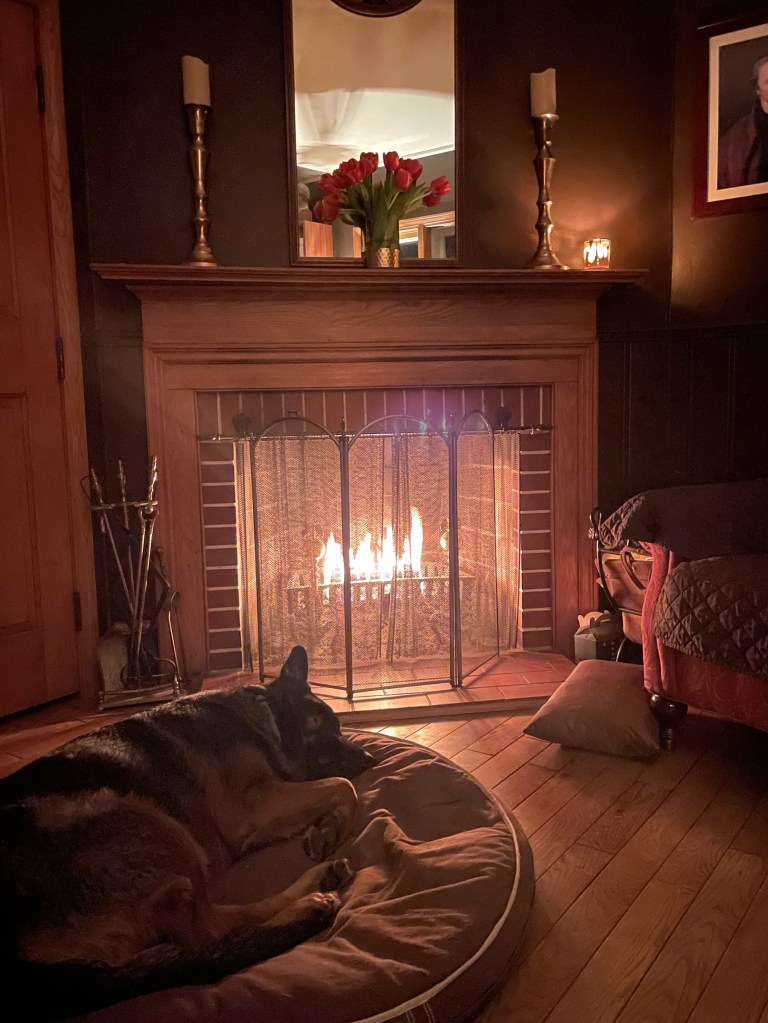
It’s cold enough again to have a fire in the morning. Auggie and Eli don’t mind.

My friends, Evelyn and Rose, are twin sisters, age 93. I have known them all my life. They have their share of challenges, as do we all, but they are utterly undiminished by age in any meaningful sense, and carry on with rare gallantry.
Today, for my birthday, they sent me not one, but two bottles of Veuve Clicquot, all beautifully packaged in a big box with excelsior that feels like a beautiful and elegant difference from plastic bubble wrap.
I think it will be a a very happy night. Or possibly afternoon.
When I wrote to say thank you, Evelyn said, “We know what you like.”
It’s nice to have friends.

***
Eddie was accustomed to listening to his customers’ problems. He rarely told his own. In fact, most of the time he would have said he didn’t have any. But Dirk had a quality of empathy that resonated around him, and after pouring a generous scotch for him, Eddie found himself talking, for the first time, of Danni.
“I guess, the thing is, I don’t know why I’m thinking about her now, after all this time. I mean, my life is pretty good. I’m happy. But I screwed up, you know? And I can’t help wondering where she is, and whether she’s happy. Probably married to someone else with a couple of kids by now.…” His voice trailed off.
Dirk was silent, considering, before he spoke.
“Well, if you go looking, there are only two things that can happen, really: A) You find her, and realize you still love her, or B) You find her, and you wonder what in Hell you were thinking. There are variations of both A and B, of course, but those, essentially, are the primary options, and then the road branches out from there. The question is: Do you want a new kind of regret, or are you content with the regret you already have.”
“What do you mean?”
“ Well, think about it: Sometimes, the old, familiar griefs are a kind of comfort. You can fantasize about how wonderful she was because you never had any of the normal struggles of a long-term relationship. You never got bored with one another. She never said anything cruelly cutting to you. She never nagged, or rolled her eyes. She never had annoying habits. You can have a beautiful and romantic dream of your perfect lost love. Because that’s all it really is: a dream. If you act to find her, then you will have to cope with reality, with all its flaws and joys.”
“On the other hand, what is life, but stepping off into the unknown to see what will happen? Maybe you owe it to yourself to find out.”
They were both silent. Eddie, usually a whirlwind of activity behind the bar, now stood still, his gaze fixed at something he wasn’t seeing. Dirk stared into his glass.
There was the sound of a car door slamming in the parking lot, and they were jolted out of their reveries by the impending arrival of others. Dirk was the first to speak.
“The thing is, you always get grief in life, and you don’t get to choose what kind, how much, or how serious it is. This way, what you have now is a sad longing. But you could choose to give that up to get a reality-based grief. One way or another, it’s all grief in the end.”
They could hear another car drive up, and the sound of cheerful voices in the parking lot.
“What about happiness? You get that, too.”
Dirk shrugged. “Maybe. Some people do. But there’s no guarantee of that. Grief is the only thing you can really count on.”
Eddie stared at him curiously. “I didn’t take you for being so dark.”
“Oh, I’m not. At least, I don’t think of myself that way. But I am a realist. Grief comes. It’s inevitable if you’ve lived at all. But I’ve known plenty of people who have never been happy, and never will be.”
He smiled a small, almost mischievous smile. “I, however, am not one of them.”

What would a year of your life be worth? Is there any amount of money you would accept to shorten your time on earth? What if the money offered would give you everything you dream of having? What if it would save the life of a child? When the payment came due, and your time was up, what would you pay to have it back?
This is a version of the Faustian bargain, although Faust wanted youth and love, not money, and the price he paid was eternal damnation. Most jobs are not the Inferno (although I bet we all have stories). But it is, in concentrated form, a question we all grapple with in one way or another when we work. It is the question I asked every single morning when I stood at my picture window, dressed for the office or the classroom, and looked out at the sun rising through the trees. My office was on the bluffs above Lake Michigan, and sometimes, before I pulled into the parking lot, I would stop to watch the sun and the mists rising over the water, hear the gulls crying, and feel what I now realize was a form of grief. But then I got out of the car and went into the building and went to work. And that was not a bad thing.
Most of us have to work for a living. If we are lucky we find work that is meaningful, that makes the world better in some way. But for most of us, even the best job takes time away from things we care about.
I have been very lucky these past few years, because now my work is my writing, and I can do it in my own house with my husband nearby and my dogs on my feet. I choose what and when to write, and sometimes I play hooky. But that’s because I have the freedom to make choices about my priorities.
It is a luxury I appreciate every single day. I do not look back on my years at a job as wasted. I do sometimes look back with regret, but I also know that each step I took was a step toward who I am. Besides, anyone with no regrets hasn’t been trying hard enough.
The theologian Frederick Buechner wrote something I try to think of every day:
One life on this earth is all we get, whether it is enough or not enough. And the obvious conclusion would seem to be that, at the very least, we are fools if we do not live it as fully, and bravely, and beautifully as we can.
No one has a perfect life. No one has a life without grief or loss. But I think happiness is about gathering in the small beauties all around us Right. Now.
Today will not come again.
A few weeks ago, I wrote about a turkey I saw helping another turkey. Some readers were skeptical—which I might be, too, if I hadn’t seen it myself—about whether animals demonstrate altruism.
But increasingly, after centuries of human conceit about our moral superiority, science is being forced to acknowledge that animals do demonstrate care for their communities, sometimes even for other species. Today’s New York Times story about a male elephant seal rescuing a drowning pup is another example of an animal’s taking action that was not necessarily in its own interest.
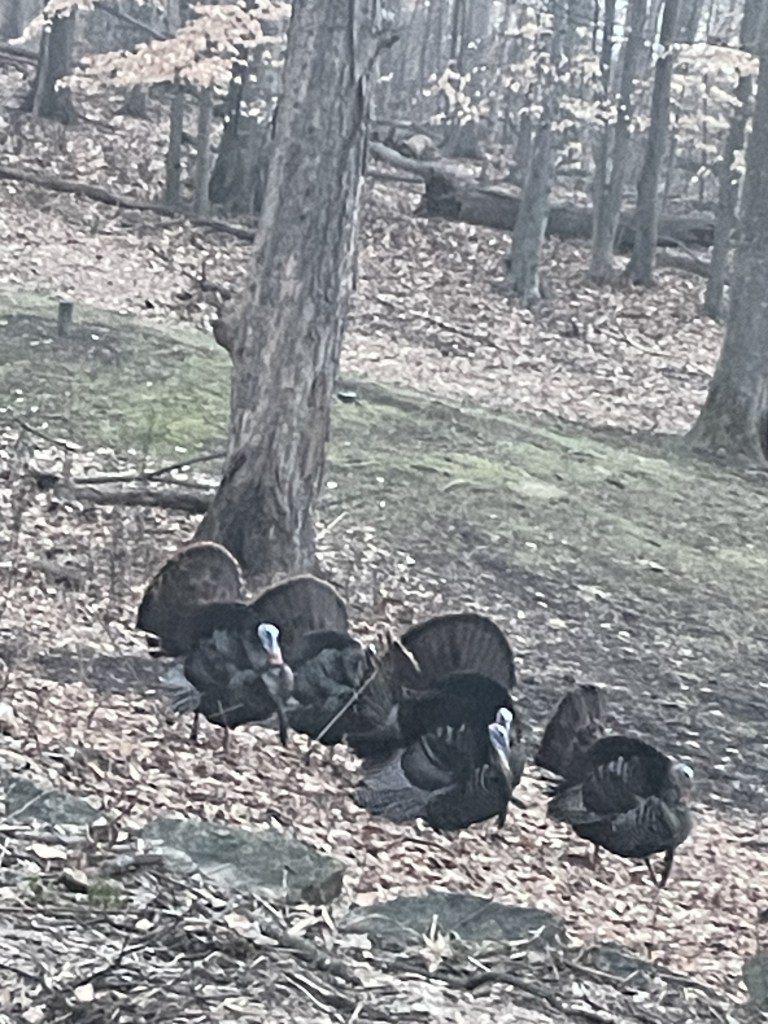
This past fall I saw another incident of turkey community action. The turkeys were on their daily march back to our woods to roost. The big toms were in front, and there were several groups of hens, surrounded by eleven scrambling poults—I counted—following about forty feet behind. Herding cats has nothing on herding turkey poults.
Our ravine is a water conservancy, which means there are some fairly deep holes that are usually dry, but fill with leaves in autumn. They seem like solid ground, but you can sink pretty deeply (and turn your ankle) if you accidentally step in the wrong place.
As I watched—seeing the babies is rare— the poults, one by one, managed to just barely avoid the biggest hole, scattering around it. Holding my breath, I could see what was about to happen: one took the wrong line, and promptly disappeared deep into the leaves. Its frantic peeping was terrible to hear.
Instantly the line stopped, and the toms turned and raced back to the sound of the crying poult. Soon the whole flock was surrounding the area—not in an orderly way at all—but homing in on the baby. I turned my head at exactly the wrong moment—dogs, you know—but suddenly the peeping stopped, and when I looked back, the adults were reassembling into the line, and I counted: one, two, three…all eleven poults were there. Counting turkeys can be tricky, so I counted three times. Everyone moved back into line, and on to the assembly grounds to carry on with their evening routine.
I still don’t know how they got the poult out of the hole.
It’s completely normal for parents to risk all for their offspring, and in this case, the poult was likely genetically linked to the adults who sped to its rescue. But to see the entire flock work together like that was another lesson to me. We humans have to learn a thing or two, and meanwhile, maybe we should stop being so smug about ourselves.
I had a little meeting with a local book club yesterday. They are all old friends, and did more talking than I did, and mostly on topics unrelated, but I’m not in a position to criticize digressions.
I almost always enjoy meetings with my readers, because by definition we have something in common, and people who don’t like my books generally don’t come to hear me speak. There was one notable exception: a book club on Washington Island shortly after my first novel came out.
It was a luncheon meeting, just before Easter, and after a pleasant lunch we all sat down for the meeting. One woman spent the entire discussion rapidly paging through the book to find things she didn’t like. She found many. Another pointed out that the map in the front was inaccurate. Another remarked how unrealistic the book was, since in her thirty years of living on the Island, she had never been invited to sit in the ferry’s pilot house. I wish I had had the nerve to say I could see why. Nor did I point out that my book was a work of fiction, only loosely based on reality. Until then, I hadn’t imagined it would be necessary.
It was an excruciating hour, and I was longing for a stiff drink. As the ladies filed out, I sat, somewhat shell-shocked. One leaned over to whisper as she went out.
“I liked it.”
Afterward, in need of some fresh air, I headed down to the ferry office to pick up a package. As I was leaving, there were some guys down at the dock calling and waving at me. “He’s mad at you for not telling him you were here,” the crewman joked, pointing at the captain. I went over to chat with them, relieved to see some friendly faces. “We’re heading out. Want to come for the ride?”
So we did a little round trip on the ferry, while I sat in the pilot house with the crew, entertaining them with the story of the book club meeting. They were able to identify everyone who was there by my descriptions, laughed about the surliness of the book-paging woman, and told stories of her rudeness. The conversation progressed to some fascinating stories about life on the Island. By the time we returned, I was in a much better mood.
So, I did say I don’t mind digressions. But my actual point is: if you live within a reasonable drive of Milwaukee, and would like to host a book talk, you can contact me here.
But only if you like my books.
I’m keeping my nails ridiculously short these days. It’s partly because I am playing the piano again, and partly because getting my nails done bores me. I am at the point in life when I don’t want to waste my time. And I am not trying to impress anybody.
There is a fairly thin line between feeling free to do what you want and letting yourself go. It’s a much thinner line for women than for men. Gray-haired men look distinguished. Gray-haired women usually just look old. I have a friend who decided to stop coloring her hair, and she looks fabulous. Not everyone does.
Most days, when I am at home writing, I still do my hair, wear mascara, and make an effort to look nice. I partly do it so my husband isn’t horrified (not that he would ever say so, even if he was). But I mostly do it for myself. I feel crummy all day if I don’t make some effort, even if it’s not all that noticeable to anyone else.
I have two particular women I always keep in mind as examples. One is someone I knew quite well. She was a friend of my mother’s who lived to be 108. Her name was Blanche, and I got to know her as an adult when we were both docents at a tiny art museum. Even though we worked together, I never dared call her by her first name; it would have been disrespectful. She was an alert and intelligent nonagenarian, and every time I saw her—even at her own home—she was nicely dressed, wearing a touch of makeup and a little bit of jewelry, and looking nicely pulled together. She was never overdone. But she took care.
The other is someone I never even met. Some years ago I was invited to speak at the opening of a museum exhibit. I only knew the curator and some of the museum staff, so after I did my part, I had the pleasure of carrying a glass of champagne while I wandered alone in a gallery of Dutch masters. This, I confess, is just about my favorite thing to do in the world, and I rarely miss an opportunity to hang out at the National Gallery. It soothes me.
But, as usual, I digress.
On my rambles, I noticed an elderly lady being shown around the gallery by one of the museum staff. He was attentive. She was clearly interested. She looked carefully. She asked questions. She spent more than the polite amount of time with the paintings. She was slim, white-haired, and elegantly dressed in black. She projected both strength and grace, while also being impeccably stylish. I asked who she was. She was Roberta McCain, John McCain’s mother.
Later, as I waited for a cab, I watched as one of the valets brought up a tiny hatchback. He handed the keys to Mrs. McCain, and she drove off alone. I don’t know exactly how old she was then, but she, too, lived to be 108.
I think often of these two women: one a small-town girl in Wisconsin, the other the daughter of an oil tycoon, wife of an admiral, and mother of a war hero and senator. What was their secret? Genetics, no doubt, were a factor. But wealth clearly was not. Nor was a life without worry. What kept them going? Faith? Curiosity? Generosity? Friendship? Or just plain stubbornness?
I can’t help thinking that there is a connection between longevity, having interests in larger things, and a willingness to make an effort. And so, I continue to try. I think it is a signal to yourself that you are worthwhile, and that you are not idling somewhere in a back room. You are prepared to meet the world. You are in the world. That matters a lot, I think.
But I also wonder whether art museums are a wellspring of long life. It’s a theory I am happy to test. Any time.
 J.F. Riordan