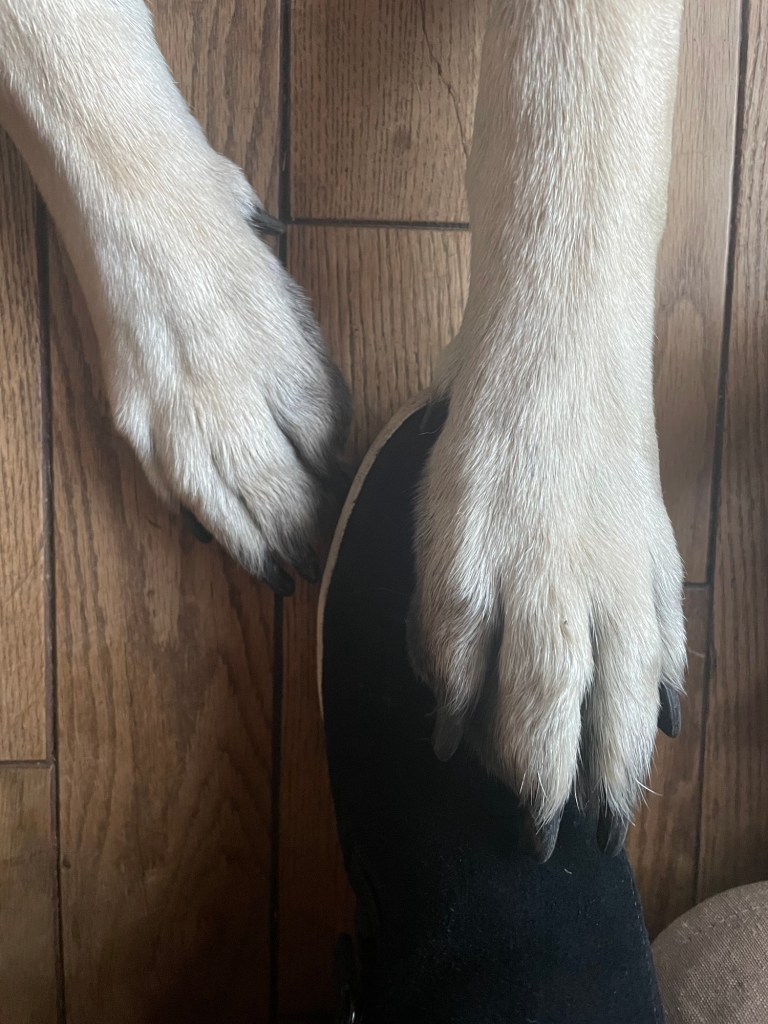
He’s got his foot on my foot.
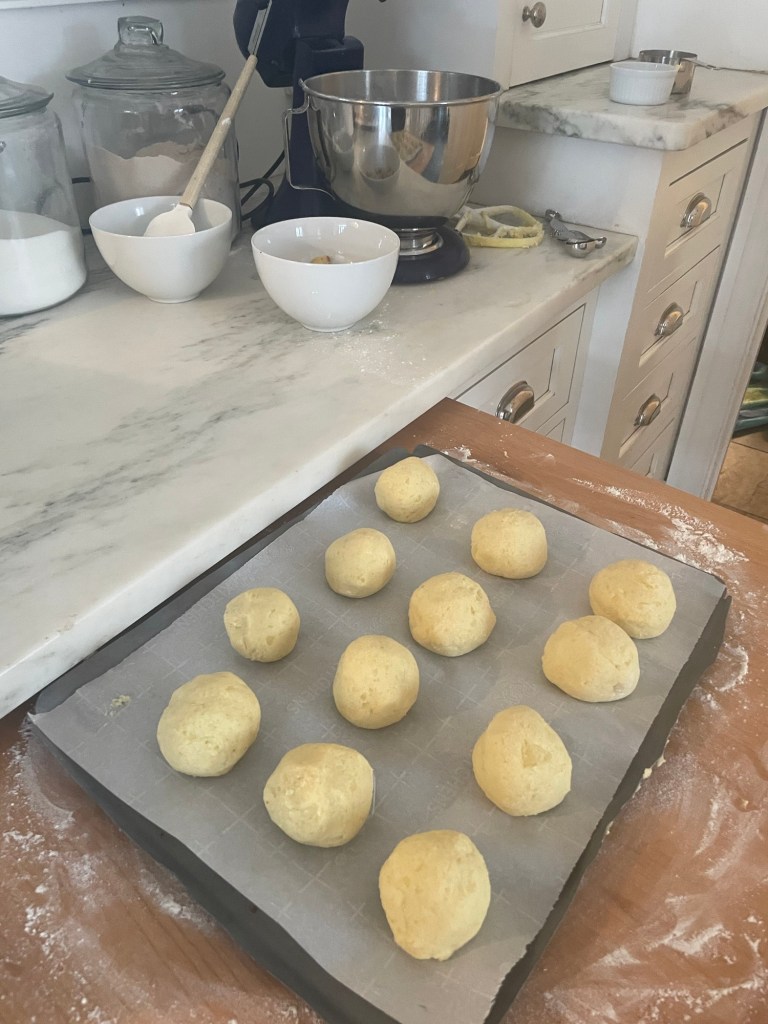
Mainly because I had never made any before. But they were easy and kind of fun to make. I could tell they were done when they floated to the surface of the boiling water.
This was one of those meals with lots of last minute preparation that can be daunting, particularly because all the recipes were new to me. But dinner was a success.
I sent all the leftovers home with my friends. I really don’t enjoy heavy meals like that anymore.
But I could eat a lot of dumplings: so chewy and dense and delicious. I sent them home, too.
They weren’t married in Annapolis, although my father trained at the academy there. They were married at the Navy chapel in Norfolk! My thanks to an alert reader, who pointed out that a trolley ride from Virginia to Maryland would have been a bit tedious. Note to self: keep your Navy chapels straight.
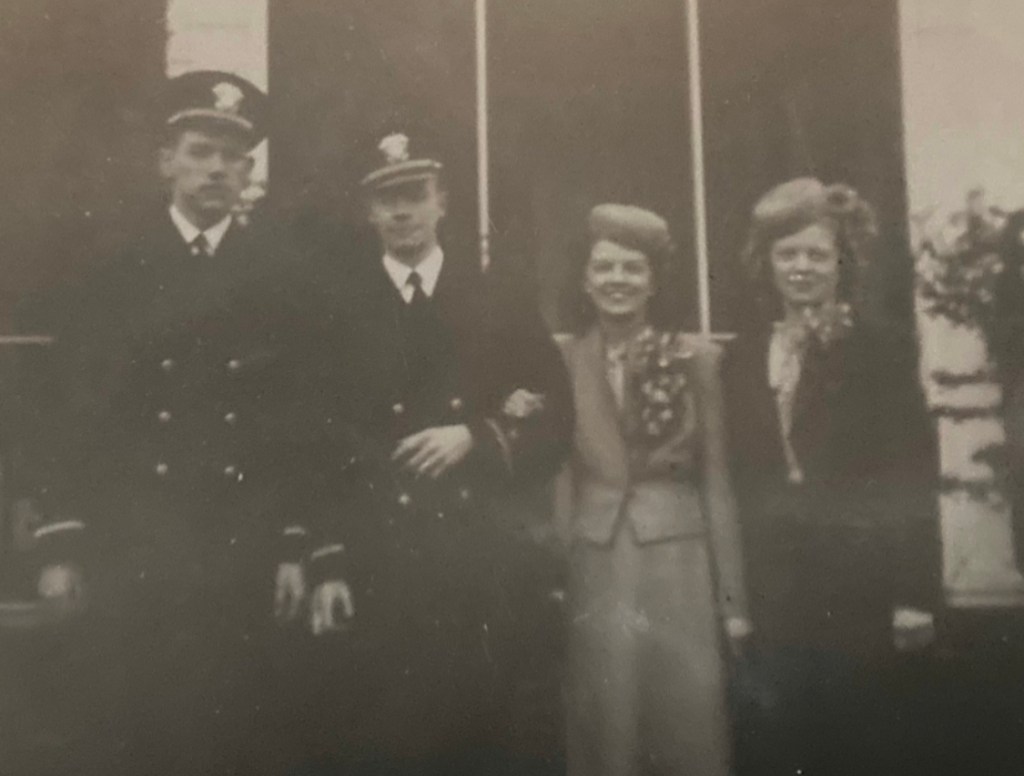
Today would have been my parents’ 79th wedding anniversary. World War ll was coming to its climax, and my dad begged my mom to come to Annapolis to get married before he shipped out. So she, my aunt, and my paternal grandmother—my other grandmother had already died—took an unheated train from upstate New York to Virginia. They were so cold they all snuggled together under my grandmother’s big fur coat.
It was war time, so there were no cabs, and they had to take a trolley to get to the Navy chapel. My mother always said that was the moment she was glad she hadn’t worn a wedding gown. Instead she wore a dove gray suit with a spray of yellow roses. My father always gave her yellow roses for their anniversary.
They all spent the wedding night together in one room. Romance wasn’t really an option in war. My mother said many times how when they kissed good bye she didn’t know if she’d ever see him again. It’s hard to imagine how difficult life was then.
And we all think we are stressed.
My mother was an excellent cook. Her meals were complex, flavorful, and creative. She baked her own bread, catered to my father’s sweet tooth with all kinds of amazing desserts: pies, chocolate eclairs, apple crumble, cookies. Her stews and main courses had depth and richness. She cooked with lashings of wine and butter, and although she used recipes, they were merely jumping off points for her creativity.
She was also not a woman much devoted to method. I think you could fairly call her general style slapdash, except for the fact that her results were so wonderful. Her handwriting was distinctive, but often scrawled (much like my own) and such recipe cards as she had—and she had a lot—are often nearly impossible to decipher. My niece very thoughtfully gave me a dishtowel with some of my mother’s recipes reproduced in her own writing, and when people see it they almost always ask: Can you read that? Usually, I can. A lifetime’s experience. But sometimes reading them isn’t enough.
My old friend, Julie, from sixth grade, like so many Wisconsin natives, is German through and through. She was lamenting recently that most of the old restaurants that served Sauerbraten are gone. Sauerbraten is a dish that requires three to five days to marinate the beef, and comes with complicated side dishes. Very German. My mom always made it, and although I have the recipe, I never have. So, back in December when things were hectic I told Julie—who is a treasured friend—that come January I would make Sauerbraten for her husband and her. It was a leap of faith.
Sauerbraten is one of those things that really does require a recipe. The seasonings and details vary regionally: Some versions have raisins, some have crumbled Lebkuchen, some have a chunk of rye bread at the bottom. But the fundamental seasonings are the same: apple cider vinegar, sugar, bay leaf, peppercorns, cloves, onions, lemon. It doesn’t sound good, does it? But it is delicious: the German version of sweet and sour. The beef has been marinating since yesterday, and today I will make potato dumplings—which scare me— and red cabbage. So I am depending heavily upon my mother’s recipe cards.
The funny thing is my mother’s recipes are a bit like that old Far Side cartoon, where the mathematics professor has a long equation with an arrow pointing to the phrase: And then a miracle occurs. Many of the steps are not clearly explained. It makes me laugh. SO like her. For example, the recipe tells me the ingredients for the potato dumplings (Kartoffelklösse), but it’s kind of vague on how to cook them. The Sauerbraten is the same. I inherited her authentic German cookbook, and it, too, assumes that every idiot knows how to cook dumplings. But the Sauerbraten steps are so elaborate and complex that they tell the close reader much about the German mind.
My mother didn’t have a German mind. She had a passionate, fiery and creative Irish mind—which made her an interesting match to my studious, brilliant, but also passionate father. Tomorrow will be their wedding anniversary—79 years ago they were married at the Navy chapel in Anapolis—so it seems appropriate to be making the meal that was my mother’s specialty and my father’s favorite. And I think the best approach for me will be to throw culinary caution to the wind and adopt my mother’s joyful carelessness. If nothing else, it will be more fun.
I will report back.


I believe I have mentioned here that we had a sort of appliance armageddon in November and December. Since not all of them were amenable to repair, we have some new ones. Aside from the fact that they do actually function, none of them are improvements.
The new dishwasher—which is the equivalent model to the old one— is missing some of the handy features of the other one. The racks are different and less adjustable, and the buttons have fewer choices. It also cost a lot more than the last one, and had to be specially rigged by the installers in order to fit in the same space.
The new microwave is also the latest and greatest version of the old one. But it doesn’t have a one minute button—which I used all the time—or the butter softening/melting feature that I loved so much. How many sticks? How soft? How melted? What are you defrosting? Press 1 for meat; 2 for chicken; 3 for fish. None of that. The machine, with its super fantastico intelligent programming decides. It’s usually wrong. The other day the turkey sausages came out like hockey pucks. Maybe it’s a bit too powerful. I’ll get used to it, I guess. But I don’t want to. I don’t want to spend my increasingly limited brain power thinking about appliances. I want my appliances to do my bidding, not their own. Adding insult to injury, it beeps five times instead of once, a particular pet peeve of mine. (See also: “Electronic Narcissism” in my book of essays But Still They Sing.)
Which brings me to the source for which I reserve most of my animus: the new television we so jauntily installed in the library. It’s a small television, but we thought it might be nice to be able to watch while all snuggled into our coziest room, with the bar cart nearby and the fire going. We were delighted when all we had to do was hold our phones up to the QR codes to install our streaming services. Very cool, we thought.
Lately, my husband has been getting up excessively early, frequently adjusting his bedtime to right after dinner. This leaves me a little bit at a loss. I’m usually too tired to read. Practicing piano would disturb him, and I don’t want to go to bed yet. A perfect time to sit in the library with large dogs and watch something on television.
I was settled in the other night watching a two hour program, when suddenly the television turned off. Nothing I did could turn it back on. Having twigged the eco-settings on the bedroom television, which automatically dims the picture, I had already turned all that off. I changed the batteries in the remote. I reset the wireless. Nothing. Finally I packed it in and went to bed. But my husband found it running in the middle of the night.
“You left the television on.”
“I sooooo did not.”
Last night, same scenario. I wasn’t watching anything I was particularly invested in, but I was beginning to think we would have to embark upon an endeavor that reflects what my husband calls “the asymmetry of power”. You know: when you have a problem with a product and have to contact the enormous monopolistic corporation that has eliminated service from its mission statement. My sister has spent the past three days engaged in such an exercise, which mostly consists of listening to repetitive and annoying hold music while someone on the other end files their nails for hours at a time. But I digress.
One of the most useful aspects of the internet, I find, is being able to look up problems and see whether you’re the only one experiencing it. So this morning I did this, and what did I find? “LG TV keeps turning itself off.”
Apparently, in their (asymmetrical) wisdom, the LG corporation has decided that after a certain period of time without interaction with the remote, the television should turn itself off. The settings say this happens after four hours. I can attest to its being much less than that. Nevertheless, I found the button and turned it off.
Happy Ending. Sort of. But I have questions. What makes electronics companies think we need someone else to turn our devices off? Isn’t that why we have a remote? With a timer we can set? What if I’m watching a David Lean movie? Or a Wagnerian opera? Maybe I don’t want to be interrupted. Why I can’t I turn it right back on? Why do they hide these settings so you have to dig around in the depths of the system like a turkey looking for bug? Why aren’t these “features” listed openly in the manual? Why does it seem we have become the servants rather than the other way around? I have a sneaking suspicion it’s because all these companies know they have us over a barrel, and we will choose to serve in order to have our conveniences. It’s a very strange turn around.
Capitalism isn’t all it’s cracked up to be.

 J.F. Riordan