We didn’t celebrate St. Nick’s Day when I was a child. I hadn’t even heard of it until we moved to Wisconsin. And it didn’t occur to my parents–who were not big on following along with the crowd–to adopt the local custom. I never felt deprived.
But St. Nick is a thing, both among the local families, and according to French custom, so with our French/American grandson living with us this year, the old fellow was expected to make an appearance at our house. I bought candy and clementines and a rather beautiful US Passport Christmas ornament, and felt I had met the mark. But when we heard that little brother in France got earbuds, we realized we had to up our game. So a late-night emergency trip to the local drugstore yielded a pocket retro electronic game which Grandpa had observed being coveted, and a crappy-cheapo plush Santa hat, which, apparently, is a middle school thing. St. Nick has dutifully delivered these treasures into the depths of the très chic name-brand boots we bought for the non-existent snow.
The boy is happy. And so are we. Kids make the season more fun. Although the game makes a familiar and annoying electronic noise that may drive me mad.
The adults on my side of the family are in a quandary about Christmas gifts. We don’t see each other very often since I am the only one not on the east coast. Some of us love the spirit of the thing, and love the connection of everyone giving something to everyone. Some are concerned about the cost. Some of us live carefully edited lives, either by choice or by circumstance (i.e., a tiny NY apartment). Some of us don’t edit, and therefore have too much stuff.
What to do? If any of you have come upon a nice solution beyond simply exchanging names, please offer your advice. Lest you think we are keeping this to the last minute, we are.
But we’ve been debating since last year.
***
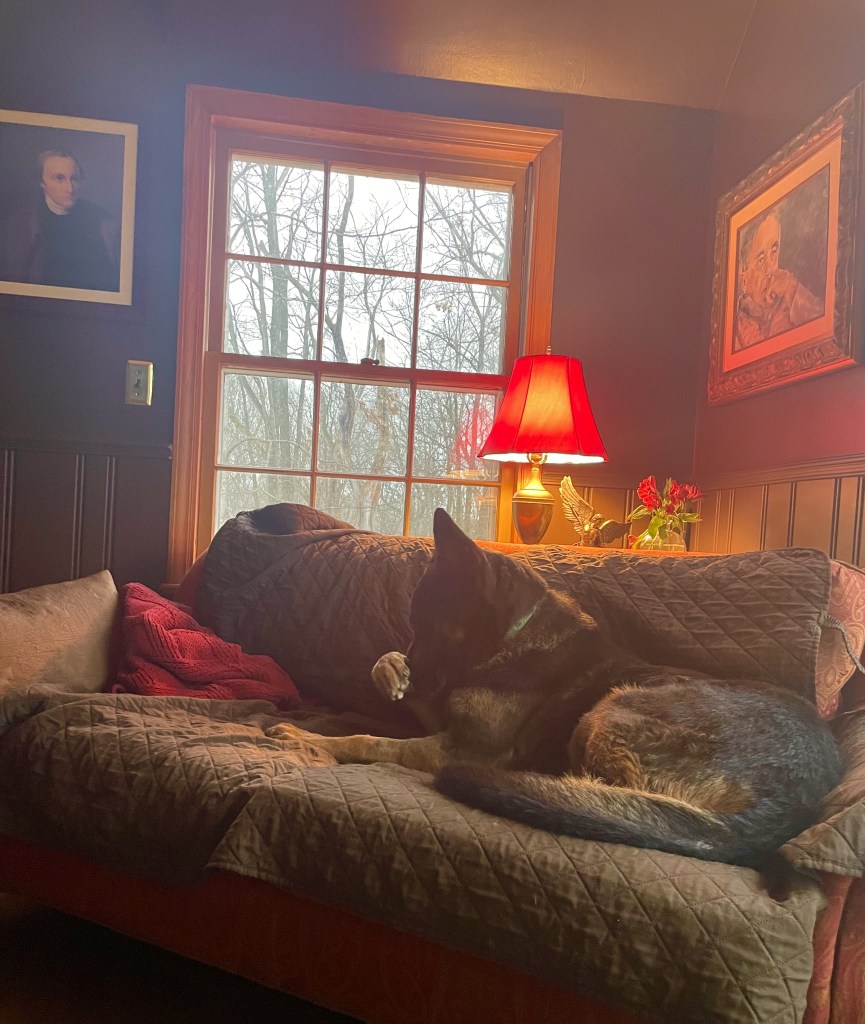
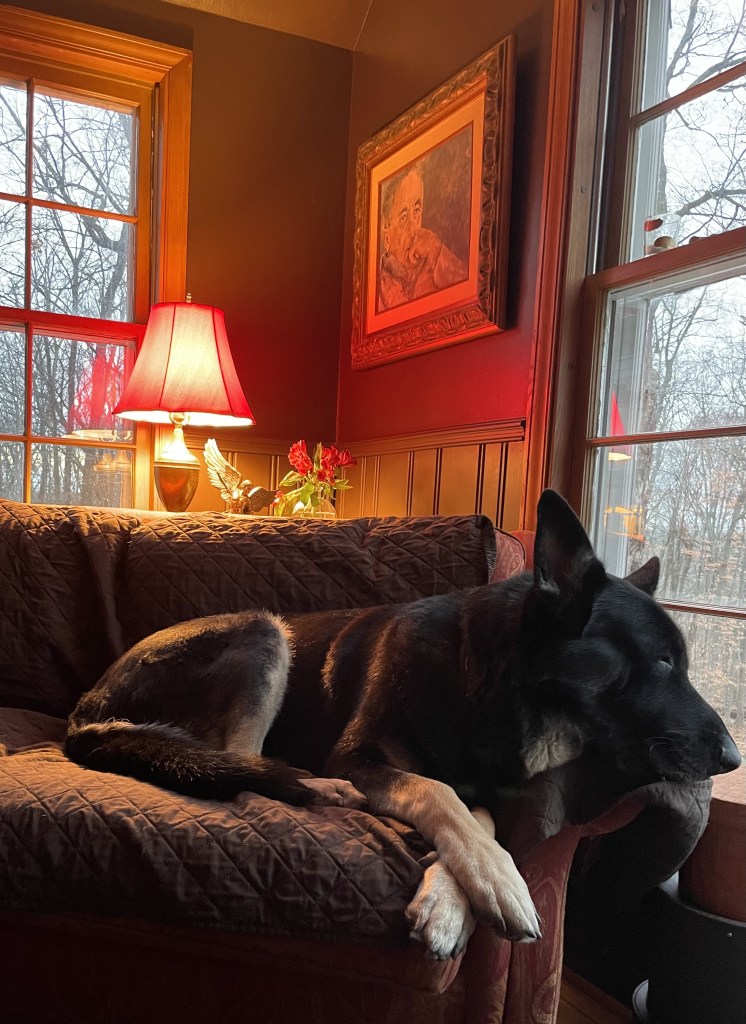
Today’s gratuitous dog photo:
He has an itchy nose.
By the way, it can be complicated to comment or like a post here. But if you sign up for WordPress and/or get their app, it is much simpler. Just a thought.
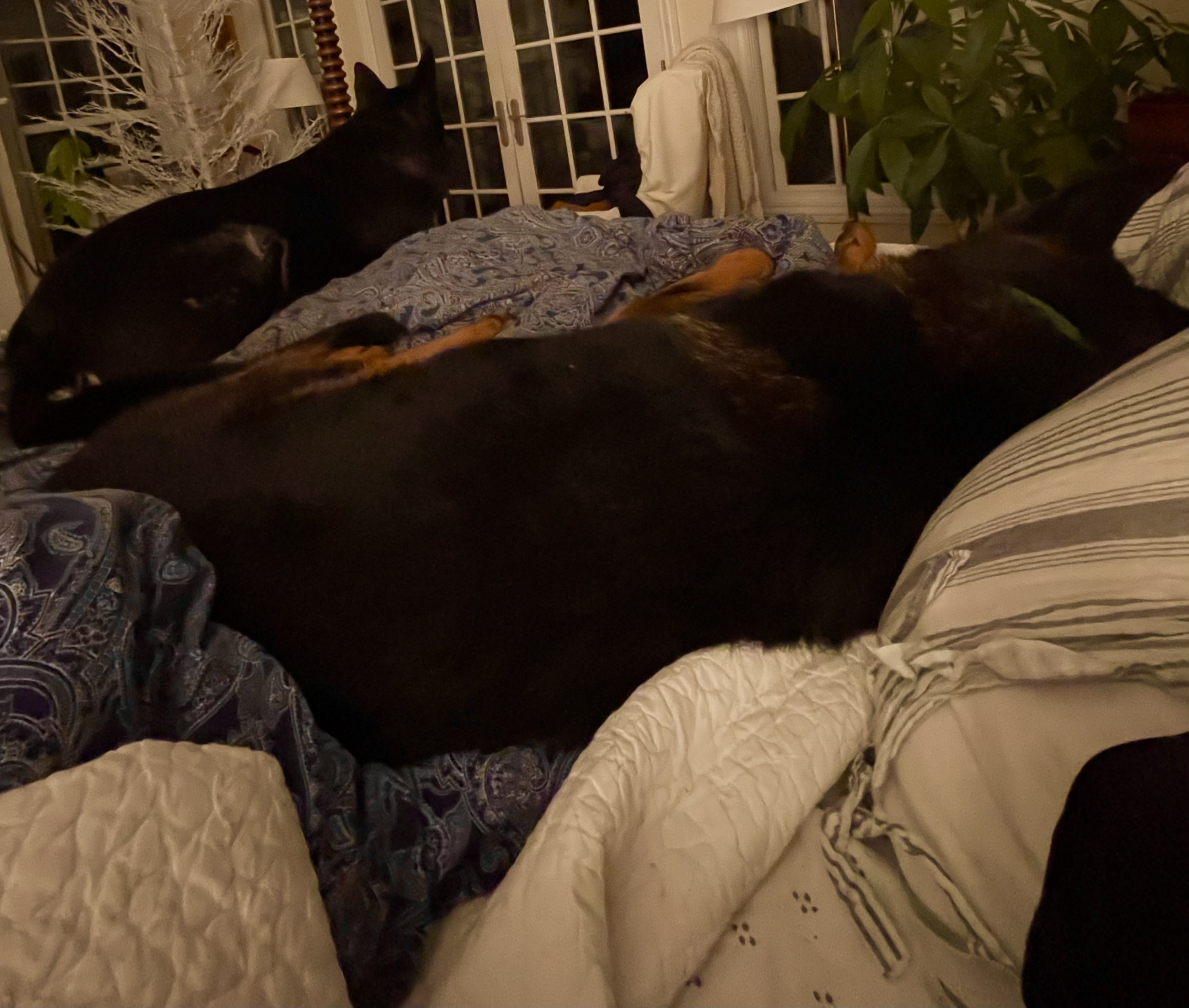
Dad’s upstairs reading for an important interview while I read a novel and snuggle with dogs. By midnight Auggie will be squashed up against me as close as he can be. This is new. He was traumatized by the hospital kennels. Nothing in his life before prepared him for being separated from us.
My niece and her husband—both executives at a big company—run a paperless home. They don’t write notes on paper; they receive and pay their bills electronically, and, well, I don’t know what else, because I cannot imagine living that way.
This is not a criticism. It is a confession.
My husband and I are writers. But while we both use computers most of the time, we do regularly make handwritten notes. When I need to download information for myself, I find that the simple writing of lists in a notebook is somehow refreshing to my mind. My notebook sits next to me now as I write, and on my bedside table at night. I carry it with me into the grocery store and prop it up on the seat of the cart. It often sits on the passenger seat in my car. It travels with me, so I can write on the plane when electronics are prohibited. I will use my phone to make notes if I have to, but I always prefer paper.
My preference for paper extends to a preference for a particular notebook, which seems no longer to exist anywhere in the world, but of which I have an extensive backstock. Occasionally in an idle moment I still search for them, but my hope is gone.
I like pens, too, and I am particular about them. This is not to say that I prefer anything expensive or fancy. The office cheapo store has perfectly fine pens. But they have to feel right in my hand, and they have to move across the paper in a certain way. When I had a day job and traveled often, there was a certain luxury hotel in Washington D.C. whose conference room pens I absolutely coveted. I still have two, and try to spare them for special occasions. The truth is, I love office supplies of every kind, really. Since childhood I have enjoyed a leisurely meander through the aisles of paper, pens, and whatnots. I have always been drawn to those bound accounting books, even though I have an absolute horror of accounting. I don’t buy them, but I eye them speculatively. I am also drawn to boxes of crayons.
But the thing is, we are drowning in paper. Most of it comes in the mail, and it is of no interest whatsoever. That’s easy to get rid of. But aside from the advertising stuff or the solicitations for donations, much of it—despite its unimportance—is unsafe to throw away. It has account numbers, or personal information that you really don’t want floating around. I used to have a shredder, but after a few iterations the shredders went the way of my robot cleaners: Fun while they’re working, but that’s not for long. And so the paper sits around on my kitchen counter, and later slithers out of the bonfire burn bag in the closet and escapes under the door, making a mess in the back hall. You know why I can’t wait for snow? So I can have a big bonfire and get rid of it all.
The thing I miss about Tw*%^tter is the little pockets of community we built among ourselves. The connection was mostly about animals, and then mostly about dogs, but there were also the writers, photographers, farmers, and scientists whose work you could take interest in, and the neighborly people whose company warmed on a bleak day.
Among the unlikely acquaintances I made was a bookseller in a little town in England, whose job was to comb through estate sales, the ruins of well-loved libraries, and mountains of cardboard boxes dumped like abandoned puppies, rescuing old or even ancient books. At first he would tweet about some intriguing find and I would reply requesting a price. But soon I had given him a hopeful list, and he began keeping an eye out for me.
The arrival of these books was an event. They always came beautifully wrapped in brown paper, or sometimes in the pages of old magazines. There was twine. The packaging suggested to me the perfection one used to expect from a purchase in London: very much not shoved into a bag. There were no plastic bubbles.
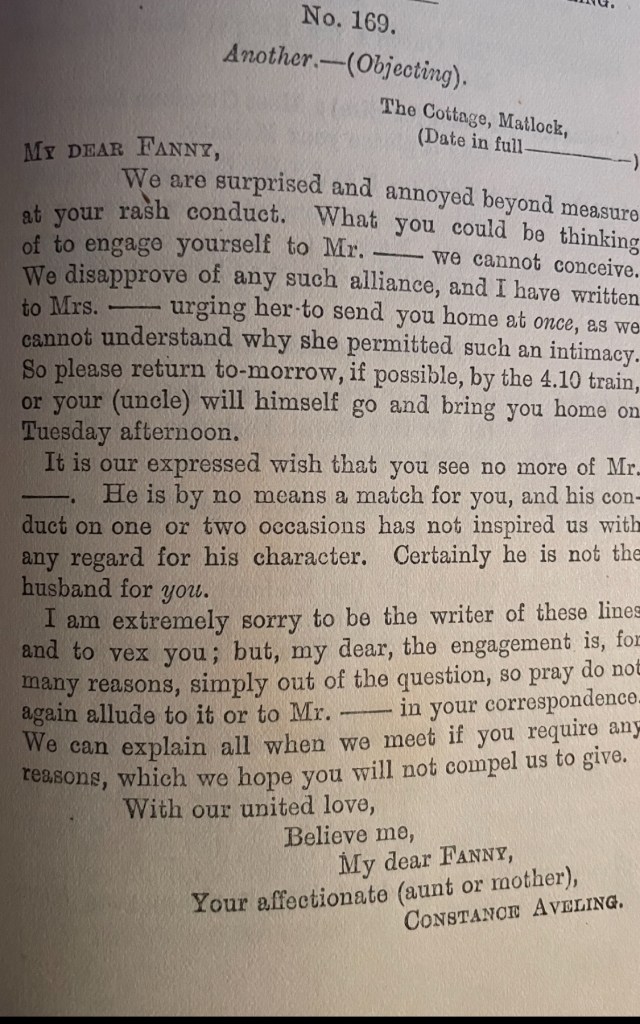
Among the purchases I made were a tiny shirt-pocket sized Book of Common Prayer, a 19th century book of beautifully painted pull-out English maps (in an unusual shape, and filled with geographic detail unlike anything I’ve seen elsewhere), first editions of some favorite authors, and other very specific and odd literary delights. One of these is a vintage edition of Beeton’s Complete Letter Writer for Ladies and Gentlemen; Containing Love Letters, Complimentary Notes, Invitations, Business Letters, Applications; With Domestic, Fashionable, Friendly, and Formal Correspondence.
I find it endlessly entertaining.
I can’t find an exact date in it, but it was published in late nineteenth century London, and sold for One Shilling. It is a thing out of time, since letter writing is no longer our primary means of communication, and since we live in such a graceless era, when manners in particular and civilization in general are all up for grabs.
It is amusing, too, in its formality and superannuated language. There is the sharply worded note from a father to a fractious boy at boarding school; the disapproving note from an aunt to a newly-engaged girl; letters enquiring into the character of servants; and, as the title promises, love letters: all earnest, some moving, and some rather improbable (“Answer to a Missionary’s Proposal Negatively”).
I am happy to live in our era, with its science, medical advances, and convenience. But I do wish that along with all our advantages, we still lived among thoughtful, gracious people who understood that formality was an act of respect and dignity, and who had the time to ponder proposals of marriage from well-meaning missionaries.
You will have to believe me that a magnificent buck was outside my window this morning. I looked away for a moment, and when I looked back he had melted into the camouflage of leaves and bark, still, invisibly, there.
I have come to believe that the invisible things are often the most important. These are the things we feel intensely and sense around us: maybe passion, maybe tension, maybe danger, maybe the proud buck in the trees.
Advent is an invisible thing, too, covered in mystery and in the deepening darkness of the earth. I don’t think it’s contradictory, or even surprising, that in this time when the earth stands sleeping we should await, with hope, the promise of light and new life. Because whether you accept the theology or not, those things are coming, literally and visibly.
But it is the invisible that beckons, that clutches the heart and draws us deeper.
And as winter comes, that silent moving of the universe is the darkest, deepest mystery of all. What is eternal? Can some part of us be eternal, too? What is this thing that I am, that wakes, and dreams, and sees the stars, and speaks to the souls of the trees? Why am I here, this small thing, trembling at my mortality while soaring out to meet the edge of sky?
The human soul has seasons, and the earth, wheeling through darkness and light, prepares us for them.
Auggie has spent the past three nights sleeping cuddled up next to me, which is not his usual thing. I believe he’s seeking reassurance after so many weeks of having been abandoned (in his view) at the hospital. He’s dozing so contentedly this morning.





 J.F. Riordan