Adding to the Menagerie

We were walking the dogs the other night, and we saw something ahead of us in the road. The sun was going down, and it was shining in our eyes. “What is that?” my husband asked. “Is it an animal?”

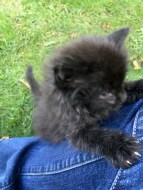
He held the dogs, while I went up to see. It was a tiny black kitten, sitting in the middle of the road. At first, I thought its eyes were not yet open, but as I peered into its face I had the terrifying thought that perhaps it had no eyes at all.

I picked it up reluctantly, and cuddled it against my sweatshirt, while my husband took the dogs and continued on the walk, figuring that their feelings toward the kitten might not be especially altruistic. The kitten and I went home.

I dabbed warm water on his eyes with a paper towel, and wiped away the crust that was keeping them shut. He had been completely blinded, but now his eyes were open.

I found some powdered milk in the pantry, and made some warm milk with brown sugar, and he lapped it up, trying, as Auggie does, to put his feet into it. 

Out in the country at our cottage, the township had no contract with the local humane society, so the Sheriff’s department contacted an emergency number, and somebody from the humane society called me back. They wouldn’t pick up, so we would have to bring him in.

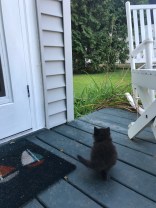
By now he was getting lively, and didn’t want to be held, but I was afraid he would disappear under the porch or a bush and we wouldn’t find him again. When the dogs arrived the kitten stood on my shoulder and hissed and spit. Moses just looked puzzled. Pete and Auggie didn’t even notice him.

We drove him to the humane society, where nice people took him in, assured us that he wasn’t seriously ill, and made us sign a statement that he didn’t belong to us. “What’s his name?” asked the woman.

“Doskar,” I said. “Felix,” said my husband.

We missed the sunset, which had been the whole reason we had gone to the cottage, but we didn’t really mind. That kitten had a lucky, lucky day. I doubt he would have survived a night blind, in the woods, with raccoons and foxes and coyotes, swamps to get stuck in, water to fall into.  I can’t help worrying about what happened to his littermates.

Every time we left the house we found ourselves looking for kittens in the road. Hope they are safe somewhere, and warm.


He’s all right

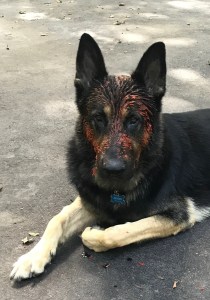
After multiple treatments, Moses still smelled like skunk around his eyes and muzzle. I couldn’t put any of the harsher treatments near his eyes, so we went with the old-fashioned method of tomato paste.

Moses made it quite clear that this was beneath his dignity, but after he had wiped his face on Pete and splattered tomato paste all over Auggie, he contented himself with licking off some of the residue. He got several very big pieces of chicken for his patience. And he actually smells better too.

Meanwhile, I think we have his Halloween costume in the bag.

Sith warrior, anyone?

QUICK NOTE: If you would like to read my first novels in preparation for the release of the third in the series, Robert’s Rules, next spring, they are both on sale for $1.99 each on Kindle this month.

Skunked

FullSizeRender 7

So at 4:56 pm yesterday, four minutes before my you-can-stop-working-now alarm went off, I was done. My husband was away, I had worked all day, and I was a little stir crazy. So were the dogs.

I combed my hair, put on some lipstick, and decided to go to the local farmers’ market to see if there was anything tempting. The dogs had already had their big walk of the day, but it was cool and cloudy, so they could come along and sit in the car if I stopped. That way they wouldn’t sulk at being left behind.

We all piled into the car, but when we got there, everybody had already gone. I needed to see the sky, so we went for a little drive. After some random driving around I ended up at the grocery store. Not as good as the farmer’s market, but I’m always happy with a fresh rotisserie chicken.

As I returned to the car ten minutes later, I opened the hatch to put the groceries in the trunk. Moses was leaning his face on the backseat looking soulfully at me. “Oh, you big baby,” I said. “You are such a good dog. I know what you want.” He sighed, his eyes never leaving my face. “Ok. Just one little spin around the woods. Would you like that?”

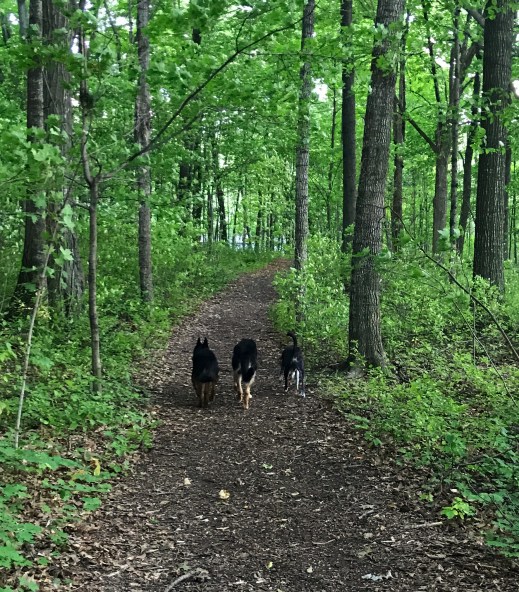
So we went to the woods. I in my new jeans and new suede espadrilles (I know) and dogs in their usual attire. The woods have trails that make successive circles with intersecting paths. One long route around would make everyone happy.

As I walked I was very pleased with myself for having made this decision. I had needed this as much as the dogs, but they especially deserved something extra nice for having been so patient all day. The sun had come out for a bit, and it was a beautiful night.

Why is it that when I get all sentimental and self-congratulatory something bad always happens?

Pete is always the pack instigator. He’s the one who ran off the path to sniff at something interesting. Moses immediately followed, and Auggie galloped after them with his adolescent enthusiasm. At first I thought it was a routine disgusting thing, and then I thought it was a squirrel because I could see the white tail flashing. It was not a squirrel. Squirrels do not have white tails.

Thank God, Auggie listened to me and did not get close. Pete, too, managed to get away. Who knows how.  But Moses, who is particularly fond of squirrels in a way that squirrels don’t quite appreciate, got a full frontal spray of skunk. I think he must have gotten a mouthful of it. I was so concerned about getting them away from there that I barely attended to his misery, which was profound. But by the time we ran back to the car he seemed better.

Let me tell you that skunk smells much, much, much, much, much, much worse than you think. My dogs have had minor skunk encounters, so I had been lured into thinking that these situations are not all that bad. I was wrong. It was a very long five minute drive home.

Then began the fun part.

Today we did a re-treatment with the anti-skunk enzyme, which is pretty good, except for the fact that you can’t just spray it on a dog’s face, where the worst smell is. Then we will wash Moses again. And probably again. And we will wash all the towels and things with the enzyme too. If that doesn’t work, the towels will have to go.

Possibly we will repeat the process. I may also buy some tomato juice for his face. Maybe tomato paste.

I suppose I should be grateful that I only have one skunky dog, not three.

Did I mention my car? And the suede espadrilles?

I’m not sure this counts as procrastination for the novel, but the results are the same.

UPDATE:

And then I noticed the lump on Moses’s leg. Skunk Bite. Vet visit. Rabies booster. Antibiotics. Rotisserie chicken dinner for Moses. Wine for me. Possibly bourbon.

For Ruth: A Remembrance

To everyone else she was Barbie, but since my mother called her Ruth, we did, too. I don’t even know why.

Our Aunt Ruth will be buried on Friday in a rural cemetery in upstate New York, and we will not be there. She, my sister, Eileen, and I had discussed this. She was quite clear that she didn’t want a fuss: no funeral; no flowers. So, as we all agreed, we spent our time and efforts while she needed them.

We were with her on her 95th birthday. On her 96th birthday we couldn’t come until the following weekend, so we sent her 96 roses, and combined with all the other flowers she received, her tiny house was so filled with flowers there was no place to set a coffee cup. I didn’t make it for her 97th, but I took a small comfort in knowing that Eileen and her children were there.

Aunt Ruth’s 95th birthday, with her great-nephew, Jeff

Eileen, living nearer, visited Ruth more frequently than I. We made little visits together that always felt like pilgrimages, and I wept so often after saying good bye, thinking it would be the last time, I think I got complacent. It almost started to feel that she would always be there. But last week we held her in our arms as she took her last breaths. As we drove away from the hospice, I kept looking around me at the familiar landscape, thinking I would probably never come back. After a lifetime of trips to that cluster of little towns on the Hudson, it felt very strange. It was the end of more than her life. It was the end of an era in my own life, and the end of my family’s history there. The shadows of my aunt’s and my parents’ young lives, of their hopes and dreams, and the young lives of their parents, all left behind, with no one living there to meet them and remember.    
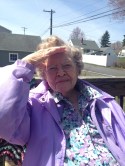
When a celebrity dies, there is always a flurry of remembrance, while most of the rest of us disappear into obscurity. But in the end, it doesn’t matter whether you are famous, and it doesn’t matter whether you are perfect.

Ethel and Ruth approx 1924

Ethel and Ruth, circa 1924

What matters is that you craft a life with what you are given: you make friends and lose them, you have your small pleasures, your personal triumphs, and your private tragedies.

It matters whether you did your best to struggle through, whether you were kind sometimes, whether you were generous sometimes, whether you handled your troubles with as much grace as you could muster, whether you found some love, and gave some love. These are the things that give our lives meaning. And these are the things that deserve tribute, and remembrance, and a prayer.
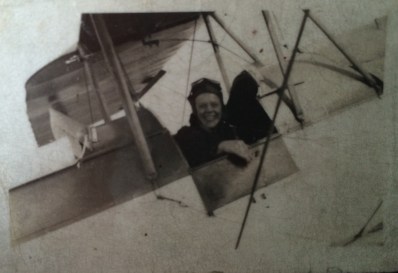
Barbara Ruth was an adventurer.

Like my mother—her sister—Ruth was vibrant, enthusiastic, adventurous, and headstrong, stubborn, opinionated, and extraordinarily difficult. And let’s be honest: she took great pride in being difficult. Apparently, it’s a family trait.

But she also had great love. She adored my Uncle Ken, and he adored her. They endured terrible tragedy together, but they always had each other. Not in a fluffy, romantic way, but in a difficult, holding it all together, we’ll get through this kind of way. They had grit.

They travelled extensively throughout the United States and Canada, and they seemed always to be having fun. They once surprised me by appearing in Halifax Nova Scotia, where a ship on which I was working as a singer had docked. They were so pleased with my delight at seeing them.

During World War II, on her way to Seattle to meet her husband’s ship, Ruth was the survivor of a notorious train wreck. She decided not to go to the dining car at precisely the right moment. Many passengers died. She walked away.

Ruth in hat
Ruth could handle a gun, and she used to hunt and trap with her father to feed their family during the depression. She was a gifted seamstress and knitter, and until she lost her sight near the end, made countless caps for preemies at local hospitals, and beautiful, intricate baby sweaters, and booties, and caps. I gave the last one to someone only this past summer.

When I married, she made me a full trousseau of dishtowels and placemats with matching napkins, and crocheted tiny white lace snowflakes and beaded icicles for my Christmas tree. I still have them all—even the dish towels.

When Aunt Ruth’s first husband, our Uncle Ken, died suddenly after many years of marriage, Eileen and Ruth and I went up to their little cabin in the Adirondacks together to empty out the remnants of their life together. As a remembrance, Ruth gave me one of Wedding to KenKen’s plaid flannel shirts, over whose torn pocket she had patched a red felt heart. I gave it back to her on her 95th birthday. She hadn’t known I’d kept it, and she cried with delight to have it back.
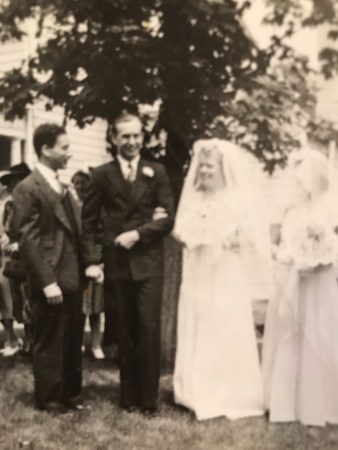
She fell in love again at the age of 80, and married another lovely man, Al, who was both generous and kind. We have a picture of her and my mother on the night before the wedding, their arms around one another, laughing. Ruth was as beautiful as any younger bride, so filled with happiness. The rain came down in buckets, but it didn’t matter.

To her sorrow, Aunt Ruth outlived Al, too. They only had a few years together.

My mother and Ruth were both beautiful young women, and like the princesses in the fairy tale, one was blonde and the other was dark. As she got older, Ruth was proud that her blonde hair had no gray in it. Last week at her bedside, as Eileen stroked her head, she reminded Ruth that even at 97, her hair was still blonde.

Eileen viewed Ruth as a second mother, and she was closer to Ruth than I. But when my mother was alive, Eileen and I split our duties. I was close enough to help Mom. Eileen was close enough to help Ruth. We were so grateful, though, to have one another last week during the ordeal of Ruth’s death. Neither of us could have endured it alone.

Barbara Ruth Rabie Hajeck, née Cornes, died August 15, 2017. She was 97 years old. She was born in Watervliet, New York on April 15, 1920 to Edna and William Cornes.
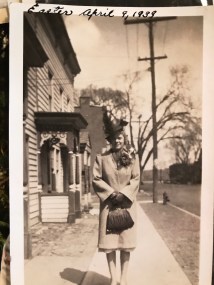
Extraordinary Hat

Ruth in an extraordinary hat.

She was preceded in death by her son, Keith, her brother, William, her first husband, Kenneth Rabie, her sister, Ethel Riordan, and her second husband, Alton Hajeck. She is survived by a daughter, Susan, a granddaughter, Paula, and a great-granddaughter, Nora Kate. They are also strong women.
She was also loved by her extraordinary friends, Randy Anselment, and Laura and Tim Plumway, who, beyond all call of duty, were a blessing to her in the last years of her life.

This tribute comes at Eileen’s urging. Aunt Ruth did not want an obituary, but since Ruth didn’t always do what she was told, my sister and I are following her example. We come by our stubbornness honestly.
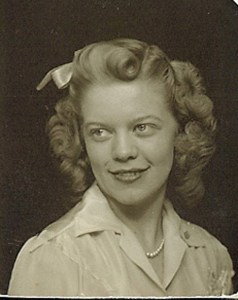
Ruth is the last of her generation in my family. My father and mother have already been gone, it seems, forever. For my sister and me, she has left another gap in our hearts, another hole in the landscape of our lives. She fought, she loved, she created, she struggled. And in this eternal and sometimes merciless universe, she mattered. Her loves mattered. Her struggles mattered. Her fierceness mattered. Her sorrows mattered. The people she lost matter. The lives she created matter.

We loved her. We love her still.

We will miss her always.


Island Update

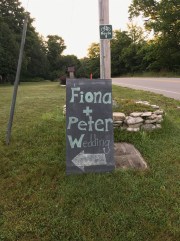
As both of my readers know, when I am writing a book, the blog gets short shrift. A couple of weeks ago, however, I had an experience which may be of interest: I went to Pete and Fiona’s wedding.

My novels (Available at Amazon, and also here, Barnes and Noble here and here, Target here and here, Walmart here and here, or at your favorite booksellers, for example, here, herehere, here, and here. I’ll wait.) feature the story of Fiona Campbell, a Chicago reporter who moves to Washington Island on a dare. That’s all I’m going to say.

But by an extraordinary coincidence, a couple whose names are Fiona and Peter got married at the island property where I write my books. Susan, my landlady, made sure I knew about it, and the couple were gracious enough to invite me.

It was a perfect summer day. The bride and groom were beautiful, kind, and clearly in love. Everyone was happy.

Just thought you’d like to know.


Don’t get any ideas.

Pray for Ruth

Holy God, Heavenly Father.

I beg of You to forget the world. Forget that we sit on the brink of war and chaos. Forget that the last best hope of Mankind sits under the power of the unworthy. Lord God, Most Holy, Creator of Heaven and Earth, please sit with Barbara Ruth. Let her know Your love. Let her feel Your comfort. Let the embrace of Your angels surround and protect her in her fear and pain. Love her. Hold her in Your love, and let those of us who love her, too, comfort her in every possible way. In Jesus’ name I pray that I may be an instrument to her peace. Please, God, let me be a blessing to her, and let her know that she is not alone.

And, as always:

Keep watch, dear Lord, with those who work, or watch, or weep this night, and give your Angels charge over those who sleep. Give rest to the weary, Lord Christ. Soothe the suffering, pity the afflicted, bless the dying, and shield the joyous, all for Your love’s sake.

Amen.

Barbara Ruth Cornes Rabie Hajeck: Extraordinary woman, Born 1920.


Signing at ALA in Chicago this Sunday

So, book signings are always fun, but this one has an interesting twist. In accordance with ALA (American Library Association) tradition, unedited copies of the first 40 pages or so of North of the Tension Line’s Book 3, Robert’s Rules will be given out. First come, first served.

Sunday, June 25th, from 10:30-11:00 am.

Come on, all you librarians!

I hope to see you there!

A Small Sneak Preview of Book Three: Robert’s Rules

In June I will be making an appearance at the ALA (American Library Association) 2017 Conference and Exhibition in Chicago. One of the traditions at this event is for authors to provide unedited copies of the first three chapters or so of their upcoming books, flaws and all.
So, with the permission of my editor, I think it is only right that those of you who follow me here should have the first glance.

So watch this space for periodic sneak previews of what’s to come in the third book of the North of the Tension Line series, beginning with this snippet.

PROLOGUE

My earliest memories are of fire.

I was lying in my crib in the dark, and my father woke me, wrapped me in my blankets, and carried me from the house. There were sirens coming closer. I remember the scratchy wool of his jacket on my cheek, its dusty smell in my nostrils, and the feel of the cool night air. Then the smoke was everywhere.

My mother and father and sister and brother were all there, with jackets over their night clothes. My father carried me in his arms as we all moved toward the fire down the street.

“The pig farm,” my mother said.

I knew the pig farm. I knew the comfortable smell of well kept animals; the sight of the red barn on the hill, the pleasures of catching a glimpse of a tractor, or better yet, a family of piglets, on an afternoon ride.

Instead, I could see the silhouettes of men against flames that reached into the sky, the yellow and orange fire that flickered and shot up; the black shadows of men in big coats, and boots, and helmets, carrying hoses and axes.

There was a low rumbling sound from the diesel engines of the fire trucks; the crackling static voices of the radios and walkie talkies.

My father hoisted me up on his shoulders, and I could look down at the tangle of hoses, the gleaming puddles everywhere, with the circling red lights. I could hear more sirens in the distance, more fire companies arriving, the undulating shift of their sound changing as they moved.

“The poor animals,” murmured my mother, watching the flames. There was another smell in the air that was not wood burning.

I was afraid, but I did not cry.

Maybe I slept on my father’s head.

At last the men’s voices changed from shouts to words, the brilliant, intoxicating light in the night was gone, leaving a gray dawn. The red lights of the trucks still turned, reflecting in the puddles of water as the firemen coiled the hoses. The voices on the radios still crackled, but with less frequency, as the fire men, weary, diminished their conversation.

I do not remember being tucked back into bed. But I remember the flames.

I always remember the flames.