Even saints need comfort

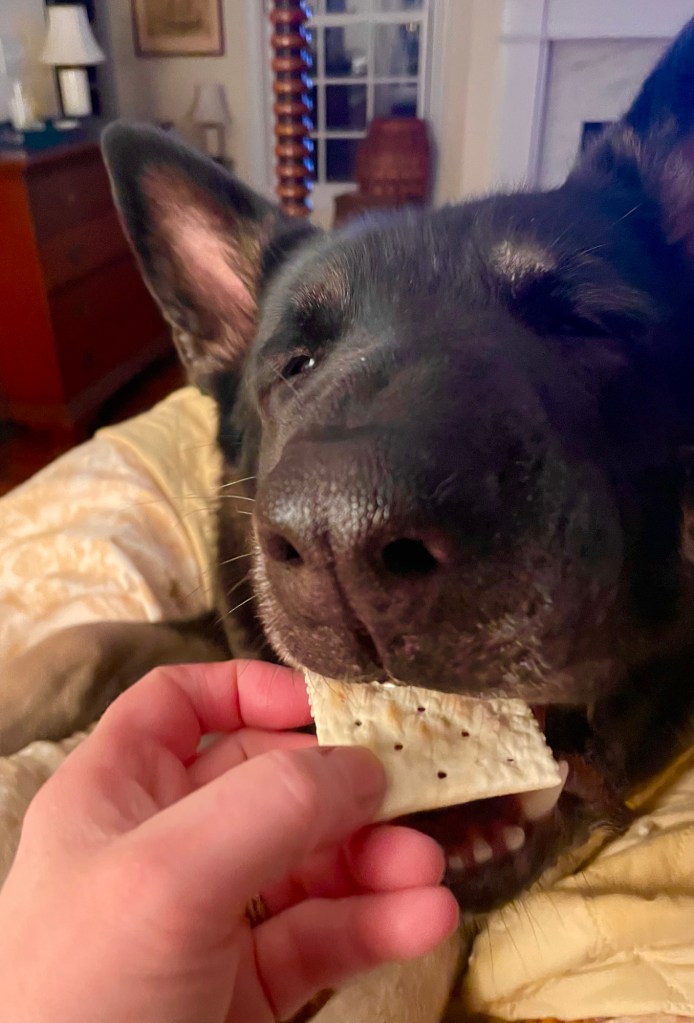
Most of the time Auggie is not a demonstrative dog. He is a very high energy personality who is always on high alert for opportunities to go outside. He has a hair trigger that is activated by our slightest movements. Sometimes it can be a bit much, and I have to continually work to encourage him not to break out in a wild frenzy of barking when I am merely opening the closet to get something out of a coat pocket. His heedlessness in these moments can be dangerous, and I am recovering from a bone bruise on my knee after the combination of his exuberance with my tenacity flung me to the stone floor. Auggie didn’t even look back.

But you would be mistaken to think Auggie does not love hard and deeply. He is wired to run at full speed, and nothing can change that. But he is also incredibly gentle and sweet. I never worry about him meeting a stranger, or being around a child or a puppy. He will sit quite patiently with someone who wants to pet him, and he gives lovely little nose kisses while looking straight into your eyes. Auggie is very focussed on eye contact, and when we’re playing I take off my sunglasses so we can look deeply into each other’s eyes.

When we come in to wash the mud off—after what we call his “slow walk of doom”back to the house—he obediently gets into the shower, and patiently lifts each paw for me to clean without my having to ask. Often when I am bending over him to spray his underside, he reaches up and gives me a gentle kiss.

Sometimes I think he feels a bit lonely or jealous because snuggly, low-key Eli always asks for—and gets—the love he needs. And Eli is both sly and pushy about inserting himself between Auggie and an object of mutual desire, making himself into a giant, furry wedge. It can be difficult to divide attention exactly. So when Auggie asks for attention, I notice.

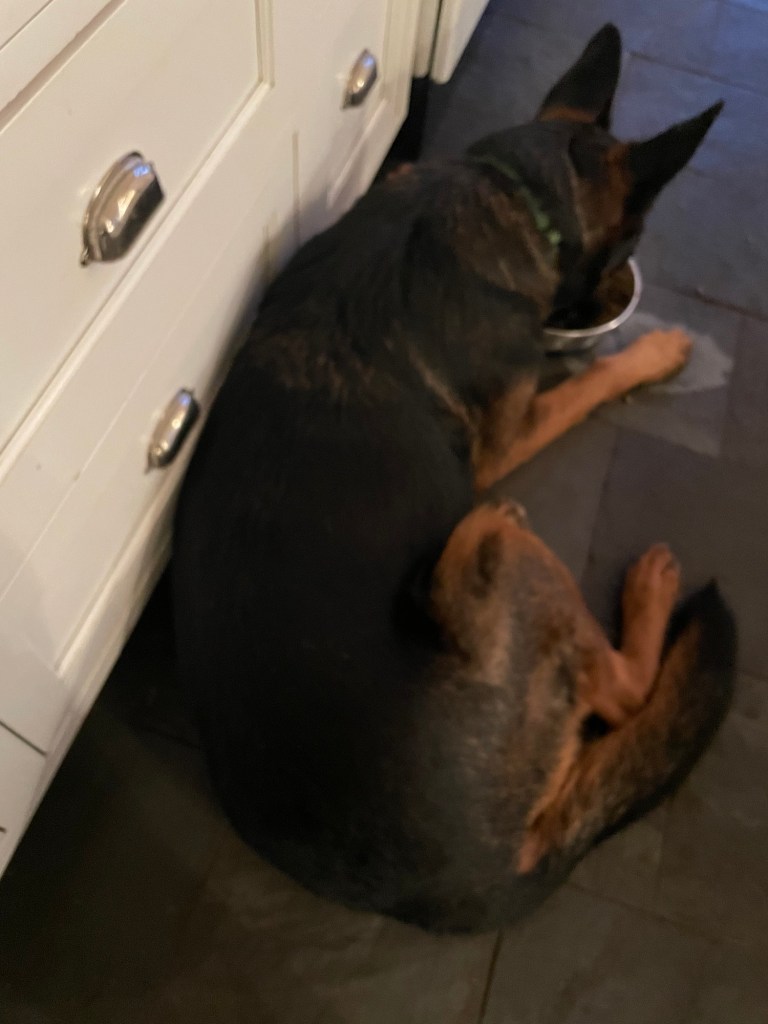
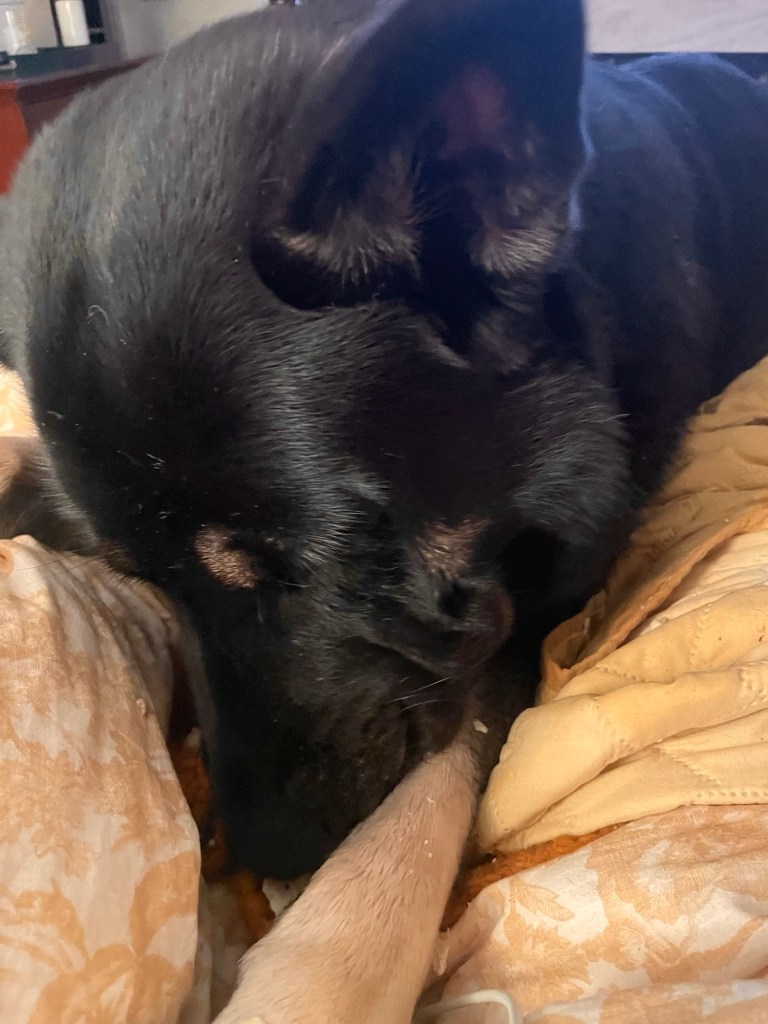
Last night, Auggie asked. Instead of settling in at the foot of the bed, he was waiting for me with his head on my pillow. He made room for me, and when I was settled, he nestled in, molding the shape of his body to mine, his head resting on my leg. Later he moved up so I could keep my hand on his back. He stayed that way all night, comforting and being comforted.

He is a very good dog.

St. Augustine, Foe of Coyote Pagans

Just thinking

One of the things I love about sunrise is the giddy sense it gives me to contemplate that while it seems the sun is racing into the sky, it is we who are spinning through space at 67,000 mph (or so) while the sun stands still. At the same time, the earth is spinning on its axis, its mass creating the force of gravity to keep everything firmly grounded.

Meanwhile, tiny particles are spinning in their own miniature cosmos forming everything around us, even ourselves.

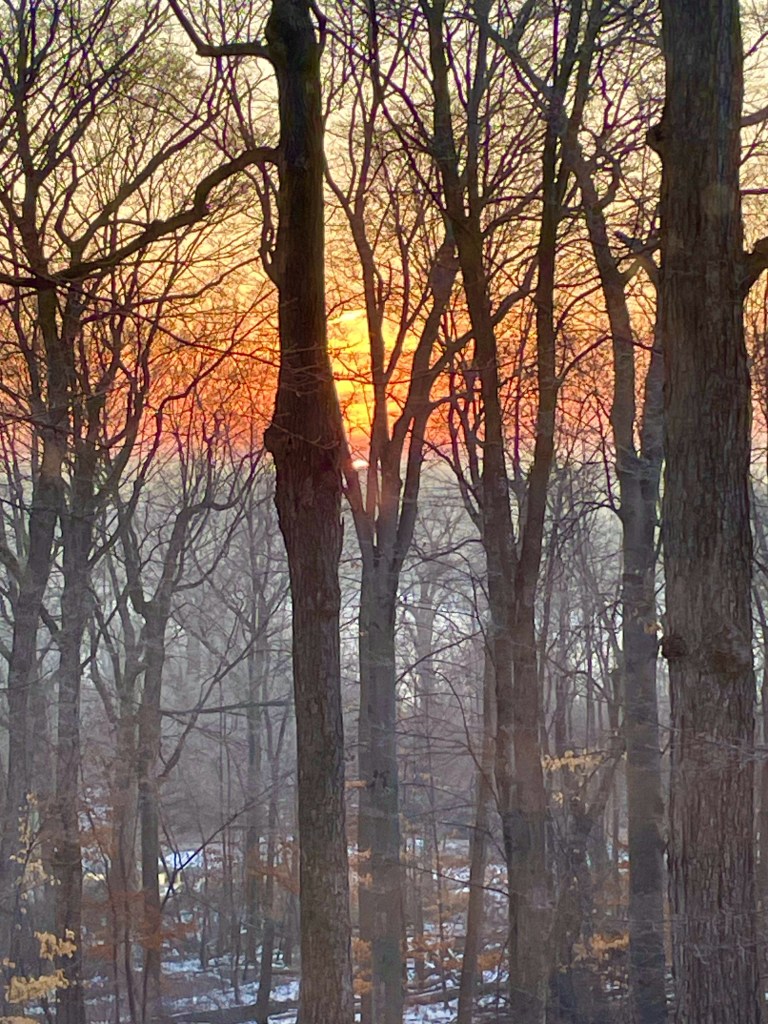
This morning the heavy fog was frozen on the branches of the trees, and an icy mist still hung in the air. The sun rose neon pink, turning the mists purple. All the invisible forces, large and small, at every moment, come together to make it possible for a human being—and her dogs— to sit here and think.

You don’t believe in miracles?

An update on Pet First Aid

I received this helpful note from a reader:

Hi, I work at a Poison Control Center for people and we get a number of calls concerning animals (for which we have little knowledge so ultimately refer them to vet or Animal Poison Control as you mentioned above). Just thought you might want to know there is another animal help phone number –the Pet Poison Helpline –they also charge a fee ($85) and their phone number on the website is (855) 764-7661. Many people can’t or won’t pay that fee so I also direct them to another option that might be more affordable option of a online chat service with a Vet/poison specialist–that is called “Just Answer Pet Poisoning” … and that has a service fee of $35.

Thank you to the kind person who sent this advice.

Souvenirs

(Today I am reprinting an excerpt from my first book of essays, Reflections on a Life in Exile.)

My mother outlived my father by several years, and when she died, my sister and I faced the sisyphean task of cleaning out their house. This included going through my father’s shop in the basement and in the garage, where he did everything from making wooden lamp bases on his lathes, to machining new parts for his car, to carrying out scientific experiments. I’m fairly certain that he never threw anything away. Nothing.

For my sister and me, each decision to keep or discard bore an emotional weight that devastated us both. It took some months, and we were weary in heart and soul both during the task, and for a long while after. Frankly, it would have been much easier for us if my parents had followed the modern art of “tidying-up”. But if they had, so much would have been lost.

The word souvenir comes from the French: a thing that makes you remember. And, perhaps that is what exhausted us so much: every little item we found had a memory attached. My mother’s battered ancient fruitcake tin, where she kept her needles, pins, and thread, and which was always hidden under her chair in the living room. My father’s homemade work aprons that had so often been our gifts to him on father’s day or his birthday.; his navy insignia; his little leather notebooks where he kept lists of books he wanted to read, recordings he wanted to buy, the names, ranks, stations, and bunk numbers of everyone on his ship during World War II,  poems he wanted to remember, a recipe for applejack eggnog.  Even my grandmother’s things were still enmeshed in the collection: her vanity set; her hair ornaments; her love letters. My sister dissolved into tears one evening when we had finished. “I feel as if I am throwing Mom and Daddy away.”

But the reality is that we couldn’t keep it all. So painstakingly, emotionally, and exasperatedly, we combed through the house as if it were an archeological dig. And, in a way, I suppose, it was.

Among the things I found was a dirty metal file box with little plastic drawers for sorting diodes, resistors, and transistors and other early electronic parts. The box had stood on my father’s workbench for as long as I can remember. At the top was my name, printed out in the same style as the labels on each drawer.

I remember the day my name came to be on that box. I was about three, and my father had received a new gadget in the mail: a label maker that used long flat spools of plastic to impress letters on. It was an exciting thing. I remember my father showing me what it did by painstakingly printing out the letters of my name, and then pasting the result at the top of the box.

Seeing that box on his workbench, years after his death, brought me fully back to that moment. I remembered the smell of cut metal and wood, the difficulty of seeing the top of the bench unless I were given a little stool to stand on. I remember my pride in seeing my name on the top of that box, and mostly, I remember being loved as clearly as if I had been embraced.

There is a–by now–somewhat aging trend in the world of home interiors known as “tidying up”. The process, which is a method of decluttering and living a minimalist life, has an almost spiritual quality, in that it claims it will change your life, and its adherents have the tone and enthusiasms of Nineteenth Century evangelists.

Dad's diode case

There is a vaguely moralistic and superior tone taken by these doyens of home organization. They are the new Puritans. No one needs stuff. No one needs other people’s stuff. It is clutter. It clutters your home and your life. In this age of materialism, when we all have bulging closets, attics, basements, and enough stuff to create another entirely separate household, people’s interest in the process is perfectly understandable.

But, had my father not kept his old things–radio parts that were no longer needed by any working radio–my memory of the label-making would have been lost to me, for there would have been no material thing in the world to remind me of it. That moment would have been lost to me forever.

This is the value of things, perhaps, even, of clutter. It is memories that make us who we are; which haunt us; which enrich and warm us; which remind us of how to be better. And the things, they are the memory triggers. They bring back the moments we might have forgotten in the depths of time: of my mother in her kitchen, or cutting off a button thread with her teeth; of my grandmother combing her hair, of picking her up at the bus station and sitting next to her in the car, touching the softness of her fur coat; my father listening to opera at high volume while he worked on his car. These are moments that form us; that make us ourselves.

I will admit that I have kept too many things. We jokingly refer to our garage as “the home for wayward chairs.” I have much of my parents’ good mahogany furniture, their wing chairs and their china cupboard. I have my grandmother’s vanity. I have all my father’s designs, and the paperwork for his one hundred twenty-something patents. It is a lot, and it can be overwhelming sometimes.

But I’ll take clutter any day. It is the price of remembering how it felt to be a little girl who was loved by her father.

Tidying up, indeed.

I love New York…sometimes

I recently wondered whether art museums are the secret to long life. Lately, I have had the urge to visit New York City again. I didn’t like living there, but I love to visit. I love the buzz and hum of the city. I love the concert halls, with the murmuring of the audience and the expectation of something beautiful about to happen. I love the museums with their echoing quiet, and the inner peace they instill while outside their walls the world buzzes on. And the restaurants. I love the subway. I love the main Library in whose Rose Reading Room I finished writing one of my books…so many things…including people I love and encounters with my past.

I love the shopping, too, although the great stores are considerably diminished. And the restaurants…did I mention the restaurants? Oh, how I miss them. In any big city I will always want to go to the best French restaurants, but there are so many restaurants of all kinds to choose from in New York it can be overwhelming. Last time I was there I went to an Italian restaurant twice because it was so good and in the neighborhood, but of course I went to a French one, too. Often, because it is near the home of a friend, I go to the famous and charming Cafe Luxembourg.

This past week I read of a new restaurant in New York, the province of a well-known chef: Café Carmellini. It is in a two-story atrium with full-grown trees, and it sounds like exactly like my kind of place, with “a formal, European style of service” and creative French food—although I’d go just for the trees.  The chef is an alumnus of L’Arpège in Paris, and is said to have a deft touch that shifts from French to Italian, sometimes on the same plate. I long to go there. I long to go to Paris, come to think of it.

The irony is that I detest travel. At least, I detest the beginnings of it. Just this morning, when I arose before dawn, I was thinking about the anxiety of early morning preparations for travel, with all its last minute domestic details, like packing toiletries and emptying garbage, and comforting soon-to-be abandoned dogs. And once I leave, even when I’m having a wonderful time, I miss my dogs, and my snug house, and the bucolic peace of my days. So, I took extra pleasure in my leisurely bath and my complacent pups. Sometimes it’s nice not to have to be anywhere…and yet, I long to visit New York.

Maybe soon. But first I have to finish the novel.