Coming soon, in three…two…one…
Coming soon, in three…two…one…
When writers get together, the conversation immediately moves to the vicissitudes of publishing: which house treats authors well; who never issues checks on time; what kind of publicity is offered. And in these days of social media madness, the subject of blogging is always high on the list of topics.
If you’re a writer, you have to have a blog. And if you have a blog you live for comments. But you are always lured into disappointment by Spam. “You have 162 comments!” your blog site tells you. Eagerly, you check in, only to discover that your comments are 100 percent spam.
Maybe I’m missing something, but I don’t understand how spam works. The majority of the come-on attempts are so patently false, and–at least on my blogging system–so completely separated out from the genuine, that I almost feel sorry for the perpetrators. Almost.
Remember Mad Libs? It’s a party game in which you are instructed to come up with a list of words: a noun, a verb, another noun, an adjective. And then your words are inserted into a previously unknown paragraph, with hilarious results.
Spam comments always remind me of this. And this is why I am puzzled.
Somewhere in the world, someone has provided a list of English synonyms to be inserted into standard sentences for the express purpose of permitting miscreants to invade your website and computer. Maybe the mastermind behind it played Mad Libs games as a child. Or maybe he has an unwarranted confidence in the intellect of his minions. And not incidentally, he may be underestimating the intelligence of the average blog writer.
To wit:
(All errors below are as written by senders.)
“I’ve been browsing online more than 3 hours today, yet I never found any interesting article like yours. It is pretty worth enough for me.”
“Personally if all web owners and blogrrss made good content as youu did, the net will be much more useful than ever before.”
“i’ve read this put up and iff I maay desire to suggest soke fascinating issues of suggestions.”
“Ahaa, its good conversation not he topic of this article here at this website, I have read all that, so now me also commenting here.”
“Thank you for the auspicious writeup. It in fact was a amusement account it. Look advanced to more added agreeable from you!”
One fellow (non spam) writer confessed to me that she was so fearful of contamination from these comments that she was afraid to even look at them. She was missing the opportunity for some fine comedy.
But all the same, I am deeply grateful for spam filters. And I look advanced to your comments.
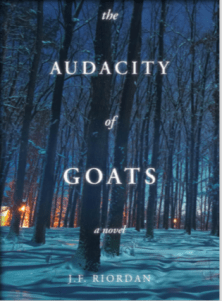
[New York, NY] Second in the award-winning North of the Tension Line series, The Audacity of Goats (Beaufort Books, April 2016) is the continuing tale of Fiona Campbell, and her reluctant adventures among the pleasures, mysteries, and exasperations of life on a remote island.
J. F. Riordan has been called “a modern day Jane Austen” for her lyrical prose and rich characters. Her books are a tribute to small town life and the beauty of the ordinary. Peopled with sharply drawn characters whose experiences are by turns serious, mystical, and ridiculous, The Audacity of Goats brings into sharp focus the pitfalls and vicious politics that prevail in small towns everywhere.
In an age of celebrity, this series honors the well-lived life of the common man and woman. Its protagonist, city-bred Fiona Campbell, is a strong-willed, independent woman with an intellectual bent, and a sense of irony that comes in handy during her frequent lapses into public humiliation. Although she doesn’t quite fit into her adopted community, her resolute attempts are wryly observed—and endorsed—by her circle of vaguely eccentric friends.
Elisabeth and Roger are not yet back from their honeymoon when a series of unsettling nighttime incidents leave the islanders uncertain whether they are victims of an elaborate teenage prank, or whether there might be a malevolent stranger lurking on the island. Out-of-state owners of a new goat farm seem to consider themselves the self-proclaimed leaders of the island; Pali, the ferry captain, is troubled by his own unique version of writer’s block; and Ben, the captain’s ten year-old son, appears to be hiding something. But it is only when the imperturbable Lars Olafsen announces his retirement, and Stella announces her candidacy for his office that the islanders realize trouble is brewing. Fiona must decide whether it is time to leave the island for good, or to make another reckless gamble.
The Audacity of Goats is literary escapism that will appeal to both adults and young adults, in a return to characters who feel like old friends amidst the picturesque and mystical way of life North of the Tension Line.
###
ABOUT THE AUTHOR: A transplanted Midwesterner, J. F. Riordan lives in exile from Washington Island with her husband and two and a half dogs. She blogs at http://northofthetensionline.net
The Audacity of Goats By J. F. Riordan $24.95, 5.50” x 8.25” Hardcover 9780825308260 E‐book 9780825307553 Available April 29, 2016 .For more information, a review copy, or to schedule an interview with J. F. Riordan, please contact: Felicia Minerva, (212) 727‐0222, Felicia@midpointtrade.com
As I have mentioned before in these pages–no doubt to the accompaniment of wearied sighs from you–it can be difficult for an author to break through. There are so many things to read, and so many ways to read them, and the big publishing houses can pay magnificent fees to promote their wares on Goodreads and Facebook and in bookstores. For the rest of us in the Indy world it’s a bit of a slog.
Having said that, one of the fun things about promoting a book is meeting with readers. It’s fascinating to hear people’s theories about characters and to listen to them talk about why certain things happen–or don’t.
So, if you have a book group somewhere within reasonable driving distance of Milwaukee, you can borrow me for an afternoon or evening to meet with you. Contact me via this website, or through my publicist, Felicia Mineva at felicia@midpointtrade.com.
The release of The Audacity of Goats, Book Two in the North of the Tension Line series (available here, and here, and here, and here, or at your favorite bookstore) is imminent, and my calendar is starting to fill up.
Come on, it will be fun!
My Aunt Ruth, whose sudden stroke a few weeks ago caused us to drop everything and run to her side is home again. I spoke with her on the phone this weekend, and she is filled with joy to be home, speaking normally, and in the company of kind and affectionate people.
That woman is a fighter. And on Friday, God willing, she will be 96 years old. My sister and her husband and son are going to see her next weekend, so she will have a celebration.
Don’t tell her, but on her birthday morning she will receive a bouquet of 96 pink roses.
She has earned every one, and then some.

We went to see a world premier play at the Milwaukee Rep last night: American Song by Joanna Murray-Smith. It was beautifully written and moving, and performed by only one actor, the talented James Devita, whose career I have been following since we were both students in Milwaukee. It was a powerful theatrical experience about which I have only one quibble. But this is not a theatrical review blog, and what matters is that you should go, if you can. You will weep.
But what actually came away with me on the deepest level, former English major that I am, was the long and loving reference to Walt Whitman.
This sounds a little silly, but I had forgotten about Walt Whitman.
I grew up reading Walt Whitman, often, and with gradually increasing understanding. At first I just loved the rhythms of the poetry. I was carried along by his passion. Then I fell in love with what it was.
I am annoyed by people who ask: “What is the poet trying to say?” My slightly irritable answer is: He’s not trying to say anything. He’s saying it. The poem is what he says.
And this is why imbuing a message in art which is not intrinsically involved in the art itself can be dangerous. But Whitman was not delivering a message. He was writing poetry. The poetry IS the message. At least it is, if it’s done well.
I taught Whitman’s poetry as a high school American Lit teacher. And even now, I am a great–possibly overly-enthused–re-reader of many things. But Walt Whitman has not entered my thoughts for too many years now, and last night I re-encountered him with a fresh heart.
The play quotes a line from Leaves of Grass, in which the songs of people in different lives sing out in their own voices to make the joyous melody of freedom, of individual value and dignity: Each singing what belongs to him or her and to none else…singing with open mouths their strong melodious songs. I loved that Murray-Smith celebrated that celebration of America.
Pali, the poetry-writing ferry captain in my books, is a man who sings songs, whose work vibrates with a unique and beautiful voice. The question is: whose voice is it?
I love this question more than any of the others. The mysteries of life delight me.
I found myself in the position, recently, of explaining Holy Week to someone who does not believe. Perhaps a bit too earnestly, I tried to describe what happens: The triumph of Palm Sunday with its awful portent, the congregation taking the part of Christ’s accusers, facing-whether we want to or not–our own sins; the washing of the feet, and the ritual vigil, kept with Christ throughout the night on Maundy Thursday. On Friday, the awful full-eyed clarity of the torture and agony of the crucifixion, and then at last, the breath of life gone, the Pascal candle extinguished, the altar stripped, and the deep internal stillness of grief hanging over the congregants.
We are all diminished by every death. But this one death is ours and His. The fear of it lingers in our hearts as we wait in hope.
It is Good Friday. And the earth stands still.
…but it wouldn’t be spring in Wisconsin without a spring snowstorm. Snow always makes me happy.

For some reason, my husband decided yesterday to take Moses to the barber shop with him.
Don’t ask.
Perhaps one factor may have been that the night before Moses had had a rather thorough bath, complete with shampoo and conditioner, as opposed to the daily rinse in the dog shower he usually gets to clean his feet. He smells good now, and he’s all soft and shiny, and this seemed like an opportunity to give him a good brushing. Thought for the day: Never brush a wet dog. Especially not in the house. No, not even if it’s really cold and miserable outside.
German Shepherds are a breed that have a spring molt, which is referred to as “blowing their coats”. An odd expression, I thought, in my innocence. But that was before. Now that he is four, and officially fully mature, Moses is having his first real blowing-of-the-coat, and I have come to think that whoever coined the phrase had a gift for understatement. Moses’s long black hair with its creamy roots is coming out in massive tufts which do, indeed, blow. Everywhere. Piling up in insane quantities in the corner behind the kitchen door. Stuck to the stamp on the Easter card I sent to my aunt. Appearing, unexpectedly—and disturbingly— in my coffee cup at work. But this was nothing compared to the wet dog hair that he and I, together, artfully distributed about the mud room, on the white kitchen cabinets, and on my person. There is no broom, no vacuum, no lint roller sufficient to the task. It’s like glue, and your only hope is to wait for it to dry and then wipe it off with a dry rag.
NASA ought to look into potential applications.
In any case, and for whatever reason, Moses had a trip to the barber shop. He was permitted to wander around and sniff at things, he obligingly lay on his back to have his tummy rubbed by several admirers, and when asked, he lay quietly on the floor nearby while my husband had his hair cut, all amidst the chaos of dryers, and razors, and customers coming and going. He was, in short, a very good dog.
It would have been nice if a trip to the barber shop had resulted in a bit less dog hair, but I suppose I should just be grateful that he was shedding somewhere else for a while.

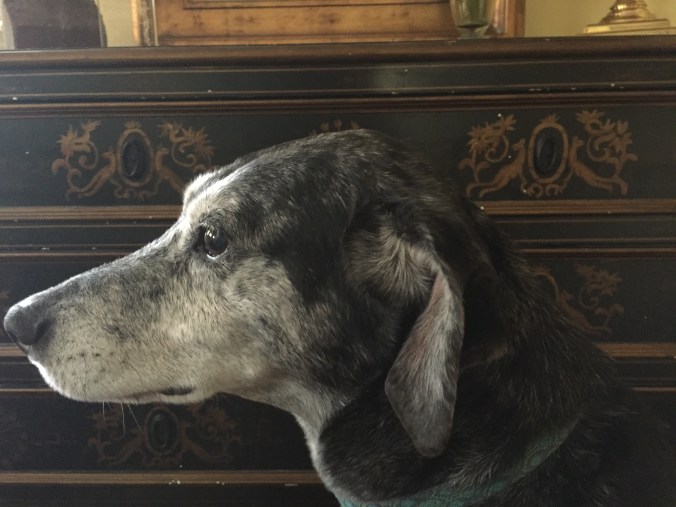
No, not that Pete. But yes, the love interest in my novels is named Pete. I was half-way through writing the first book before it struck me that my character and my dog shared a name, so it was completely unconscious. Pete, the dog, however, is not quite as suave or subtle as the novel’s Pete, and he rarely quotes poetry. But he’s every bit as good at getting his own way. We’re not quite sure what breeds went into his creation, but we call him an Indiana Spotted Dog because he’s from a kill shelter in Indiana, and because he’s, well, spotted.
So, sometimes the quieter members of the family get a bit lost in the shuffle. Moses is big, and young, and boisterous, and he can easily put himself between Pete and a hug from one of us. We have to make an extra effort to make sure he gets his share of attention. Pete, himself, makes sure he gets his share of food. Nothing gets between Pete and food.
Pete is eleven-ish, and he has been with us since he was about ten months old. We’re not sure what happened to him before we met, but it was something that has scarred him forever. When we first brought him home, he would flinch if you moved your hand suddenly, and roll over fearfully and subserviently if you tried to reach for him. Occasionally, under stress or commotion, he still will. Oddly enough, he is not shy with other dogs. On the contrary, his injured leg came when he attacked Moses, and in the scuffle, Moses landed on him. In our house, even though he is only 70 pounds, Pete is the Alpha Dog. Moses is the follower.
I started out obedience training with him, as I do with all our dogs, but once he had learned to sit, and lie down, and stay, and come, I left him alone. The whistles, the shouted commands to drop, the wheelchairs, and the sudden noises that are part of the training left him shaking and slinking away. It wasn’t worth it.
So Pete isn’t a Canine Good Citizen. He is afraid of children, and of people with hats. He will not go outside in the rain, and does not delight in our new dog shower, no matter how necessary. He used to be afraid of cameras, and for that reason, until the advent of the I-Phone, we had very few pictures of him. The camera would come out, and Pete would disappear. My husband says that someone must have once taken an unflattering picture of him, but I think it might have been the high-pitched whine of the electronic flash. A friend has commented that the expression on Pete’s face often looks as if he’s in a hostage situation. Unless he’s around food. He smiles around food.
We didn’t teach him to sit up and beg, or to respect the plastic flags of an invisible fence. He came pre-programmed. But we never hit him, either, and he came pre-programmed to expect that, too. For the first few months after we got him, I would wake up in the night worrying about what had happened to his reported ten brothers and sisters. But Pete, no matter what had happened to him before, had won the dog lottery.
On the other hand, Pete is a survivor, and he has learned the survivor’s skill of how to quickly ingratiate himself once he knows you are not dangerous. He has a sort of Eddie Haskel quality that he uses to great advantage, even–or perhaps, especially–on us. He also has the survivor’s knack of knowing exactly what he wants: yes, it’s usually food–he must have a lot of hound in him–but often just his own space.
We got a new big bed last year for our new bedroom, and it’s pretty high. Even 120 pound Moses contemplates the leap before attempting it, but for Pete, who is about half that size, it’s a bit of a reach. Now, Pete is a snuggler. Lying in bed is what he does. Many times in the past, I have awoken to Pete’s face lying against my face, cheek to cheek. But with the new bed, he simply wouldn’t come up. Maybe it hurt the leg he once injured. Maybe it was better to be away from that nuisance, Moses. But he wouldn’t come.
We felt bad about it, and called him, and tried to lure him with treats. Pete is always lured by treats. But it wouldn’t work.
One day, our friends and general contractors were over. They were at our house every day during our almost two years of remodeling, and our dogs love them like family. Pete was pressing earnestly against their legs, begging for love and attention.
I watched him, and shook my head sadly. “Poor Pete,” I said. “He thinks no one loves him. He can’t get up on the bed anymore, and he’s sleeping all by himself.”
My friends exchanged glances while rubbing Pete’s ears. They were silent for a moment, and then Patti said: “You know, as soon as you leave every morning, he’s on that bed. He stays there all day.”
She sent me the photo later to prove it. There he was, comfortably ensconced on the pillows of my cream colored bedding.
He is mostly trained, and pretty well-mannered, but not perfect, and I don’t demand of him the same things I demand of Moses. There’s no margin of error for Big Scary Dogs, but for Pete, well, we let some of the details slide. Pete does things pretty much the way he wants. And in the end, that’s ok, because we love him, and after everything he’s been through, he deserves it.
But I do wish he wouldn’t leave quite so much black hair on my pillows.
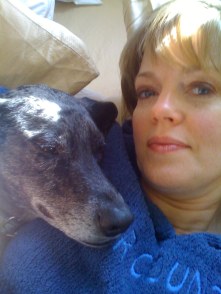

Pete, above, snuggling. Pete, in a hostage situation.
 J.F. Riordan