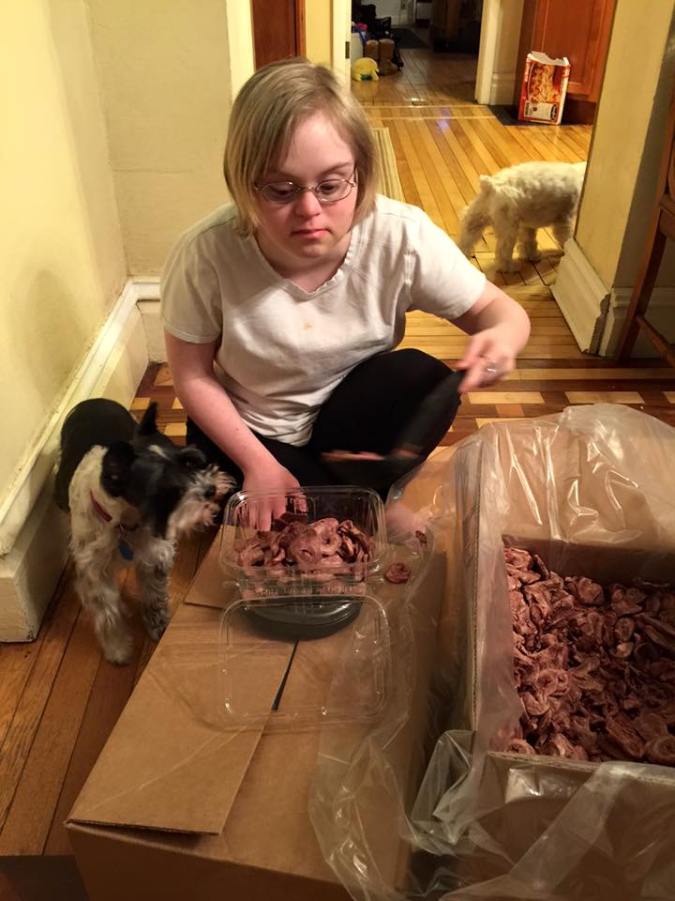
Gracie Jagler
If you have a dog you love who would appreciate some home made treats, stop by, and give Gracie a very happy day.
Gracie Jagler
If you have a dog you love who would appreciate some home made treats, stop by, and give Gracie a very happy day.
My gift to my husband this year was a series of tickets to plays. Our first was this past Saturday, the Milwaukee Rep’s Of Mice and Men. Since this was my husband’s gift, the choice was made to please him, because this is most definitively not my kind of story.
So, embarrassing fact: I was an English major, and I read a lot, as you might imagine (And I should also point out that I am of an age in which English majors actually read literature. No, seriously. It was something that was required.), but somehow, I had managed my whole life never to read Of Mice and Men. I suppose we all have gaps in our educations, but this was an intentional one. I knew instinctively that I would feel bad reading this book, and I hate feeling bad. In fact, I spend a great deal of effort and energy working on feeling good. I knew vaguely that Lennie was mentally challenged, but I was content to leave my information level there.
So (spoiler alert, for those of you whose education gaps are similar) when they shot the dog in the first act, I had a pretty clear idea of where we were headed. Recognizing foreshadowing is an English major thing. My husband, who watched me uneasily out of the corner of his eye pretty much during the entire play, said later that he was fully prepared for me to break out in noisy sobs when they killed the dog. He was holding his breath about what might happen at the end. To me, I mean, not to the characters. He, literate, cultured, and urbane creature that he is, had actually read the book.
Curiously, I was utterly dry-eyed throughout the entire play. This is not typical of me, since, as my family never lets me forget, I cried at the end of the sailboat race in Stuart Little. But I have been thinking about the story for three days now.
I have been wondering about George; wondering about the choice he made. Could he come to terms later with the relief he must have felt? Could he forgive himself for what he did, even though he did it to spare his friend pain and terror? Did he go on to fulfill the dream he had carried so long in his wanderings? If so, was he able to find joy in it? Or was it poison-filled?
And isn’t living with your choices–without regret–a difficult thing? Or is regret the right thing? Do our souls require it?
If you live nearby and have not seen the Milwaukee Rep’s performance, you should go. The actor who plays Lennie, Scott Greer, is exceptional.
Lars Olafsen had been Chairman of the Town of Washington for going on twenty years, and a member of the town board for five years before that. He was a dutiful man, and a public servant in the old fashioned sense. He had earned the respect of his constituents through his fairness, his honesty, and his innate, steady, Scandinavian calm.
But Lars was beginning to feel the wear of so many years at the beck and call of his fellow islanders, and had begun to yearn for a reprieve. His children and grandchildren lived downstate in Milwaukee, and his wife was continually urging that they spend more time there. And Lars, though he was only in his early seventies, was beginning to feel his energy wane, and his enthusiasm for the job with it.
The major consideration, however, was one he would never admit to anyone, not even to his wife. Although his feelings were complicated, secretly Lars still glowed with a feeling of heady triumph after his out-maneuvering of Stella DesRosiers last spring in her mean-spirited attempt to drive her neighbor, Ms. Fiona Campbell, out of town. He had stooped to political blackmail, no doubt about it, and he had suffered many moments of doubt about what he’d done. Had it been a violation of the public trust that disqualified him for continuing in office, or a valiant stroke for the public good? Lars had struggled with this question, but he always returned to the conclusion that it had been no more than Stella deserved, and an act of natural justice. Stella had been bullying her fellow citizens for years without any repercussions other than her unpopularity. And while he continued to wonder whether it was wrong to feel proud of it, his career, Lars felt sure, could reach no greater achievement. “Might as well go out on a high note,” he thought.
And so, one Wednesday night at Nelson’s Hall, when a quorum of his regular circle was in attendance, Lars Olafsen announced his retirement. He was immediately surrounded by a jovial, back-slapping throng, and shots were thrust into his hand in rapid succession.
“Lars,” said Paul Miller, his childhood friend, “you can’t retire. We’re too young.”
“You’ve been an asset to us, Lars,” said another old friend.
“You run a tight ship, Lars. Those meetings will take twice as long without you.”
But the real concern was the one voiced by Jake, who had a reputation for cutting to the heart of every discussion. “You can’t leave. There’s nobody who’ll take your place.”
This was true, as everyone at Nelson’s well knew. Being Chairman was a thankless job, and few people wanted to be bothered with it. There was a slew of paperwork and arrogant State officials to be dealt with, not to mention the unceasing need to wrangle volunteers for committees and other public work, and the inevitable squabbles—both petty and potentially fatal. No, particularly in these days of escalating state bureaucracy, you’d have to be a fool to want the job. And the Island was remarkably short of fools, unless, of course, you counted that new woman, Fiona Campbell.
Fiona would have been shocked to know her reputation. Her intelligence, wit, street savvy, and seriousness of purpose were not things shown to good advantage in a small town. Add into the mix her city polish and lack of practical knowledge of rural life—and the evil rumors that Stella DesRosiers had very particularly and intentionally spread—and an average observer might have an impression of a flighty young woman who wore impractical shoes, was oblivious to the first principles of survival and sensible living, and whose morals were, well, not what one would hope.
Fiona was, in fact, far from being a fool, but this didn’t stop the locals from thinking her one. Many of them—particularly the men—had come to feel a mixture of pity and admiration for her, a circumstance that Stella’s rumors had unwittingly created, and one which frequently worked in Fiona’s favor. In this instance, however, Fiona was exactly as oblivious as her neighbors thought, and it may have been just as well. She went about her business utterly unaware of her many critics, observers, and secret admirers.
Like what you’ve read so far? You can pre-order at your favorite bookstore!

I had to stop at a store yesterday to return something, a task I detest, but which you might think was among my very favorite activities, given how often I find myself doing it.
The clerk and I started chatting, and one thing leading to another, I mentioned my two dogs in the car. “What kind of dogs?” she asked. I gave my standard answer: Pete, an Indiana Spotted Dog (Pete is a rescue from a kill shelter in Indiana, and of indeterminate breed, but with a speckled coat that looks like granite), and Moses, a German Shepherd.
Her attention was instantly riveted by the words “German Shepherd.”
“I had a German Shepherd,” she said. “But I had to put him down.” I felt a wave of sympathy. The shortness of dogs’ lives is a looming loss for those of us who love them, and the thought of it can shatter me if I linger on it.
She knew what I have learned: that there is something different about German Shepherd Dogs, no matter what other kinds of dogs you have had or how much you have loved them. I told her what the vet told me when Moses was a tiny puppy: “Nothing and no one on earth will ever love you as much as a German Shepherd will.”
Her eyes filled with tears, and mine did, too. She told me how true that was, and how smart her dog had been, and what a clever jailbreak artist he was. She told me that even when his hip dysplasia had made it impossible for him to walk she had cared for him until his pain became too much.
She seemed so sad. When I suggested that somewhere in the world there was a dog who desperately needed someone like her to love him she shook her head. No. She could never endure that loss again. It was too much.
The store was busy, and people were waiting for her attention, but I wished I could have taken her out for a cup of coffee, and brought her over to meet Moses and Pete, waiting patiently, if a bit odoriferously, in the car.
I have writing to do, and I have to go to Washington for work tomorrow, and I don’t know how I’m going to get everything done before I leave the house at 5:30 in the morning.
But Moses and Pete and I are going for a ramble. Life is all about priorities.
Dear Readers:
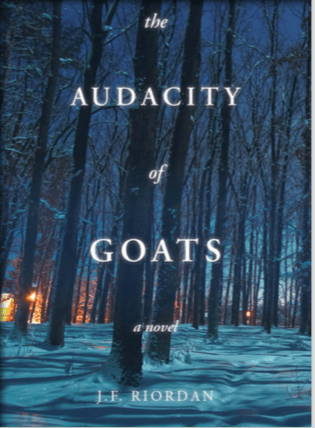
Are you still there? I apologize for the long silence, but I was getting my life in order so we can put book two to bed and start work on book three.
Book two in the North of the Tension Line series, The Audacity of Goats, will be released by Beaufort Books on April 29, 2016. It is available now for pre-order at your favorite bookseller.
Watch for some sneak previews coming soon.
Working now on final proofs, and then it’s on to Book Three.
I promise to be a better correspondent.
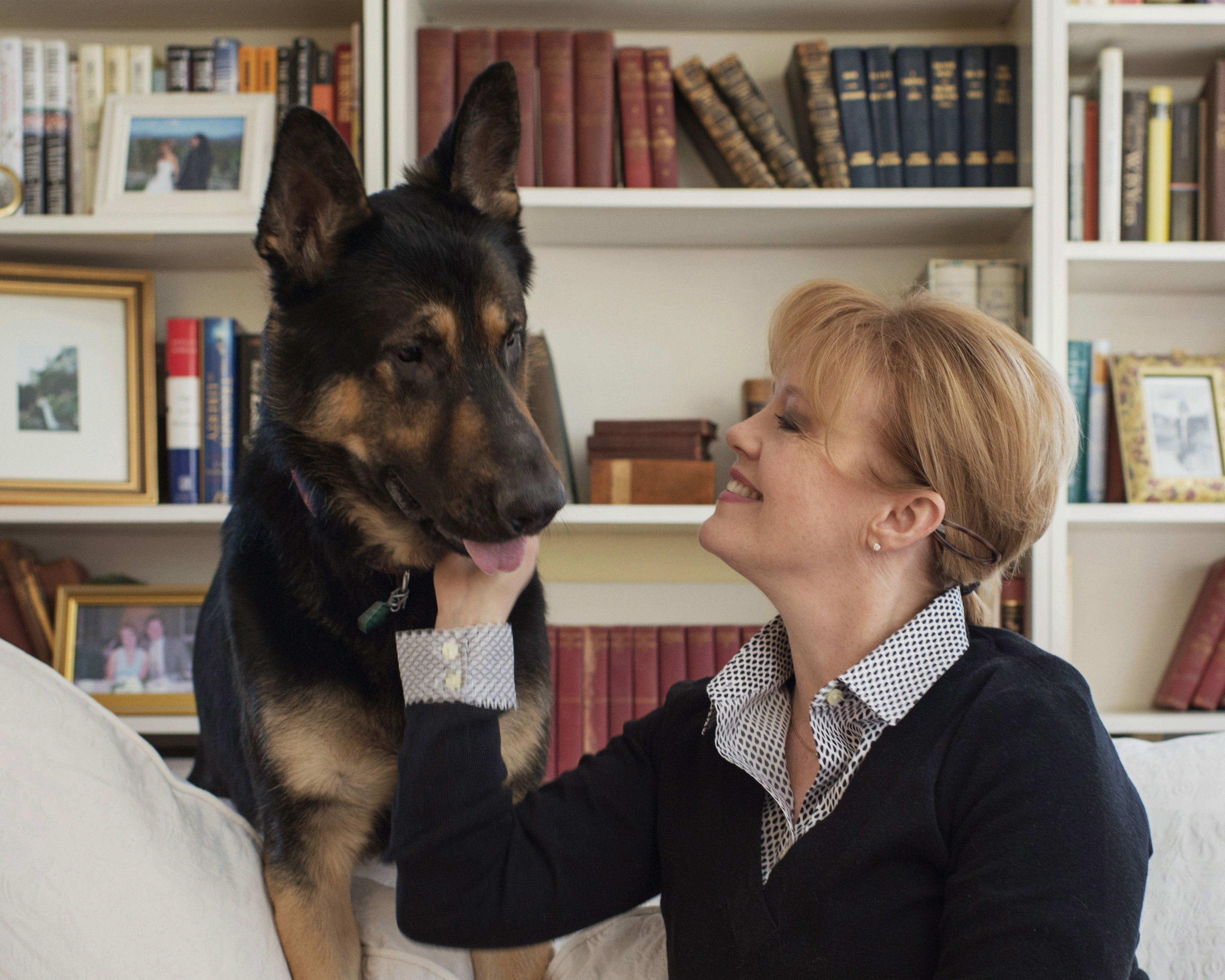
Gratuitous Dog Picture
I will be speaking and reading from the sequel to North of the Tension Line tonight at 7 pm at the Hartland Public Library.
The above picture is purely deceptive advertising, because as far as I know the library does not admit dogs. But please come if you’re in the neighborhood.
North of the Tension Line is coming home to Door County next weekend.
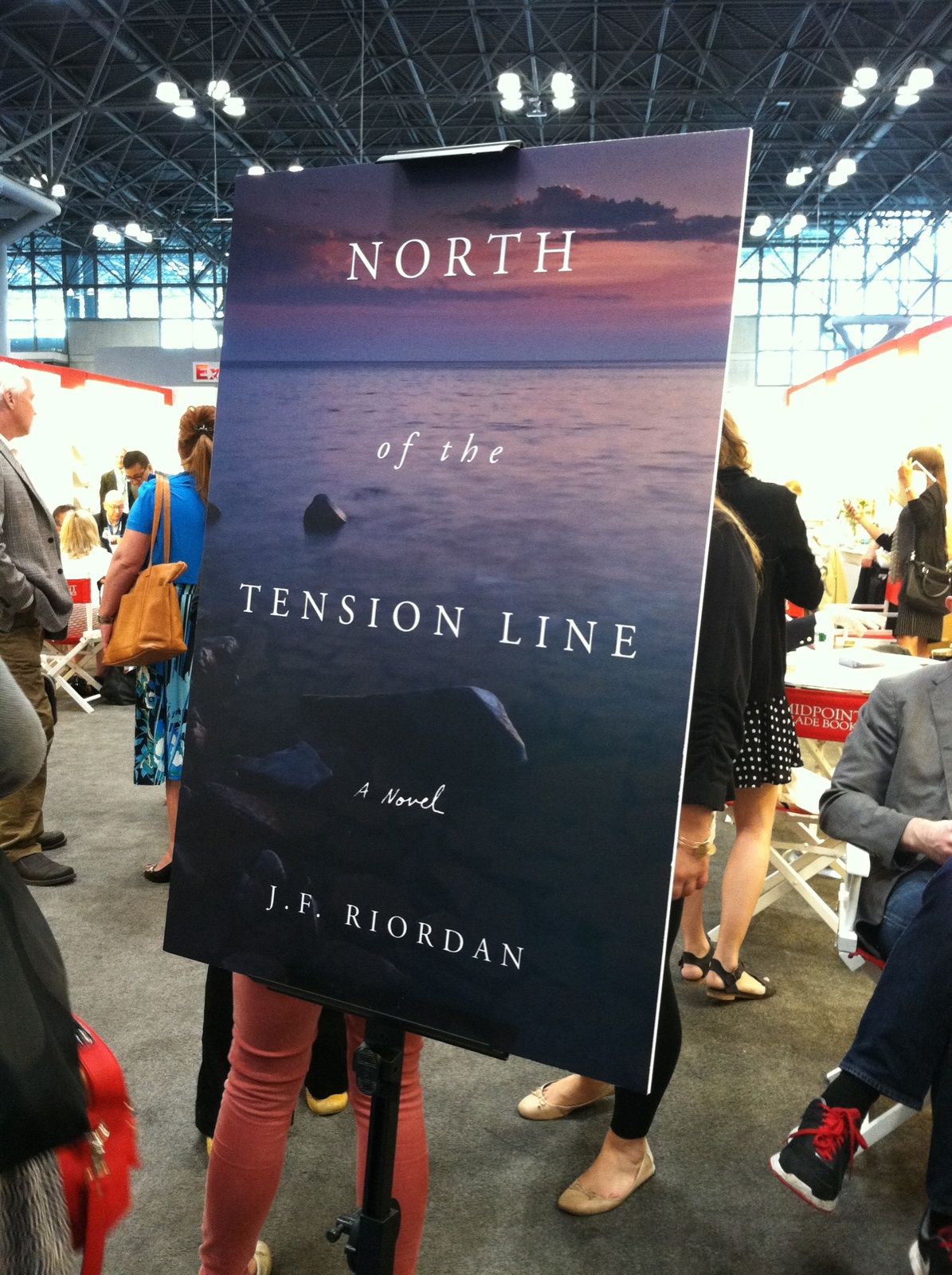
September 26
10 am to 5 pm
The Peninsula Bookman–next door to the Oilerie
4083 Hwy 42, Fish Creek, WI 54212
And then back to Lake Country:
Hartland Public Library
October 7
7 pm.
Hartland Public Library 110 East Park Ave. Hartland, WI 53029
I would love to meet you and sign your book. Stop by and say hello!
My husband and I have a treehouse. At least, it feels like one. It is an upstairs deck under the branches of a very large old crabapple tree that can only be accessed via secret door. It was an accident of design in our new addition, but a delightful one. Last year, when it was new, I surprised him by having adirondack chairs delivered and hoisted up by ladder and ropes. On nice nights we go up there with the dogs to drink wine and enjoy the last light of the day before the mosquitoes get too aggressive.
We are both early risers, and go to bed absurdly early, but tonight when he was ready to go in, I was about to follow when it suddenly occurred to me that I could do my evening yoga practice there.
It’s not a particularly convenient location, what with the tiny secret doors and all, but I gathered my yoga things, and accompanied by two faithful dogs went back into the twilight among the branches. It is utterly private, and the night was one of those late-summer-feels-like-fall-is-coming nights.
Afterward I lay on my back for the final pose of relaxation, and instead of closing my eyes, I looked up into the deepening blue sky, the scene rimmed by the branches of enormous trees. Two nighthawks were whirling, and, I hope, dining on mosquitoes.
It was the best moment of the day.
So, I have been engrossed in writing the sequel to North of the Tension Line, and then, this past month, immersed in a long and lovely visit from family.
But it has been the writing, mainly, that has engaged my entire heart and mind these past eighteen months. I have done nothing but go to work and write, and in the process have ignored everything from friendships to laundry, and all the common attentions to little things that comprise daily life. The weight of a deadline was heavy, and I simply did not have room in my head for anything else.
With the novel finished and in the hands of my editor, I have begun the process of digging out. I am attempting to renew my connections to the people I care about, to do the laundry, sort the mail and the many dropped details of life, and to attend to this blog. The neglect has left a field strewn with casualties.
So yesterday, alone and unscheduled for the first time in almost a year, I sat down to re-engage here. In the process I re-read old postings, and began, with some dismay, to discover how heavily the theme of death marches through my thoughts. I suppose that I have played out my grief here more thoroughly than I had been conscious of.
I heard someone say recently that we get sadder as we get older. That is clearly the natural trend of things. We are battered by life, by the struggles and the losses, and as we lose our people we become less sheltered from it all. The multiple losses these past eight years have made me acutely aware of my own mortality, and it looms.
This is the struggle. I look back at my parents’ lives, at the lives of my godmother, my 95 year old aunt–who is still with us and struggling herself to find meaning in her loneliness–and I wish I had known enough to listen more closely to them. I did try. I did my best. I still do. But then we get caught up in our own lives. And that is right, too.
I am sure Fiona Campbell would have a quote from Marcus Aurelius to fit here.
So anyway. Getting older and facing loss requires strength and courage and determination and a whole lot of cussedness. We cannot succumb to despair. We must accept the new landscapes of our lives and get on with it. Not with sadness, but with joy and gratitude and, well, cussedness.
Damned if I won’t be happy today.
I had a birthday in February. Not a big one, just a I’m-glad-to-have-another-year-on-earth one. It was also my first birthday without my mother, so there was a tinge of melancholy around the edges. Perhaps more than a tinge. My husband’s gift was tickets to a concert I had wanted to see, and even though I had asked to go, by the time I got home from work I wanted to put on my pajamas and sit by the fire with the dogs. We went anyway. And in one of life’s great lessons, in not going, we would have missed something irreplaceable and rare.
The concert was the 300th anniversary of the Lipinski Stradivarius. It’s the same violin that made all the headlines last year when it was stolen, and subsequently recovered. The violin is called the Lipiniski because it was once owned by Karol Lipinski, a virtuoso performer renown throughout 19th century Europe.
All of the music on the program was music that had been played on or written for the Lipinski Stradivarius. The last piece was a well-known quartet by Robert Schumann, written for Karol Lipinski. In the introduction to the piece, the violinist, Frank Almond, spoke about the history of the music. It was a favorite piece of mine, known since childhood. After he had finished speaking and the music began, it suddenly struck me. I was listening to music played on the same instrument that probably first played those notes; That the violin had been in the presence of Robert Schumann, and, no doubt, his beautiful and gifted wife, the pianist Clara Wieck Schumann, and perhaps their friend and her admirer, Johannes Brahms.
It was a moment of acute awareness of the transitory nature of human life, and of connection to these real people who had existed before only as names and figures of history. The Schumanns are long dead. They had tragic lives, but the longing and intensity of their love for one another give them an immortal status, even without their respective musical genius. And here was this object, this inanimate, yet fully animated instrument, which was here to bear witness to lives long gone: Stradivari; Lipinski; the Schumanns; Brahms; now remembered not by their own intimate and personal consciousness, but by their creations. Their bodies are dust, but the expressions of their hands and minds live on for the benefit of civilization 300 years later, 180 years later, and for as long as human beings still cherish such things. May that be forever.
It was a memorable birthday.
 J.F. Riordan