Miscellaneous

I am preoccupied with novel writing, so my thoughts are uncollected this morning.

My friend, Julie, she of Christmas tree adventure fame, called me this morning to cancel our belated joint birthday celebration for tonight. She hasn’t been feeling well, but she always cheers me. Her young grandson has signed up for school band and decided to take up the trumpet. When asked why he chose that particular instrument he explained that it was because it only had three buttons.

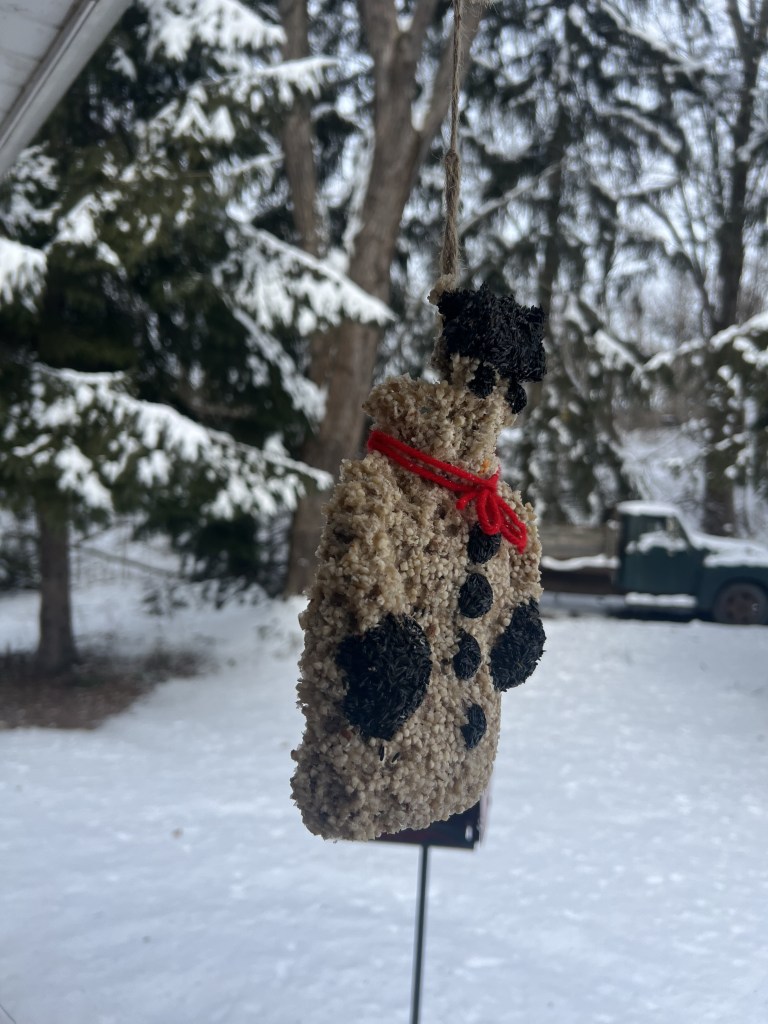
She also sent me this gallows edition of the cheerful birdseed snowman her daughter had given her. It’s become so morbid she’s decided it will have to be cut down, no matter how delicious the birds find it.
I don’t generally feed birds with or without moribund snowmen, mostly because the turkeys kept sitting on the birdfeeders and breaking them. But the deer have been visiting regularly in hope of finding the seeds I put out during last month’s extreme cold. I feel a bit guilty, but I try to hold firm on my only in extreme conditions policy. My late father always said deer were “vectors for disease”, which is completely true, but they are so innocently beautiful, it’s difficult to remember. Auggie and Eli help keep me in mind of ticks, however. Two dogs of my acquaintance have been diagnosed with Lyme disease recently, and we don’t need that.

Turkeys—despite their unconstructive birdfeeder habits—do make themselves useful in their consumption of ticks. I also encourage possums—but only morally, as I am unaware of any particular method of enticing them, aside from seeds, which seem likely to deter tick consumption. Are there possum houses?
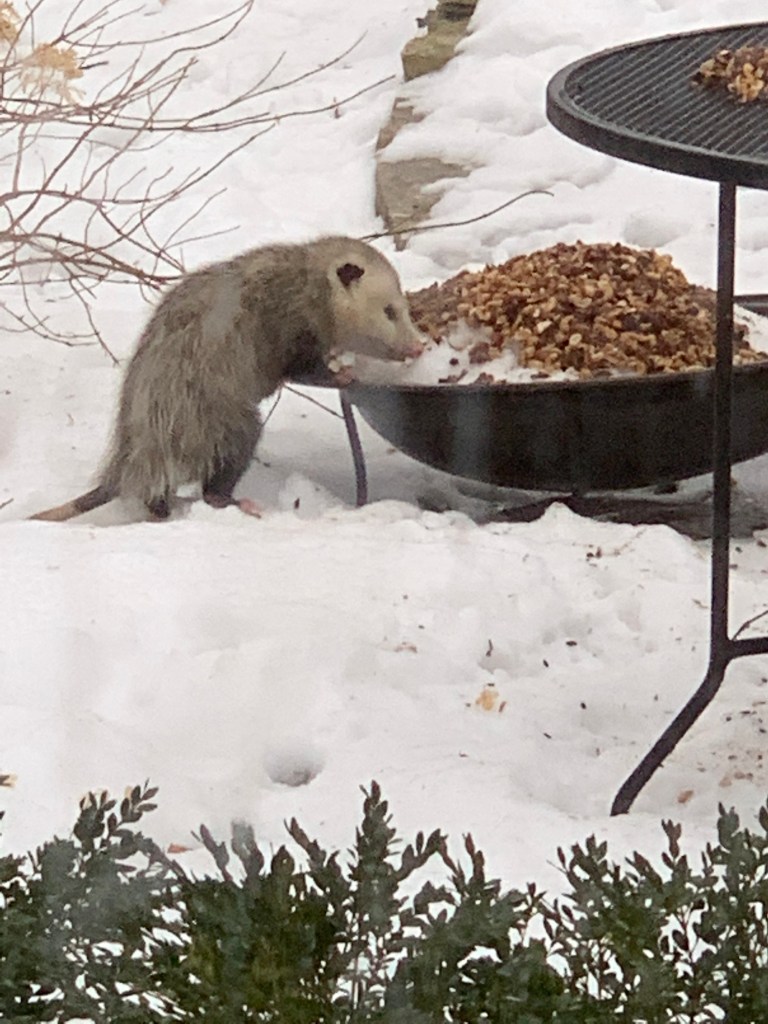
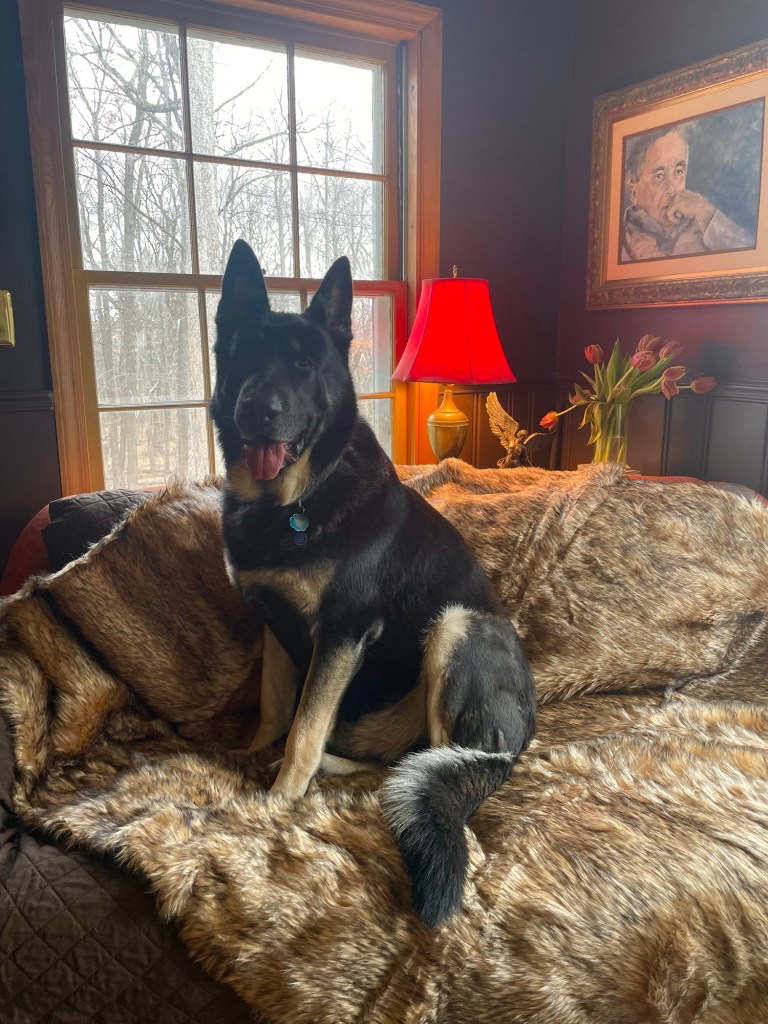
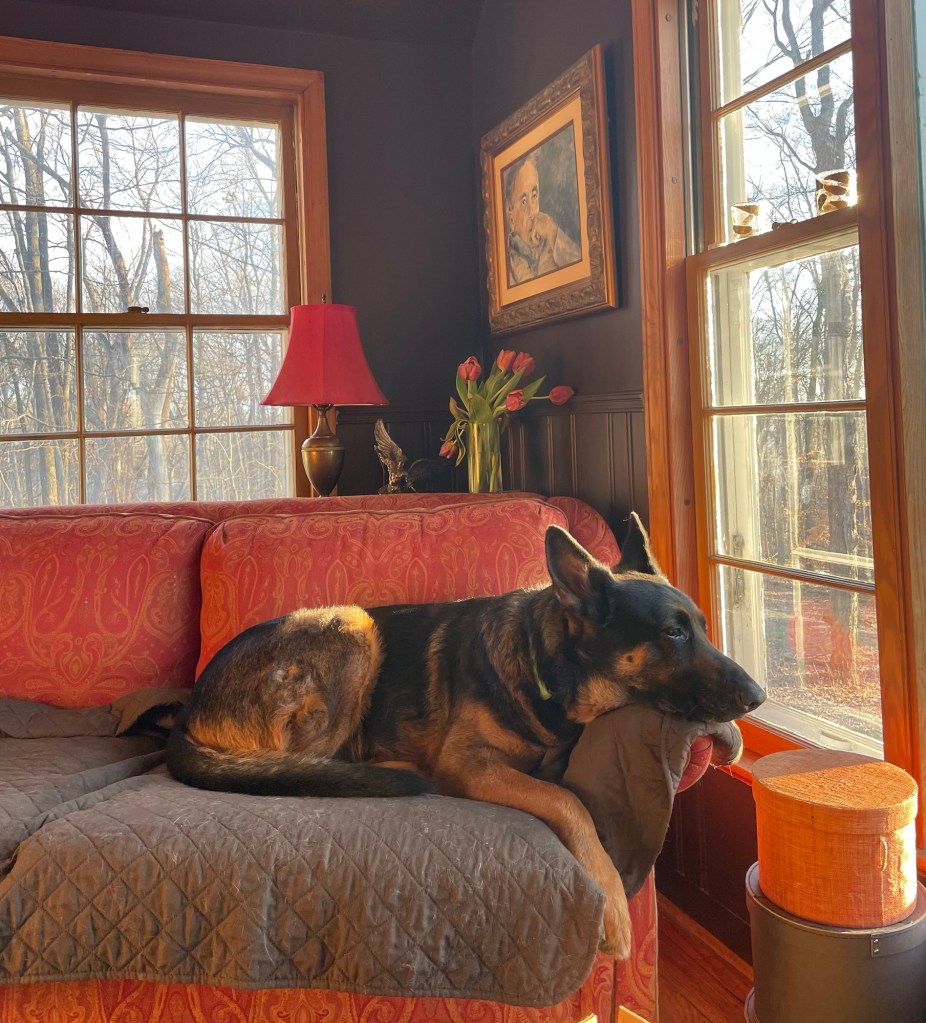
I am pro-possum. This guy likes to stand on his hind legs and look in the bedroom windows. He is unfazed by German Shepherd Frenzy.

The weekend approaches, and with our Friday night newly free, I suppose we will fall upon the tried and true drinks by the fire and dogs on the feet. If we feel ambitious and the wind doesn’t come up, we will venture outside with our cognac snifters and have a bonfire.

The dogs will love that.

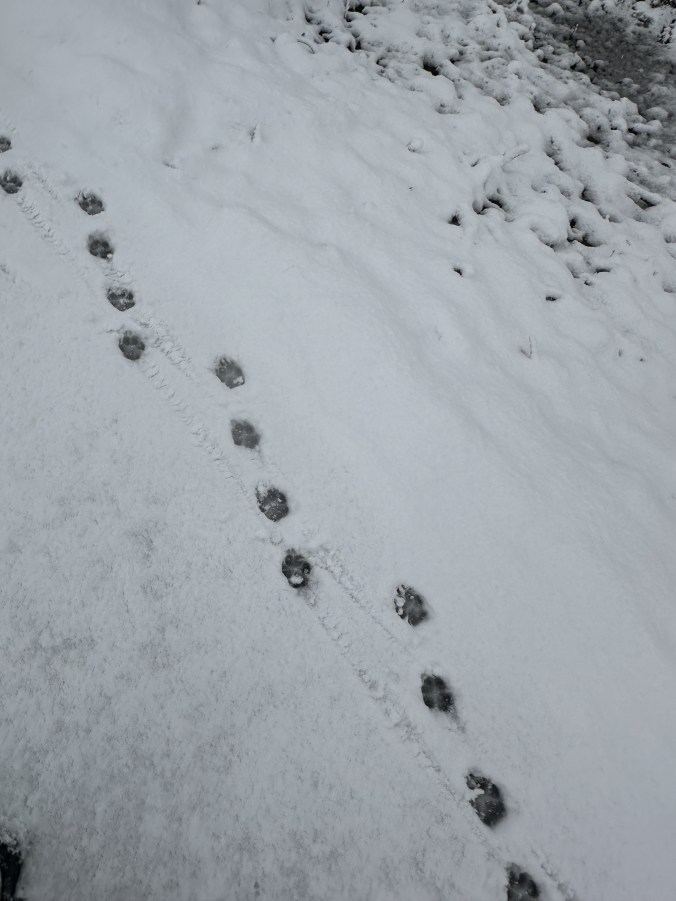
I leave you with some gratuitous dog footprints: the peculiar paw pattern of a standard dachshund. No, not Frank, but Oscar, the wire-haired dachshund. My family are dachshund people on all sides.
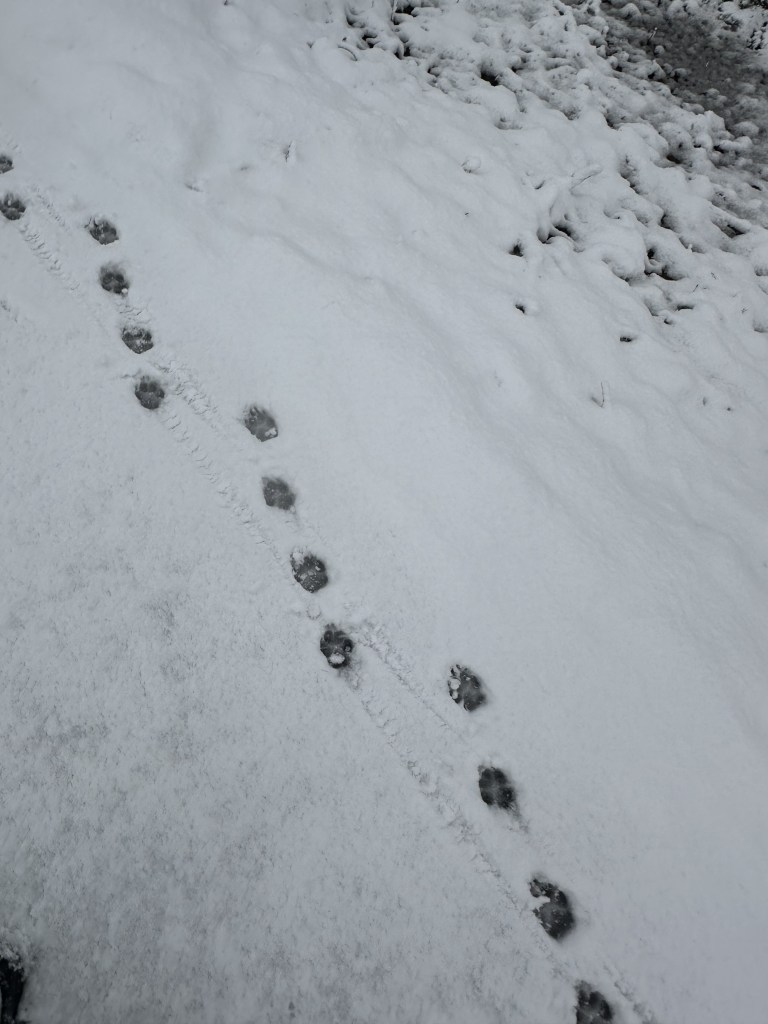
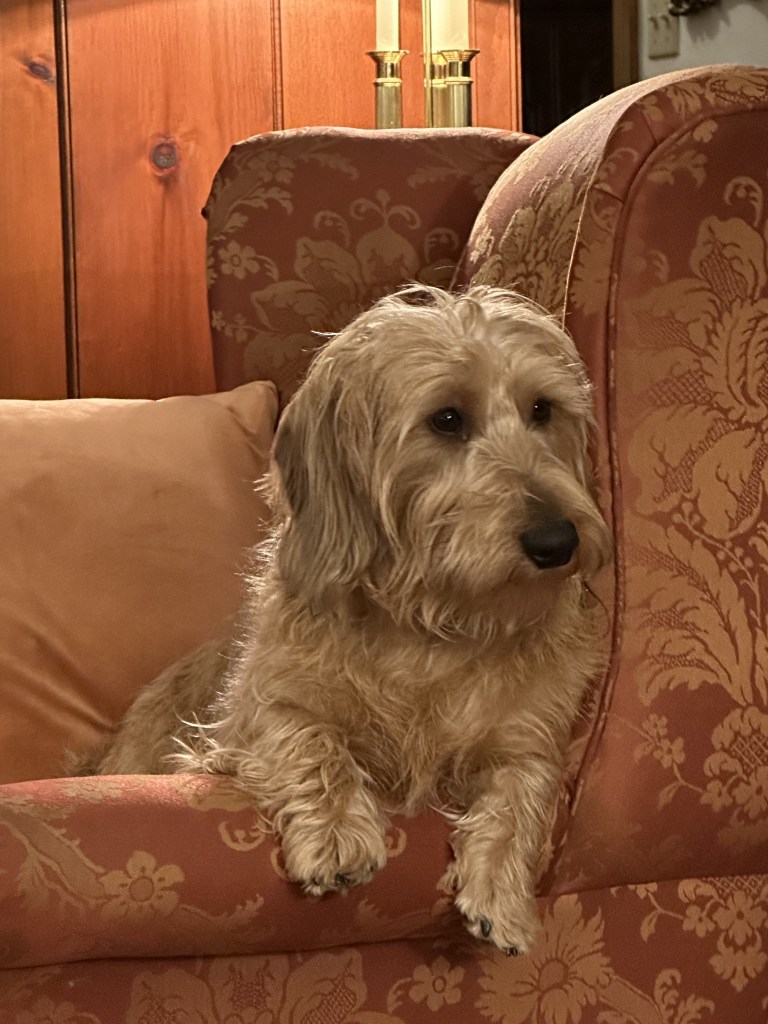
My sister’s wire-haired dachshund, Oscar.
My niece’s standard dachshund, Frank, on a recent rainy day. He is unchanged by success.

The day after Valentine’s Day

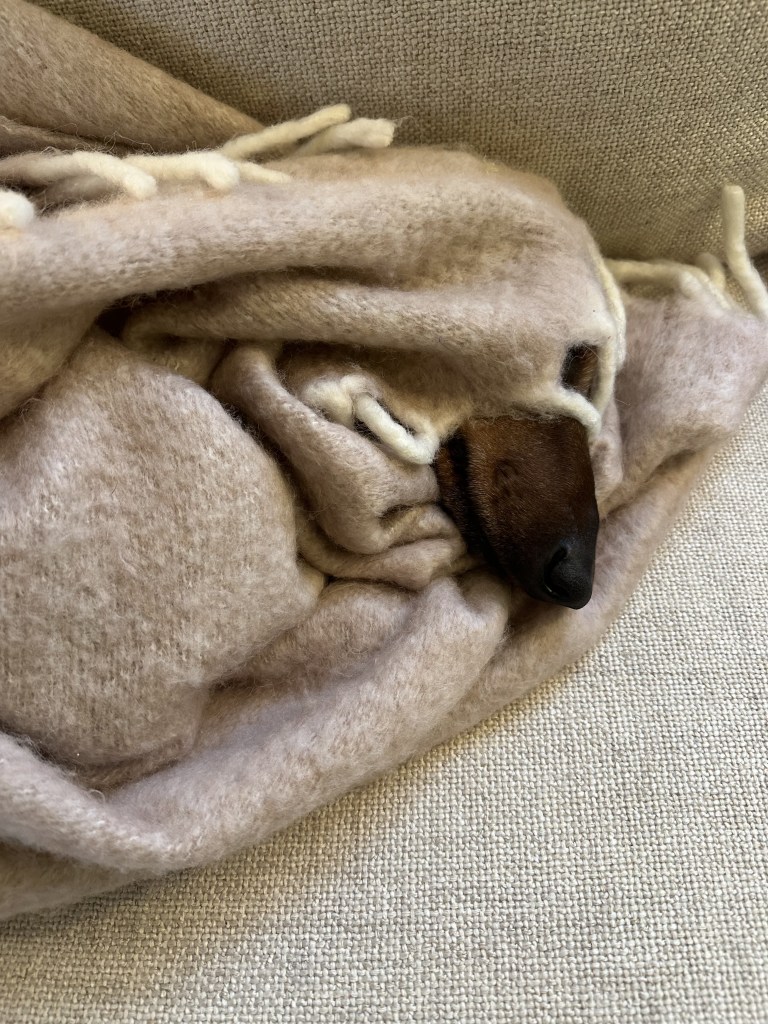
We woke to three inches of new snow, coating the branches in the magical way that reawakens childhood. There’s a fire in the fireplace, and a big snoring Eli on the couch. It feels very cozy and pleasant, and much more like February in Wisconsin.

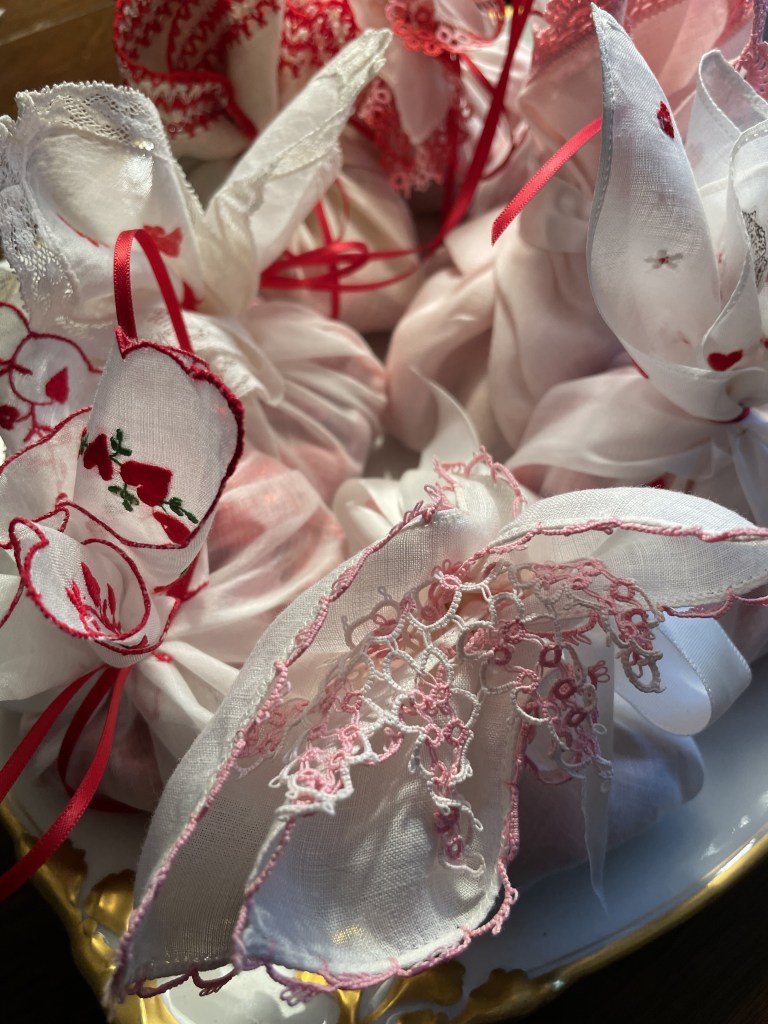
I think the pandemic created a sense of the loss of time passing, and maybe that’s why I began assembling little Valentine gifts every year for my friends. They are never anything important, just a little token whose preparations feel festive. This year I read somewhere about a grandfather who always gave the writer candy tied up in a handkerchief, and the story was accompanied by an embroidered Valentine handkerchief that could be purchased for a ridiculous price. I wasn’t going to pay $40 for a handkerchief, but it gave me the idea.

So I began a hunt for vintage embroidered handkerchiefs. Soon they started arriving in little envelopes from all over the country, some with handwritten thanks. I paused over the note from one woman who wrote that she had been collecting handkerchiefs all her life, but now, as she was older, she wanted them to go to people who would enjoy them, rather than leaving them to her children who would just toss them out.

They were all white, with pink or red decorations. Some of the embroidery was by hand, and some was not, some were trimmed with lace. The combination of the different designs made a cheering jumble. They were all beautifully ironed, and some still had their original labels. I bought red and pink foil-wrapped chocolate hearts; foil-wrapped chocolate lips in pink, purple, and gold; a big spool of red satin ribbon; little white boxes; and heart stickers.

I suppose it’s all a little silly, but in the end, we are all children at heart. And who doesn’t miss the fun of valentines and a snack of Hawaiian Punch and cookies?

Incidentally, the grownup version of Hawaiian Punch is Ina Garten’s Cosmopolitan. Mix 2 cups vodka; 1 cup triple sec or Cointreau; 1 cup cranberry juice; 1/2 cup of fresh lime juice. Chill. Serve on the rocks in frozen glasses. No need to wait for next year’s Valentine’s Day. But be warned: too many Cosmopolitans can lead to the writing of terrible poetry.

A not-for-breakfast post

Last night, Auggie and Eli’s good friend, Scary Lisa1, and I went to a pet first aid class. It was something I’d been meaning to do for a very long time, but simultaneously dreaded. I am not squeamish as such, but I have too much imagination, and at some points in the class my eyes filled with tears thinking about my sweet boys being in the described situations.

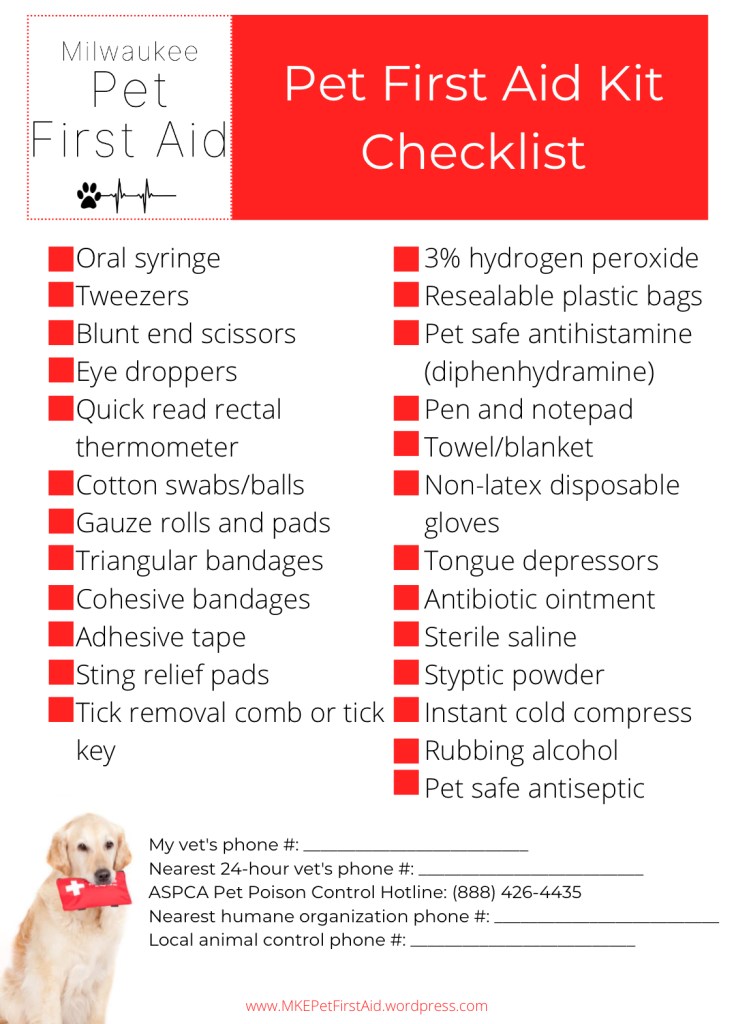
I did learn important things, though, and although I have most emergency necessities available around the house, I am inspired to put together additional first aid kits for the cottage and both cars. In case you’re interested, the list is below. You should also add a mylar blanket and towels.

If you have big dogs like Auggie and Eli, in addition to the oral syringe, you should keep a turkey baster on hand to administer sufficient doses of Hydrogen peroxide in case you need to induce vomiting (which you should never do until a veterinarian who knows what has been ingested tells you to). I’ve had to do this twice, and it is heartbreaking, but lifesaving.

Speaking of poisoning, here is the ASPCA poison hotline (yes, I hate the ads, too). They will charge $75, but if your own vet is unavailable, they are a valid option, with veterinarians on hand.

Here are some important notes: Your pet can take Benedryl (diphenhydramine) if stung or having an allergic reaction, BUT only plain Benedryl—not Children’s Benedryl, which has the poisonous-to-animals artificial sweetener Xylitol, and not Benedryl with Tylenol (acetaminophen). Both ibuprofen and acetaminophen are poisonous to animals, too. The dosage is easy to remember: 1 mg of plain Benedryl per pound of animal.

We practiced CPR and artificial respiration on a canine version of Reusci Anne, and we all had large stuffed animals at our desks to practice muzzling and bandaging. These last were handy for hugging when a discussion of evisceration got stressful. It was not exactly a fun night, but I’m glad I attended.

My biggest dilemma is how I would get Eli into the car if I were alone and he were unconscious. I am thinking about asking our carpenter to modify a toboggan. Too weird?

Here are Eli and Scary Lisa once he’s reminded himself that he loves her.

  1. Scary Lisa has known Eli since the moment we brought him home, and they love one another. But, because Eli is a COVID puppy and was not properly socialized, sometimes he forgets who she is and runs from her. Once he remembers, he’s on her lap. Lisa is not otherwise scary. All our dogs have loved her. ↩︎

Would “dangling with a chain saw” make a good book title?

Our property is almost entirely wooded, and the trees have a way of creating their own little ecosystem. It can be warm and sunny elsewhere, but when you turn in our driveway the shade envelopes you, dropping the temperature, delaying the melting of ice and snow, and, in the summer, providing sanctuary to far too many flying insects.

The shade in our house is so ubiquitous that I have chosen the color schemes to maintain a warm coziness, lest the leaves turn everything inside green in summer. In winter, the bright sunlight is a welcome change.

Maintaining this property is a bit like managing a park, and sometimes it means making some hard decisions. This week we are having to take down a healthy sugar maple—which truly pains me—but it was leaning perilously over the house, and after our recent heavy snow and ice, it became clear that it was us or the tree.

Enter Johanna. She runs a small tree care company, and recently won a state championship for her climbing and cutting skills. She is not someone we call for the minor things, but I trust her implicitly with the big stuff. Her calm cheerfulness is warm and reassuring, even as she is dangling from a rope and holding a chain saw.

She has colleagues who manage the ropes, feed the chipper, and help to make sure she is safe, but she does the climbing. Her team will be here for at least three days, felling the tree, cleaning up the storm damage, and cabling another big sugar maple to ensure its stability.

Whenever she is here I am distracted by a compulsion to watch her work. It isn’t something you see every day, and, frankly, her courage dazzles me. So, today may not be a very productive day, but it will certainly be an entertaining one.

Remembering Abraham Lincoln

Today is Abraham Lincoln’s birthday. It bothers me that we have lumped Lincoln’s and Washington’s birthday’s into one generic Presidents’ Day. They were not generic men; each in their particular ways were fathers of new eras in the American experiment. It bothers me still further, that at a recent trip to an elementary school, even the third graders didn’t know who Lincoln was, or recognize that distinctive profile. It’s a subject simple enough for kindergarteners, but we seem to assume that children are incapable of learning things these days.

As a former teacher—and lifelong admirer of President Lincoln—I consider the abandonment of history a disgrace to our schools. Not to mention the abandonment of grammar, literature, and civics and…just reading. If you don’t believe me, look at the statistics. I’ll wait.

Children are sponges. They love knowing things, and their brains are programmed to memorize facts. It’s what human beings are meant to do. The education establishment dismisses memorization as mere rote learning—as if memorizing is somehow wrong. But I see memorization both as a gift and as the proper preparation for thinking. And at any rate, it would be a nice start.

I saw this close-up and personally when I was helping my grandson with his algebra this fall. How do you factor if you haven’t (in second grade) memorized the multiplication tables? It’s a form of rote learning that forms the facility for all the mathematics that follows.

Literature, too, is aided by youthful memorization. Children may not be ready to grasp the depths of meaning or the literary allusions in a memorized poem. But they internalize everything. Once memorized, the poem belongs to them in their own personal library to be recalled at will, or to arise unbidden at an apposite moment. And because it is theirs, their understanding gradually develops as they mature. They internalize the rhythms, too, and those old lines roll up like waves in the unconscious, building a sense for the language and its music. These things form good writers and appreciative readers, and create a common cultural underpinning that bonds us as human beings.

And history—that rhythm of ascent and failure that we repeat as civilizations and as individuals—begins with facts. Who did that? When was that? What happened first? What happened next? It’s only armed with these facts that we can form any opinions of what we think. You can’t think about history without knowing its essential details. And if we don’t know essential details, what do we have to remember?

The millennia-old tradition of education was that children go to grammar school to memorize—history, grammar, languages, literature, scientific and mathematical facts—until the age of twelve. At twelve, having reached the age of reason, they begin their true education. But that education is based upon the foundation of everything built before.

On this day in 1809, a great man of American history was born in a log cabin in Kentucky. He was a poor farmer’s son, and his life grew terribly hard when his beloved mother, Nancy Hanks, died at age 34 of poisoned milk. But his step-mother, the determined Sarah, encouraged him to read, and insisted that he educate himself. And read he did—whatever he could find—after a grueling day of manual labor, by the fire light. His speeches and letters reflect how deeply he internalized the great literature of his time, how influenced he was by the Psalms, by Shakespeare, by Milton, by the ancient Greeks. He walked miles to borrow—and return—books. He read widely and deeply, and he memorized. Today, if we have any sense, we look back and honor him for his righteousness, his valor, his humanity, and his martyrdom to the cause of freedom. He was an honorable man, worthy of being honored.

I didn’t use a book to look this up this morning. I learned it in elementary school.

It makes me sad that so many Americans did not.