Moses Leads his People out of the Wilderness- Part 3

I wrote this series of essays two years ago, and I publish them here at the request of a friend who just lost her big dog. My sympathies, Anna. He was such a good, sweet boy.

Pete and Baby MosesDogs grieve. I had heard it and understood it, but I’d never seen it before. We stood in the kitchen talking about Reggie, and hearing the name, Pete’s ears perked. I looked him in the eyes and said, “Reggie’s gone”, and had the uncanny sensation that his face had changed. What did he understand? He had been moping; not eating. He ran outside briefly when necessary and ran right back in. No dawdling in the sun, no sniffling where squirrels had been. He didn’t bark when we came home, there was just silence when we opened the door. Pete wasn’t in the mood for cheerful greetings, preferring to hide upstairs.

We realized very quickly that none of us could bear the empty silence of the house with Pete hiding and refusing to eat, and us feeling our own mortality too much. You get tired of crying, and you can’t dwell on death. Another dog was inevitable. We knew, at least, that much.

Since I was a little girl, I have wanted a German Shepherd. I admire them for their bravery and intelligence, their dignity and loyalty. And I think they are beautiful. But the time had never been right to have a dog who would demand so much training and so much attention. With the passing of Reggie I realized that this was my last chance. In the span of another dog’s life I would probably be too old to have such a powerful dog. And maybe as much as anything, I couldn’t bear having another Golden.
I knew from long correspondence the right person to call who specialized in gentle German Shepherds, but the wait would be long. Probably 6-12 months. We sent an e-mail to add our names to the list.

So life-changing things hang upon the large things and the small. And sometimes on the misfortune of others. We all live within some margin of error. At home we joke about how houses and cars always seem to sense that there’s a little extra in the bank, timing their infirmities or demise with the moment when you have something special planned, just as you’re about to get ahead. And when you’ve been saving to buy the German Shepherd puppy you’ve been waiting for since last year, that’s probably about the right time for your furnace to die. And sure enough. Within half an hour of applying we got an e-mail back. “I’ve just had a cancellation. Would you like to pick him up this weekend?” Somewhere in the universe someone named Nick has a shiny new boiler for his furnace. But he will wait for another year to get a puppy.

On the other hand, there is Fate. What made us write then, that night? It was too soon; we weren’t ready yet. There aren’t many weekends in which we have no obligations, but we had nothing planned. And then there was poor Nick and his furnace.

We got up at 5 that Saturday morning and drove the twelve hour round trip to an Iowa farm on a dirt road in the middle of nowhere, leaving Pete at home with a friend. It was so remote the GPS didn’t recognize the place. We arrived around noon. Even knowing what I knew about the disposition of these dogs I was a little nervous about getting out of the car while an extremely large German Shepherd with an enormous head barked at us. But when we met, he gently nudged my hand and then leaned against each of us separately like a big cat. We knew who he was. We had seen his picture on the breeder’s website standing shoulder to shoulder with a pony. This was our puppy’s uncle. We met the family: Dad, Mom, Grandma, another uncle, a full brother from another litter, and, of course, the puppies.

His official name is Moses, Prince of Egypt. We call him Moses Mooch. He is mostly black, with red legs and paws, and the beginnings of red markings around his face and inside of his ears. He wasn’t the biggest puppy in the litter, but he had the longest legs. When we brought him home he had two floppy ears, like all German Shepherd puppies. This morning he woke up with one standing straight up, the other still flopping at the tip. He looks like a small puppy rabbit.

Moses bounces in with joy. His mother, his father, and his uncles are gentle giants, so calm and sweet that they make a Golden look like Cujo. He is too young to know about big losses, and he seems delighted to have a new house with a soft blanket and no littermates to eat his dinner. He is curious about sounds. He’s not too keen on sleeping alone, but he is getting the hang of it when he has to. He likes singing: both his own and others’. He chews hair and the tassels on blankets. He chases ice cubes around the kitchen floor, and has learned to sit when he comes in the house. He’s trying really hard not to bite fingers when he plays, although I dreamt the other night that we had a pet crocodile. He has an endearing way of climbing into your lap to snuggle. He has a special affection for the big yellow blanket that probably still smells like Reggie, and from the first moment in the car he curled up in it and went to sleep.

He’s a smart puppy. Today he showed admirable, almost supernatural restraint in resisting the temptation to bite Pete’s tail as it hit him repeatedly in the face. You could see his eyes sparkling at the prospect. Pete snarls, though he is just barely tolerant, like a teenager rolling his eyes. But little by little, Moses creeps up on him. Sometimes with a paw on Pete’s paw, sometimes copying what Pete is doing, sometimes waiting until Pete is asleep to snuggle up against his back, and sometimes with an insistent puppy bark and a play bow. This morning as we walked, Moses was leaping alongside, trying to bite Pete’s floppy ears. We tell Pete that now is the time to make friends, before Moses changes his mind.

The house feels different. There is a puppy bed in the kitchen and toys on the floor, and half a dozen kinds of large breed puppy food samples in the pantry. We hurry home after work. Charlie has notions of the correct number of toys for dogs, but I just buy new ones when I see something he could handle. Moses can’t carry most of the ones you see around; they’re too big and heavy for puppy teeth.

The juxtaposition of life and death is everywhere always, but it slips in and out of our awareness, sometimes in the background, and sometimes in the front. Moses was comforted on his first nights sleeping on the yellow blanket where Reggie closed his eyes for the last time. The puppy trips along behind me to the bird feeder, and I see Reggie’s paw prints in the mud. On our visit to the vet for Moses’s shots the tech gently placed a small package on the counter, and while the staff passed around the puppy, I took Reggie out to the car for his last ride home.

Tonight we all sat on the couch together, and we had to counsel Pete to take note of the dangers of co-sleeping; Moses just barely escaped Pete’s indifferent sprawl by climbing onto my lap. Pete seems less than grateful for his new brother, occasionally snarling, and sometimes snapping at the puppy. But even so, I think Moses will win out with Pete in the end, even before he gets too big. He’s kind of difficult to resist in a force of nature kind of way.

The puppy is sleeping on the rug by my feet. He sleeps hard, indifferent to the sounds of the squirrels chuckling, the geese on the water and the cranes squawking. He has had a run and eaten as much as he can hold, dancing in excitement while he waited for his bowl. He looks so innocent lying there, probably growing as I watch. I think he’s bigger since yesterday, but that’s a good thing. He has big boots to fill. And judging from the size of his paws, they might actually fit.
Pete Loses his Wingman-Part 2

I wrote this series of essays two years ago, and I publish them here at the request of a friend who just lost her big dog. My sympathies, Anna. He was such a good, sweet boy.

Pete woke up this morning an only dog. He is an animal with odd pockets of timidity, and has depended on Reggie’s cheerful steadiness for inspiration to leave the warmth of the house. Normally when we get up in the still dark mornings both dogs rush out together, but this morning Pete wouldn’t go. He doesn’t like the wind and he doesn’t like the rain. I put on his coat and told him there were squirrels. He wouldn’t go. There were no squirrels. Pete isn’t stupid, and Reggie wasn’t there to encourage him.

We had a rough night last night. Our kind vet and one of his techs came to the house while Pete was locked away upstairs with a very nice bone. We held Reggie and told him we loved him and used something I learned from the late Barbara Woodhouse, an old-school British dog trainer whose advice was of mixed value, but who said that the phrase “What a good dog” had an electrifying effect on dog morale. It was a term with meaning for Reggie, and we said it repeatedly, along with other endearments that are embarrassing for me to admit, but which Reggie seemed to like. He passed into a deep sleep and was gone. They carried him away. We cried.

Pete wouldn’t come down. Pete is our rescue dog. Part whippet, maybe; part pointer, maybe; part lab maybe. It’s a lot of maybe. We call him an Indiana Spotted Dog, because he came from a kill shelter in Indiana. We were told that he was abused, but he’s never said anything about it. His disposition is a curious mix of Eeyore and Eddie Haskill and he is extremely skillful at gaining love, even from strangers. But his courage—and he actually has a great deal—has always been supplemented by the knowledge that he had a larger, eager comrade who was never as fast, but always right behind him. Anyway, in the end, we went up and sat on the bed with Pete so he wouldn’t be alone.

This morning will be the first of many adjustments for Pete. All the bones that are scattered around the yard are his now. He gets both the squeaky squirrel toy and the squeaky frog. There will be no one to steal the thrown tennis ball from because he’s faster; the ball will be for him. He doesn’t have to nudge his nose in while someone else is being loved; he gets all the love to himself. He gets both windows when we go for a ride. He won’t have to hang around veterinarian waiting rooms to offer moral support. And the two months of gourmet foods: the sautéed chicken livers; the chicken breasts; the raw beef; the Italian sausage will suddenly cease. It will be back to health food, which is boring, as we all know, but important if you have a future.

We did the right thing. It was hard, but it had to be. I found myself thinking of my late father over the long last days, and remembering the agony he was forced to endure from this same disease.

Thank you to all of you who sent us so many words of kindness and support. You can never know how much it meant to Charlie and to me. Pete can’t write a thank you. But I think he would if he could. Maybe.

The Stove

The Stove

My husband and I recently changed our cable service, and suddenly, after years of watching TV only for Packers’ games, election nights, and storm coverage (we live in the Midwest), we have TV’s in three different rooms and I am watching nearly every night. DVR technology is nothing new to most Americans, but to me, it is an exciting new arena for experimentation. Gone is the slightly stuck-up tone I used to use when I’d say in response to someone’s query about a great new TV show: “We hardly ever watch TV.”

In short, I have been watching a lot of cooking shows. Actually, only one: Ina Garten, the Barefoot Contessa. I adore her and want to be her friend. Although, for the record, someone who cares about her should take her aside and suggest that she stop relying too much on stock phrases lest she descend into self-parody like Martha Stewart. But I digress.

As I am fast-forwarding through my DVR’d shows (I also adore Top Gear, the British version, and am already heartily sick of Rehab Addict), I have had occasion to pick up the tail ends and the very beginnings of other cooking shows, and gradually, I have been slowing down to watch these brief parts of them. It’s fascinating how many chefs and/or cooks with widely varying styles one can find. There was a time when Americans had only one beloved television chef: Julia Child. But now we have as many as the Food Channel can program.

What intrigues me most is the sanitized methods of these TV cooks, even as they, apparently, revel in their idiosyncracies. They may be ranchers’ wives, or girls who dress up in costumes to match their menus, or people who have very tight budgets, but their ingredients are mise en place; their kitchens are carefully organized; and everything always goes smoothly. They always have the ingredients they need and the right size pan.

This is not an accurate reflection of the cooking adventure. At least not in my house.

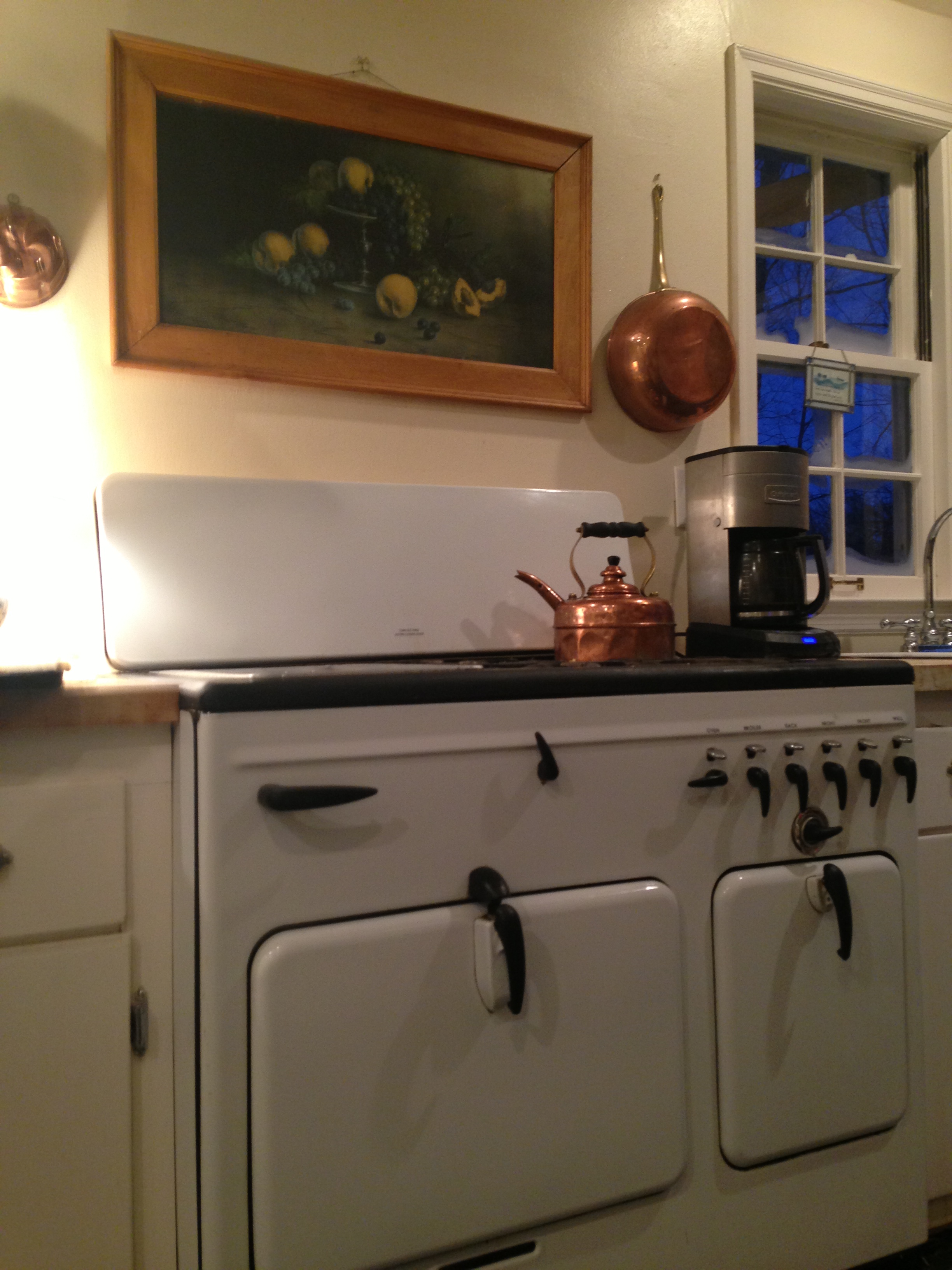
Let me begin with my stove. It is a vintage Chambers stove from somewhere in the 1950’s. It is lined with firebrick, and weighs about 600 pounds. I got it for free 23 years ago, and shipped it to Wisconsin from Maryland.

I know.

Anyway, this stove has become a strange part of my identity. It is special, and mostly wonderful. The rusty burners are infinitely adjustable, and have different configurations for different kinds of cooking. There’s a stove top broiler with a griddle on top, and a well, a kind of mini oven, which I may have used once. One of the things I love about my stove is that there is no electronic anything on it. This means that even in a power outage I can make a cup of tea or a lovely beef stew to eat in front of the fire. We’ve lived in our current house for 13 years and had approximately 3 power outages. But never mind.

The other identifying characteristic of my stove is that it has no oven thermostat. Apparently—and I hadn’t realized this until he told me some months later—when my late, adored, engineer father re-installed the stove in our new house, he decided for some reason that the thermostat was dangerous. Or something. Anyway, he removed it.
We won’t get into my father’s approach to repair. I’ll save that for another day.

But in the aftermath, when I was complaining that my oven either burned or under-cooked things, no matter how I set the temperature, the subject of the thermostat came up. After pondering this problem for some weeks I casually mentioned to my mother that it was probably time for me to get a new stove. “But you can’t!” she exclaimed, horrified. “Your father worked on that stove for two whole days. He would be so hurt!”

This line has become a source of first, teasing, and now, resignation for my husband. When I mention that in our kitchen renovation we should consider getting a new stove, he points out that we can’t, because my father—now gone for nearly 6 years—worked on the stove and it is now historic. I used to think this was funny.

But anyway, this is one reason that cooking in my house is not like the cooking on TV.

The other reason is me. I’m actually a pretty good cook. I learned the art of creative cooking from my mother, who all her life made delicious meals by artfully tossing in a bit of this and a handful of that—all accompanied by copious quantities of butter and good white wine—but whose techniques were somewhat erratic. My mother rarely used a measuring cup, and when she did, it was only a gesture.

I learned the need for method in cooking from my 6th grade home economics teacher, Mrs. Wallesverd. Mrs. Wallesverd was old school in every sense. She was the kind of teacher who brooked no nonsense, and who looked at you in a disapproving way if you strayed from the path. Those looks had a powerful effect. But cooking is chemistry, after all, and I learned from her why sifting flour mattered, but also why you wash the glasses and silverware first, and other key points of organized housewifery. Another topic for the future: the serious loss to children in the elimination of home economics courses.

So my cooking is a curious amalgam of creativity and method, and except for those days when the oven temperature isn’t quite right—which, I must admit, are rather frequent—it usually turns out rather well.

So on Thanksgiving morning, I decided to make pumpkin bread. Bread, as you probably know, requires baking. Which requires an oven. Which, unless you are a French chef with a traditional boulangerie, usually requires a thermostat. Nevertheless, emboldened by the success of my pies yesterday, I decided to give it a try. Quite apart from anything else, the kitchen in our old house is cold, and the oven heats things up nicely. It’s the firebrick.

I have discovered that by pushing in on the alleged temperature gauge as it turns, I can usually alter the temperature of the oven up or down. But only generally up, or generally down. Never so specifically as, say, 350 degrees. It’s all a crap shoot. So I turned on the gas, listened for the sound of it rushing through the burners, and inserted my little plastic igniter into the hole in the oven. A sort of a WHOOMP sound told me that the oven was lit.

It’s all an adventure.

It was while I was doing this, and pulling together the ingredients, that I was struck by how completely unlike a television show my cooking was. Now, I know from Mrs. Wallesverd that level teaspoons are important in baking, and I also know that if I don’t put everything out and pre-measure that I will forget something. That’s like a cooking show. But that’s pretty much where the resemblance ends.

I have never seen a cooking show chef peer into her flour canister and discover that it’s empty. Nor have I seen her have to open a bag of flour and have to deal with the mess as it poufs out of the paper package all over the counter and floor. Television chefs don’t have to interrupt their cooking to rinse out the flour canister and dry it because the rim has something crusty on it, and it’s probably not a great idea to put a new bag of flour in it without washing it first.

Cooking show chefs have the right size pans carefully laid out. They rarely have to sit down on the cold kitchen floor to rummage through the pan cabinet, searching for the right size. There is no avalanche of colanders when they pull out the possibilities. They don’t run out of paper towels and have to run down to the basement for another roll.

They don’t have bread pans purchased on the run from Piggly Wiggly that were intended 23 years ago to be temporary, but have endured ever since with no sign of a Williams Sonoma replacement. They don’t have to dig around for their reading glasses, and then hold said pans under the light to see if, somewhere, they have their dimensions imprinted on them. “That’s probably about 8 inches, isn’t it?”

Rarely are TV chefs reduced to pulling a tape measure out of the drawer (conveniently stored in the kitchen to resolve extemporaneous remodeling inspirations) to measure their pans. Television chefs never lick their fingers. Nor even the beaters of the mixers. They never have to interrupt themselves to throw the ball for the puppy, and then have to wash their hands again so that their pumpkin bread doesn’t have puppy spit as a flavoring, which is undesirable, no matter how engaging the puppy.

Television chefs remember to plug in the mixer before they try to turn it on, and their whisk attachment doesn’t have one broken wire that makes an ungodly racket when it hits the sides of the bowl.

Television chefs also don’t have to open the oven and then discover that the hardware store thermometer has once again overturned itself, and has to be fished out from the bottom of the oven, while carefully avoiding the burn from yesterday’s similar adventure, and then curse the designer of the thermometer who thought it would be a good idea to make a little clip for the thermometer which serves only to make it impossible to move it, but not to actually make it stay in place when someone is trying to put a pan in or take it out.

I was reflecting on all these things as I bumbled around, making bread, relishing my time in my kitchen, sipping my café au lait, and licking my fingers. There were all kinds of birds on the bird feeder outside the kitchen window, and deer browsing in the snowy woods below the house. My husband was still sleeping, and later when he woke up, the house would smell of good things and the kitchen would be warm. So, not so much like television chef cooking, but much more satisfying and real; a truly happy morning.

I have to stop now. The timer just went off. The one that only works occasionally.

And the pumpkin bread smells delicious.

Irony Alert:

As I should have realized had I not been lured into oven complacency by the success of my pies and bread, the reason the baking went so well was because the oven was keeping its temperature low. But this is not the right temperature for roasting a turkey. Especially not a larger than usual turkey.

Real Cook Kitchen

Long Goodbye: Part 1

I wrote this series of essays two years ago, and I publish them here at the request of a friend who just lost her big dog. My sympathies, Anna. He was such a good, sweet boy.

I am lying in bed with 170 pounds of dog: one big, one medium. They are, I regret to admit out loud, in the same proportion in my heart. I do love them both. But the big one, the one who lives inside my soul; he is dying.

Tonight we did the last thing: a rescue protocol of chemotherapy used only as a last resort. The vet said there was a fifty-fifty chance that it would give him a few more weeks. But no chance that it would save him.

I listen to his breath. The blissful thing is that he doesn’t know. Among all the deficits and injustices and hard things of dog life, the one great blessing is not to know your mortality. So to him, a hard day is just a hard moment, maybe not an oppressive forever.

Golden retrievers are gentle creatures. They are born sweet. Their docility is not a lack of character, though, as Reggie has demonstrated. He is an artist. His summer days at the lake are not for lounging. They are for a determined and relentless search for the perfect shape, the perfect addition to his sculpture. Tail high and wagging, he scours the floor of the lake with his feet, treading back and forth in a deliberate grid, fully engrossed in his life’s work. When he finds what he needs, he pushes it into place with his feet, and dives down to retrieve it, emerging triumphant to the shore with a rock the size of maybe half a soccer ball. He places it on the lawn in his own pattern, discernible only to him. Every morning my husband picks up the rocks—including those stolen from the neighbor’s shoreline—and throws them back. But by the end of the day a new work of art—a kind of Reggie Stonehenge—has reappeared.

Struggling to straddle the good days and bad days, to balance his happiness and his pain is my job; watching the progression of the evil cancer, and desperately trying to weigh my needs against his. Trying not to think of my deepest wish—to have him forever—and only of his—not to suffer. That’s all. Just no suffering. No nights in the scary hospital, only nights at home with his people who love him. He doesn’t understand if we abandon him as we did for the surgery on his torn knee. He trembled uncontrollably when we returned to that place for a routine thing.

Among the blessings is the kindness of those who care for him. His vet who returned to the exam room while we waited for blood tests with a flowered quilt to lay on the floor for Reggie and for me; the lab tech who smuggles him extra treats; the oncologist who wraps her arms around him and kisses his face before she begins her work.

We cuddle. I let him lie on the white couch. I rub his tummy, he puts his head on my shoulder and we comfort one another, as we do. We feed him rotisserie chicken and imported sausage because he will eat it while healthier things go untouched. And who cares. It nourishes him, and he will eat it. It makes him happy. That’s all.

This big dog, my puppy dog, at 7 weeks used to put his whole self into my arms when he came back inside from his outdoor responsibilities. I would hold his small body in my arms. He slept on my pillow so I could carry him outside when he stirred. As he grew, he still remembered how to express love, and would lay his massive paws on my shoulders as I knelt next to him, his head towering over mine, and he would lay his enormous chin on my shoulders. I always held tight; but sometimes distractedly; sometimes hurriedly; sometimes without the same level and intensity of love he had to give me. I had other thoughts. But he always thought about loving me first.

The loss of this love, not human, but canine, may not seem important to everyone. But to me it is the intimate, personal and once in my life love of this soul; entrusted to me as a gift I did not deserve or fully appreciate. With all due humility about myself, I wonder if anyone could deserve this trust, this love, this kindness, this full and open heart. Anyone other than another soul like his.

I owe him the most reverent, beloved, happy and respectful days I can offer him. In his innocence he is both my king and conscience. He is better than me. And he was born to break my heart.
Reggie