North of the Tension Line Reviewed in National Review

Screen Shot 2015-04-12 at 5.09.41 PM

It’s behind the paywall, but here is the text of the review found in the April 20 edition of National Review.


Women’s Lives

by ROBERT P. GEORGE
April 20, 2015, Issue

North of the Tension Line, by J. F. Riordan (Beaufort, 478 pp., $24.95)

My initial impression of this book was: I’ve walked into the novelistic equivalent of a chick flick. What am I doing here — by myself? I go to these only in my wife’s company and at her behest.

Other male readers are likely to have the same first reaction. North of the Tension Line is a novel by a woman about women. Is it for women? Well, I wouldn’t say it’s not for women — but my judgment in the end is that it’s also for men, perhaps even primarily for men. A gifted female writer — one with a nearly Austenian gift for observing human nature and describing the quirks and foibles of the entire cast of characters one finds in the human drama — has produced a novel that reveals some things to us guys about how women’s minds and hearts work.

Women themselves, of course, already know these things. They can read North of the Tension Line for entertainment. Men should read it for instruction.

Fiona and Elisabeth, our heroines, are intelligent, attractive thirtysomething single women — and best friends. They have interests and professions — satisfying but not high-powered — and are far from preoccupied by the need to find Mr. Right. They are open to his walking into their lives and hopeful that someday he will: Finding him would be a good thing — indeed, a very good thing — and they’re not making the perfect the enemy of the good by holding out for the Ultimate Mr. Right when Mr. Right Enough will do. But neither are they pining away, or pursuing their avocational and professional interests as mere distractions while they wait. They have lives — lives worth living, lives in which non-romantic friends, jobs, passions, goals, and challenges of various sorts occupy them meaningfully and worthily.

Yet J. F. Riordan’s point is not the old feminist canard about a woman’s needing a man like a fish needs a bicycle. Quite the contrary. Fiona and Elisabeth are, like most women, sensible. Their hearts yearn for a special bond with one of those creatures on the other side of the mysterious line dividing the sexes, and their minds tell them that such a bond is worth the sacrifices — including some degree of loss of independence — required to establish and sustain that bond. They are not boy-crazy, nor are they imagining a knight in shining armor who will come astride a white charger to sweep them off their feet. What they want is a decent, honorable man, a man who is comfortable in his own skin and who is willing to be a man — a fellow whose gentle strength would complement their own strong gentleness.

There is nothing more familiar to readers and viewers these days than the story of a woman who manages to be caught up in an unhealthy relationship with every man in her life. She has, or had, an unhealthy relationship with her father; an unhealthy relationship with her first boyfriend, then her second, then third, and so forth; she has unhealthy non-romantic relationships with her guy friends, her boss, her dentist, her pastor, her plumber. She has an unhealthy relationship with her husband — one that doesn’t improve when he becomes her ex-husband. By the time her son is a teenager, she has an unhealthy relationship with him, too. Is the problem with her — or with them? In the standard plot, she begins by blaming herself.

But, of course, enlightenment eventually comes when she realizes that the fault is not with her at all, but indeed with them — and even more fundamentally with the institutional sexism and sexist (and, of course, heterosexist) culture that is ultimately what is driving both their bad attitudes and behavior and her initial impulse to blame herself. Pretty soon she is “off men” and living happily ever after in a lesbian commune in central Massachusetts.

What’s refreshing about Riordan’s novel is that her protagonists have healthy relationships with men. And it isn’t because Fiona and Elisabeth — or the guys with whom they have romantic and non-romantic friendships — are perfect. They’re not. In fact, North of the Tension Line is a sort of study in how imperfect but fundamentally decent women and imperfect but fundamentally honorable men can relate to each other (whether their relationships are romantic or not) in constructive ways, and find satisfaction and contentment in their relationships. In fact, part of her message is that the project of navigating the mysteries involved in relating to people of the opposite sex can — and where our relationships are healthy almost certainly will — challenge us and change us in ways that make us better men and women than we were: a little less imperfect. Relating to each other across the mysterious divide takes effort, but it’s worth it. The payoff is genuine. There must be something to the idea that men and women are made for each other — that by entering each other’s lives they supply a lack and have a lack supplied.

What about the relationships between women and other women and men and other men? Perhaps part of the reason Riordan’s characters can relate in healthy ways to those of the opposite sex is that they have deep, constructive friendships with people of their own sex. The friendship between Fiona and Elisabeth is front and center, and a beautiful friendship it is. The two women delight in each other’s company and each appreciates and cares deeply for the other. They are cognizant of each other’s imperfections, but each is no less aware of her own deficiencies. And each is grateful to the other for the gift of her friendship. They are fast friends, loyal friends. Yet neither woman jealously worries that the entry of a man into the other’s life will weaken the lovely bond between them. On the contrary, they are pulling for each other on the boyfriend front — precisely because they appreciate that there is something good, something uniquely fulfilling, that even the deepest friendship between two women (or, I daresay, two men) cannot provide.

Most of the guys in the book are good guys, and their friendships with other guys are good friendships. J. F. Riordan finds countless ways — usually suitably subtle ways — to call attention to the deep bonds of affection good men can form with each other. Of course men, being men, don’t talk about their feelings much, but rather express them in actions — including in actions toward women or for their sakes. Because of the setting Riordan has chosen for her study, most of the men in the novel — at least those we get to know best — are skilled workers. They build things, or fix things, or do things (like run a ferry from the mainland to an island). They are not intellectuals. Indeed, most are a bit less intellectual than the women. But they are not less intelligent, nor are they less thoughtful. What they are, God bless them, is old-fashioned, even chivalrous. They respect the womenfolk, and even look up to them in various ways; but their instinct is to help them and protect them because . . . well, because that’s what good men do.

You may, gentle reader, be worried that North of the Tension Line has no villains, mean dogs, or ghosts. But fear not: There is an excellent villain — a woman, by the way — a scary mean dog, and an exemplary ghost. To avoid spoiling things for you, I’ll say no more about them than to report that Riordan’s verbal artistry is up to the challenging task of handling villains, mean dogs, and ghosts — which is saying something when reviewing a writer’s first novel.

Mr. George is the McCormick Professor of Jurisprudence and the director of the James Madison Program in American Ideals and Institutions at Princeton University.

Read more at: https://www.nationalreview.com/nrd/articles/416347/womens-lives

Special Giveaway: North of the Tension Line

Tension_Line_rd4

It’s cold out. There’s not much to do, so why not enter a contest to win a free autographed copy of North of the Tension Line?

Submit a comment to this post explaining why you should receive a copy. Wide readership and/or a willingness to be a shameless shill are highly recommended.

Winner solely determined by the author’s whim. All decisions are final.

TNBBC’s The Next Best Book Blog: Where Writers Write: JF Riordan

Exile desk

TNBBC's The Next Best Book Blog: Where Writers Write: JF Riordan.

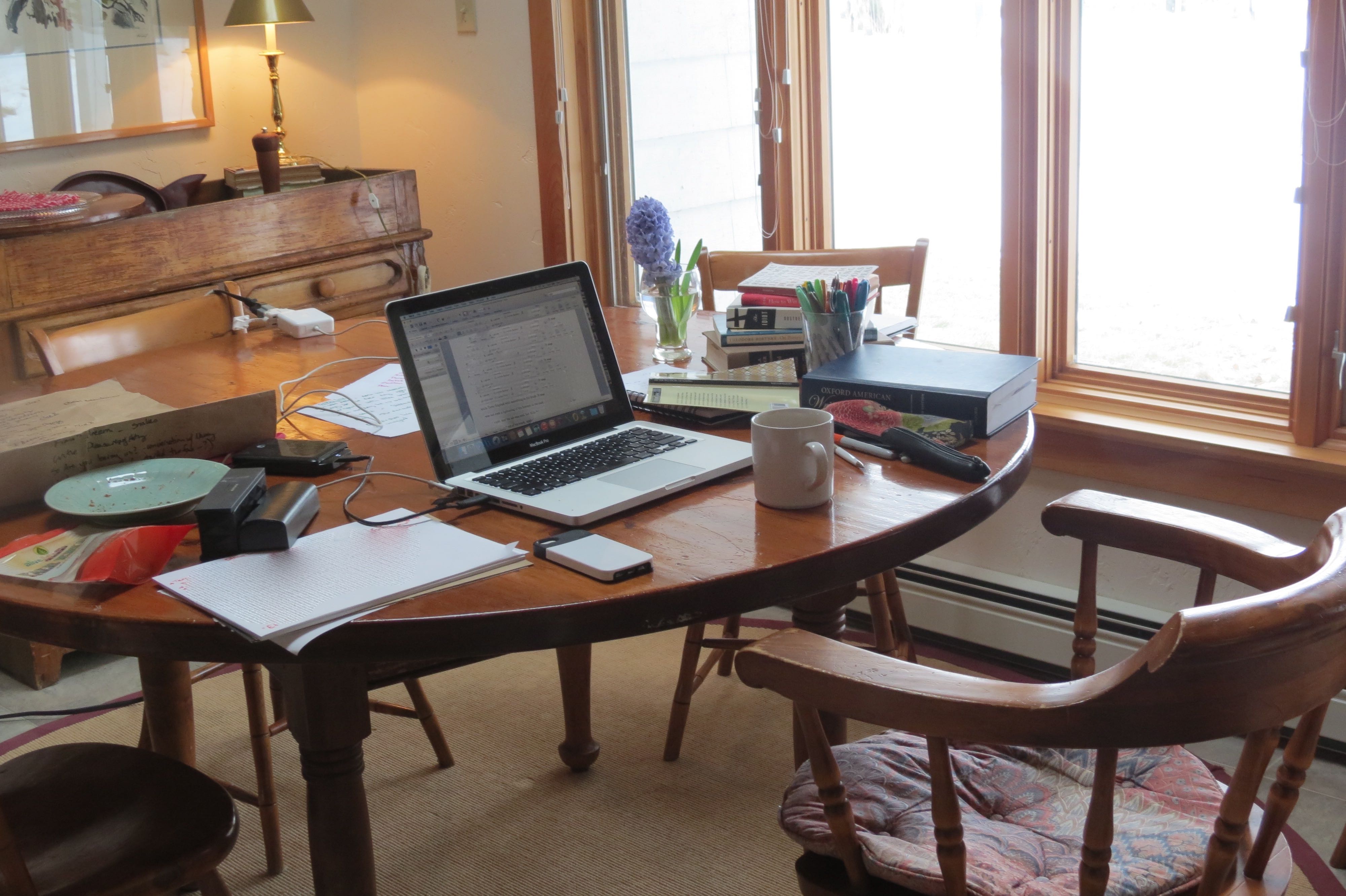
TNBBC is a blog that features small press and indie books and their authors in varying playful question formats. Among these is the request for writers to show where they write. I was pleased to be asked, and was deeply tempted to discuss the drinks of choice for the characters of North of the Tension Line, but in the end I settled on a photo essay on where I write. I recommend heading to TNBBC for the chance to meet some great under-appreciated writers and their books. Believe me when I say we will all be grateful.

Last Day North of the Tension Line

January sunset

Today is my last day on Washington Island. The ferry leaves tomorrow at 8 am and we’ll be on it.

Normally I like to walk the deck and chat with the crew, but the dogs are with me, and there’s something about the ferry ride that scares them. So we sit together in the car, and I talk and sing to them. They like that, and they usually sing along. Pete, who is undoubtedly the coward in the family, is mostly unbothered by the motion, but that is enough for Moses. When we hit the ice fields the noise frightens them both and they tremble. It seems to get worse each trip.

Last night I walked home from a dinner party in the dark with the wind screaming from the lake. Its noise and power were awesome–in the old fashioned sense of the word. The dogs leapt with joy to see me, and we went out again to hear the wind and look at the moon and the clouds. They ran ahead of me through the snow, sniffing at deer tracks. The wild remoteness of the Island is oddly comforting to me, and I feel safer here than anywhere else on earth, even when the wind leaps and howls as if it would tear us off the ground and spin us into space.

I like to say I live in exile from Washington Island, and most people think it’s a joke. But leaving this place tears at me, and even though I will be happy to be home again, a part of myself will be missing.

January Island

January Island

Greetings from North of the Tension Line. Our days are simple here. I get up in the dark, drink coffee and write for a few hours. Then the dogs and I go for a long walk. We come back and I write some more. Sometimes I procrastinate and then I write. I have lunch. Then I write some more. In the afternoons we go for another long walk. Usually at night we just hang out and go to bed ridiculously early.

The dogs are happy. I am happy, if a bit lonely. The good news is that sequel is coming along nicely.

The Big Question

I am beginning to sense a pattern. I’ve been on the book club circuit recently and it has been great fun to have total strangers engaged with my characters, asking about them and why they do the things they do. Readers have come to own my story. It’s theirs now as much as it is mine, and they want to engage with it. Some people have theories, and I listen to these with great interest because they often surprise me. There are also certain questions people ask routinely, and the answers to these questions have become a bit routine, as well. People want to know what Elisabeth sees in Roger. They ask about Roger’s mental health. They love Rocco. They pretty much all hate Stella and want her killed, and many people comment on developing cravings for scotch.

But there is one question–the one I get most–that I have no routine response to: What happened to Robert?

I believe that this is the kind of question that a reader must resolve alone, and I have steadfastly remained silent, even though the sequel to North of the Tension Line is nearly finished.

This is driving one of my friends crazy. In a bid to draw me out she recently sent me an article from the Washington Post with a map of all the goats in the United States.

There was just one question accompanying the link: Is he here???

The Nostalgia of Crows

I am a crow lover.

I had never seen a crow until I moved to Wisconsin in my childhood, and I remember being astonished at how big they were. I first noticed them in the spring when their big, clumsy fledglings would fall off their perches onto their beaks, and would make odd, baby caws that were laughably unbeautiful. But their parents were sleek and affectionate, and they seemed to be large families of mothers and fathers and aunts and uncles.

We fed them. My mother would leave them meat scraps and suet. They would gather in the early mornings and winter evenings, circling overhead and calling. It was rare to see one alone. Most often, though, they would travel in pairs. Nordic myth says that they were the messengers of the god, Odin, and they always seem to carry both mystery and omen.

When I grew older my brother gave me a crow call, and I would use it to summon them. They almost always responded, and we would carry on conversations in a language that consisted on my side merely of imitation. I can’t say what was intended on their side.

Crows are very intelligent. I remember reading somewhere that there was a man who somehow rescued a baby crow, and from that day on, the entire flock (technically, I believe, a murder of crows) would greet him in his car every day as he entered his subdivision, and escort him to the main road when he left. They always remembered his heroism, although, perhaps, it was a tribute that not everyone would appreciate.

Somehow, bleak winter days–the days with neither sun nor snow–seem like crow days, and today was one of those days. As I was hurrying in from my car to a meeting, I heard in the distance the rough song of crows, and it flashed me back to my childhood, ambling home from school through the snow, cawing and calling to the birds who seemed to know me.

I realized at once how much I have missed them, and I have resolved to go back to carrying my crow call in my pocket.


Night Crow
When I saw that clumsy crow
Flap from a wasted tree,
A shape in the mind rose up:
Over the gulfs of dream
Flew a tremendous bird
further and further away,
Into a moonless black,
Deep in the brain, far back.

(That great man) Theodore Roethke

I see you never

There is a short story by Ray Bradbury–an underrated master of American literature–that I read long ago. In it, Mr. Ramirez, an illegal immigrant, and tenant of Mrs. O’Brian, is being taken away to be deported. He is a good man, and she likes him, but she is unable to help him in the face of the law. At the last moment, desperately, he cries out to her, “Oh, Mrs. O’Brian! I see you never! I see you never!” After he is gone, the woman starts to go on with her interrupted dinner, when she suddenly puts down her knife and fork, painfully struck by the realization that she will never see Mr. Ramirez again.

In winding up the details of my late mother’s estate there are large griefs and small ones. Each time I come back from her house I am spent from the turmoil of emotion. There are so many things to do: the paperwork, the bills, the wrapping, the packing, and the decisions about what remnants of my parents lives to keep and what to abandon. It is heavy work. I never liked the house itself, but the finality of each step of the parting beats on the walls of my heart.

The house will be sold tomorrow, so I was there yesterday to meet the movers. The mailman, whom I have known for decades, was on his way to deliver a package across the street, and he stopped to talk. He is a kind man, always smiling, and he delivered mail to me in my own small house when I lived in that town, as well as to my parents. I haven’t lived on his route for many years, but when we see each other we exchange pleasantries. He is, as a friend of mine likes to say, one of my life’s cast of characters. He doesn’t have a major part, but he has played in many small pleasant scenes, and his cheerful interactions have given me some of the happy little ordinary moments of everyday life.

Our conversation was light, and he enquired about the house. As we parted we shook hands for the first and only time, and I said to him something I don’t think I’ve ever said to anyone before: I will probably never see you again. I had to turn away quickly to hide my feelings.

The finality broke hard, and I cried all the way up to the house.

I don’t even know his name.

Joys of the Season

Dear Secret Santa:

First, I want to thank you for reading my blog. I need all the readers I can get.

Second, I want to thank you for the package of Chuckles I found in my mailbox yesterday morning. My husband handed me the envelope which he had opened accidentally, and recognized who the gift must be for. The message inside said: Merry Christmas from your Secret Santa.

I was in the middle of vacuuming out the car so human beings could sit in the back without acquiring full coats of fur, but I opened the package and ate them immediately. Green one first; red one last, all in the proper order. They were slightly frozen and chewier than usual. Delicious.

It was a lovely surprise, Santa. I am grateful.

My love to you, whoever you are.

And, of course, Merry Christmas!