Old friends

Winter sunrise

My late mother had a good friend whom she admired greatly. Blanche will be 108 years old in February, and she still lives alone in her own house. She gets her hair done weekly, dresses beautifully, and is generally in good health.

A year or so ago I stopped by to deliver my mother’s birthday gift to Blanche while my mother–then 90–waited in the car. I spoke to Blanche and to her daughter, and, accustomed to my mother’s deafness, used my opera singer voice.
“You don’t have to yell at me,” said Blanche, with great dignity. “I am not deaf.”
“I’m sorry. My mother is,” I said apologetically.
“I know,” said Blanche.

I picked up my mother’s mail this week, and in the piles of junk mail and solicitations for donations for every charitable cause imaginable, I found a Christmas card from Blanche, signed in a firm, lovely hand.
Somehow, in my mother’s small town, the news of her death six months ago had not reached Blanche, and it had not occurred to me to call her personally.

I will have to write a note this week. I dread bearing the news that will reduce the small circle of contemporaries for this remarkable old lady. (If contemporary is the right word. At 91, my mother could have been her daughter.) My mother used to say how hard it was when all your friends were gone. How lonely. Blanche is accustomed to death, no doubt, but each loss must surely add up, and one hesitates to add weight to so many years.

I am wondering if I should wait until after Christmas, but perhaps that would be a form of selfishness.

It’s difficult to know. But probably sooner is better.

The intricacies of the casual conversation

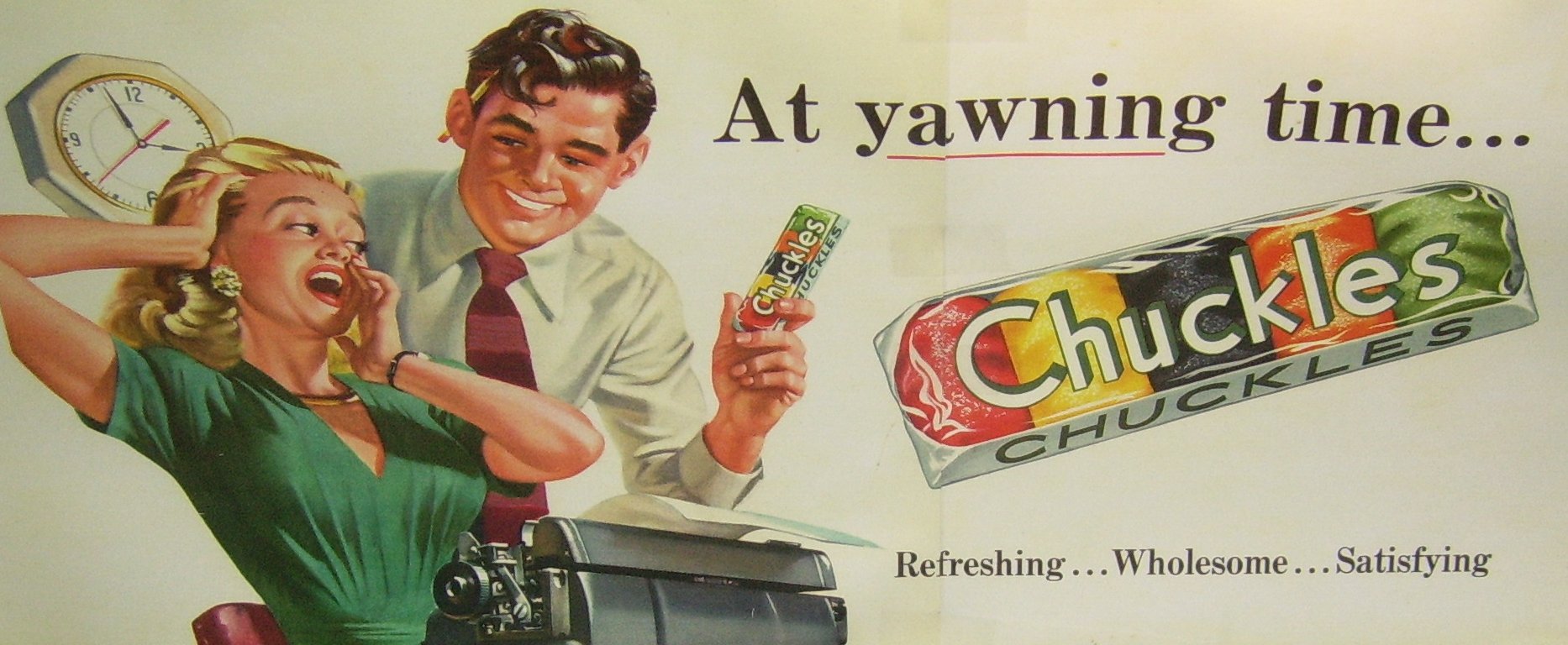
CHuckles flickr

I am on a first name basis with the people at our local hardware store. I am there sporadically but often, and they have patiently–and without one note of patronization–advised me on various topics ranging from the correct size of a wall anchor to replacing an outlet. They greet me like an old friend when I come in, and this minor element of small town life cheers me.
The frequency of my visits has increased recently for various reasons, so our conversations have taken on a serial quality, generally picking up where we left off. I was standing at the register this week piling up my purchases. “Will this be all?” I was asked politely. I struggled perfunctorily with myself and lost.
“And a package of Chuckles.”
Chuckles are a candy I know from my childhood, rarely seen anymore, at least in the midwest. They are an oblong package of five flat squares of gum drop style candy, with little ridges shaped into them, and coated with a crystal layer of sugar. They are always laid out in the same order: red, yellow, black, orange, green. I’m not sure when the hardware store started carrying them. But I first started noticing them this summer, when I was making frequent visits for items to prepare my late mother’s house for sale.
After our business was finished, I stood chatting, and opened up my package of Chuckles as I did so. Watching me, the owner said:
“You know, no one who buys those can ever leave the store without opening the package.”
“Really?”
“There’s something about their connection to childhood, I think. It’s powerful.” She paused for a moment, recollecting. “One guy who comes in stands at the counter to eat them so he can throw away the package here and his wife won’t know.”
“Maybe it’s better as a guilty pleasure.”
“So many things are.”
There was a moment of silence as I ate the first Chuckle.
“Which is your favorite?” the owner wanted to know. She pointed to the clerk. “He never eats the orange ones.”
“Really?” I was aghast. Orange is one of the best flavors.
“I find the orange ones hidden behind the counter.” She looked sideways at her assistant.
The clerk was not in the least abashed. “I start to eat them, and then forget about them.”
“You have to eat them in order,” I said.”It’s a cardinal rule.”
This interested them, and they both looked at me.
“You must be right about the childhood thing. I’ve been eating them this way since I was small. Green first. And then each flavor in order. Because the best one is the red one, and you have to save the best for last.”
As I thought about this piece of childish philosophy, I suddenly realized that it was more complicated, and I hadn’t been aware of it until this moment. I spoke slowly as my awareness of the process unfolded from my subconscious.
“And you can’t bite them right away. You have to let them melt in your mouth until all the sugar is gone, and then you bite into the little ridges very carefully. Then you can chew the pieces. But it’s better if you let them slowly melt in your mouth.”
“It’s a childhood ritual,” commented the clerk.
I nodded, thinking about the oddities of the mind, and how this leftover from my very early life could still be, unconsciously, part of my behavior. Another customer walked in, and we all went on with our day.
Somehow the conversation came up with my friend later on.
She listened, and then she said:
“How long have you been doing this?”
“All my life.”
“No. I mean eating the Chuckles. You don’t eat candy.”
I thought about it.
“I don’t know. All summer, I guess. I’m not used to eating sugar and they make me feel terrible afterward, but I can’t resist. It’s weirdly comforting.”
“So you’re eating a childhood candy, using a childhood ritual, as you work on fixing up your late mother’s house. You don’t need a degree in psychology to understand what’s going on here.”
“I guess not.”
Hardware stores are interesting places. I’ve always thought so.

North of the Tension Line’s Publicity Machine

IMG_9009-0.JPG

When people talk to me about North of the Tension Line,, they often mention Rocco, the thoughtful and easy-going German Shepherd who lives with Elisabeth.

When people see Moses-shown above-they assume that Rocco is Moses. But, in fact, the reverse is true: Moses is Rocco. I began writing about Rocco long before Moses came into my life. Opportunism, however, is a new author’s responsibility, and this permits me to bring Moses along to book events.

Children climb on him, people want their pictures taken with him, and, inevitably, when people hesitantly reach out to touch this Big Scary Dog, he rolls over so they can rub his tummy. A dog is a public relations boon.

And also excellent company for the road.

Going With the Flow

Pirate ship

My niece’s wedding took place on a dock on Baltimore’s Inner Harbor, a fashionably updated working harbor surrounded by sailing ships, industrial areas, refurbished warehouses and chic shops and restaurants. It was a formal wedding, with the bride in cream satin, five bridesmaids in teal organza, and the groom and groomsmen in classic black tuxedoes.

Among the various tourist attractions on the Harbor is a pirate ship. It has lots of flags and sails, and a skull and crossbones, and its purpose, apparently, is for people to get happily sloshed while sailing around and experiencing various kinds of pirate schtick, all electronically amplified. I’m not clear on exactly what this involves. Maybe it’s something like the routines of the flight attendants on SouthWest Airlines only with a pirate theme, and probably a cannon or something. Anyway, the bride had been warned by the venue that the pirate ship made regular trips on Saturday afternoons, and that the pirates and their passengers tended to be somewhat…uninhibited.

Sure enough, just after the officiant had begun the service and The Sainted Aunt had been invited to come forward to speak, the pirate ship made its appearance, accompanied by amplified uproar. Naturally, it was impossible to speak over this, so the ceremony paused and everyone turned to watch the ship go by. This took some time. Everyone on the pirate ship waved, and the entire bridal party and guests all waved back. A ceremonial ARRRRRRRRRR was raised from the ship, and the guests responded in kind.

No matter what what else was said and done that day after more than a year of planning–what the vows were, what music was played, what was on the menu at the reception–I’m pretty sure that this act of exuberant spontaneity–and the response to it–is the one thing everyone will remember twenty years from now.

Another lesson for married life.

Words for the Newlyweds

From my talk at my niece’s wedding.

I would like to point out to those who don’t know me that I am not merely an aunt, but that I am in fact, The Sainted Aunt. In that role—and since you’ve given me a microphone—your mistake—I would like to offer some small pieces of advice which the bride and groom probably won’t hear today or remember later.

Never mind.

Madeleine L’Engle is best known for her science-fiction children’s books. But she was also a prolific essayist. One day while reading something of hers about creativity, one sentence brought me up short.

It was this: Love isn’t an emotion. It’s a policy.

That may be an odd thing to say at a wedding, but it is the secret to all relationships. Because if we base our relationships solely on how we feel, then we have the power to ignore them if we become tired; to throw them away if we can’t forgive; to crush them and destroy them if we are angry.

The intense passion and devotion we feel for one another at the beginning is not an experience that continues constantly. People annoy us; they bore us; they disappoint us; they desperately hurt us; they forget to pick up their socks. So does that mean if we aren’t feeling passion we don’t love? Of course not—if it did, no human relationship would last more than a few minutes.

No. Love has its seasons of emotions that come and go, but it is, in fact a policy. It is a decision we make about commitment, about value, and for the day to day essence of any relationship: It determines how we treat each other in the casual exchanges of every day life.

It is so often true that we make more effort to be civil to strangers than we do to people in our own house. Surely these people whom we love most deserve our most full effort to be kind? So my first piece of advice is to be polite to each other. Save your best selves for each other, not for strangers. If you do that, your home will always be a place of refuge.

Life with humans—even with dogs, as any of us who loves dogs will know—also involves a lot of mistakes. And thoughtlessness. And grievous hurts. And when we are hurt, it is natural to be angry. It is an instinct of self love and preservation. But to nurture anger is to willingly harbor a killer within your heart. George MacDonald said “It may be infinitely less evil to murder a man than to refuse to forgive him. The former may be a moment of passion: the latter is the heart’s choice. It is spiritual murder, the worst, to hate, to brood over a feeling….”

And in any relationship—especially in marriage when, at our most vulnerable, we can innocently hurt one another—it is essential to drop your pride and to forgive, forgive, and to forgive again.

But if you remember one thing, make it forgiveness.

My last piece of advice may be, ironically, the most difficult.

We have some friends who have a very busy life. He has a very successful business; she does, too. His 93 year old grandfather with the beginnings of dementia lives with them and likes to wander out on his own to mow the lawn; they have 3 children, and one of them, a teenager, is seriously ill. Their life is full and busy, and demanding. It can be hard. But every morning when they wake up, he says to her: How are we going to have fun today?

One of my favorite public figures is John Cleese—one of the original members of Monty Python. Think: a sort of 1970’s version of Eddie Izzard. Since the days of the television show he has gone on to a career—believe it or not—as a creativity consultant—which sounds like a sketch from the show, but it is actually perfectly true.

Cleese talks about the distinction between being serious and being solemn. He points out that you can be sitting around a table talking about the most serious things in the world: Love, death, the meaning of life, great literature, and you can be laughing while you speak of them. Serious doesn’t mean humorless. And you don’t have to go to the circus—or the New York trapeze school—to have fun.

But laughing and finding escape can be liberating and inspiring, and relationship building.

Not to mention a whole lot cheaper than psychotherapy.

Our life’s landscape isn’t geographical. It’s human. When you are young, life is an endless horizon of years ahead. It’s hard to realize how fast time goes, and how quickly the people we assume will always be here can suddenly be gone, changing the landscape of your life forever. It’s easy to allow the demands of every day to take up our energy and our hours. But in this, in every day, we have the essence of our lives. Our lives are only time, and, however far off the horizon seems, finite. So take the time every day to have fun together.

For all that, Marriage is serious business. To return to Madeleine L’Engle, (and I am paraphrasing) marriage is a fearful gamble, requiring risking everything of yourself. Marriage starts with love, and it is something that you must create together. And, she says, it is that creation that is part of our human calling.

So…Remember: love isn’t a feeling. It’s a policy.
Be polite. Forgive, forgive, forgive.

And have fun.

Off you go.

The Kindness of Strangers

In the interests of realism–as opposed to self-pity–it is reasonable to point out that the life of an unknown author on book tour is not glamorous. It is, in fact, lonely, discouraging, and humbling in the truest sense of the word. You know how when people win the Nobel Prize and say that it is humbling? Well, winning the Nobel Prize is not humbling. No. Waking up alone in a hotel room, driving all day, having a book event and having four people show up in a room set up for 35, then going back alone to another hotel room that is humbling.

I am not complaining. At least not at this moment. This is all part of the process of breaking into a difficult business as an unknown author. If I persist, I hope that someday I can increase my audience turnout to something more respectable. Possibly even to double it. I am merely pointing out how meaningful interactions with people can be in these circumstances. So the other night in Lake Orion Michigan, after a day of this kind, I decided to take myself out for a nice dinner. And possibly a cocktail. Possibly more than one.

It was a Saturday night. The place was packed, and the wait for a table was over an hour. So I found a single place at the bar–an advantage to traveling alone–and decided to have my dinner there. There was a couple seated next to me–I was on the corner–and we started chatting. We talked for well over an hour. They were parents whose first child was a freshman in college and they were struggling over parenting withdrawal, and I was deeply grateful for the conversation. They generously asked questions about my book. I gave them a book card and wished that I had a book with me to give to them. When they left we all exchanged good wishes, but I didn’t realize until I was ready to leave a little while later that they had paid my bill.  So I didn’t have a chance to thank them.

So to the couple at the bar in Lake Orion, just in case you decided to check out my blog, please accept my thanks. Your gesture was gratefully received and will be duly passed along to someone else who may appreciate it.

Cheers.

Heigh ho, the Glamorous Life

Barnes & Noble

So many writers have written about the humiliation of book tours: the awkwardness of sitting at a table waiting for strangers to approach. There are people who don’t want to buy a book and feel that it would be a form of rejection to stop and not purchase (and they’re right),  but I hadn’t realized how many people are actually just shy. I watched today as people carefully turned their heads so as not to have to see me sitting alone at the table at Barnes & Noble. For the people who didn’t care it was easy. I could hail them and offer a bookmark which they could take or not, and they could then wander on. But there were several people whom I knew perfectly well wanted to engage in conversation, but who couldn’t bring themselves to do it. They lingered agonizingly near, sometimes for nearly an hour, but could never position themselves in such a way that I could catch their glance or smile and thus invite conversation.

I knew them, because they were me. I remember sitting next to Beverly Sills at dinner for an entire evening and hardly knowing what to say to her. I was 18 years old, and wanted so much to be an opera singer just like her, but I couldn’t think of a single thing to say. Ultimately she took pity on me, but it was an opportunity missed.

Today I am going to see if I can engage more people. If nothing else it will be a way to pass the time.

A Long Time Coming

I began this novel seven years ago. I didn’t know it was a novel then, and there were many times between then and now that I doubted it was anything at all. But here it is, a published novel, and tomorrow I will leave home–without dogs,and I haven’t explained that to them yet–to begin a book tour.

First autograph ever

I am nervous, excited, and have a certain wry awareness that the life I abandoned as an opera singer–living out of a suitcase in strange cities–has come back to find me. Why? I wonder. There are peculiarities about fate at work here.

Nevertheless, here we go. At least there will be no one with bulldozers to ask me about the water lines.

So:

Saturday, September 20–Shelby Township, Michigan–Book Signing

2:00 pm

Barnes & Noble

14165 Hall Rd, Shelby Township, MI

Sunday September 21 Northville, Michigan–Book Signing

2:00 pm

Barnes & Noble

17111 Haggerty Rd, Northville, MI

Tuesday, September 23–Muskegon Michigan–Talk, Reading, Book Signing

Hackley Public Library

6:00 Pm

316 W. Webster

Muskegon, MI 49440

I have to admit that I am using this as an excuse for a four hour ferry ride to Michigan. Who wouldn’t?


An Unprepossessing Beginning

Today was one of those days. Generally, I try to remind myself that all my problems are lucky people problems. But sometimes you have to allow yourself a tiny bit of self pity.

So, I arrived at the office, dressed for the long day of back-to-back meetings. Since I usually start early, I eat my breakfast at my desk. I am fortunate to have a beautiful office in an historic building, with oriental carpet, oil paintings, and a brass chandelier. But underneath my desk, in a concession to practicality, is one of those plastic sheets that allow your office chair to roll on carpet. I should note that for once in my life I was wearing (relatively) sensible shoes, a pair of low-heeled black sandals, but with, as it turns out, very slippery soles. I was carrying my bowl of yogurt and blueberries in one hand, and my cafe au lait in the other, and had just stepped behind my desk when my foot slid from under me. In what seemed like slow motion, I went down, my hands went up, and a cascade of yogurt, blueberries, and cafe au lait went up into the air in a spectacular arcing curve, landing, with rather remarkable accuracy, on my head. My Italian designer suit jacket sleeves were soaked through with coffee, my hair was clinging to my forehead,  and there were blueberries kind of mushed into the part of the oriental carpet that wasn’t covered by the plastic sheet thing. The receptionist called from downstairs to ask if we had knocked over a file cabinet. “No,” I said. “That was me.” My colleague from across the hall tried to be helpful by laughing and bringing paper towels. After going through a massive stack of paper towels, in a triumph of optimism over yogurt, I went to one of my female colleagues (assuming that the males would be of little use in this case, since they would have only laughed) and asked her if I were presentable enough. She paused for a moment as she looked me over. “I think you need to change.”

I went home to start again and missed my first meeting.

I suppose, in some respects, it was the highlight of the day.