Souvenir

My mother outlived my father by several years, and when she died, my sister and I faced the sysyphean task of cleaning out their house. This included going through my father’s shop in the basement and in the garage, where he did everything from making wooden lamp bases on his lathes, to machining new parts for his car, to carrying out scientific experiments. I’m fairly certain that he never threw anything away. Nothing.

For my sister and me, each decision to keep or discard bore an emotional weight that devastated us both. It took some months, and we were weary in heart and soul both during the task, and for a long while after. Frankly, it would have been much easier for us if my parents had followed the modern art of “tidying-up”. But if they had, so much would have been lost.

The word souvenir comes from the French: a thing that makes you remember. And, perhaps that is what exhausted us so much: every little item we found had a memory attached. My mother’s battered ancient fruitcake tin, where she kept her needles, pins, and thread, and which was always hidden under her chair in the living room. My father’s homemade work aprons that had so often been our gifts to him on father’s day or his birthday.; his navy insignia; his little leather notebooks where he kept lists of books he wanted to read, recordings he wanted to buy, the names, ranks, stations, and bunk numbers of everyone on his ship during World War II,  poems he wanted to remember, a recipe for applejack eggnog.  Even my grandmother’s things were still enmeshed in the collection: her vanity set; her hair ornaments; her love letters. My sister dissolved into tears one evening when we had finished. “I feel as if I am throwing Mom and Daddy away.”

But the reality is that we couldn’t keep it all. So painstakingly, emotionally, and exasperatedly, we combed through the house as if it were an archeological dig. And, in a way, I suppose, it was.

Among the things I found was a dirty metal file box with little plastic drawers for sorting diodes, resistors, and transistors and other early electronic parts. The box had stood on my father’s workbench for as long as I can remember. At the top was my name, printed out in the same style as the labels on each drawer.

I remember the day my name came to be on that box. I was about three, and my father had received a new gadget in the mail: a label maker that used long flat spools of plastic to impress letters on. It was an exciting thing. I remember my father showing me what it did by painstakingly printing out the letters of my name, and then pasting the result at the top of the box.

Seeing that box on his workbench, years after his death, brought me fully back to that moment. I remembered the smell of cut metal and wood, the difficulty of seeing the top of the bench unless I were given a little stool to stand on. I remember my pride in seeing my name on the top of that box, and mostly, I remember being loved as clearly as if I had been embraced.

There is a–by now–somewhat aging trend in the world of home interiors known as “tidying up”. The process, which is a method of decluttering and living a minimalist life, has an almost spiritual quality, in that it claims it will change your life, and its adherents have the tone and enthusiasms of Nineteenth Century evangelists.

Dad's diode caseThere is a vaguely moralistic and superior tone taken by these doyens of home organization. They are the new Puritans. No one needs stuff. No one needs other people’s stuff. It is clutter. It clutters your home and your life. In this age of materialism, when we all have bulging closets, attics, basements, and enough stuff to create another entirely separate household, people’s interest in the process is perfectly understandable.

But, had my father not kept his old things–radio parts that were no longer needed by any working radio–my memory of the label-making would have been lost to me, for there would have been no material thing in the world to remind me of it. That moment would have been lost to me forever.

This is the value of things, perhaps, even, of clutter. It is memories that make us who we are; which haunt us; which enrich and warm us; which remind us of how to be better. And the things, they are the memory triggers. They bring back the moments we might have forgotten in the depths of time: of my mother in her kitchen, or cutting off a button thread with her teeth; my grandmother combing her hair, of picking her up at the bus station and sitting next to her in the car, touching the softness of her fur coat; my father listening to opera at high volume while he worked on his car. These are moments that form us; that make us ourselves.

I will admit that I have kept too many things. We jokingly refer to our garage as “the home for wayward chairs.” I have much of my parents’ good mahogany furniture, their wing chairs and their china cupboard. I have my grandmother’s vanity. I have all my father’s designs, and the paperwork for his one hundred twenty-something patents. It is a lot, and it can be overwhelming sometimes.

But I’ll take clutter any day. It is the price of remembering how it felt to be a little girl who was loved by her father.

Tidying up, indeed.
 

Idle wishes

IMG_6842

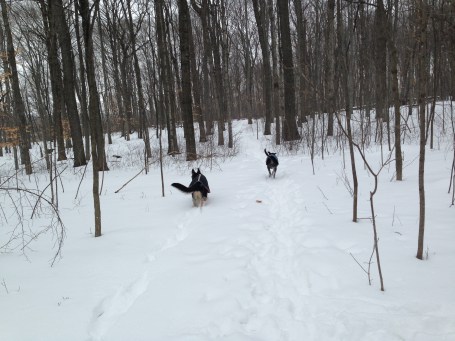
Over the course of the nearly twenty years we have lived here, there is a particular route I often took with the dogs, through the woods, and around an open field. It used to be an uncivilized, practically forgotten place, where we never met anyone except skunks (see preceding posts), raccoons, and the occasional squirrel with a death wish. But, sadly, the woods have been upgraded with wood-chipped paths, new signs with rules that forbid unleashed dogs, and other niceties which are not improvements. There are always people there, now, so we don’t go very often anymore. There aren’t many places where big dogs can just run free without other dogs around.

When we do go, I choose odd times of day and bad weather, hoping to improve the odds that we won’t encounter anyone, and we can flout the rules with wildly happy, romping dogs. There are a few other stalwarts who seem to take the same approach.

One is a runner whom we have met on multiple occasions. He is not a young man. He has a long, grizzled beard, twinkly blue eyes, and a deeply genial and sincere manner. He drives a beat-up old pickup truck, which I have come to know. There is a place in the trail where people coming from opposite directions can suddenly encounter one another without warning, and the first time we met, it was there. The dogs were happily rummaging and trotting ahead of me, when suddenly there was a figure running toward us.

Immediately, I called Moses, the scary one, to my side, and he obeyed. But Pete, who is deaf, and Auggie, the headstrong puppy, would not come. Auggie throws himself at life in general, but also at turkeys, deer, strangers, and me, in particular. I once looked out into the woods and saw Auggie joyously flying first at one line of turkeys–all four feet in the air–and without waiting to see their startled flight into the trees, turning to hurl himself at the other line behind him. There is no malice in it, just pure exuberance, and even after two levels of obedience, it’s a personality trait that I am having the devil of a time training out of him. He has a characteristic German Shepherd stubborn streak that makes him very different from Moses.

At nine months Auggie was already well over ninety pounds, and once launched, he is a projectile who can take a person down. Now–to my horror–in his customary expression of puppy enthusiasm, Auggie ran to the man and joyously flung himself at the his chest, paws first. I was expecting threats and anger, but instead the man laughed gently. “Hello, puppy!” he said, and kept running to the sound of my increasingly urgent commands mixed with profuse apologies. “It’s okay,” said the man as he ran past. “I like dogs.”

Since then we have met several times a month. Never at the same time. I take care now to take a different route so we can’t accidentally encounter anyone. When I see the runner, I call the big dogs and keep them off the path until he passes. He thanks me each time.

On Christmas Eve, on one of our solitary walks, we met him again. There was a little bit of fresh snow on the ground, and the dogs were filled with energy and eager to run. We went off on our different paths, and all was well. We were almost back to the car when I heard myself being called. The runner was coming toward me with his hand extended. “You dropped one of your leashes back there.” I thanked him, surprised that he had come all the way back, out of his way, to do this nice thing.

The logistics would have been tricky, and it would probably have been a little odd, but I would like to have given him a Christmas present.  He’s a fairly random stranger, but I feel as if our encounters are important. Life’s texture comes from these small things.

Christmas Story


We had a baby born to our family early this morning. The first of a new generation on my side.

It is a muddled winter dawn. I lie in bed pondering the miracle of birth and feeling grateful for the health of mother and baby, as two great horned owls sing to one another in the woods.

There is joy in all creation.

Merry Christmas.

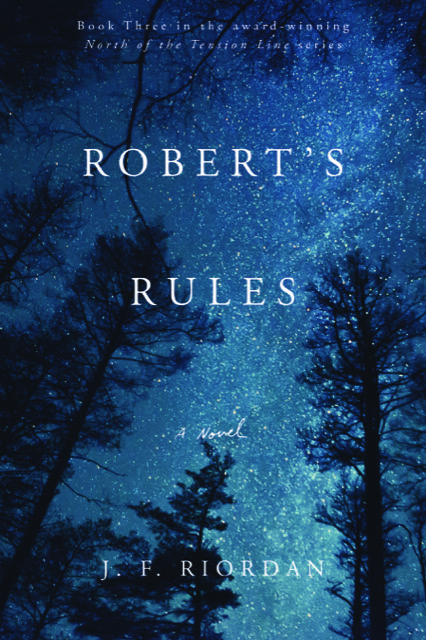
And now a little something from Book Three, Robert’s Rules.

Book Three of the North of the Tension Line Series is now with the publisher, being made beautiful for publication in the Spring.

In response to some enquiries, here is a brief excerpt.

****

After breakfast, Pali, who had the day off, came into the kitchen and kissed his wife on the neck.

“Let’s talk,” he said.

“What about?” she asked, envisioning her mental list of the many things she had to do.

“Let’s just sit down together.”

With an inner sigh, Nika followed him into the next room. She never got as much done when he was home as when he was away. She sat in her favorite chair and looked at him with some impatience.

Pali looked down as he began to talk. “I think it’s time we thought about leaving the Island. I’ve been thinking that it might be a good thing for Ben.”

Her impatience forgotten, she focused all her attention on him as if her life depended on it. She forced herself to sound calm. “But we promised ourselves we’d never do that again. We love it here. It’s our home.”

“Nika, we need to think about this. We need to prepare Ben for his life. He’s growing up, and I can’t say I’m liking the way things are going. He can’t hide away here on the Island forever. There’s no future for him here—“.

Nika started to interrupt, but Pali kept talking “—or if there is, it’s a future he can only choose when he knows what else is out there. Think about his life here. He needs to learn about the world. Ben has no experience with the worst of human character. We can’t just throw him to the winds and expect him to fly.”

“But we did. We left and found our way. We were ok.” Her voice was low.

Pali shook his head. “It’s such a different world now. This culture. The lack of values. The pace. Ben won’t be able to keep up if we don’t help him to acclimate. And isn’t it better for him to encounter these things while we’re there to guide him and protect him?”

Nika was silent. Pali could see the tears welling up.

“We don’t have to decide now. We can think about it.” He got up and went over to her, kneeling next to her chair and taking her hands in his. “It’s our decision, Nika. Ours together. But I’m going to start looking. If something comes along, I won’t say yes if you don’t want me to. Just think about it, ok?”

She sat silent, afraid to speak, her heart and mind in a turmoil. She hated this. When they returned to the Island they had sworn they would never move away again. And now, here he was, threatening to rip her away from everything that mattered.

“Well,” she corrected herself silently, “not everything.”

She felt a flash of her old passion for this man who had been her other self for so long. She had always loved him, from the first day she saw him. He was the best man she had ever known. And, when she looked into her heart, she knew, as much as she fought against admitting it, that he was right.

“Just think about it,” he said again.

She nodded.

****


An Evening with Alexander McCall Smith

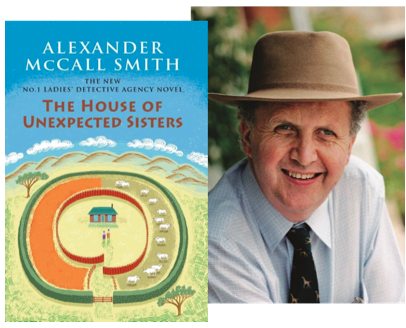
I had the pleasure of introducing Alexander McCall Smith on Thursday night at Boswell Book Company in Milwaukee. He was here to promote  his new book, The House of Unexpected Sisters. You can buy it here.

It can always be a bit dicey meeting someone you admire, because you’re never sure whether he will live up to your expectations. In this case, however, the author was exactly as his books reveal him to be: erudite, kind, funny, and charming. I hung back at the end of the signing in order to present him with one of my books (a presumption I had to work myself up to) and was able to observe his patience and warmth with every single one of the three hundred-some people who waited in line for his autograph.

Screen Shot 2017-11-10 at 7.12.54 AMIt is difficult–if not impossible–to say anything original about a man so well-known, and, indeed, a Commander of the British Empire, but my attempt follows:

We live in troubled times. Although in the West we have lives of comfort and ease beyond the dreams of any other era of humanity, we wake, I believe, most days, with the sense that something has gone deeply wrong.

And then we realize that our Iphones are safe in the next room.

Modern life, in its material richness, is often plagued by anxiety. And when we have read the dire stories in the news, witnessed the crudeness and vulgarity of mainstream culture, and exhausted our capacity for cruelty and vituperation on Twitter, our minds and souls are in desperate need of an escape. If we have any sense at all, we turn to books as our refuge.

Alexander McCall Smith is the master of escapist literature. I use that term with deep admiration. It requires firm principles, deep courage, and a steadfast heart to look around and find joy and things to laugh about. Perhaps it also requires a bit of desperation.

His books, however charming, express both a deeply held moral philosophy and biting social satire. And whether it’s Isabel Dalhousie in her beautiful house in Edinburgh, Mma Ramatswe in Botswana, or seven year old Bertie reluctantly practicing yoga at 44 Scotland Street, his protagonists have a firm determination to do what’s right: to be honest, to express and appreciate beauty, to find meaning, and most particularly, to be kind.

The humor can be subtle or riotous, but the beauty, and warmth, and rich value of everyday people living everyday lives of meaning and virtue is at the core of every book. And today—indeed, in any era—that is a powerful and important thing.

Escapist literature is a banner of hope in a dark world. And, as Mma Ramotswe says: “… it is possible to change the world, if one is determined enough, and if one sees with sufficient clarity just what has to be changed.”

Our guest, tonight, is an extraordinarily prolific novelist and story writer, over the course of many years. He is the author of multiple series—including my favorite, Portuguese Irregular Verbs, which features the hapless Herr Professor Dr Moritz-Maria von Iglefeld—and along with this new addition to his Number One Ladies Detective Agency series, and to the 44 Scotland Street Series, has another new children’s book about to be published in Britain. He is the recipient of many honors, and a Commander of the British Empire.

The truth is, he needs no introduction to any of you, but I really wanted to meet him.

Ladies and Gentlemen: Alexander McCall Smith.


The King is Dead. Long Live the King.

Well, it’s happened. Book Three, Robert’s Rules (Beaufort Books, Spring 2018), is finished, and off to the publisher. I say that in passive voice, as if it miraculously wrote itself. Not so. Over the course of the past year, and most particularly of the past six months, I have neglected friends, family, and dogs, and reduced my life to work, writing, and basic human survival. A trail of entropy lies behind me.

IMG_5146So, you ask: Now what will you do? Revel in the freedom? Drink champagne, or possibly bourbon? Walk the dogs? Go to Disney World?
Well, some of the above, except for the Disney part. But mostly more mundane things like do laundry, overthrow the reigning chaos in my office, and remind my family and friends that I still love them (the dogs, being dogs, still knew that). For both my dear readers, I will also go back to writing my blog.

On the other hand, I have, unintentionally, but apparently irresistibly (again that misleading sense of the passive), begun work on Book Four, A Small Earnest Question.

Life has its cycles.


Why Exile?

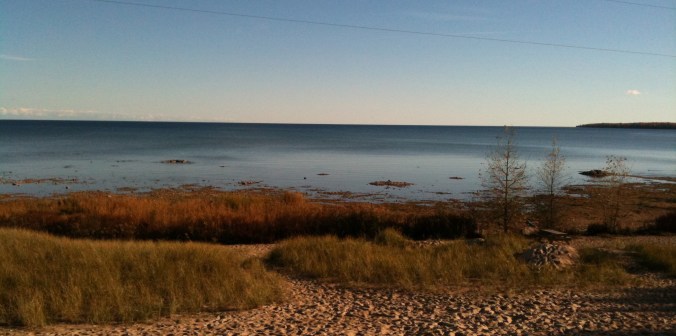
My books are set primarily on Washington Island, located in Lake Michigan about four miles off the tip of Door County Wisconsin. From the first moment I crossed Death’s Door on the ferry, Washington Island took hold of me. I often tell people that I live in exile from the Island, which they tend to assume is a joke. But the truth is that whatever magic the place weaves has utterly ensnared me, and when I am not there I am thinking about being there, imagining being there, and, well, writing about being there.

I suppose I write these books so that I can create for myself a sense of being on the Island, even when I’m not.

Big Mouse

Gratuitous Dog Picture

Ein Mäuchen and me

We’d been having a butter situation. I mean, I am one of those people who scoffs at the avoidance of butter. Avoidance of wheat? Fine. Sugar? Ok. Salty crackers? Reluctantly. Dairy products? Sigh. Ok. Alcohol?  On week nights. And even for long periods of weekends. But butter is essential to the flavor of vegetables, and if I’m going to eat vegetables, or eggs, or…lots of things, there has to be butter. Not a whole stick or anything, but enough. I am willing to eat healthy things. I have my blueberries and kale daily. But we all have our limits to sacrifice.

I make omelets a lot in the morning, and these require butter. They used to require a special, expensive omelet pan, but it’s gone now. Another story. Anyway, I’m the only cook in our household, so I’m fairly acquainted with the butter usage in our house, and I suddenly noticed that we were going through an awful lot of butter. But I’m busy, kind of absent-minded, and not always fully attentive to the tasks at hand, so when the butter ran out, I didn’t think that much about it. I’d just grab another stick, and put it on a fresh butter dish, in its place on an open shelf next to the stove, about five feet up.

This had been going on for some time. But eventually the light dawned on me, even when I’m in the midst of plotting out a book.  I knew I’d opened a fresh stick of butter at dinner, and the next morning there wasn’t any.  Odd, I thought.  I asked my husband: Did you use any butter? He hadn’t, as I had known. I turned to look at my dogs, lying patiently nearby, and they gazed back with the usual proportion of adoration, hope, and pseudo guilelessness.

Pete is nearly 12–we think–and not inclined to much in the way of vigor these days. When inspired, he can still run like the wind, but inspiration is more of a once-a-day thing: during one of our walks in the woods, for example, or to chase off a particularly arrogant turkey. But he doesn’t jump much anymore. We have to lure him with treats to get him to come up on the bed to cuddle.

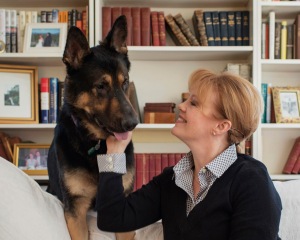
This left Moses, our 125 pound German Shepherd, who has been known to jump horse hurdles in agility classes, and has an intellectual capacity superior to that of a small child. He held my gaze and thumped his tale affectionately. He is a well-trained–and, like both my dogs–a very well-loved animal. He knows the rules. He lies peacefully nearby while we eat. He takes treats gently from fingers. He asks to go out. He comes when he’s called, crashing thunderously through the underbrush when drawn away from chasing a deer, to sit, panting, at my feet. He stays where he’s been told for long periods of time in unfamiliar environments. He is certified to go to schools and hospitals, and it is only my own schedule that keeps him from being certified as a therapy dog. He is my heart and soul.

I’d like to point out, too, that my dogs are well-fed. In addition to ridiculously expensive grain-free organic dog food, they eat fresh chicken or turkey every day; eggs on occasion;  human-grade freeze-dried chicken and turkey hearts as treats; and large, lovely, smoked beef bones from the grocery store butcher shop.

The suspicion in my mind was fully formed. “Listen,” I said to my husband, who needs prompting to do so. “You are my witness. I’m putting out a full stick of butter this morning.” He was skeptical. “That shelf is pretty high up.”

We went our separate ways to work.

He called around lunch time to tell me that the butter was gone.

A little butter isn’t bad for dogs. But too much fat is, causing pancreatitis, which is pretty serious.

The next morning, with some trepidation, I put out a fresh stick of butter. On the counter I put a mouse trap, and covered it with a dish towel, a method I had learned from our dog trainer, but had never tried before. It is not suitable for small dogs, but for big dudes like Moses, it merely startles and stings. Nervously, I tried the trap on my fingers. It hurt.

When we came home, the trap and towel were on the floor. The butter was untouched, and has not been touched since. We caught a very big mouse that day. A very big, very smart mouse.