Love and Grief

IMG_4810

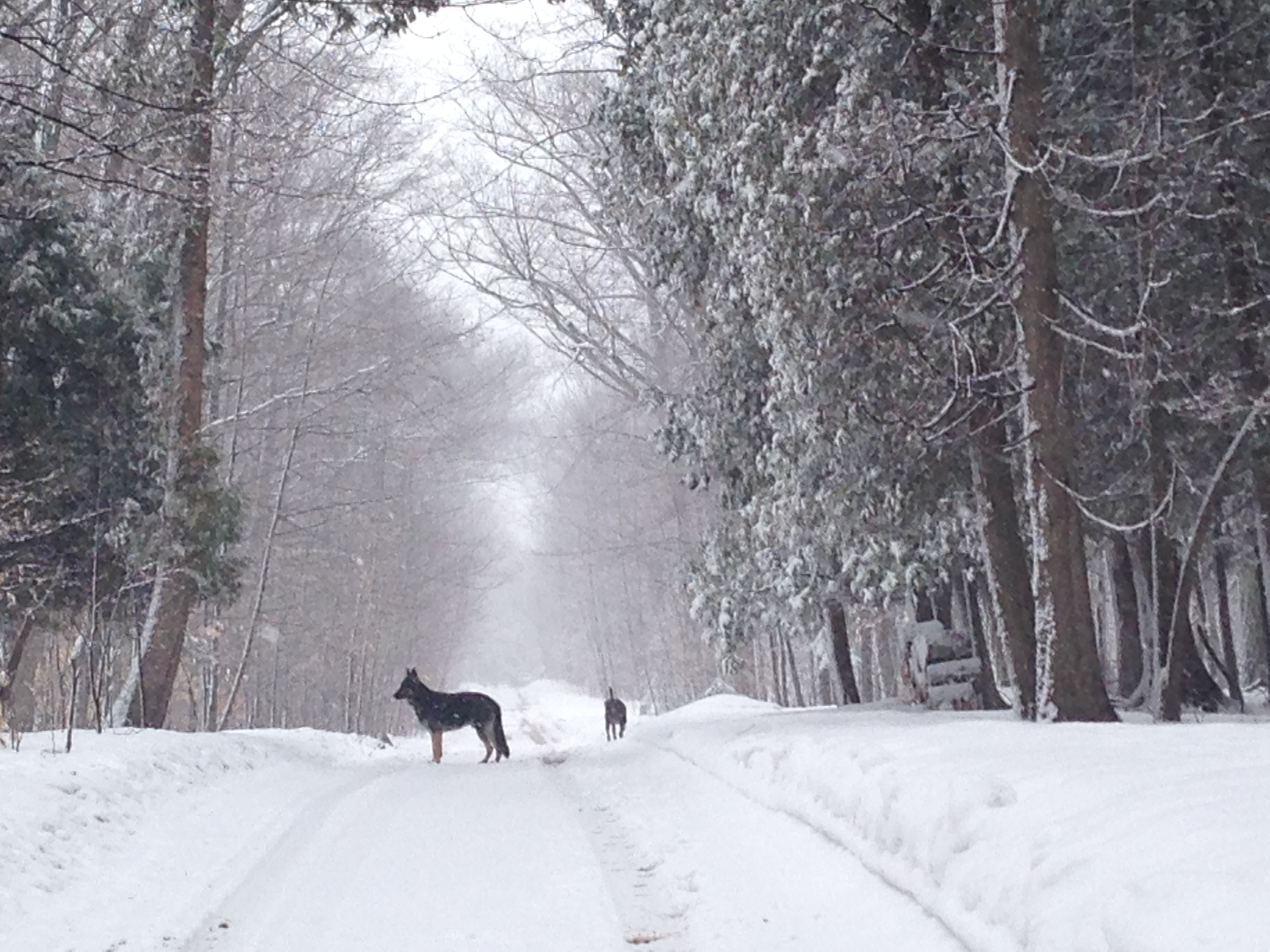
My husband likes to say that Moses is a tuning fork. He is our German Shepherd who loves by pure concentration. His every focus is on those he loves, and he trembles when he senses our stress. The night I left to go to my mother in her last crisis, he fought to be with me where he could not come, even as Charlie lovingly urged him to stay at home.  In his distress, gentle Moses put his teeth on Charlie for trying to stop him from getting in my car. It was a protest, not an attack. But my leaving Moses behind was a betrayal to us both.

As a comfort and a way of drawing out my stillborn sorrow, I have been re-reading Madeline L’Engle’s adolescent novels which are explorations of faith and mortality. They will provoke my grief eventually, if not immediately. My own faith, so relatively new and untested, is approximately the same as the novel series’ teenager as she encounters death for the first time: in a friend’s father, in a friend’s illness,  then in her grandfather. At the same time in the story, a dolphin’s baby dies, and the teenage protagonist writes a poem. Maybe it isn’t great poetry, but I like it because it expresses the value of life and love regardless of the boundaries of species. In it the angels weep because every life matters even in the span of the universe.

I am in a place where I am gathering all the love I can find. And the love of Moses, who sleeps now at my feet, is a treasure as deep as any I can claim.

The devotion of dogs is not new. Homer acknowledges the love of Argos, the dog of Odysseus, who, waiting twenty years for the return of his master, is neglected, flea-ridden, and sleeping on a pile of dung. And yet, when Argos at last sees his master–even though no human creature recognizes him–Argos wags his tail in greeting to the one he has always loved, and dies. Odysseus, who has endured the battle of Troy, Sirens, Circe, the Cyclops, Scylla and Charybdis, the deaths of all his companions, and the wrath of Poseidon, nevertheless weeps for the love of his old dog.

Moses is a dog. And his deep love for me is as real and palpable as any other love I know. He grieves when I grieve, and he is filled with joy when I am. What is love, if not this? And what greater comfort in grief than this deep devotion?

His soul reaches out to me and, gratefully, I answer.


An Editing Cautionary Tale

We are in the final edits–the galleys–of North of the Tension Line (Beaufort Books, September 2014; Available now for pre-sale on Amazon and Barnes and Noble. Sorry. Had to be done. ) just at the very moment that things are intense at work. Although a professional proofreader and my editor have been through the book, as the author, I, too, need to review it, and time is pretty crunched. My good friend, Mary Beth, aka “Impromptu Librarian”, offered to be an extra set of eyes, and I gratefully accepted. In less than a day she had read the book for probably the third time,  and returned the proofed documents for me to pass on to my editor. But the next morning she called and we had an odd conversation.

Mary Beth: “What is hapcedarss?”

Me: “I’m sorry?”

Mary Beth: “Hapcedarss.”

Me: “I hate your bluetooth system.”

Mary Beth: “It’s in your book. Hapcedarss.”

Me: “Hapcedarss? It’s in my book? Are you sure?”

Mary Beth: “I’m sure. The proof reader has many notes about it.”

Me: “In my book?”

Mary Beth: “She had been commenting on it several times, and then pointed out that she had googled the word and checked with OED, but cannot find any such word.”

Me: “That’s hardly surprising. I don’t think there is any such word.”

Mary Beth: “Well, it’s in your book.”

Me: “Hapcedarss is in my book.”

Mary Beth: “Right.”

Me: “Hmmm. Very odd.”

It was a busy day of meetings and preparations for meetings at work, so it wasn’t until quite late that, now having forgotten about hapcedarss, I was able to finally sit down with my manuscript to begin my own proofreading. Not far into the manuscript light finally dawned.

I sold my book much more quickly than I had expected, so submitting my manuscript for fact-checking had therefore also had a much tighter timeline than I had expected. Among the more essential things was sending the book to my friend, Captain Bill, the ferry captain, to make sure that I hadn’t committed any egregious ferrying errors. He called me, and in one of the more delightful moments of this whole process, left a message telling me that he had read the book, and that he had liked it. I still have his voice mail on my phone and listen to it when I’m feeling blue. Anyway, when I called him back, I anxiously enquired whether I had made any mistakes about the ferry, or said anything stupid about the lake or its navigation. He assured me that it was all fine, but he had one correction. The trees at School House Beach, he pointed out, were not pines, as I had written. They were cedars.

Armed with this information, I sat down with my manuscript and created a “find and replace”. Wherever P-I-N-E appeared, it should be replaced with C-E-D-A-R. For some reason, I have rarely used find and replace, even though I have been using Word at home and at work for a pretty long time. What I hadn’t realized was that find and replace doesn’t just find and replace words. It finds and replaces the interiors of words.

It was late in the day, but I called my editor in New York. “I’m so glad you called to tell me this,” she said. “I had a terrible day, and this makes it so much better.”

Apparently, there is a great deal of happiness–or at least the talk of it–in my book. And it’s likely that hapcedarss will forever be a part of Mary Beth’s and my, and my editor’s vocabularies.

Our cups overflow with hapcedarss.


Talking Points for My Publicist

My publicist has been discussing talking points for North of the Tension Line. In working through my suggestions, I left my notebook on the kitchen table while I cooked dinner, and my husband got his hands on it. In retrospect, I should have foreseen this.

What follows are his ideas for talking points for North of the Tension Line.

1) There is a talking goat.

2) There is a protagonist who is suspected of writing pornography, perhaps involving the goat.

3) Outrageous things happen after a spontaneous dare.

4) There is a male character who quotes Noel Coward but is, oddly enough, apparently not gay.

They are actually all true.

But he’s still a goof ball.


North of the Tension Line Debuts at Book Expo of America in New York

This past weekend, at the invitation of my publisher,  I traveled to New York to sign advanced reading copies (formerly known as galleys) of North of the Tension Line. I couldn’t imagine that anyone would want an unknown author to sign an unknown book, but I was wrong. Maybe it was the lure of the free book, maybe it was the beautiful cover designed by Oliver Munday, or the lovely interior design by Jane Perini, or maybe it was the charismatic salesmanship of the delightful intern Kate Prince. But whatever the reason, people lined up for an autograph, and before I knew it we had run out of books.

It isn’t every day that you hold your first book in your hands. I am so grateful to my friends at Beaufort Books and Midpoint Trade–Eric, Megan, Felicia, Michael, and everyone–for two of the happiest days of my life.

And now, a brief word to my friends and readers: Pre-ordering is really important. Please go to Amazon or Barnes and Noble, or your favorite local bookseller and place an order for North of the Tension Line. If you write to me here, I’ll be happy to sign it for you.

A Question About Jane Austen

I recently received this question from someone on Goodreads:

Good evening. I am Ken from New York. I have no preference in reading any book as long as they are entertaining. The last couple of books I read were graphic novels. Some light and easy reading. I’m ready to jump into the classics again. I’m not sure which classic to read next as I passed by Barnes and Noble while on the way to the office earlier. It was interesting to note there were several Barnes and Noble customers by the classics section and were reading mostly Jane Austen books. I am not familiar with her work, and decided to ask here at Good Reads before buying the book and reading it. I wanted to try out Pride and Prejudice.

I see that you rated this book book recently this year. I hope you don’t mind me asking you two questions about the book and its author.

1] What do you as a reader get, from reading a classic novel like Pride and Prejudice?

2] May I ask your opinion on the story of this book, and what about Jane Austen’s storytelling and writing appealed to you as a reader?

Thank you very much for taking the time to read my message to you. Your time is very much appreciated. Have a good week, and happy reading on your side.

Best Regards,
Ken

I responded:

Hi Kenny:

I have never read Pride and Prejudice because it is a classic. I read it–and re-read it–because it is beautifully written, funny, and engrossing. In my view, that’s the only reason to read anything, unless you are going to school.

Jane Austen’s books are beloved because they capture the foolishness and comedy of society with great characters and wonderful stories. And just in case you think it’s just for women, my very manly (and very smart) husband loves Jane Austen, too.

Jane Austen’s books are among those I return to again and again as an escape, but they always sharpen my insight into human behavior. When I come to the end, I always feel as if I’m returning to the world from a dream.

My advice is to try it and see. And if you don’t like it, put it down and try something else. There are too many great books in the world to waste time on something you don’t enjoy.

One caveat, however: If you don’t like it, try it again a few years from now. You owe it to yourself. I once heard a teacher say to a frustrated student “If you don’t like Shakespeare, the flaw is in yourself.” I think she was probably right. But that doesn’t mean you have to like it now. I have certain writers I have grown into, and I am so happy that I went back and tried them again.

Incidentally, I have just written a book called “North of the Tension Line”. I hope you will try it and see if you enjoy it.

All best of luck,

J.F. Riordan

Lessons in the Modern Age

Screen Shot 2014-03-02 at 3.02.09 PM

I know. I’m supposed to have a Facebook page to market my book. But I have spent Facebook’s entire existence avoiding it. It seemed too intrusive; too much trouble; too…unrestful. But this morning, succumbing to earnest advice, I launched my page.

The first thing I did was omit to capitalize the initials in my name. I had managed somehow to type  J. f. Riordan.  So I went to edit it. You can’t. I couldn’t believe this, thinking it must be some personal failing on my part. But it wasn’t. You actually can’t. If you try, they want you to submit a copy of your driver’s license. I am not doing that. So I tried to ask Facebook for help. This was my first exposure to Facebook customer service. There is none.

Then, I thought, maybe I can put my author’s bio at the top of the page. I can’t. You can’t. No one can. You have to have the things they want on the top of the page. Like your favorite tv shows, and movies you watched recently. I went to the “about” section and removed things like favorite tv shows and movies I watched recently. But the tv shows were still there. TV shows have nothing to do with why I have a Facebook page. But it doesn’t matter.

Then I realized from my sister that my birthdate–which wasn’t my real birthdate–had been posted, even though I didn’t want to post my birthdate. “Oh yeah?” she wrote. “You were born only a few months before we were married? Hahahaha!” I don’t want to post my birthdate. Did I mention that? So I “hid” it. But when I look at the page it still shows in my timeline. I tried changing my birthdate. A Facebook message popped up: “You can only change your birthdate a limited number of times.” How many? I wondered. How often do people want to change their birthdates? And why can’t I change it whenever I want? Why would they care? What’s one woman’s vanity to them? (Answer: they are collecting data on you and want to tell their advertisers that they know everything about you.)

Facebook asked to access my e-mail contacts. Reluctantly, and against my better judgment, I allowed this. Should I send to business associates? I suppose. It’s marketing, right? To the vet’s office? Maybe. I write about dogs. The Dentist? Well, why not? They want me to like them on Facebook. A billion e-mails went out to people who will probably be wondering who this J.F. Riordan is who is sending random invitations to perfect strangers. 

By this time, my 1 friend–a relative–had increased to 7. I had friends! But the reason I had built the page was no longer visible on the time line–namely, my book. My husband informed me that (oh, fond hope) once you have 5,000 followers you can’t have a regular page. “You shouldn’t have a regular page,” he said. “You should have a book page. You’re an entity, not a person.”

This sounded about right. I was feeling rather like an entity. So I went back to Facebook to create a business page. It wanted to link to my other page, to J. f. Riordan. I really didn’t want my book going out with an error in my name. But nothing I did, from private browsing, to creating a new e-mail account with a different name enabled me to escape from the original page. I deleted the account and tried all this again. I got an e-mail saying they would delete my page forever in 14 days. Was I sure I wanted to delete this account.  I was sure. Very, very sure.

So I have spent my entire morning in my pajamas fruitlessly messing around with social media on the computer. I have become that person. My day is half gone, I am frustrated, the dogs are restless and unhappy, and I haven’t gotten one actual piece of writing done on my one actual day of writing. 

And billions of e-mails have gone out to invite friends, associates, veterinarians, dentists, and miscellaneous others to a nonexistent Facebook page. 

Facebook, I hate you.