I am preoccupied with novel writing, so my thoughts are uncollected this morning.
My friend, Julie, she of Christmas tree adventure fame, called me this morning to cancel our belated joint birthday celebration for tonight. She hasn’t been feeling well, but she always cheers me. Her young grandson has signed up for school band and decided to take up the trumpet. When asked why he chose that particular instrument he explained that it was because it only had three buttons.
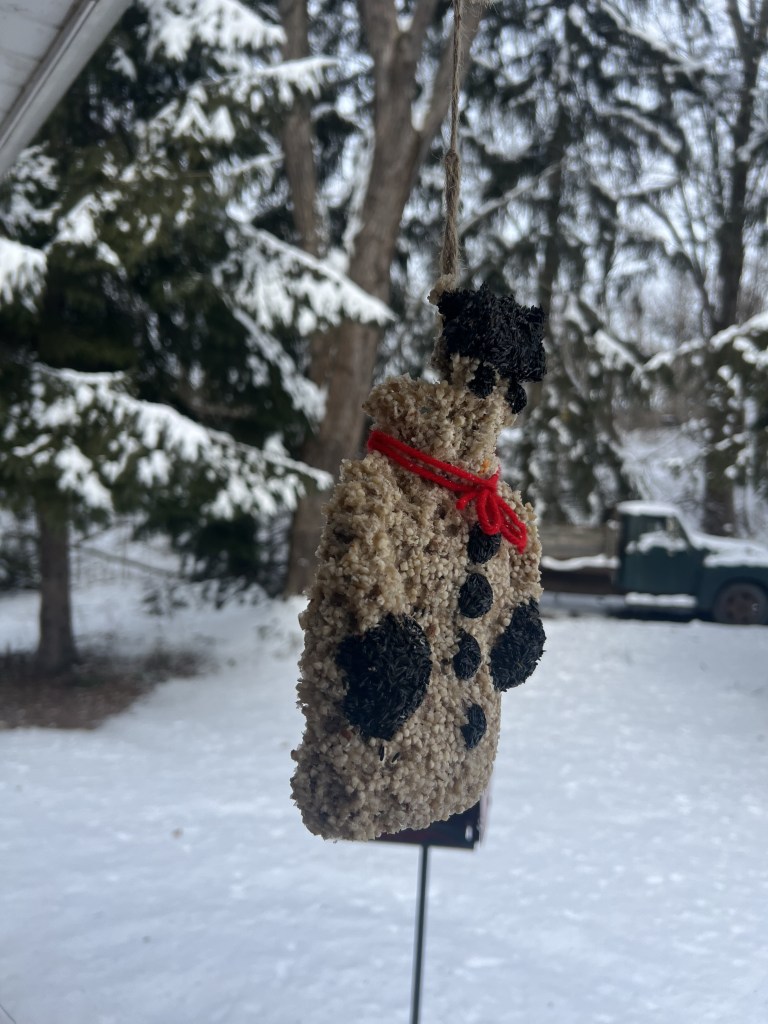
She also sent me this gallows edition of the cheerful birdseed snowman her daughter had given her. It’s become so morbid she’s decided it will have to be cut down, no matter how delicious the birds find it.
I don’t generally feed birds with or without moribund snowmen, mostly because the turkeys kept sitting on the birdfeeders and breaking them. But the deer have been visiting regularly in hope of finding the seeds I put out during last month’s extreme cold. I feel a bit guilty, but I try to hold firm on my only in extreme conditions policy. My late father always said deer were “vectors for disease”, which is completely true, but they are so innocently beautiful, it’s difficult to remember. Auggie and Eli help keep me in mind of ticks, however. Two dogs of my acquaintance have been diagnosed with Lyme disease recently, and we don’t need that.
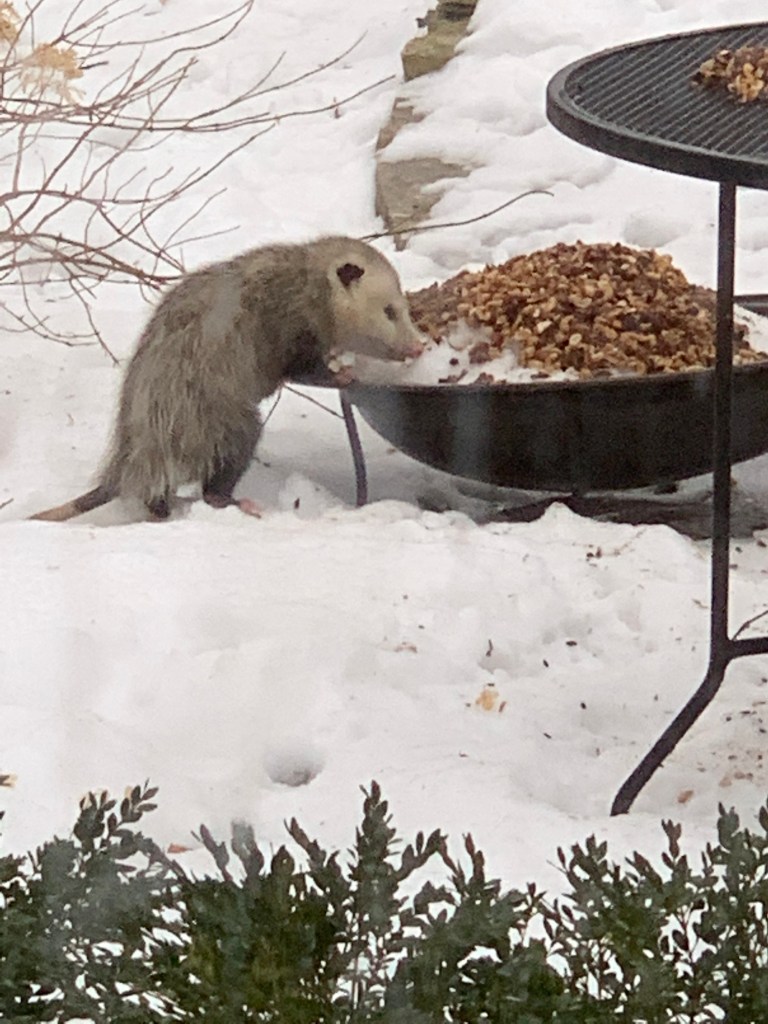
Turkeys—despite their unconstructive birdfeeder habits—do make themselves useful in their consumption of ticks. I also encourage possums—but only morally, as I am unaware of any particular method of enticing them, aside from seeds, which seem likely to deter tick consumption. Are there possum houses?
I am pro-possum. This guy likes to stand on his hind legs and look in the bedroom windows. He is unfazed by German Shepherd Frenzy.
The weekend approaches, and with our Friday night newly free, I suppose we will fall upon the tried and true drinks by the fire and dogs on the feet. If we feel ambitious and the wind doesn’t come up, we will venture outside with our cognac snifters and have a bonfire.
The dogs will love that.
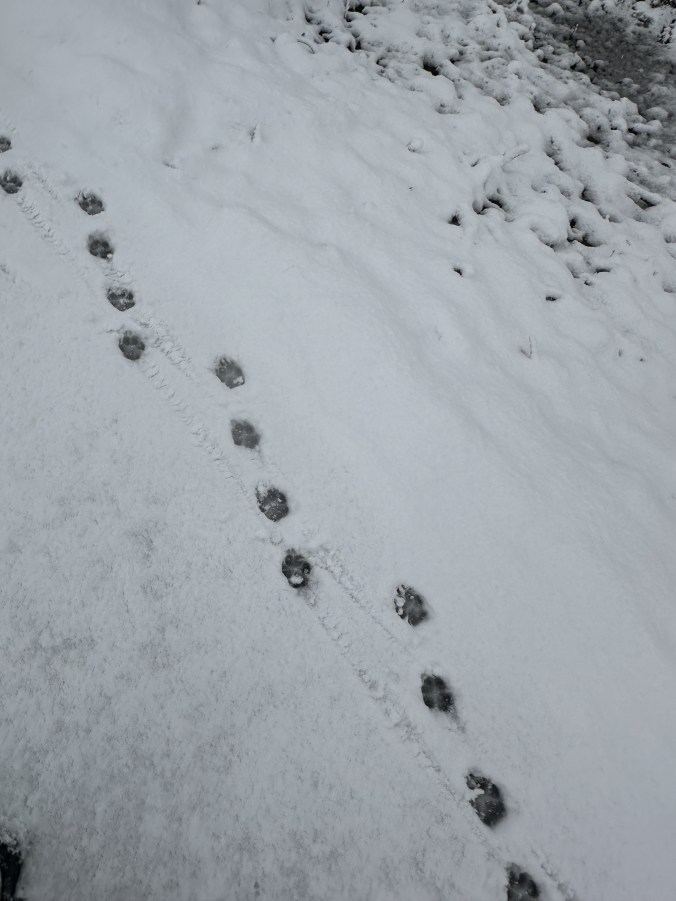
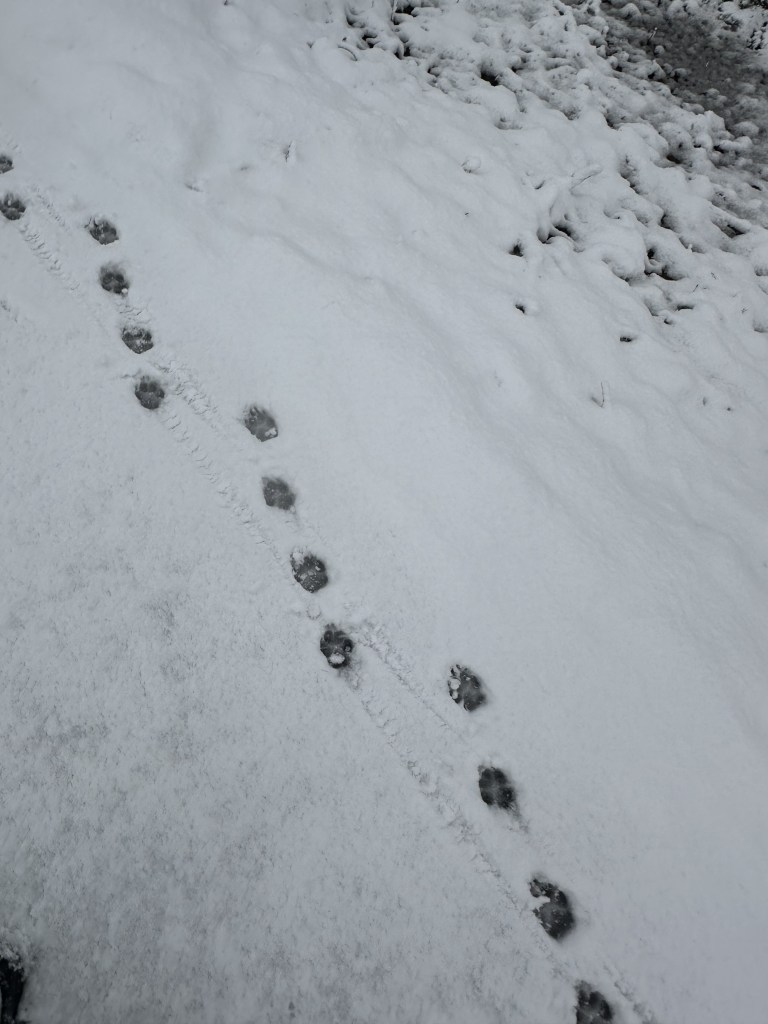
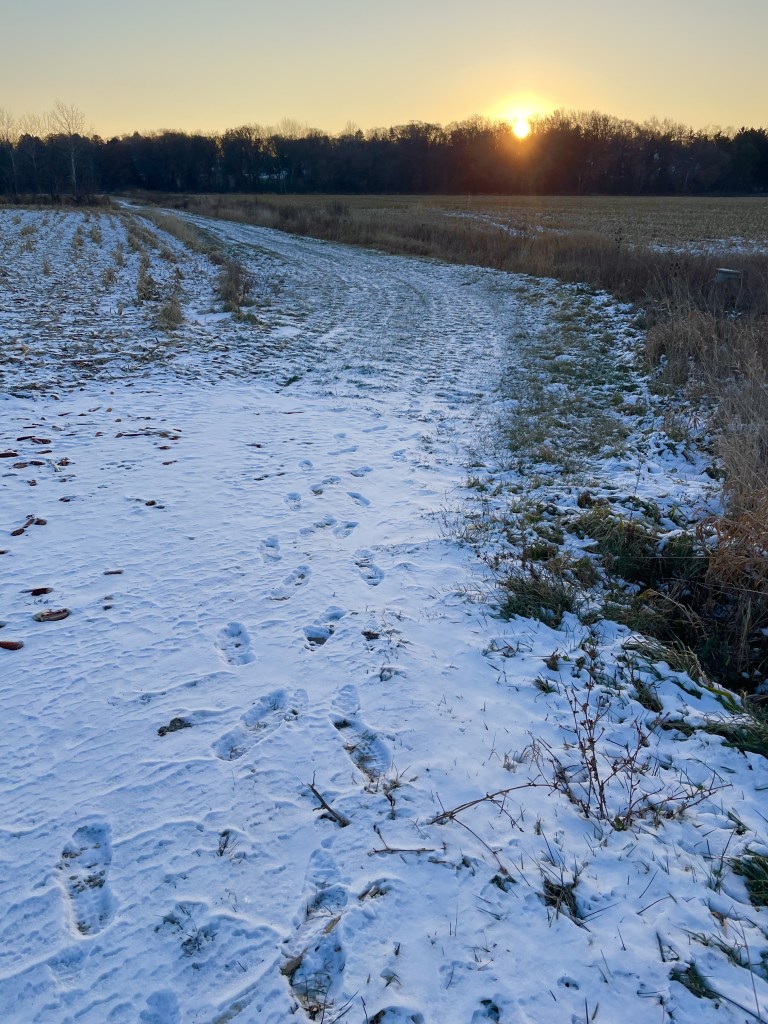
I leave you with some gratuitous dog footprints: the peculiar paw pattern of a standard dachshund. No, not Frank, but Oscar, the wire-haired dachshund. My family are dachshund people on all sides.
My sister’s wire-haired dachshund, Oscar.My niece’s standard dachshund, Frank, on a recent rainy day. He is unchanged by success.
But increasingly, after centuries of human conceit about our moral superiority, science is being forced to acknowledge that animals do demonstrate care for their communities, sometimes even for other species. Today’s New York Times story about a male elephant seal rescuing a drowning pup is another example of an animal’s taking action that was not necessarily in its own interest.
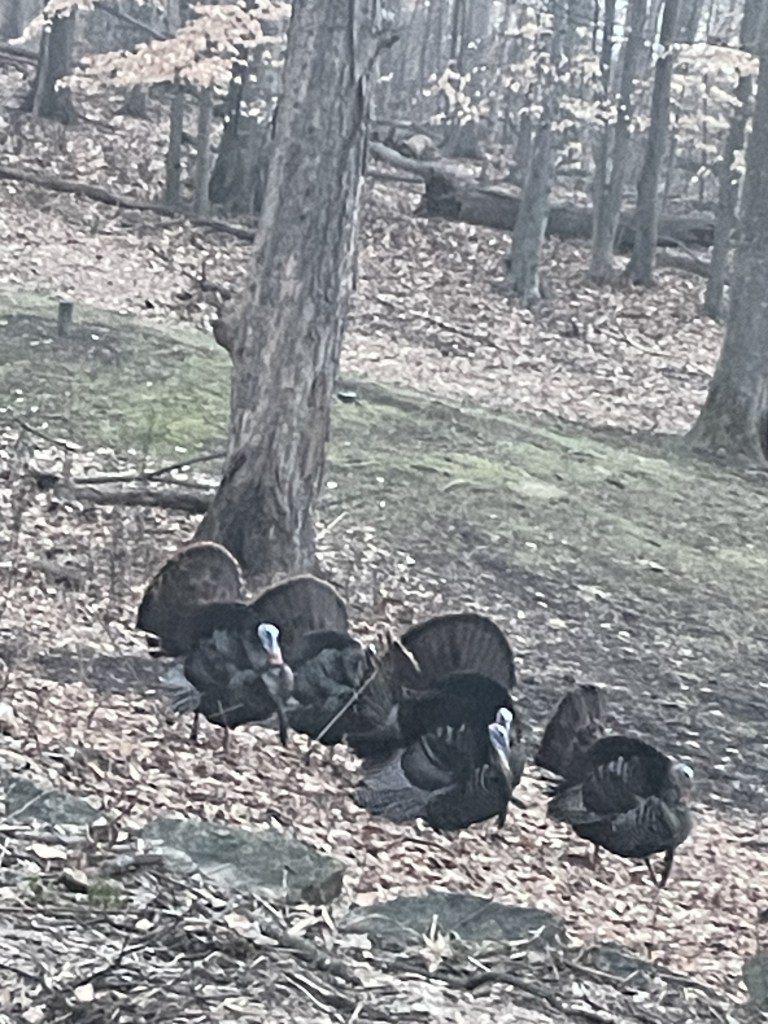
This past fall I saw another incident of turkey community action. The turkeys were on their daily march back to our woods to roost. The big toms were in front, and there were several groups of hens, surrounded by eleven scrambling poults—I counted—following about forty feet behind. Herding cats has nothing on herding turkey poults.
Our ravine is a water conservancy, which means there are some fairly deep holes that are usually dry, but fill with leaves in autumn. They seem like solid ground, but you can sink pretty deeply (and turn your ankle) if you accidentally step in the wrong place.
As I watched—seeing the babies is rare— the poults, one by one, managed to just barely avoid the biggest hole, scattering around it. Holding my breath, I could see what was about to happen: one took the wrong line, and promptly disappeared deep into the leaves. Its frantic peeping was terrible to hear.
Instantly the line stopped, and the toms turned and raced back to the sound of the crying poult. Soon the whole flock was surrounding the area—not in an orderly way at all—but homing in on the baby. I turned my head at exactly the wrong moment—dogs, you know—but suddenly the peeping stopped, and when I looked back, the adults were reassembling into the line, and I counted: one, two, three…all eleven poults were there. Counting turkeys can be tricky, so I counted three times. Everyone moved back into line, and on to the assembly grounds to carry on with their evening routine.
I still don’t know how they got the poult out of the hole.
It’s completely normal for parents to risk all for their offspring, and in this case, the poult was likely genetically linked to the adults who sped to its rescue. But to see the entire flock work together like that was another lesson to me. We humans have to learn a thing or two, and meanwhile, maybe we should stop being so smug about ourselves.
The toms think they’re pretty important. They’re not wrong.
We live in the woods, and partly because our property is contiguous with other large wooded areas, we have diverse wildlife. It is endlessly fascinating. I spend more time looking out at the activities beyond our windows than I do watching television.
But I’ve never really paid much attention to squirrels. We have approximately eleven million gray squirrels, and a rapidly increasing population of red squirrels, whose aggressive habits chase other mammals from the territory, and cause destruction to human property. You can hear them scold if you dare to walk beneath any of their trees. They are smaller than gray squirrels, but they box above their weight. All together, squirrels are the most common animals on our property, and I take them for granted. They are not mysterious and fascinating like raccoons or possums; or innocently beautiful, like deer; or showy and cantankerous like turkeys. They’re just squirrels. Always there. Always busy. Almost always solitary except during mating season. Not particularly interesting.
And yet, I recently learned that squirrel intelligence is superior to that of dogs, and this has given me a lot to think about. It certainly explains how in the dog vs. squirrel chase category, squirrels are definitely winning.
Anyway, this is not meant to be a treatise about squirrel species. It is the observation of—if not friendship—camaraderie—and, perhaps, of something more important.
I first saw a pair of gray squirrels running together in the summer months. At the time—and without paying close attention—I marveled over How. Many. Squirrels we had this year. It was like a squirrel invasion. (A circumstance due, probably, to the sudden diminution of the coyote population.) Every morning, they were running together, one after the other: racing across the lawn, spiraling up trees, and looking, to my wandering and inattentive gaze, as if they were either rivals or a mating pair. I didn’t think about them, or pay particular attention. But they were always there.
Only recently did it suddenly occur to me that they were still always there, and it wasn’t just a pair. It was a group of four. And it had always been—I realized—a group of four. There were lots of other squirrels around, but here was this…clan…running together in the clearing down the hill, foraging together, and racing across the grass to a particular tree, where they would run up the trunk and disappear.
Their relationship is as constant as that of the turkeys, and as I look back I realize how much their antics have been a fixture of my mornings, if only in the background of my awareness. The other squirrels nearby did not interact with them, unless it was to run off a competitor. But I think it was the other squirrels who must have been run off most often in the face of this four-squirrel brigade.
I can only guess that they are siblings, but who knows. They seem to have broken the usual squirrel pattern of solitary nut-gathering, but maybe these behaviors have been happening all along and I wasn’t paying attention. Or maybe it is an adaptation, a move to provide a common defense against the aggression of the red squirrels. Not being an authority on squirrels means I have the fun of speculation. Do they feel affection for one another? Do they feel a blood connection? Or is this merely a business/military relationship?
I have one clue—based on pure observation without anthropomorphizing. Last year, I passed a newly-dead squirrel by the side of the road, and beside it, I could see a living squirrel, frantically patting the dead body as if attempting to revive it. I wanted to stop, but there was nothing to be done. Was I going to comfort the living squirrel? Help it bury its dead? I watched for a second or two in the rearview mirror and went on in a somber mood.
It is pouring rain in the precursor to a winter storm, and the rain is just now—finally—changing to heavy, wet flakes. As I sit in my cozy library, fire crackling, coffee nearby, I see the four friends, utterly indifferent to the weather, running together up the tree, down the tree, to another tree, and jumping from branch to branch, tree to tree overhead. They don’t seem to be working, but playing. Maybe to keep warm, or maybe because the hard work of food gathering is seasonal. Or maybe because it’s good squirrel fun. I’d certainly do it if I could. Although maybe not in this weather.
I wish them safety in the coming storm.
***
Gratuitous Dog Photo
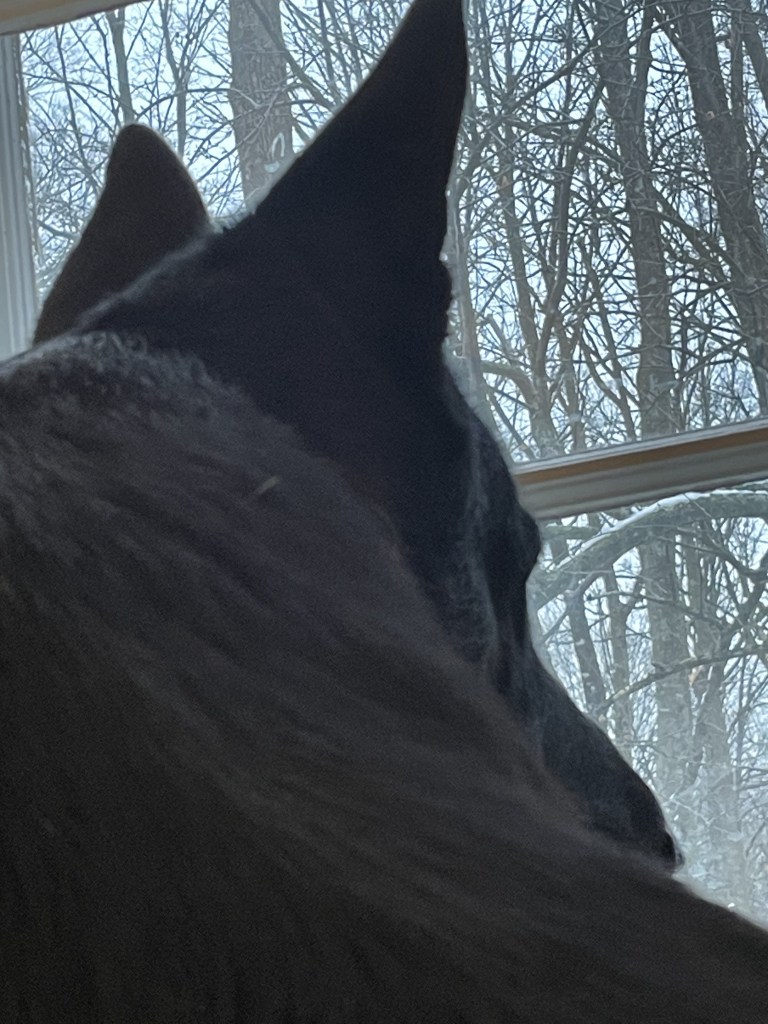
Eli doesn’t want to be out in the damp, but he watches Dad and Auggie closely from my office window.
We live in the country. So, when the temperatures dipped into the teens this week, of course, that brought an influx of mice.
Mice are a houseowner’s horror. They are destructive, filthy, and carry disease. But—and I know how this sounds—I cannot bring myself to kill them. I see their big black eyes, and their tiny feet, and they are so frightened and vulnerable. They are like very tiny puppies.
By the way, did you know that mice sing to one another?
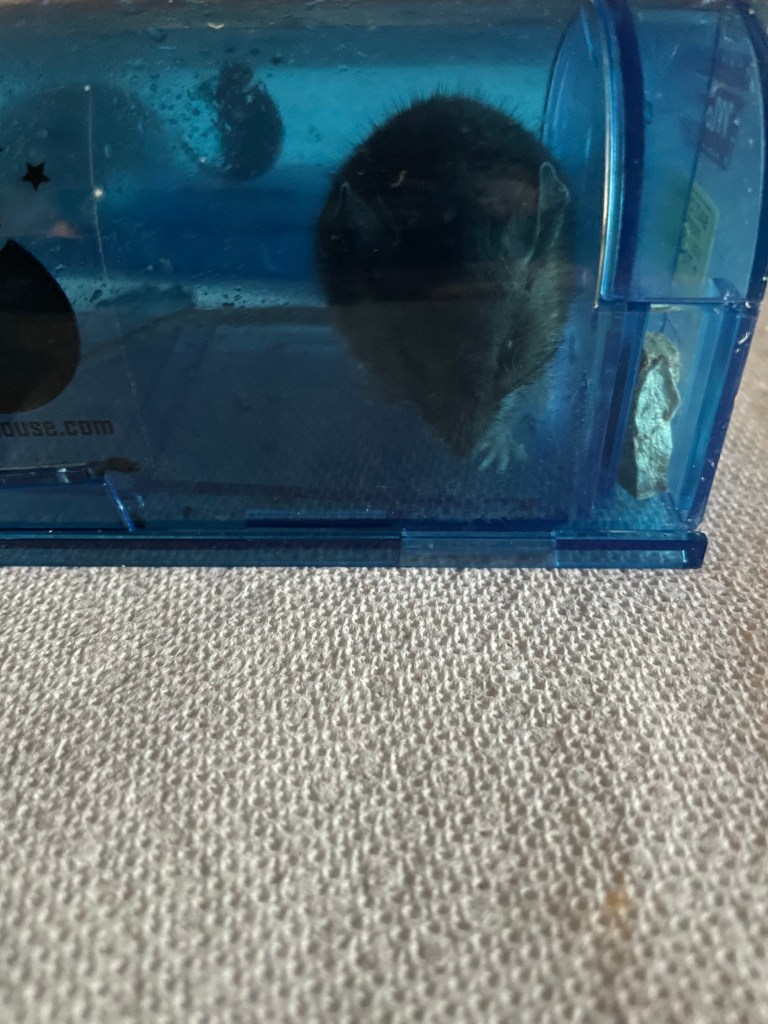
So I buy humane traps, bait them with the dogs’ freeze-dried liver treats, and early each morning load my catch into the car and drive out to a cornfield a little more than three miles away. It must be three miles, because, apparently, mice can find their way back over any smaller distance.
Yesterday I caught three. My 13 year old grandson willingly accompanies me because we stop for a doughnut afterward, and he then gets a ride to school. It’s a bit of an adventure.
Last night I set three regular traps, and something new: a bucket trap, with a little ramp and a trap door. I filled the bucket with dried leaves for a soft landing, and smeared the top with peanut butter with dog treats stuck into it. Although I can’t be sure whether anyone is in there this morning, there is a hole in the center of the leaves which suggests there might be. I’ll know when we get to the cornfield. When I dump out the bucket I will be sorry to lose the cache I’ve saved of dry leaves for soft mouse landings, but it can’t be helped.
I don’t know whether the farmer has noticed a car stopping by his field in the early mornings, but it’s a nice field, with corn stubble and lots of kernels scattered in a mouse-friendly way. I have some minor concerns about whether the mice are too cold, but I am doing my part. They are on their own now.
No, I’m not actually back on the Island. But I do feel that I am back from the brink of grief. We have had a rough month with our six year old German Shepherd, Auggie.
Without getting too gruesome with the medical details, there were times when I left the veterinary hospital sobbing, thinking we would have to let him go. He was in and out of the hospital for the better part of three weeks. Even after his second surgery to remove two enormous cysts, we did not know if he would ever recover. Then he got pneumonia.
We couldn’t explain to him why he was in pain, or why we left him with strangers. The veterinarians didn’t want us to visit because it upset him for hours afterward. It upset us, too.
But…Auggie is nothing if not obstinate…and so are we. We promised each other to do whatever we could to save his life, and we were blessed with a dedicated and relentless team of veterinarians, who studied, and researched, and watched, and consulted, and kissed him, and fed him braunschweiger. He has a neurologist, but not until a week after his surgery could we begin to hope that he did not have a vanishingly rare neurological condition which is, essentially, untreatable, and would have meant he could not go on.
Auggie goes back to the surgeon on Wednesday to get his staples out–he has an incision that must be 20 inches long. He is healing–so far as I can tell–beautifully. I know because we cannot keep him quiet.
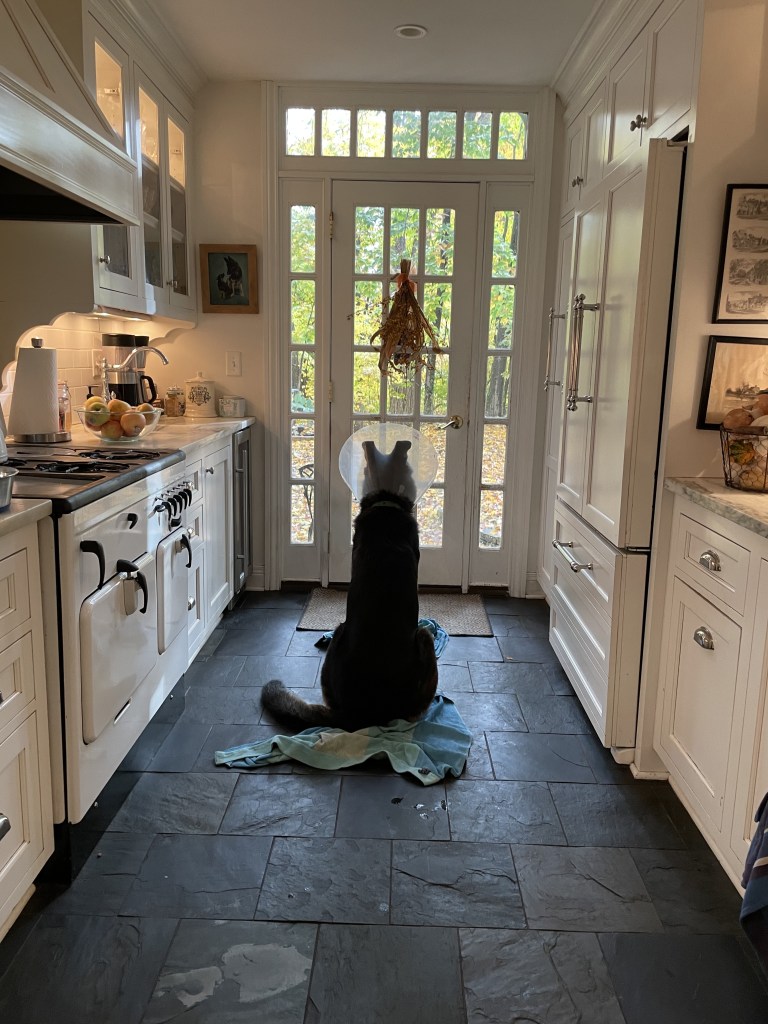
He has blasted through two hard plastic cones (the soft ones were too easy for him to get around) and the one he’s wearing now is patched together with duct tape. He has figured out how to use it as a battering ram to open doors and push past his brother, and also how to position it so he can pick up his beloved green ball. He is not permitted to run with green ball, but carrying it comforts him. I have piles of boxes and baskets on the chest on the foot of our bed so he can’t jump up, but he wants desperately to be cuddled. We have had to keep him tranquilized to prevent him from ripping out his stitches, which are both internal and external. In the process he has had nine separate prescriptions which need to be given at varying intervals of six, eight, and twelve hours, which has meant lots of middle of the night, early morning, and late night alarms. Also lots of braunschweiger, freeze-dried tenderloin, and Secret Cheese.
I haven’t gotten much writing done.
But along the way I have learned once again how much it matters to count your blessings. And since I am inexplicably locked out of Twitter, I will be putting my energy into more blog posts, and more serious writing. Please pass the word for me on twitter with @audacityofgoats so people know to look for me here.
This piece will appear in my new book of Essays And Still They Sing coming soon from Beaufort Books.
There comes a moment in grief when you begin to feel that you are being judged for it. People tell you that life goes on; that you need to stop looking back. I know that, because although I would never say it to anyone, I have often felt impatient with people who get into their problems and lie down in them. I have wanted to tell someone to get over it. In my own life, after various hard blows, including some difficult losses, I have managed to accept, to pick up the pieces of my life, and to move on. But it’s closing in on two years later, and I still have not gotten over Moses.
Life has a way of teaching us our faults.
His full name was Moses, Prince of Egypt. My husband and I argued about the name all the way to Iowa when we went to pick him up for the first time. I was insistent. It had to be Moses. It wasn’t a particularly religious choice. I had just watched too many reruns of The Ten Commandments, and wanted to be able to shake my head sadly at a naughty puppy and say “Oh, Moses, Moses, Moses.”
The name suited him. Despite having been bitten by one as a child, I had wanted a German Shepherd my whole life. I had even made a German Shepherd a character in my novels. Readers who met Moses always assumed that my character Elisabeth’s big dog, Rocco, was based on him. But Rocco was really an expression of longing. He came first. Then came Moses. Sometimes I have the sense that I willed him into being.
And he did, after all, lead us out of the wilderness. Our beloved Golden Retriever had died after a futile battle with lymphoma. Our other dog, Pete, was grieving, and our house felt empty, so we decided to sign up for the twelve to eighteen month waiting list for the perfect German Shepherd. Within twenty minutes we heard back: there had been a cancellation. Did we want a puppy on Saturday? I had the sense that it was meant to be: unplanned, the result of a series of unforeseeable events. And isn’t that what Fate is? The inevitable coming together of paths that seemed intended to diverge? Does it always have to be a human story?
From the beginning, I knew he would break my heart. I loved him too much. I can’t even explain exactly why. All I know is that there was a kind of destiny, an inevitability about him that I always felt. We belonged to each other. He was my soulmate. How to convey how much I loved him? How much I love him still? I know most people won’t think it normal. I can’t help that. It just was. It just is.
When he was only a few months old I sat in our living room, holding him on my lap, hugging him and whispering endearments. He was already too big to really fit, but I had my arms around him like a baby. My husband walked into the room and said casually: “You love that dog too much. You know he’s going to break your heart some day.” To the surprise of us both, I burst into wild sobs.
I was afraid of him at first. I’d never had a German Shepherd before, and I didn’t have confidence in how to handle him. By the time he came along I’d trained four dogs, and felt that I knew what I was doing. But when he chewed a shoe and I slapped the floor with it, scolding to show my displeasure, he avoided that spot in the kitchen for three days. That’s when I realized how delicate his sensibilities were. If I hurt his feelings, I could lose him forever.
But the moment that really frightened me was when, at 9 weeks, I tried to pull him off the bed he had no permission to be on. He growled and snarled at me, and I was struck with fear that I had a dragon in the house I could not control. I called my dog trainer that day, and begged her to let us start early. He earned his first obedience title at six months, and his second not long afterward. It required retrieval and he did not really take to retrieving, but he obliged me because that was what he did.
This is not to say that he was a tamed creature, tied to my will. Quite the contrary. Moses did things because he knew he should, and when I asked him to do something that was wrong for both of us, he would flat out refuse. One night, in the dead of a Wisconsin winter, I had an emergency call about my elderly mother. It was well below zero, and I had to meet the ambulance at the hospital. Moses knew I was upset, and he saw his job as being with me no matter what. But of course, he couldn’t sit outside in the car for hours in sub-zero temperatures. He followed me out to the car, refusing to let me leave without him, and trying to climb onto my lap. My husband gently put his hand on Moses’s collar to pull him away, and Moses turned and very meaningfully put his teeth on my husband’s arm. He did not bite; he nevertheless expressed his feelings very clearly. Moses knew his duty, and he was not easily dissuaded from it. I had to drive away from him, knowing we both felt betrayed by the separation.
I felt so much pride having this magnificent animal walk beside me. Moses loved going to the Fourth of July parade. The parade begins every year with a long line of historic fire engines, followed by the latest and most innovative, as the proud company of volunteer firefighters marches along. Moses would sing with the fire engines, a long, lovely howl that made people turn and smile. He would sit upright and bark at the three gun signal that began the parade, and he would duly accept the admiration of anyone who stopped to see him. When the parade was over, we would walk with the crowds down the street toward the park, and people would reach out their hands to touch him as he walked by, like Aslan in the resurrection.
There was a fierceness about Moses that is not in my other dogs. It lay beneath the surface, but it was right here for anyone to see. People respected Moses. As he deserved.
While we were remodeling our house, a five man insulation team arrived one morning without notice. My husband and I were at work, and only the carpenter, who adored Moses, was there. The insulators opened the door and walked in. According to the carpenter, who laughed while telling the story, Moses chased all five of them “screaming like girls” into the powder room, where they all crowded in, slamming the door behind them.
They called their manager while Moses waited outside the door.
Moses had a passion for butter. When he was young, he would steal whole sticks of it from the plate on a high shelf next to the stove. After we broke that habit, he sang for his butter, his paws dancing as he looked from the butter dish to my face and back, carefully explaining what he wanted.
More than anything else, Moses loved the lake. He was the first of our dogs brought up to swim, and he took to it immediately. But it wasn’t swimming that was his passion; it was splashing. His jumps to catch the water we splashed at him were stupendous. He leapt out of the water like a mythical beast, and his yearning to splash was relentless. If I were lazy and lounging on the dock, he would swim around the edge to me and paddle his paws to splash me, hoping to start a game. If I ignored him, he would urge me with increasingly louder moans of protest and pleading, splashing harder. He was impossible to resist.
There’s a Christina Perry song from a silly vampire movie that I used to sing to Moses. I remember the last time we were at the lake, a few months before he died. The music came on, and I whispered it to him, holding him in my arms, tears rolling down my face.
I’ve loved you for a thousand years.
I’ll love you for a thousand more.
I see now that I knew at some level it would be the last time we splashed together. Somehow, some part of me knew he was dying.
He had been in pain from an injured back, and it was slowing him down. I took him for exams. I asked every medical professional we saw—and there were a few—to reassure me that he would be all right. He’s not going to die, is he? He’ll be okay, won’t he? They all, with varying degrees of patience and curiosity assured me. Why would I even think that? He was only 7 years old. His back hurt. That was all.
But they were wrong. Somehow, in the deep connection Moses and I had with one another, I sensed that something, but it was nothing that showed up on any tests. It was just arthritis pain from a back injury, nothing more, I was told. Of course he didn’t feel well if his back hurt. We did acupuncture, chiropractic, and laser therapy. I took him for swimming therapy. He had varying levels of pain meds.
But he didn’t look right. His eyes were glassy. His fur seemed without luster. And all the while, the tumor was growing unseen, waiting to break his heart, and mine.
What hurts me most is that I wasn’t there. We had slipped away for three precious days to spend Christmas with our new baby granddaughter. While we were away, Moses had an upset tummy, but, like so many German Shepherds, he often did. We used to joke about such a big scary dog having “princess tummy”. We also live in the woods, and the dogs tend to eat things that require periodic doses of antibiotics.
He was sad when we left. He knew what suitcases meant. But we were unconcerned because he would be in his own home with his brothers and someone who cared for him. Over the course of our trip I spoke with the dog sitter multiple times. She was kind and reassuring. He wasn’t sick, but he was moping. He wasn’t eating, but he was drinking a lot of water. I was more worried about reassuring her than I was about Moses. We’d dealt with these tummy troubles before. I called the vet and arranged to pick up some antibiotics on the way home from the airport. We didn’t know he would already be there, cooling on a metal table.
Our dog sitter, never imagining we would go to the vet first, waited at our house, dreading our return. She didn’t want to tell us on the phone.
The one obligation of a soulmate is to be present when you die. But I wasn’t there. Instead, while we were in the air, Moses lay down next to our dog sitter, put his paw on her arm, looked into her eyes, and let out a long sigh. Then he died.
I know it sounds overly-dramatic, but I will never forgive myself. People have tried to tell me that he knew he shouldn’t die in front of me. I don’t buy it. He felt abandoned. He didn’t know where I was. I let him down. I, who sang love songs to him, who loved and trusted him, for whom he would have laid down his life, wasn’t there when he needed me most, and he died not knowing whether I would ever come back.
Looking back on that last year, I almost did the best I could. I didn’t miss his cues. The mistake I made was believing everyone—good people who didn’t know him as I did— who told me he was okay. I should have trusted my own heart. He was telling me, and I didn’t take his word for it.
Grief is one thing that never dies. I will be haunted by his loss forever. My only hope is that those insipid rainbow bridge poems are true, and that someday he will run to me, and I will be able to kneel down, gather him into my arms, and whisper my love into those big fierce ears.
Yesterday was a spring day of transient weather, but during an episode of sunshine (and between chastising Eli for chasing the neighbor’s dog) I took photos of the wild flowers blooming: blood root, violets, bluebells, and trout lilies. Later before bed, I opened up the photos from one year ago, to see if there were any fun reminiscences of 14 month old Eli’s puppy antics, and there were photos of the same flowers, exactly on time, blooming one year ago. When we had a snow storm a week or so ago, I opened my photos to find the storms of years past. Same patterns, to the day.
My mornings are usually the same. I wake in the dark, pour myself coffee, and wander into either my office or our cozy library to write. My writing is usually more productive in my office, but my ability to observe the morning rituals of the woods is better in the library, and this is where I usually end up. As the dogs settle into their customary places, I drink coffee and write. I like seeing how the tilt of the earth changes the location of the sunrise behind the trees, and I gauge the time of year by its place along the long horizon visible from the ridge where our house sits. With the leaves not yet out, the sparkle of the lake down the hill forces me to move my chair so I can see, but in a week or so, the lake will have disappeared behind the foliage.
I can see the turkeys flying down from their roosts, the deer browsing, the plump raccoons waddling up their trees to bed. On a sullen morning like this, there is no burst of sunlight, only a gradual undarkening. On sunny days, the mists rise from the valley in a haze of purple. For the dogs, the scenes of life outside the windows are riveting, too. I like watching the rhythms of life, the interplay of the different creatures who wander in and out of one another’s paths, and the sameness of it—with only small variations to account for the seasons—is reassuring.
At this time of year, in a ritual I now understand, the turkeys are dividing themselves from the large winter flock into smaller family groups. The males parade up and down before the females in full regalia—spectacularly beautiful and with great pomp—making a mechanical thrumming sound like enormous insects—I think by vibrating a set of feathers that skim the ground like a 19th century train’s cow catcher. The females scurry back and forth, cackling, in some kind of hierarchical battle with one another. In the end, it is unclear to me who choses whom, but there will be five or six adults in each final group, and they will pair off to start families. Every morning there will be fewer and fewer remaining from the main flock, until they have melted into the woods for summer. We won’t see much of them again until fall, when they come together again. Finding a nesting hen is extremely difficult, but they nest on the ground, and stay in place from the moment the eggs are laid until they hatch, with no apparent help from the males—although I suspect they keep watch nearby in military readiness to fend off attackers. Turkeys are fierce.
The deer, who do their pairing in the late fall, are already heavily pregnant and browsing hungrily, as are the raccoons, whose cumbersome travels up and down very tall trees make me hold my breath in suspense. I recall one spring watching the antics of a raccoon family, as five or six babies, chirring excitedly, popped out from the hole in their hollow tree, while their mother frantically clung to the tree with her back legs and used her front paws to stuff them back in like someone trying to close a drawer filled with too many socks. No sooner would she get one in, than two or three more siblings would pop out from another hole further down and swarm the tree trunk. They would fall with quite terrifying thumps to the ground, and call wildly for their mother. Then, while she made a laborious trip down to take them by the scruff of the neck to carry back up, more would fall like hail from the den above, while the sound of their frightened and excited calls came from above and below. She would try to carry two at a time: bringing one up a few feet, leaving it to cling to the trunk, returning to the ground to retrieve another, like a relay, while the first one promptly fell past her head with another resonant thunk. The cycle of babies was unceasing as they continued popping out, swarming, and falling with more thunks as is if they were in a cartoon. Mama’s increasingly desperate attempts to gather them up and stuff them back in were as futile as they were comically pathetic. This went on for more than an hour, and I can only imagine how tiring it is to be a mother raccoon. It’s remarkable how much noise a baby raccoon can make when it falls, and even more remarkable that they seem utterly unfazed—which is more than I can say for their mother.
It pleases me to understand these patterns, perhaps because it makes me feel a part of the cycles of the earth. Later, less charming cycles will begin: the annual infestation of deer flies who torment dogs and humans equally with wicked bites, the mosquitoes, the unceasing battle against invasive garlic mustard and buckthorn plants, and one peculiar festival we have come to refer to as “personal fly season”, when a walk down the driveway invariably includes one—and no more—fly to accompany each individual, buzzing and landing on our heads. They don’t bite, but their relentlessness is exasperating, buzzing with a particular emphasis on entangling themselves in hair and crawling on ears. A hat is essential, and preferably a handheld electronic bug zapper, which sizzles satisfactorily when it encounters the enemy. Success makes no difference, since a new assistant ineluctably appears to take the place of its fried colleague.
It is usually at this moment that summer in the woods ceases to charm, and we gather everybody together and decamp to the lake. There, we will inevitably find a different cohort of creatures with their own summer patterns, and we will begin our own. It is a modest place, a rickety cottage with only the water as an amenity, but that is amenity enough. There will be the pleasures of a quiet summer morning on the dock, drinking coffee with a blanket tucked around our toes, of wet dogs and floating, of visits from friends and family, of cocktails at sunset.
There are also the millions of wet towels to drag home to wash, dishes and pans to wash in the tannic water, muddy feet from wet dogs, and the back and forth of various necessities from one household to the other. It’s joyful at the beginning, but by fall I will be tired of the discomfort and upheaval, and ready to settle in at home again. Even as I anticipate the joys of summer, I am already excited at the prospect of the beauties of fall, and its own patterns of renewal.
When we return to the woods, the deer, unmolested by barking dogs, will have browsed the hostas and lilies to the ground, the raccoon babies will have grown and wandered off on their own, the turkeys will be returning to gather their clans together for the winter. And the sun, whose slow track across the horizon will have continued unobserved by me, will be rising far to the south as the days continue to shorten.
My city friends wonder how I can live without the museums, theater, restaurants, and vibrancy of the city. But I wonder how anyone could live without this vibrant scene of the earth, the animals, and their own dramas.
I have lived in the city and felt my soul shriveling among the pressures of a life removed from nature. Here, I breathe, and my soul drifts out among those of the animals and trees, their calls and their battles, and I know I belong, too.
As I write, the horizon brightens, and I hear the last sleepy calls of the great horned owls conversing with one another. The dogs sit up, alert to the presence of the deer in the dark, the turkeys thrum and cackle, the sun hits the water of the lake, and I settle into myself, content, and glad to be alive.
Every morning in the dark, my prayer comes in silence. Or rather, it comes in my silence amid the conversations of others: of the hundreds—possibly thousands of geese calling at sunrise; the turkeys having another of their frequent family squabbles; the robins in their distinctive sweet monotony; the sparrows and the chickadees, each with their own language of singing; the owls calling their last sleepy good nights; and the raccoon silently ambling across the open lawn and slowly up the tree trunk to bed.
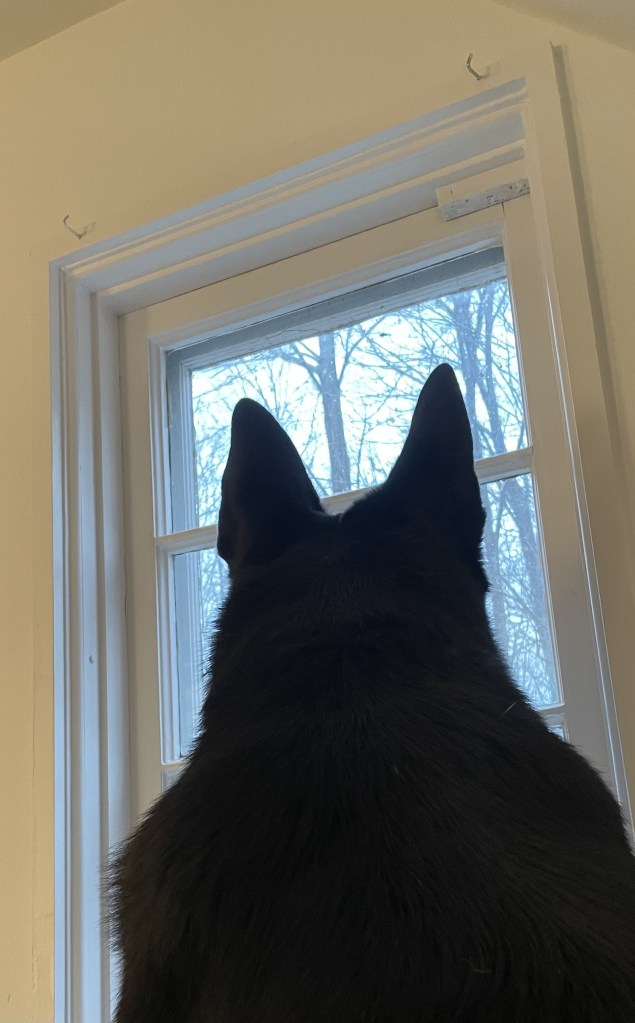
The soft sleeping breath of dog one; the impatiently waiting breath of dog two; and the intense watchfulness of the puppy who sits at the window to see, hear, and smell the lives of others, these are the sounds of my prayer. This morning noise is the sound of life, of the world.
The traffic sounds that rise from the valley will come soon, too, but not yet. For now there are just these other lives among us, busily, and with unknown degrees of self-awareness, going about the hard work of living. If they worry—and I think the garter snake who encountered us yesterday in the orchard was damned worried—they don’t sit around and wallow in it. They don’t have time for self pity. They have to eat, and get where they have to be, and find a mate, and feed their young, and elude homicidal neighbors. Every decision they make is life or death. It’s a lot. It is, frankly, more than I have to worry about, and probably more important. But they start each morning by raising their voices.
I don’t know that it’s cheer. Who can say? But it is life affirming. It’s a statement of presence, of vitality, perhaps of territory, perhaps of love.
Life is hard, and may be over before the sun sets.
But still, they sing.



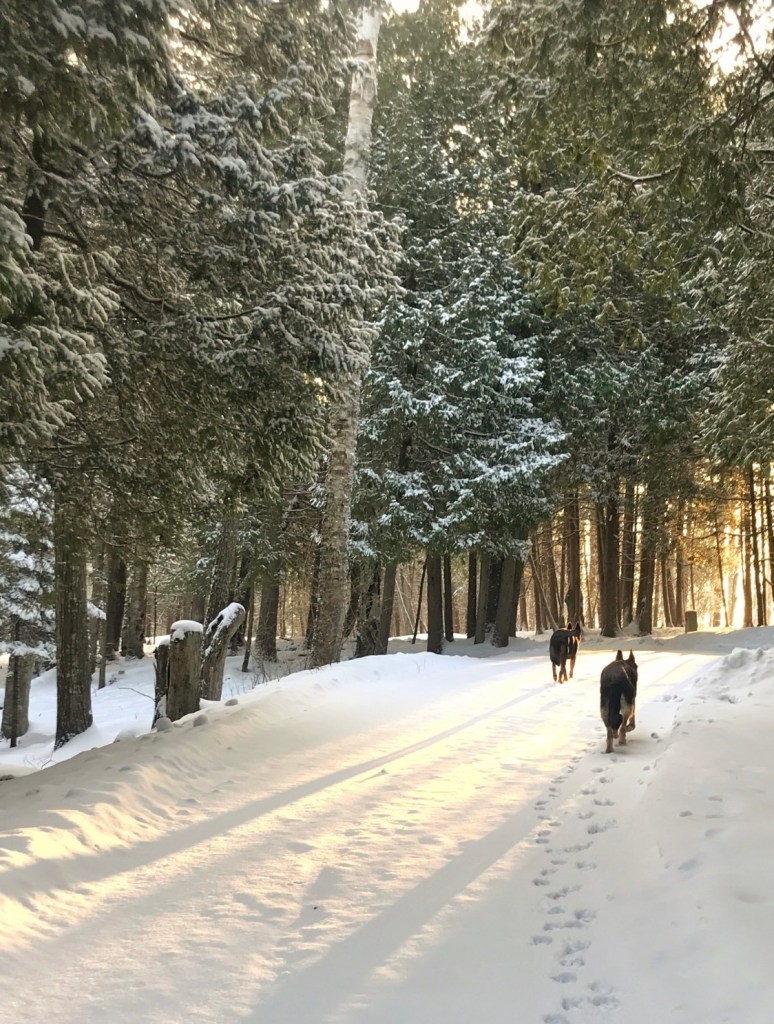

 Every morning in the dark, my prayer comes in silence. Or rather, it comes in my silence amid the conversations of others: of the hundreds—possibly thousands of geese calling at sunrise; the turkeys having another of their frequent family squabbles; the robins in their distinctive sweet monotony; the sparrows and the chickadees, each with their own language of singing; the owls calling their last sleepy good nights; and the raccoon silently ambling across the open lawn and slowly up the tree trunk to bed.
 J.F. Riordan