In which: I am annoyed

I believe I have mentioned here that we had a sort of appliance armageddon in November and December. Since not all of them were amenable to repair, we have some new ones. Aside from the fact that they do actually function, none of them are improvements.

The new dishwasher—which is the equivalent model to the old one— is missing some of the handy features of the other one. The racks are different and less adjustable, and the buttons have fewer choices. It also cost a lot more than the last one, and had to be specially rigged by the installers in order to fit in the same space.

The new microwave is also the latest and greatest version of the old one. But it doesn’t have a one minute button—which I used all the time—or the butter softening/melting feature that I loved so much. How many sticks? How soft? How melted? What are you defrosting? Press 1 for meat; 2 for chicken; 3 for fish. None of that. The machine, with its super fantastico intelligent programming decides. It’s usually wrong. The other day the turkey sausages came out like hockey pucks. Maybe it’s a bit too powerful. I’ll get used to it, I guess. But I don’t want to. I don’t want to spend my increasingly limited brain power thinking about appliances. I want my appliances to do my bidding, not their own. Adding insult to injury, it beeps five times instead of once, a particular pet peeve of mine. (See also: “Electronic Narcissism” in my book of essays But Still They Sing.)

Which brings me to the source for which I reserve most of my animus: the new television we so jauntily installed in the library. It’s a small television, but we thought it might be nice to be able to watch while all snuggled into our coziest room, with the bar cart nearby and the fire going. We were delighted when all we had to do was hold our phones up to the QR codes to install our streaming services. Very cool, we thought.

Lately, my husband has been getting up excessively early, frequently adjusting his bedtime to right after dinner. This leaves me a little bit at a loss. I’m usually too tired to read. Practicing piano would disturb him, and I don’t want to go to bed yet. A perfect time to sit in the library with large dogs and watch something on television.

I was settled in the other night watching a two hour program, when suddenly the television turned off. Nothing I did could turn it back on. Having twigged the eco-settings on the bedroom television, which automatically dims the picture, I had already turned all that off. I changed the batteries in the remote. I reset the wireless. Nothing. Finally I packed it in and went to bed. But my husband found it running in the middle of the night.

“You left the television on.”

“I sooooo did not.”

Last night, same scenario. I wasn’t watching anything I was particularly invested in, but I was beginning to think we would have to embark upon an endeavor that reflects what my husband calls “the asymmetry of power”. You know: when you have a problem with a product and have to contact the enormous monopolistic corporation that has eliminated service from its mission statement. My sister has spent the past three days engaged in such an exercise, which mostly consists of listening to repetitive and annoying hold music while someone on the other end files their nails for hours at a time. But I digress.

One of the most useful aspects of the internet, I find, is being able to look up problems and see whether you’re the only one experiencing it. So this morning I did this, and what did I find? “LG TV keeps turning itself off.”

Apparently, in their (asymmetrical) wisdom, the LG corporation has decided that after a certain period of time without interaction with the remote, the television should turn itself off. The settings say this happens after four hours. I can attest to its being much less than that. Nevertheless, I found the button and turned it off.

Happy Ending. Sort of. But I have questions. What makes electronics companies think we need someone else to turn our devices off? Isn’t that why we have a remote? With a timer we can set? What if I’m watching a David Lean movie? Or a Wagnerian opera? Maybe I don’t want to be interrupted. Why I can’t I turn it right back on? Why do they hide these settings so you have to dig around in the depths of the system like a turkey looking for bug? Why aren’t these “features” listed openly in the manual? Why does it seem we have become the servants rather than the other way around? I have a sneaking suspicion it’s because all these companies know they have us over a barrel, and we will choose to serve in order to have our conveniences. It’s a very strange turn around.

Capitalism isn’t all it’s cracked up to be.

A doll’s…house

I have an heirloom dollhouse that I have been saving for my two great nieces. I sent it with my niece and her husband when they stopped to visit us on their cross-country move from Seattle to Philadelphia. At the time, one of her daughters was about three, and she was newly pregnant with the second, so we agreed that they would save the dollhouse for a time when the girls were old enough to appreciate it.

This is the year.

It’s a big dollhouse, made of wood, with wallpapered rooms and big muntined windows. I think it dates to the early 1950s. I was not the first little girl to play with it. It had belonged to my father’s cousin, and then to her daughter.

I thought it would be nice to include a set of the right sized dolls. I had no idea how difficult this would turn out to be.

I tried the hand-made website; and the auction website; I visited the very few actual toy stores. Nothing quite right. They had dolls, but they were either hideously plastic or one step up from corn husks. Nothing that simply had a nice face and reasonably-shaped body.

So, reluctantly, I turned to the Seattle guys. They do have dollhouse dolls. But you know how the algorithms are. Even if you reject something it keeps showing up in your feed. There is no Boolean method of saying “But not that”. And there is a series of dolls that, at first glance, seemed nice. The dolls come in different ethnicities and ages. But the longer you look at them, the weirder they become.

Do you see what I mean?

I showed them to my friend at lunch to see if she noticed. Maybe it was just me. But, no. She started laughing. “What is with their crotches?”

Exactly. And once you see it, you cannot unsee it. And it doesn’t really make any sense, either. I mean…never mind.

My friend texted me later with a suggestion of some animal family dolls she came across. One great niece will get a kangaroo family, and one will get a giraffe family. They will have to co-inhabit.

Close enough.

Old Finds

The thing I miss about Tw*%^tter is the little pockets of community we built among ourselves. The connection was mostly about animals, and then mostly about dogs, but there were also the writers, photographers, farmers, and scientists whose work you could take interest in, and the neighborly people whose company warmed on a bleak day.

Among the unlikely acquaintances I made was a bookseller in a little town in England, whose job was to comb through estate sales, the ruins of well-loved libraries, and mountains of cardboard boxes dumped like abandoned puppies, rescuing old or even ancient books. At first he would tweet about some intriguing find and I would reply requesting a price. But soon I had given him a hopeful list, and he began keeping an eye out for me.

The arrival of these books was an event. They always came beautifully wrapped in brown paper, or sometimes in the pages of old magazines. There was twine. The packaging suggested to me the perfection one used to expect from a purchase in London: very much not shoved into a bag. There were no plastic bubbles.

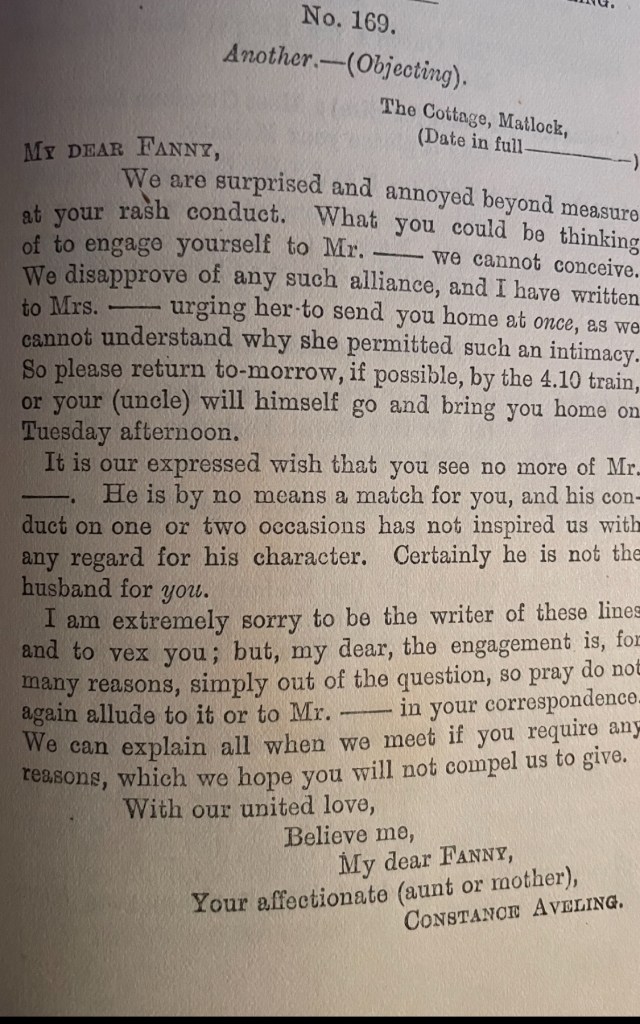
Among the purchases I made were a tiny shirt-pocket sized Book of Common Prayer, a 19th century book of beautifully painted pull-out English maps (in an unusual shape, and filled with geographic detail unlike anything I’ve seen elsewhere), first editions of some favorite authors, and other very specific and odd literary delights. One of these is a vintage edition of Beeton’s Complete Letter Writer for Ladies and Gentlemen; Containing Love Letters, Complimentary Notes, Invitations, Business Letters, Applications; With Domestic, Fashionable, Friendly, and Formal Correspondence.

I find it endlessly entertaining.

I can’t find an exact date in it, but it was published in late nineteenth century London, and sold for One Shilling. It is a thing out of time, since letter writing is no longer our primary means of communication, and since we live in such a graceless era, when manners in particular and civilization in general are all up for grabs.

It is amusing, too, in its formality and superannuated language. There is the sharply worded note from a father to a fractious boy at boarding school; the disapproving note from an aunt to a newly-engaged girl; letters enquiring into the character of servants; and, as the title promises, love letters: all earnest, some moving, and some rather improbable (“Answer to a Missionary’s Proposal Negatively”).

I am happy to live in our era, with its science, medical advances, and convenience. But I do wish that along with all our advantages, we still lived among thoughtful, gracious people who understood that formality was an act of respect and dignity, and who had the time to ponder proposals of marriage from well-meaning missionaries.

Well, we can’t say we didn’t see this coming

I’ve had a love/hate relationship with Twitter over the years, but when the new management took over, it was increasingly obvious that it was heading in the wrong direction. For weeks now, I’ve been prevented from seeing even my own tweets after about five. The functionality of posting photos has been broken. And last week I casually opened the app while sitting at the airport and found myself staring at graphic pornography.

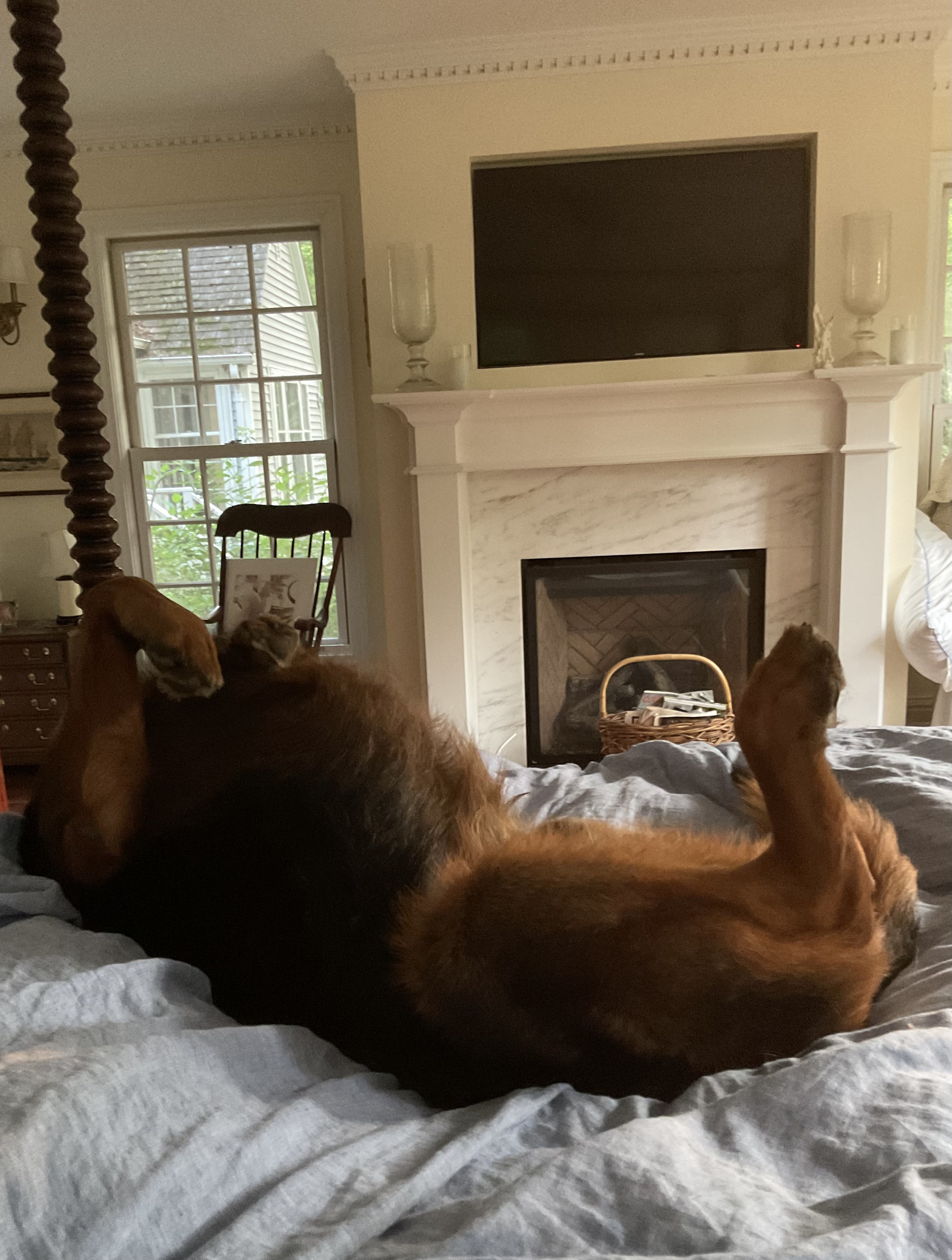
But today I have been blocked from posting at all. No cute photo of Auggie on the bed in front of me, and no retweeting to help save dogs in danger. There were two in particular I wanted to help.

I have no idea how long this will last. I’m sure it’s not personal. It’s just reality, and we deal with it. Maybe it’s just time to cut the cord. If you’re on Twitter, please pass the word. And if you’d like to stay in touch, you can sign up to receive an email whenever I post on the main page of this site.

I am looking at this as a message from the universe to do more writing. Not that Elon Musk is the universe, but I’m sure he thinks he is.

(My apologies for the technical glitches here. I’m out of practice.)

He’s not relaxed at all.
My spoiled darlings.

Detox

The house we rented in Maine is very old and very large. It has history. Perched on a small hill above the lake, it has sprawling porches, front and back, and lovely views. There’s a spacious kitchen, a laundry room, and five roomy bedrooms with four baths. There’s a massive stone fireplace in the living room. But it does not have wi-fi, and the cell signal is only one elusive bar, which seems to flit from room to room like a butterfly, and then disappear.

It has been a long time since I have left my phone sitting on the night stand, turned off, and walked away for the day. I feel released from electronic bondage. The impulse, in an idle moment, to look down at the phone is gradually being replaced by a willingness to look up, to think, to let my brain idle. That’s how writing happens. 

I had become increasingly aware of the way my phone had taken over my life. I am continually scrolling through my messages. There’s not a scene that passes before my eyes that doesn’t make me reach for the camera. There’s not a drive that isn’t accompanied by a podcast. 
It’s too much. It’s too many voices. It’s too much externality. And none of those things are good for a writer.

This week I wrote in the mornings. I hung around with my family. We did a complicated puzzle. I sat on the dock and dangled my feet, and thought about things. I jumped into the cold lake. I cuddled children. I drank cocktails. I went to bed with a book. 

It was a kind of detox, and it has put me on the path to getting my brain back. 

The temptations to return to my old habits will be strong, and I imagine there will be a gradual regression toward over-use. But I have a plan to keep it in check, and at the moment, it doesn’t even seem appealing to go back to my old ways. 

But addiction is hard. We’ll see.

Not with a Bang, But a Tote Bag

Back in the pre-covid days of festivals and conferences, my husband used to travel a lot, and my closet overflowed with tote bags. This essay appeared in the now defunct Weekly Standard September 26, 2018. An article in today’s NYTimes brought tote bags and all their environmental baggage once again to the fore.

***

I seem to recall an essay by Ralph Waldo Emerson in which he predicts that the world will be subsumed not by fire or flood, but by an overwhelming mound of common pins. It hasn’t happened so far, but that may be because we have shifted the cultural weight, as it were, to a far more voluminous enemy: the tote bag. 

My husband is on the festival circuit. He goes to exotic and beautiful places like Maui and Aspen, cavorting with celebrities and beautiful people, while I stay home with the dogs. It’s not as bad as it sounds, really, and it has the advantage of enhancing spousal appreciation, but it does have a curious byproduct. Every time he returns, he presents me with a tote bag.

Tote bags are nothing new. They have been the mainstays of museum gift shops and the low-cost premium for subscriptions to magazines and public television for decades. Environmentalists made them important by urging us to pile our groceries into their bacteria-infested depths week after week, rather than wounding the earth with the clean, fresh, disposability of plastic or paper grocery bags. 

I love the earth. But I have questions about tote bags. 

I have never had a statement handbag, but then, I live in the Midwest where things like that are considered ostentatious. I do find, however, almost against my will, that I have begun to select the tote bag I want depending on where I’m going and who I will be seeing. There is a hierarchy to tote bags that is more subtle than the kind of car you drive. Tote bags can brag without your ever having to say a word. They are signaling mechanisms to announce your affiliations. 

The local grocery store gives out a flimsy, paper-thin canvas wine bag when you purchase more than one bottle. It’s okay if you leave that one behind at your friend’s house. I have a beautiful well-made canvas bag with a painting of the Flatiron Building that I purchased in a museum gift shop. It is sturdy enough to carry books and signals my cultural sophistication. This may have slightly more cachet than the thin fabric WNYC tote that seems to suggest that I am a donor (I am not) or that I am part of the East Coast intelligentsia (I am most definitely not). I have a bag from the American Enterprise Institute, proving that I am “Fighting for Freedom, Opportunity, Enterprise.” That sounds nice. The TaxPayers’ Alliance signals my support for fiscal restraint, and the Hoover Institution is a nice way of encouraging people to enquire whether I have met Milton Friedman or George Shultz. I have bags from book conferences that suggest my writing bona fides. I have one that declares “We Can Change the World,” a claim whose sincerity I don’t doubt, but about whose particulars I am somewhat skeptical. Perhaps my favorite is my niece’s gift, a utilitarian lightweight “Totes Ma Goats” bag in which I carry my own books (especially my novel The Audacity of Goats) for publicity events. 

But of all the tote bags, the most exclusive are those presented as swag to attendees of various high-level conferences, like the Aspen Ideas Festival. We now have three or four Aspen tote bags. One is beautifully made from military grade canvas with leather handles and represents philanthropy to a veterans group. A bag from an exclusive corporate philanthropic retreat has a lovely insulated pocket underneath to carry your properly chilled bottle of New Zealand sauvignon blanc or possibly a can of bug spray that wouldn’t mix well with the potato salad. 

Does Davos have a tote bag, I wonder? Do Davos attendees ever do anything that requires the use of a tote bag? Or do they bring them home as a bonus gift to their nannies? 

As my husband’s spoils of conquest accumulate in the hall closet, and the door becomes harder to close, I have begun to feel the need for some form of triage. How many tote bags does one family require? I ought to sort through, choose the most exclusive, and chuck the rest, but I’ll probably keep the nice plastic one from the now-defunct local bookstore. It’s easy to disinfect.

The Curse of the Immortals

When I’m walking the island, my mind wanders to many things. Sometimes they’re related to the book—I often work through plot ideas while I’m walking—but not always. I have learned through hard experience that if I don’t record the idea it will disappear forever. In fact, if my notes are too cryptic, they will may still be unfathomable. Yesterday I had a thought about the coronavirus and the Greek gods. I don’t know why. They were trapped in quarantine on Olympus and bickering together—it made me laugh. but there was another idea—What was it?

Maybe not so funny: that quarantine’s illusion of immortality—of time stretching on infinitely—took away that sense we ought to have of racing against a waning lifetime. Maybe it was a respite for a while? Maybe it was a relief not to have to keep churning. But that idleness—that missing sense of time passing—is precisely what made the gods so mischievous. They had no real purpose, no goals. They were, in a word, bored. And aimless. Okay, two words.

But for mortals, it was an illusion. Time did pass. As survivors, we are, of course, just as old as we would have been otherwise. Or maybe, had the pandemic not happened, we would have been out in the world and hit by a bus. We can’t know. Even for those of us fortunate enough to have spent the pandemic merely unmoored in time, there was great loss; if not of someone we knew and cared about, then of community, of ourselves, of our precious time on earth. I feel new sympathy for the unjustly imprisoned, who must have some version of this same feeling: the sense of having been robbed of time. But especially, I grieve for those whose lives were so directly affected by the illness itself.

But as with all forms of grief, we must choose to either lie down in it and never look up, or to get up and get on with things, knowing that, whether we choose it or not, some new grief or old will be waiting to pop out at us when we are unwary. But then, so will new joys, and new, unhoped for experiences.

We move onward, with resignation and hope together, and that purpose, which comes from our sense of passing time, is the blessing of mortality.

Electronic Narcissism

I like silence. Perhaps it is a commentary on the state of my nerves, or maybe it’s because I’m a former musician and my brain is aurally focused, but I find unwanted noises distracting. I need silence to think and to write, and when I want sound, I prefer to choose whether it’s words or music. So I find the contemporary taste for household appliances that ping, beep, and play tunes extremely annoying. 

If I seem cranky, it’s probably because I have been trying desperately to write a novel amidst continual interruption from household appliances.

I have a notion that devices should A) make your life easier and B) not require distraction from your thoughts, and, come to think of it, C) achieve their purposes in silence while leaving me alone. 

In my quest to break my writing stalemate, I recently packed up and left home for the seclusion of the Island. The house I rent when I go away to write is a place I know well. I have been going there for years, and it’s like a second home. It’s a charming place: roomy, but cozy, with a wonderful property where I can walk in privacy with the dogs, and a lovely landlady who knows the precise formula of solitude and companionship to feed a writer. I have written parts of all my books there, and there’s something about the atmosphere that inspires productivity. My days there are a perfect pattern of writing and walking, and no one disturbs me unless I want to be disturbed. The house is not old, but my landlady had just replaced the range, the refrigerator, and the washer-dryer, all sparkling new and ready to be used. She is a generous woman, and likes to buy quality things.

Throughout my first day, unfortunately, I spent a great deal of time debating when to tell my host that there were red squirrels nesting in the roof. I knew it would upset her, and I also knew it would mean workmen disrupting my writing. The squirrels’ chirping and scratching was irregular but loud, and I feared they were doing damage. It wasn’t until late in the afternoon that I finally realized that it wasn’t squirrels, but the new refrigerator. I have no idea why a refrigerator should make a noise like red squirrels. Maybe someone thought it was cute. Or maybe no one ever spent any time in a room where it was running. I suppose it was companionable, in its way. I mean, at least the noise resembled living things.


The stove however, was much worse than squirrels. Writing can be both lonely and vaguely excruciating, and it is during these moments that I usually take a break to cook something nice for myself. Sometimes the food in my novels is actually something I’ve just made. Food, for me, is comfort, and when I’m alone, I look forward to meals as a way of permitting myself a break, and as a kind of companionship. In some ways, it’s as much about the cooking as it is about the eating. Cooking is a pleasant diversion, and creative, but as I’m chopping onions or browning beef, my mind is able to continue the intellectual rambling necessary for building a story.

So, having grown accustomed to the refrigerator squirrels, after a few hours of work and a long walk in lovely silence, I turned on the oven, and was jolted out of my plot-related reverie by a jaunty little tune. It wasn’t just a beep, but an actual musical phrase, only with tinky-tonk noises. When I set the timer it produced another tune, and like so many electronic devices, instead of one smooth dialing motion to set the temperature, I had to press it each time I added ten degrees, each time producing another beep. When the oven reached the temperature I had laboriously set, it sang yet another tune. Apparently each melody has a specified meaning, but I’m not interested in providing room in my head for determining which is which. I found myself missing my vintage stove at home, whose only noise is the satisfying “whomp” it makes when you light the oven with a match.                                                                          

Then there was the new washing machine. I pack lightly when I go away to write. I mean to say: the car is full of stuff—much of it dog-related, and some of it bourbon—but I don’t bring a lot of clothes, so I’m happy to have a washer dryer in the house, and I often throw something into the washer while I’m writing. This new machine could be featured in a museum as The Loudest Washing Machine in the World, and it makes what I can only describe as a rhythmic mechanical gagging sound for the entire cycle. It’s some sort of water-saving design, which is, I guess, mandatory, but seems a little silly when you’re only steps away from—literally—a quadrillion gallons of water. I found the gagging somewhat less charming than the nesting squirrels.  As if this were not enough, it beeps. Not once, for each time you choose a cycle, or once when it’s finished, but every 30 seconds after the cycle, until you interrupt the sentence you’re writing to get up and open the lid. I have had the care of less demanding puppies. 

Thankfully, I was able to close the door to drown out the worst of the noises, but the beeping penetrated the walls. Not surprisingly, the matching dryer is also an electronic nag. But the thing is, if they make weird gurgling noises and show signs of nausea, how would you know until you got them home? I have a new washer and dryer at home, and they both have the options to turn off the signals. I made sure of that. Of course, I don’t live in the same room with them, either. So there’s that. 

But still.

It used to be that appliances would sit silently and make themselves useful. Now, for reasons I do not understand, they seem to feel a need to call attention to themselves, as if, like electronic toddlers, they are announcing: Look at me! Look what I’ve done!

It strikes me as an indication of a deeply flawed society. What personal failings have led us to develop narcissistic appliances? Is it a reflection of modern life, the electronic equivalent of so-called influencers, who must announce their doings on Twitter, Instagram, Pinterest, and Facebook, or be forced to question the value of their own existences? Have we created appliances like ourselves? Is there anyone who likes this incessant mechanistic signaling? Or is there something about the electronic miasma in which we all exist that assimilates our nerves into a state of noise acquiescence? Is there some consumer movement I need to join to dissuade manufacturers from this evil path?  

The last time I bought a microwave oven I asked the saleswoman which ones beeped only once and stopped. It was clear by her reaction that no one else had ever asked this question, but she dutifully investigated the beeping of each one, no doubt thinking bad words that I am grateful not to have heard. But each time I buy a new appliance, I find that the noise factor has intensified, as if this has become a signal—as it were—of improvement. I believe it is, instead, an instrument of consumer torture.

A few days after I got home and settled into a new appreciation of my quiet appliances, the brand new, very expensive water heater silently burst a valve and unobtrusively leaked water all over the basement floor. 

I felt oddly grateful.

What Writers Do When They Should Be Writing. A List

Screen Shot 2014-03-02 at 3.02.09 PM

  1. Decide to take dogs for walk.
  2. Look for sunglasses in purse.
  3. Go outside to see if sunglasses are on porch.
  4. Talk to neighbors for two hours over fence.
  5. Look for sunglasses on bedside table.
  6. Pick up t-shirt on bedroom floor.
  7. Notice box of new beach towels in guest room.
  8. Put away  new beach towels.
  9. Look for sunglasses in car.
  10. Make grocery list.
  11. Recharge computer.
  12. Check e-mail. Nothing from anyone.
  13. Look for sunglasses in tote bag.
  14. Wonder if sunglasses are still at bookstore from last night.
  15. Call bookstore.
  16. Wonder if sunglasses are at restaurant from last night.
  17. Call restaurant.
  18. Look for sunglasses in car again, focusing under seats.
  19. Talk to friend on phone.
  20. Look at plot map. Notice holes in plot.
  21. Ponder death.
  22. Empty purse on floor looking for sunglasses. Find emptied bottle of zinc tablets in bottom.
  23. Clean out purse. Pick off lint from zinc tablets. Return to bottle.
  24. Accidentally call book store from last week. Chat with proprietor.
  25. Decide to write blog post.
  26. Look for sunglasses in car again, focusing on trunk.
  27. Stare at blog screen.
  28. Send irritable e-mail to online company who keep sending surveys that flash at you when you’re trying to think.
  29. Look for sunglasses in tote bag again.
  30. Find two day old NY Times in tote bag.
  31. Do crossword puzzle in NY Times.
  32. Walk path from car to door, hoping to find sunglasses in grass.
  33. Rub tummy of Dog One.
  34. Stare at blog screen.
  35. Rub tummy of Dog Two.
  36. Look for sunglasses in different tote bag. Find sunglasses.
  37. Resolve to carry fewer tote bags.
  38. Don’t write a single thing all morning.
  39. Decide it’s too hot to take dogs for walk. Swimming would be better.
  40. Look for sunglasses.