


We’re in the teeth of winter now. The actual temperature is -5F but the wind chill is -15F to -25F, which means the wind sweeps away your body heat at a rapid clip, and flesh freezes in mere minutes. In this bitter cold both animals and humans are suffering. Although we got our power back, not everyone did, and outside in this dangerous weather, there are people working hard to protect the rest of us, restoring power and operating community shelters.
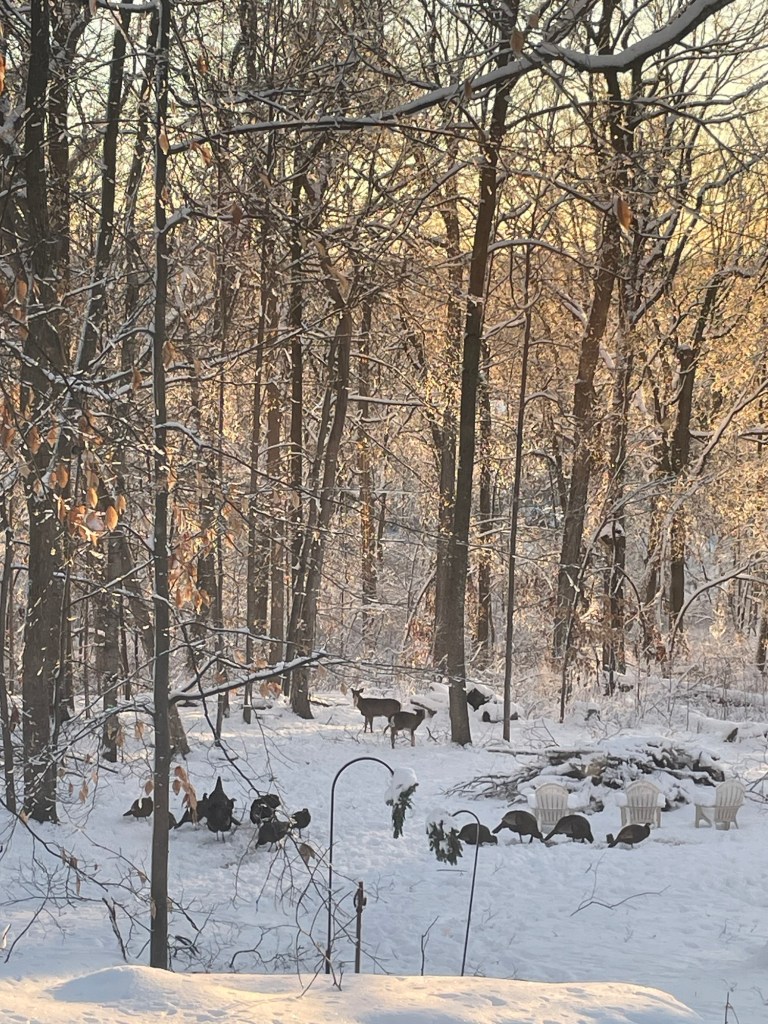
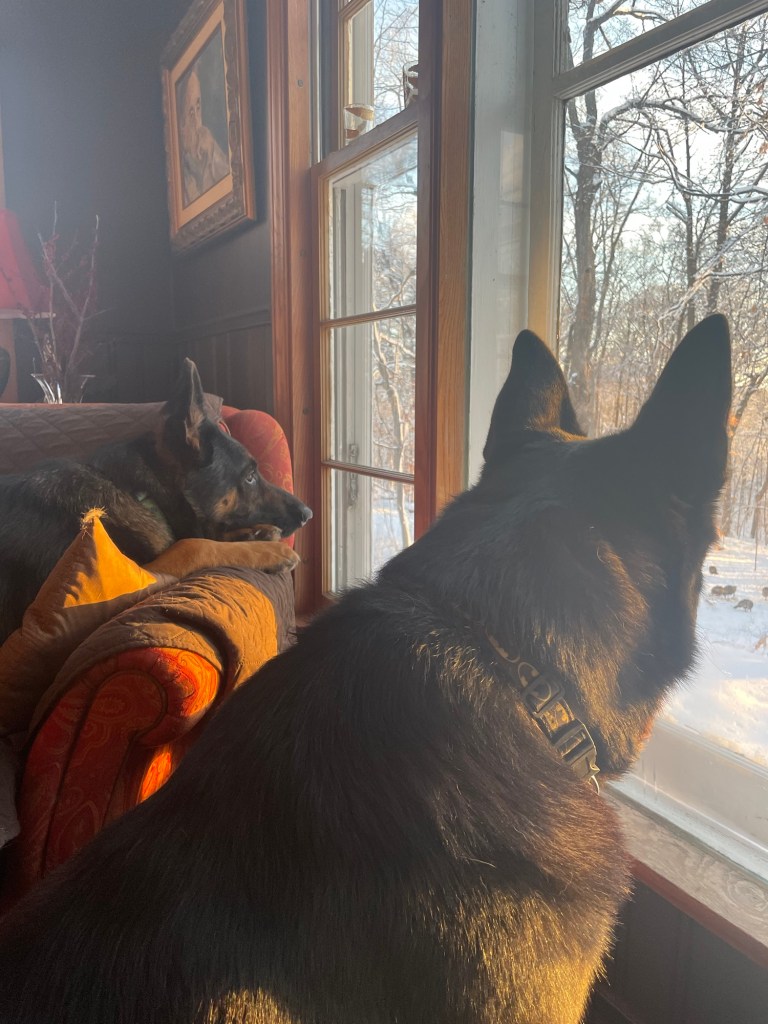
I’m watching the turkeys this morning from my warm, comfortable vantage point on top of the hill, looking down into the woods. We have a flock1 of nineteen this year, somewhat smaller than usual, but always fascinating.
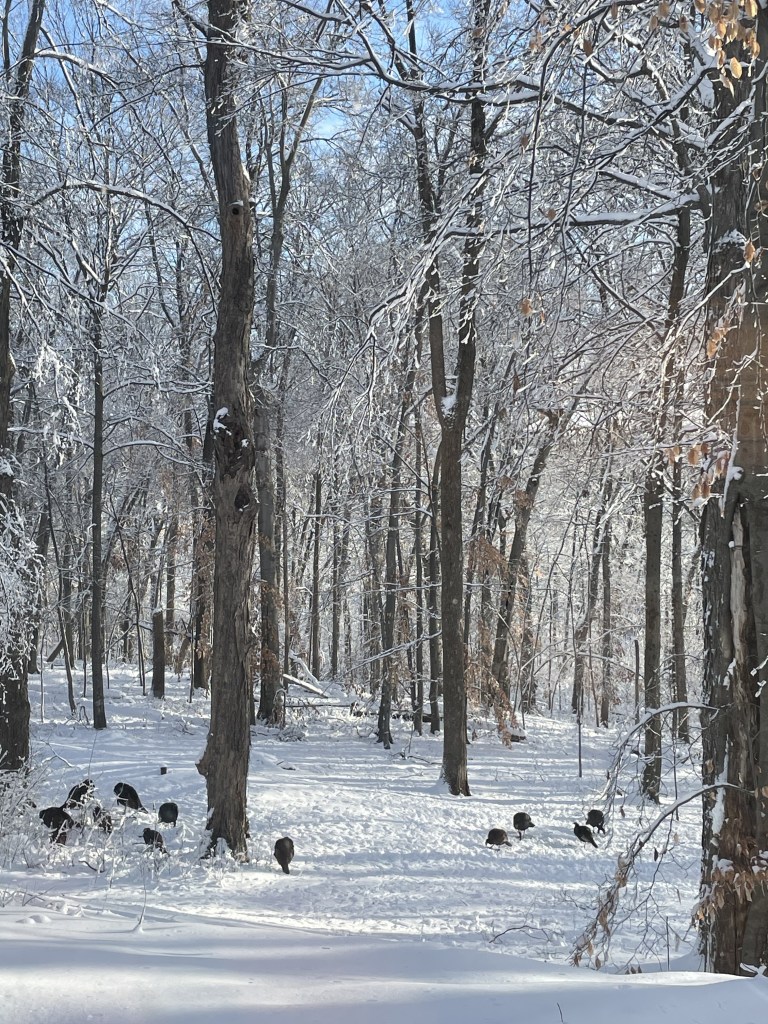
After the deer had finished their morning graze, the turkeys came down from their roosts and spread themselves among the three spots where we have put out seed. As I watched, I saw my one-footed friend—who has been with us for several years now—sit down by himself in the snow, fifteen feet removed from the rest of the flock as they fed. He knew he could not compete with the rough and tumble of the flock’s drive for food. My heart broke for him, because even though the others do seem to look out for him generally, the nature of turkeys seems querulous and wholly intent on individual survival. I told myself he would be able to eat when the rest had finished, but wished I could go out to give him his own little stash. He looked cold and lonely.
As I watched, one of the other turkeys broke off from the flock and walked over to him, nudging him gently. He got up, and together they walked to the pile of seeds, and, shielded by his friend, the injured turkey joined the others and began to feed. For the remainder of breakfast time, the limpy guy ate with all the others.
If I hadn’t seen it myself, I wouldn’t have believed it.
The turkeys are still here, and have been joined by squirrels, junkos, and chickadees. I know from long observation that today, instead of marching off on their usual trek, the turkeys will stay close by, puffing up their down coats, and sitting on logs somewhere out of the wind, preferably under bushes or brush piles. And they will all have eaten enough to fuel their bodies against the cold.
So, who wants to discuss how animals don’t practice altruism?
Fall is late this year. It is already mid-October, but for the first time the woods have a tinge of gold, just beginning, and the sunlight’s yellow is intensified when it shines through the trees. These are the kinds of days I count as finite in my life. All our days are finite, of course, but some seem to belong in a category as different as a gemstone to a handsome pebble.
Life hasn’t seemed, really, to have returned to normal for us. The contagion levels are still high where we live, so although we have tentatively dined outdoors a few times—and enjoyed it thoroughly—the cold weather will end that small bit of normality. The world feels smaller.
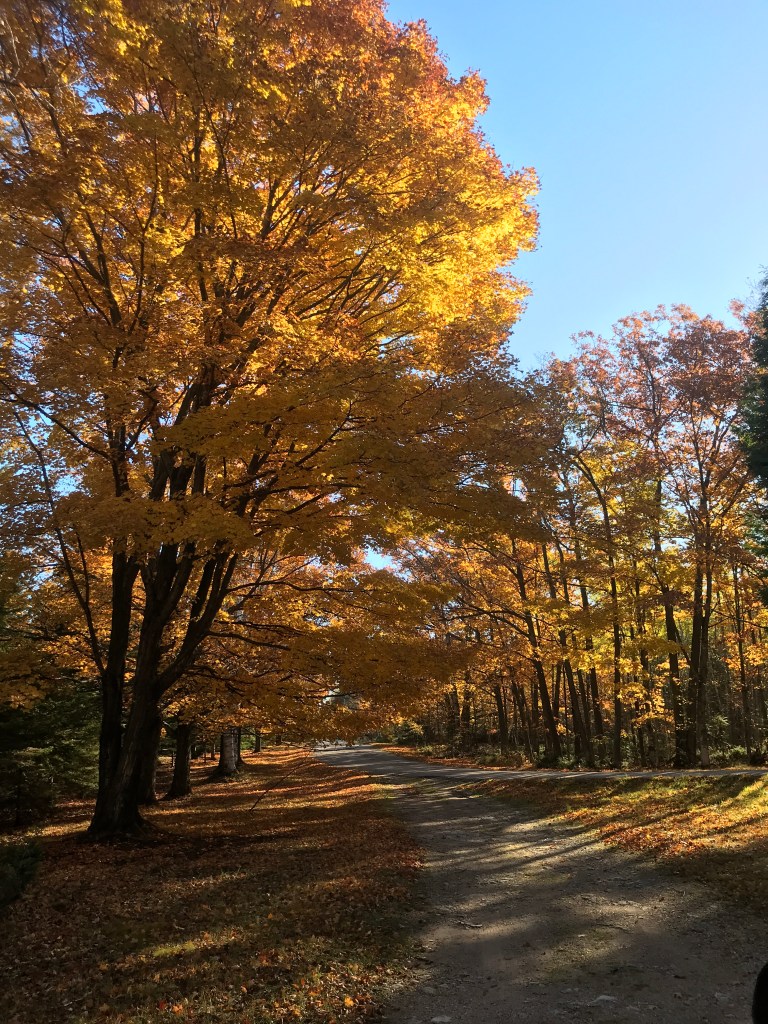
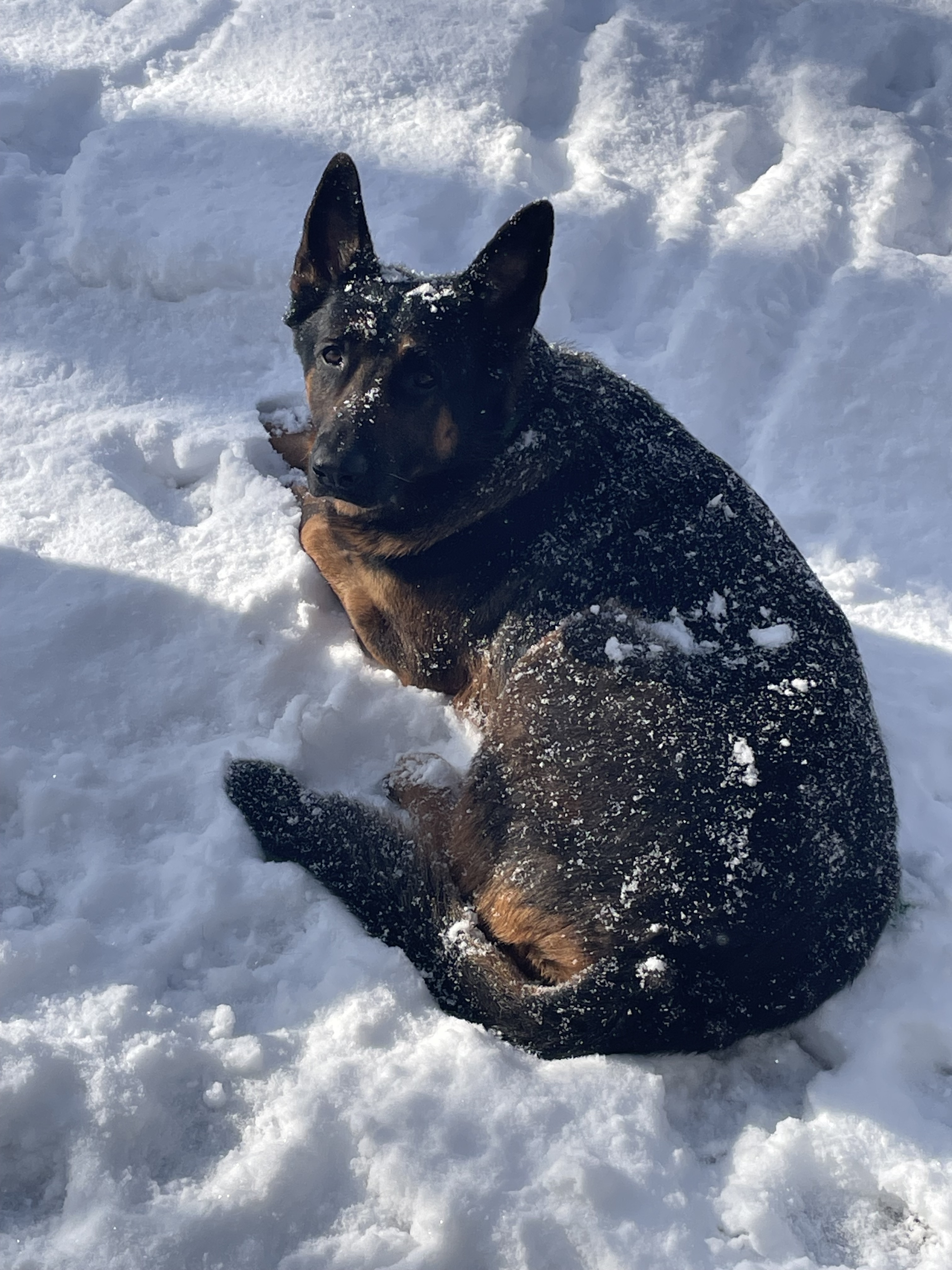
In pre-COVID times, I would go now to the Island. It is one of the places where the golden light of fall permeates everything. The long, empty roads mean I can walk for miles without seeing a car, and the dogs, who return to me instantly when I call, can run off-leash. We wander through golden lanes, and my brain, usually obsessedly plotting and exhausted by the extraction of writing, is distracted by the resonating vibrancy of the color. I remember these walks repeatedly, and return to them in my dreams, and in my books. They are, I think, how I would spend eternity, if I could.
But we are mistaken if the wet days, the bleak and dreary ones, are not treasured, too. My dogs, who love to swim, but hate the rain, nevertheless run joyfully through wet weeds and brush, shaking themselves with vigor when they come in, smelling of mud. Dogs have a capacity for appreciation that my ideal self would try to emulate, but I am not a dog, and can’t seem to achieve their purity of mind.
My joy ebbs and flows with the seasons. I have never fully understood spring, with its mud, its dirty snowpiles, its cold rains, and its disappointed hopes. For me, joy comes when fall it is at its peak, and even still later, with the stark, purple cold of winter. Once the leaves and crops are stripped away the sculptural shapes of the trees and the shape of the earth is revealed, and the light pours down, undiffused. The world seems a brighter, clearer, purer place. That cold clarity purifies me.
In our mortality, I wonder whether there is, too, a clarity that comes as we can, at last, see the end. There is no need for the extraneous, just the focus of comfort, where we can; of love, if we are blessed with it; and the firm hope that when the seasons pass, the essence of what we are will always be.
Last night, just after dark on Ash Wednesday, I took the dogs out for a little ramble. The first thing I heard was a coyote in the distance, and then, later than usual, church bells, signaling the seven o’clock service for the Lutherans. Each, in its way, calling the community to assemble. It was a curious juxtaposition: the two sounds, one of civilization, one of the wild, both of God.
We walked in the dark, the dogs and I. Old man Pete and I walked gingerly, careful not to fall on the ice. Puppy Auggie raced and slipped, and slipped again, joyous and without care. Moses loped ahead, making sure all was secure. It was warmer than it had been, but the wind cut, and the coyote made us watchful and tense. Pete paused to point into the dark ravine. We all stopped to look, and then moved on.
With my hood up, I could hear strange sounds behind me. With my hood off, I could hear the unfamiliar crunch of my new boots. The sky was clearing, and a few stars shone. We walked only a little way before returning to the warmth of the house to sit by the fire.
One way or another, we were not alone.
It’s hard to get up in the dark. I want to stay under the covers, next to the big dog who comes up on the bed as soon as he hears me stir. The fireplace in the bedroom is lit, and it is tranquil and warm. But I know if I don’t get up and write, I will have missed the fundamental purpose of my days, and so, goaded by some kind of literary jackal nipping at my heels, I drag myself up, lured by the prospect of coffee.
And yet, despite my lack of enthusiasm, once I am there sitting before my keyboard, I find myself racing against the sun. There is some mystical thing that happens when I’m writing in the dark. It’s as if I have a direct line to the muse who hides in my heart somewhere, only bold enough to emerge in the dark. The writing and the dark go together, and I have to get as much done as I can while I can.
With the light, too, comes the household activity: the chores, the dogs needing to go out and to have their feet washed, the dishwasher needing to be emptied, the bed made, the calls to the insurance company, the roofer, the trips to the dry cleaner. These kinds of mundane things scare away whatever inspiration I am fortunate enough to find, and the day slips away in the routines of living.
And so, against my will, I find myself rising earlier and earlier, reluctant and eager at the same time, dragging myself to my desk, hoping to write faster than the earth turns.
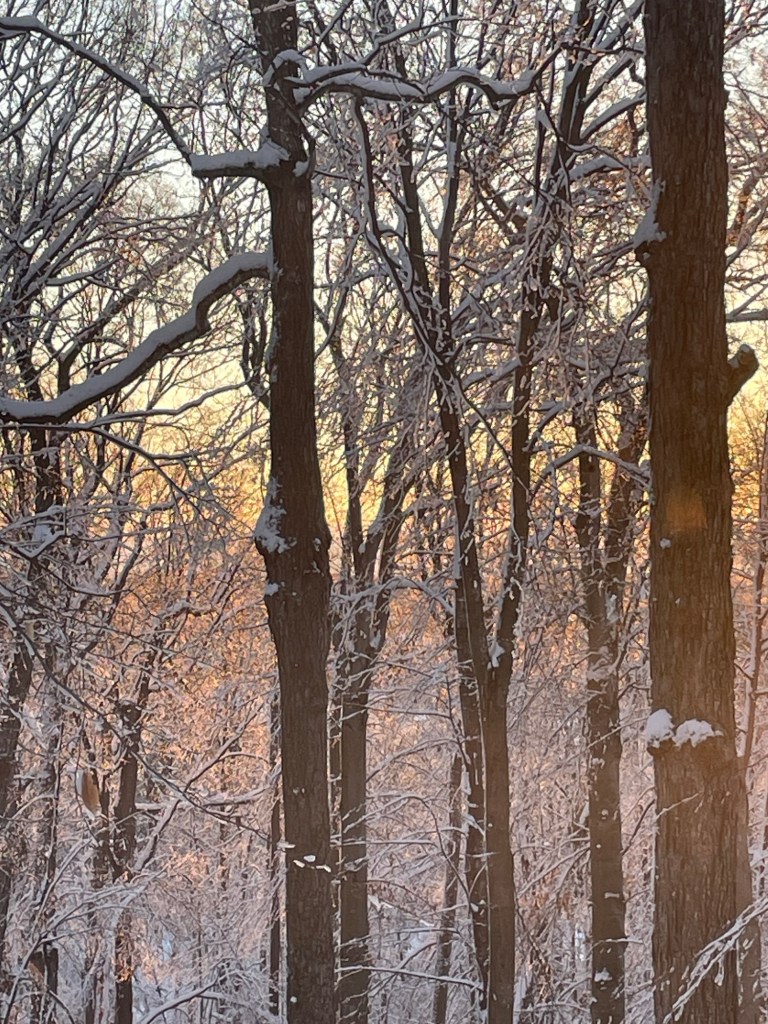
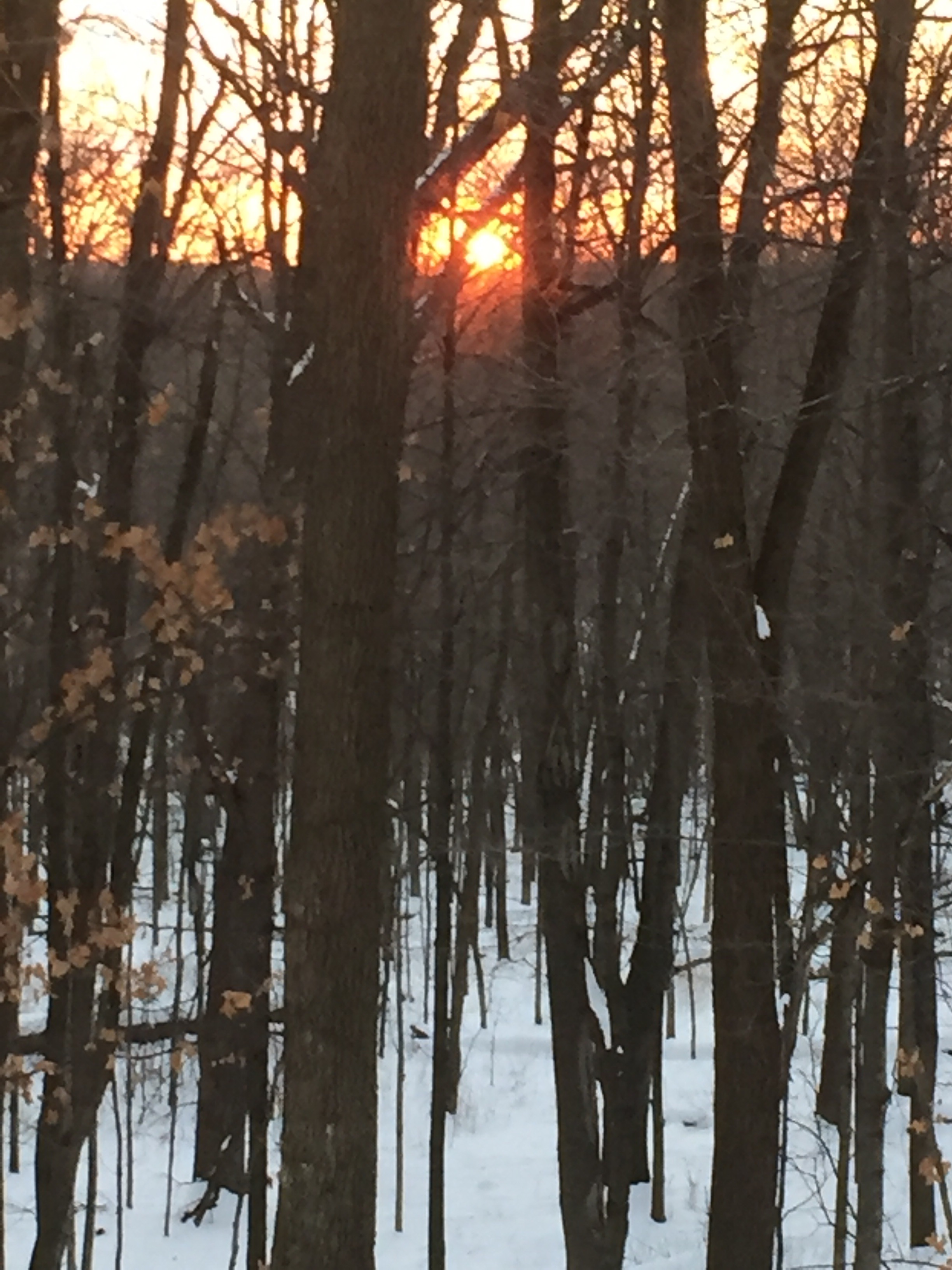
This morning it is bitter cold, and the trees are still outlined in the snow from two days ago. A pink line of the sun is showing, and a few brave birds have arrived to feast on the seeds and nuts I’ve left for them. The turkeys still balance on their precarious perches high at the tops of the trees. I am hesitant to stir, because that will signal to the dogs that it’s time to move, and then the brief moment of opportunity will be gone. I look at what I’ve written, and vow that tomorrow will be earlier still.
When I am on the Island, every night, before bed, the dogs and I go out for a long walk in the dark.
There is nowhere else on earth where I could walk alone, in the dark, in the woods, and feel so completely safe. It’s true I have my dogs with me, but they are even less worried than I, and frequently slip away into the trees to leave me to the sound of my own footsteps. On a cloudy night like this, it is so dark that only the melted dirt paths of this January thaw distinguish where to walk from the white snow everywhere.
Moses, who still carries the echoes of lupine ancestors in his soul, likes to disappear into the woods, projecting my course, to silently stalk me, later to charge out onto the path in front of me, in an unnerving fashion. It is a delightful game for him. Auggie, his apprentice, has begun to follow him deep among the cedar trees.
Their stealth is remarkable, and their ability to judge the intersection of vectors is proof that dogs understand geometry. Each has a red light-up collar: Moses with a slow blink, and Auggie with a fast one, so when they walk with me I can tell who is who. But when they dissolve into the woods and turn dead-on, their collars are no longer visible, and I cannot hear the sound of their padded feet, their bodies long and low, in stalking mode, until they are immediately in front of me, delighted by their prowess and by my praise. Their happiness shifts them from predators to pets, but there is an inner reality that is vital to remember.
These night walks are essential to their well-being and to mine. For them, it is a chance to reassess the activities of the local wildlife. The fox has been out since we walked this afternoon, and the raccoon and deer and possum. The turkeys are roosting in a tree somewhere near, and the deer are no doubt nearby, waiting for the dogs to go in before they come to feed. Their game with me exhilarates the dogs and empowers them.
For me, it is an expansive moment of the soul. Alone, in the dark, but utterly unafraid, I walk along almost invisible paths, listening to the lake, to the occasional cries of owls or foxes, and I feel that I am in my life.
Nowhere else on earth.

We had a baby born to our family early this morning. The first of a new generation on my side.
It is a muddled winter dawn. I lie in bed pondering the miracle of birth and feeling grateful for the health of mother and baby, as two great horned owls sing to one another in the woods.
There is joy in all creation.
Merry Christmas.
 J.F. Riordan