I interrupt today’s novel-writing to bring you an important message. I am about to move my blog to Substack. You will still be receiving my daily emails, but they will look a little bit different. All of the technology will be much more user-friendly. Making comments will be easier, and maybe, once I’m out of this intense phase of writing, we will find more opportunities to interact.
If you want to download the app, you can do that, but you won’t have to.
My emails will still be free.
If you don’t receive anything from me tomorrow, please check your junk folder. Look for the Gratuitous Dog Photo.
You know those word scramble videos, where the words or letters float randomly around the screen until they finally alight and settle in their right order, like birds landing on a wire? Or the place in a puzzle where, after struggling to get any sense of the solution, suddenly in a flash it’s all perfectly clear, and you pop the answers into their spaces, one-two-three?
Well, that’s where I am in the book right now.
I see the pieces of the plot line, and the specific scenes, and they are floating around in my head, not quite finding their right order, but all there, ready to settle into their proper places. This whirling phenomenon is familiar, it is the beginning of the race to the end; the last first step before the book truly takes shape, when I can begin trimming, fitting, cutting, and polishing.
It takes so much effort and fits and starts to get to this place, but it is the good part: the part where rather than struggling to find the line, all I have to do is snatch it up out of the air and lay in its perfectly prepared spot.
Long writing days ahead, but the solution to the puzzle is whirling like those birds
Who’s your audience? It’s a question asked of writers all the time. Agents want to know. Publishers want to know. Even book club readers want to know. Most writers know how to gauge our answers to meet our business needs. Of course, to be published, a book needs to meet customer demand. But, to be honest, most of the time that’s only a guess based on what has sold before, and demand can also be created by marketing teams and media campaigns.
So, while I am delighted to have my books published, I don’t think about any of that when I’m writing. I really only write for an audience of one: me.
I write the kinds of books I want to read, and to be honest, while I do read for information, I mostly read for comfort and companionship. When I had high-pressure, stressful day jobs, I didn’t want to come home to read high-pressure, stressful books. I taught in the inner city. I didn’t want to read about suffering, murder, crime, drug use, and lost opportunities. I lived with that every day. When I moved into an executive position, I still spent a great deal of time thinking about human misery and how to help alleviate it. Again, I was often in the inner city, visiting schools, homeless shelters, prisons, half-way houses, and addiction centers. I also had many uplifting experiences in the fine arts world, to be sure. But what hung with me was always the human traumas that went on before my eyes every day.
I don’t think I’m alone in that. Many people have intense, exhausting, high stress jobs. And some of them find catharsis in reading about intense things, perhaps because at the end of a well-written book, there can be a release of the built-up strains.
But that’s not for me. I want to go to a world where there is a group of characters who feel like friends I can hang out with. I want to look deeply at the small miracles of daily life. I want to feel enmeshed and revived by the creativity and joy of an ordinary day. And so, both in the novels I write, and in my books of essays, I linger on the hope, the joy, the beautiful and all the ways in which frustrations, unkindness, and misery can be diminished—although never eliminated—by the way we focus our attention.
And so, when I’m writing, my incentive is the pleasure I take in joining the worlds I’ve created. I write (mostly) about characters I want to be with, who live in a world I enjoy being in. Maybe that’s selfish. I don’t know.
But honestly, I don’t know any other way to write; I don’t think I could write a horror story if I had to. “Write what you know” is the old adage, and I really don’t think there’s any better advice. Luckily, based on my readers’ comments, the kinds of books I like are also liked by other people. And that’s a pretty good system, I think.
So now, if you’ll excuse me, it’s time to go hang out with some old friends.
Cheers.
***
Turkey in the Sky Addendum
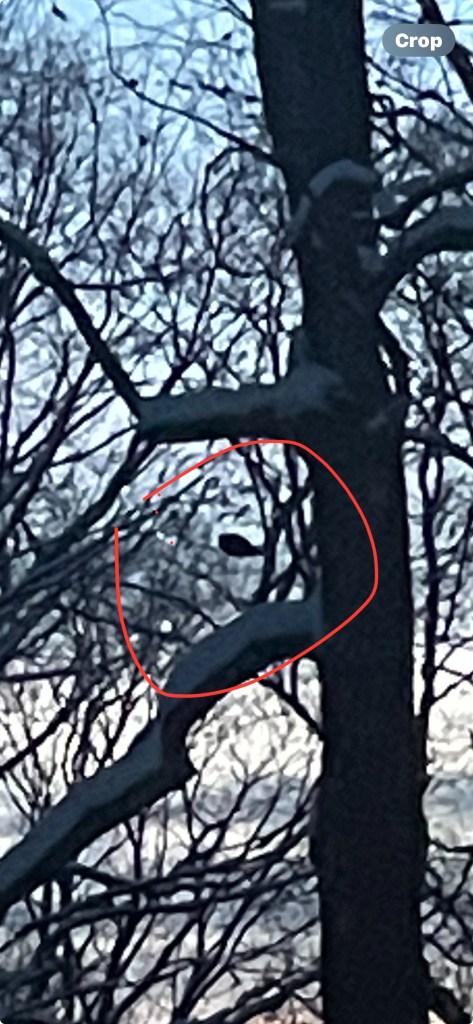
Many of you couldn’t find the turkey in the photos yesterday. That’s because I don’t have a good zoom lens. But here’s the best I can do.
There is a phenomenon I experience which may or may not be common among writers. It is the cultivation of an empty calendar.
This means that when I am trying to get the wheels turning with my writing, I cannot have appointments. I cannot have repairmen coming to the house. (Yes, I know, but in my experience, they’re all men.) I can’t have the cleaning lady. I can’t schedule lunches. I can’t schedule coffees. I only very reluctantly schedule dental appointments and haircuts, but this is mostly only so I don’t lose all my teeth and depress myself looking in the mirror.
This does not mean that I can never do these things. But it means that I can only do them spontaneously—the social things, anyway—after the day’s work is finished and I have exhausted my capacity for further writing. If I schedule something, it haunts me, and even when I try not to allow it, the little voice that plans what to wear and when I should leave interferes with the freedom of mind I need.
Like today, for instance, I have no intention of getting out of my pajamas until I am finished with my work. If I knew I had to go somewhere for lunch, it would ruin my morning. Because by 8 am I would be thinking: I have to stop at 10 so I can wash my hair, and figure out where my black jeans are, and is that new paisley blouse clean. Then I would have to stop, locate the jeans, and most likely dig the blouse out of the hamper to throw it in the fifteen minute cycle of the washer, and set the timer so I remember to put it in the dryer… And by then my concentration is ruined and the day is lost.
This can make friendships difficult, and I’m not sure everyone completely understands. I’m not even sure I understand. But at times like this, I tend to go dark, and although I will respond to texts or emails, and eventually return calls, I don’t cheerfully answer calls. Usually my phone isn’t even anywhere near me.
And I try never to schedule anything. Particularly not on Mondays.
On the other hand, on most writing days, by noon I am ready to venture forth, and I spend a happy afternoon rambling around doing errands, wandering the aisles of the grocery store, then coming home and arranging the new flowers and making something for dinner. If someone is available for a spontaneous something, that’s a bonus. But it’s not essential.
The end result of all this is a somewhat messy house, a somewhat frowsy personal appearance, a long list of needed repairs, and trying the patience of my very lovely friends.
It’s not ideal, but I have learned that writing a book requires several kinds of ruthlessness. And this is only one.
It’s back to work day, an idea our French family members find ridiculous. January 2nd?? The day after New Year’s? It’s too soon!
They’re not wrong.
I suppose I should take down the Christmas tree, which has reached the death rattle phase of balsams. One touch and all the needles fall off the branch.
But I won’t.
Back to work day means back to writing the novel day. No excuses. Not even the fire hazard in the living room. Because somehow I have to discover the link between the beginning of the book and the end.
I recently encountered two different films in which the characters tell the author what to write. In one, people look at one another over the author’s head in a mutual understanding that he is quite mad. But, I must tell you, that is precisely the process: the characters do take over. It’s apparently a common—if not universal—experience of novelists, which, honestly, I find reassuring. So far as I can tell, I may be slightly silly, but not actually insane. At least, not yet.
So, today will be spent listening as much as writing.
Meanwhile, the owls are saying their good nights to one another, and the sunrise is brilliant orange against the blue night sky. I can just see the silhouettes of the roosting turkeys. Auggie snores nearby on the couch. Eli has gone back to bed without me.
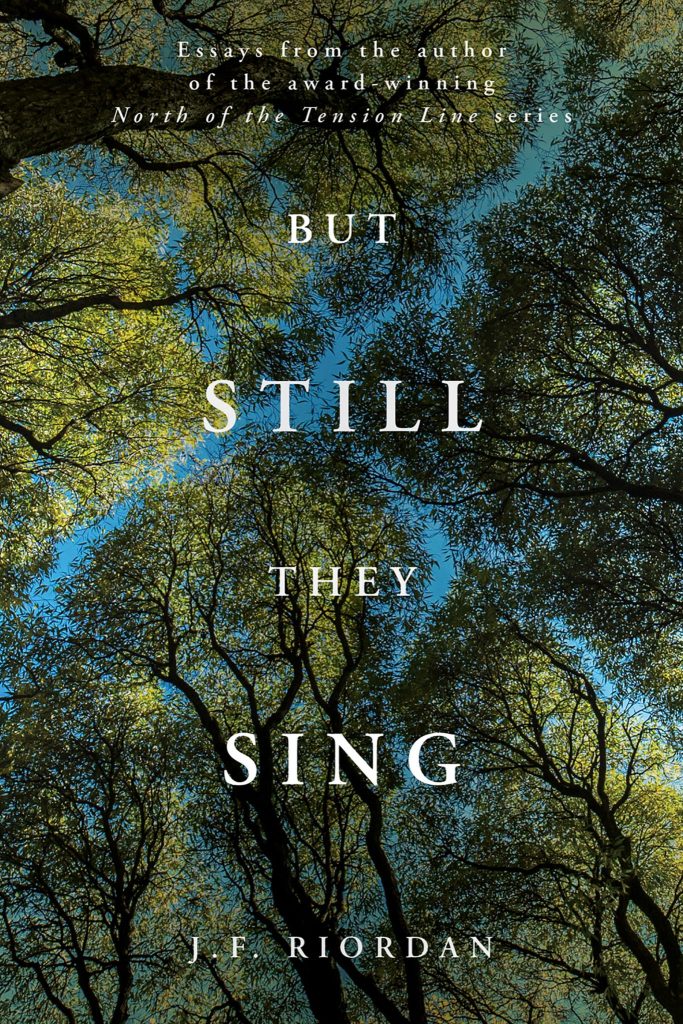
I was asked recently to assist in a list of book club questions for my latest collection of essays, But Still They Sing. Normally, I can rattle these things off easily, but I’m a bit too close to this one, and possibly a bit too distracted. Yesterday I opened the flatware drawer and found I had put a pot lid in it.
I’m wondering whether any of you have suggestions. Please reply in the comments, or, if you find that tricky, send them to me via email to northofthetensionline@gmail.com.
Many thanks!
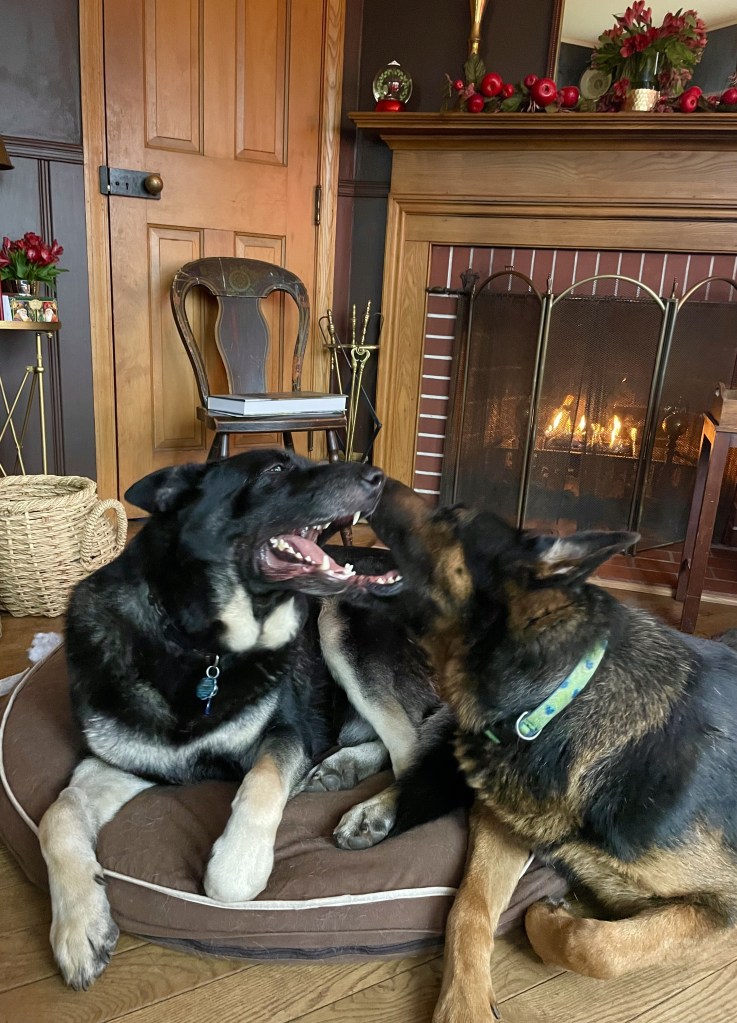
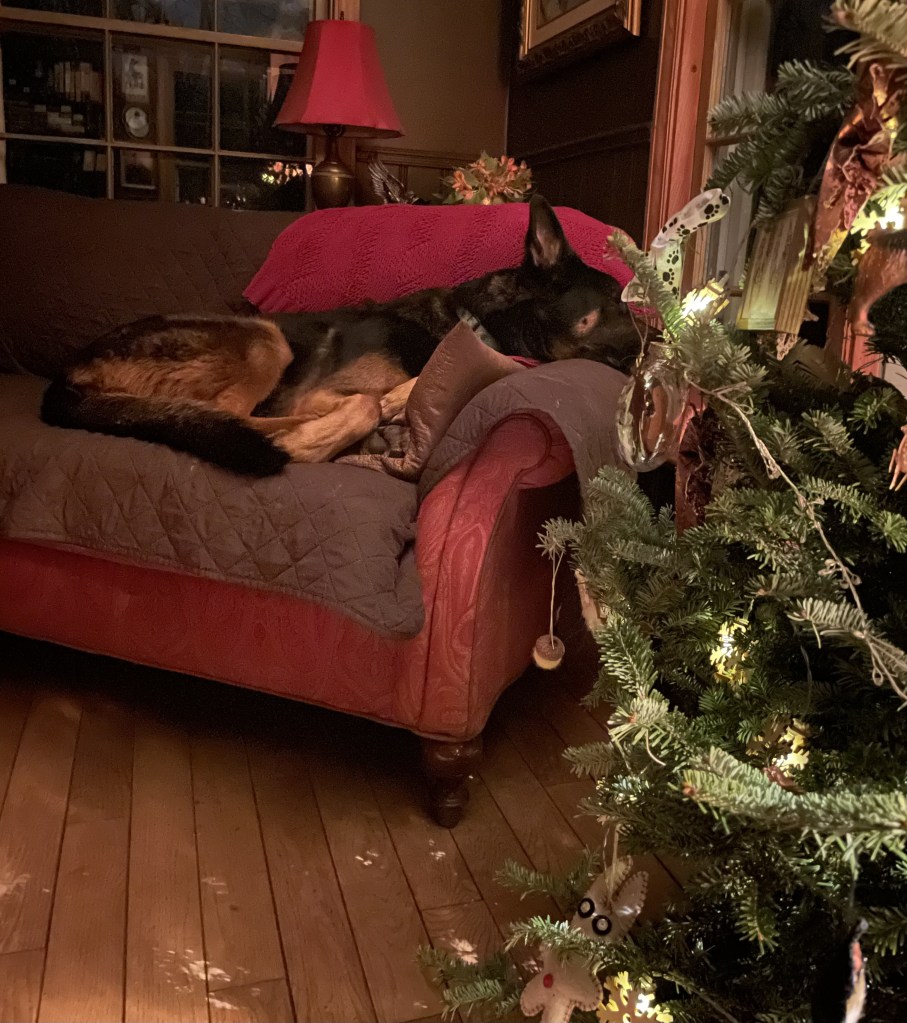
And now for your gratuitous dog photo. Here’s my faithful Auggie, keeping me company on a sleepless night.
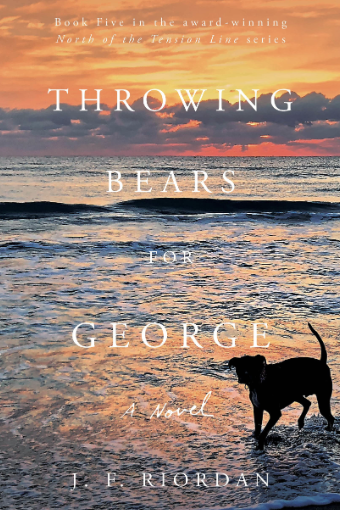
A few months ago a new book came into the world without much notice or fanfare. That’s on me. It came during a month-long houseful of family, amidst all the cheerful jumble and chaos that entails, and also as the final process of signing and shipping and accounting from the previous book was wrapping up. This wasn’t a first book, or a last book; it wasn’t even an author’s first kind of book. And so, like so many middle children, it has had to make its way along with not much help or notice. But now, as I am settling into the coming winter, I look back with clarity at the season past, and there it is: alone, abandoned, but not un-loved.
It is, like my last book of essays, Reflections on a Life in Exile, a very personal book, written mostly amid the ennui of the pandemic. Some of it is funny, some is melancholy, some of it may be slightly mad–a bit like living through the pandemic itself. In whatever mood, I hope you find it companionable.
You can order it from your favorite bookseller ( some of mine are here, here, here, and here ) from Barnes & Noble; from Target; or from the guys in Seattle. Or you can visit your local library and ask them to add it to their shelves.
In any case, I hope you’ll look for it, and if you like it, you’ll leave nice reviews in various places. And if you crave to be the first, no one seems to have ever purchased it from Target.
And, once again, if you still occupy the world formerly known as Twitter, please share with my tag @audacityofgoats.
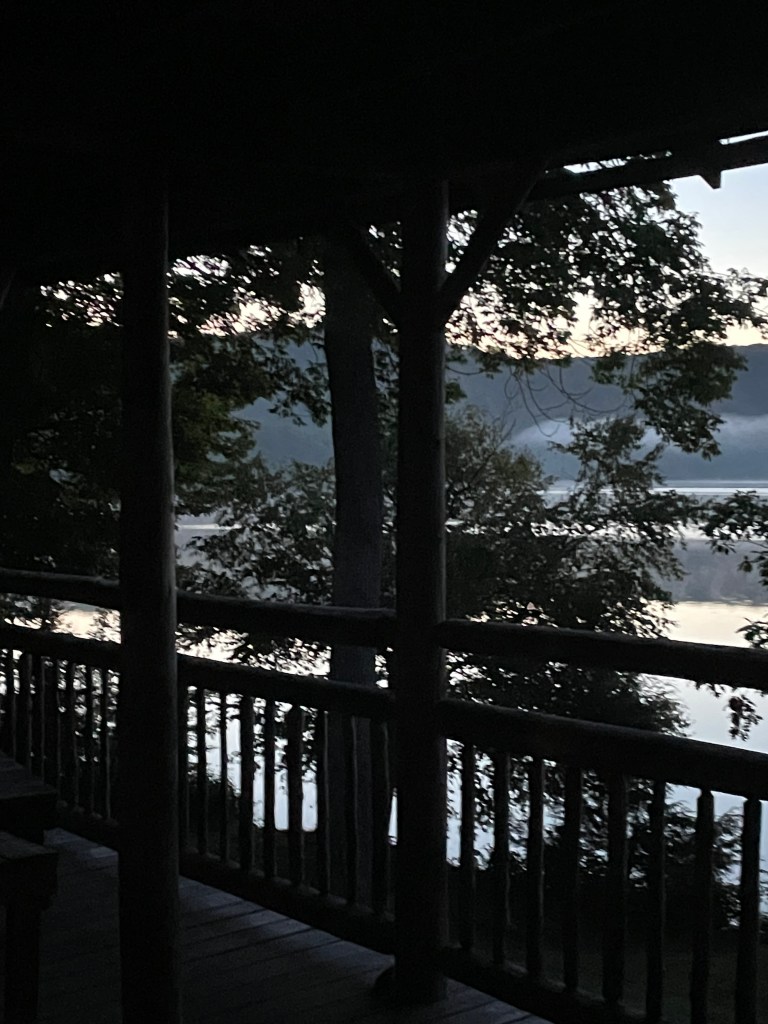
It was pre-dawn and I had been working for hours. I had just stepped out onto the porch at the house we’re renting in Maine, and was enjoying the calm, when I heard a soft, rhythmic noise. Tock-tock-whoosh, tock-tock-whoosh. I thought at first that it was drops from the eaves after all the rain we’d had, but that wasn’t quite right. I stopped, listening, trying to identify it. The sound grew louder, and I realized it was moving and coming from the water. I leaned against the railing to look out at the lake, waiting for a craft to come into view.
It was a shell with one rower. Elegantly thin, moving at a great clip, and leaving geometric designs in the water that widened and faded in its wake. The sound of the oars reverberated across the lake. I thought about the rower’s early morning, rising to be on the water before the sun rose, and felt a bit of envy at the pleasures of deep exercise, alone, with the sun just hidden behind the mountains at the east side of the water. I rise in the dark, too, but depend on hot coffee—although, perhaps, the same combination of joy and willpower—to sit comfortably on a chair, my legs crossed under me, pressing toward my writing deadline. I count words every morning, gauging my progress. Only two months left.
As he rowed back twenty minutes later, his pace was still strong, but just barely slower. Tock-tock-whoosh. The sound rose and fell as he approached, then moved off into the distance, fading into the morning’s birdsong.
It was a moment of deep and unexpected beauty.
It’s surprising sometimes the things that can make life magical.
The house we rented in Maine is very old and very large. It has history. Perched on a small hill above the lake, it has sprawling porches, front and back, and lovely views. There’s a spacious kitchen, a laundry room, and five roomy bedrooms with four baths. There’s a massive stone fireplace in the living room. But it does not have wi-fi, and the cell signal is only one elusive bar, which seems to flit from room to room like a butterfly, and then disappear.
It has been a long time since I have left my phone sitting on the night stand, turned off, and walked away for the day. I feel released from electronic bondage. The impulse, in an idle moment, to look down at the phone is gradually being replaced by a willingness to look up, to think, to let my brain idle. That’s how writing happens.
I had become increasingly aware of the way my phone had taken over my life. I am continually scrolling through my messages. There’s not a scene that passes before my eyes that doesn’t make me reach for the camera. There’s not a drive that isn’t accompanied by a podcast. It’s too much. It’s too many voices. It’s too much externality. And none of those things are good for a writer.
This week I wrote in the mornings. I hung around with my family. We did a complicated puzzle. I sat on the dock and dangled my feet, and thought about things. I jumped into the cold lake. I cuddled children. I drank cocktails. I went to bed with a book.
It was a kind of detox, and it has put me on the path to getting my brain back.
The temptations to return to my old habits will be strong, and I imagine there will be a gradual regression toward over-use. But I have a plan to keep it in check, and at the moment, it doesn’t even seem appealing to go back to my old ways.
When I’m walking the island, my mind wanders to many things. Sometimes they’re related to the book—I often work through plot ideas while I’m walking—but not always. I have learned through hard experience that if I don’t record the idea it will disappear forever. In fact, if my notes are too cryptic, they will may still be unfathomable. Yesterday I had a thought about the coronavirus and the Greek gods. I don’t know why. They were trapped in quarantine on Olympus and bickering together—it made me laugh. but there was another idea—What was it?
Maybe not so funny: that quarantine’s illusion of immortality—of time stretching on infinitely—took away that sense we ought to have of racing against a waning lifetime. Maybe it was a respite for a while? Maybe it was a relief not to have to keep churning. But that idleness—that missing sense of time passing—is precisely what made the gods so mischievous. They had no real purpose, no goals. They were, in a word, bored. And aimless. Okay, two words.
But for mortals, it was an illusion. Time did pass. As survivors, we are, of course, just as old as we would have been otherwise. Or maybe, had the pandemic not happened, we would have been out in the world and hit by a bus. We can’t know. Even for those of us fortunate enough to have spent the pandemic merely unmoored in time, there was great loss; if not of someone we knew and cared about, then of community, of ourselves, of our precious time on earth. I feel new sympathy for the unjustly imprisoned, who must have some version of this same feeling: the sense of having been robbed of time. But especially, I grieve for those whose lives were so directly affected by the illness itself.
But as with all forms of grief, we must choose to either lie down in it and never look up, or to get up and get on with things, knowing that, whether we choose it or not, some new grief or old will be waiting to pop out at us when we are unwary. But then, so will new joys, and new, unhoped for experiences.
We move onward, with resignation and hope together, and that purpose, which comes from our sense of passing time, is the blessing of mortality.




 J.F. Riordan