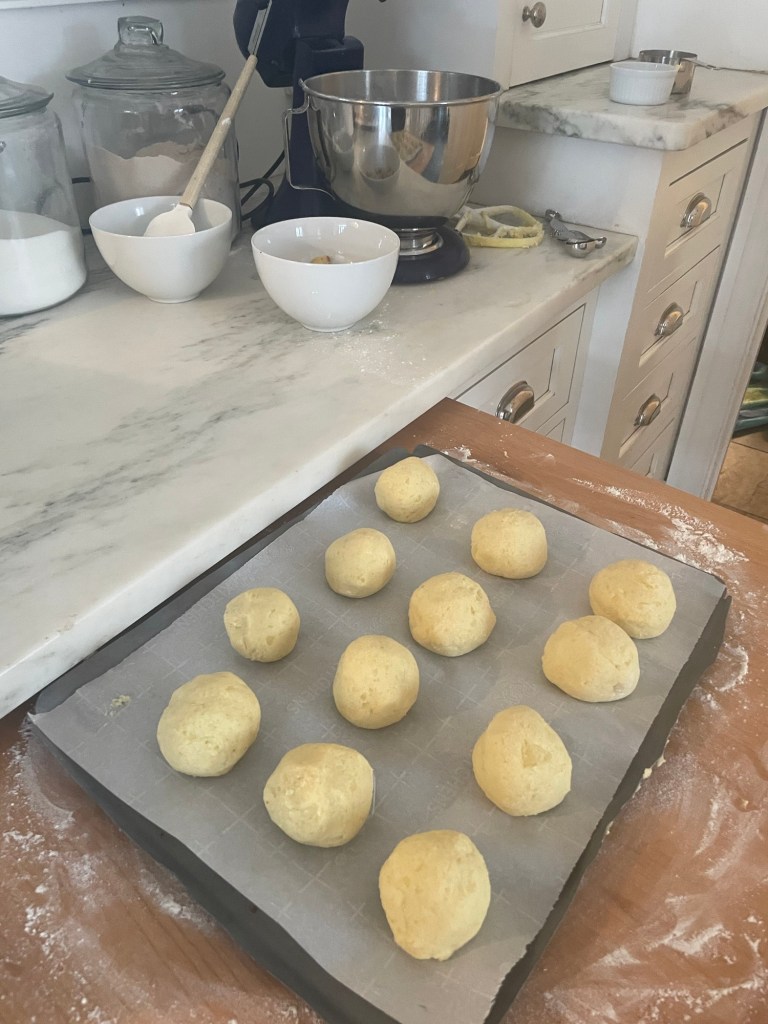
Mainly because I had never made any before. But they were easy and kind of fun to make. I could tell they were done when they floated to the surface of the boiling water.
This was one of those meals with lots of last minute preparation that can be daunting, particularly because all the recipes were new to me. But dinner was a success.
I sent all the leftovers home with my friends. I really don’t enjoy heavy meals like that anymore.
But I could eat a lot of dumplings: so chewy and dense and delicious. I sent them home, too.
Who’s your audience? It’s a question asked of writers all the time. Agents want to know. Publishers want to know. Even book club readers want to know. Most writers know how to gauge our answers to meet our business needs. Of course, to be published, a book needs to meet customer demand. But, to be honest, most of the time that’s only a guess based on what has sold before, and demand can also be created by marketing teams and media campaigns.
So, while I am delighted to have my books published, I don’t think about any of that when I’m writing. I really only write for an audience of one: me.
I write the kinds of books I want to read, and to be honest, while I do read for information, I mostly read for comfort and companionship. When I had high-pressure, stressful day jobs, I didn’t want to come home to read high-pressure, stressful books. I taught in the inner city. I didn’t want to read about suffering, murder, crime, drug use, and lost opportunities. I lived with that every day. When I moved into an executive position, I still spent a great deal of time thinking about human misery and how to help alleviate it. Again, I was often in the inner city, visiting schools, homeless shelters, prisons, half-way houses, and addiction centers. I also had many uplifting experiences in the fine arts world, to be sure. But what hung with me was always the human traumas that went on before my eyes every day.
I don’t think I’m alone in that. Many people have intense, exhausting, high stress jobs. And some of them find catharsis in reading about intense things, perhaps because at the end of a well-written book, there can be a release of the built-up strains.
But that’s not for me. I want to go to a world where there is a group of characters who feel like friends I can hang out with. I want to look deeply at the small miracles of daily life. I want to feel enmeshed and revived by the creativity and joy of an ordinary day. And so, both in the novels I write, and in my books of essays, I linger on the hope, the joy, the beautiful and all the ways in which frustrations, unkindness, and misery can be diminished—although never eliminated—by the way we focus our attention.
And so, when I’m writing, my incentive is the pleasure I take in joining the worlds I’ve created. I write (mostly) about characters I want to be with, who live in a world I enjoy being in. Maybe that’s selfish. I don’t know.
But honestly, I don’t know any other way to write; I don’t think I could write a horror story if I had to. “Write what you know” is the old adage, and I really don’t think there’s any better advice. Luckily, based on my readers’ comments, the kinds of books I like are also liked by other people. And that’s a pretty good system, I think.
So now, if you’ll excuse me, it’s time to go hang out with some old friends.
Cheers.
***
Turkey in the Sky Addendum
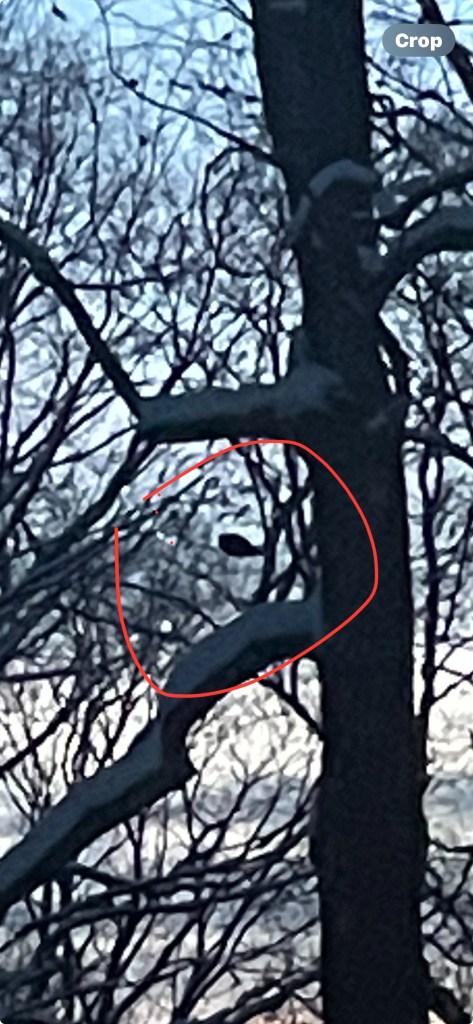
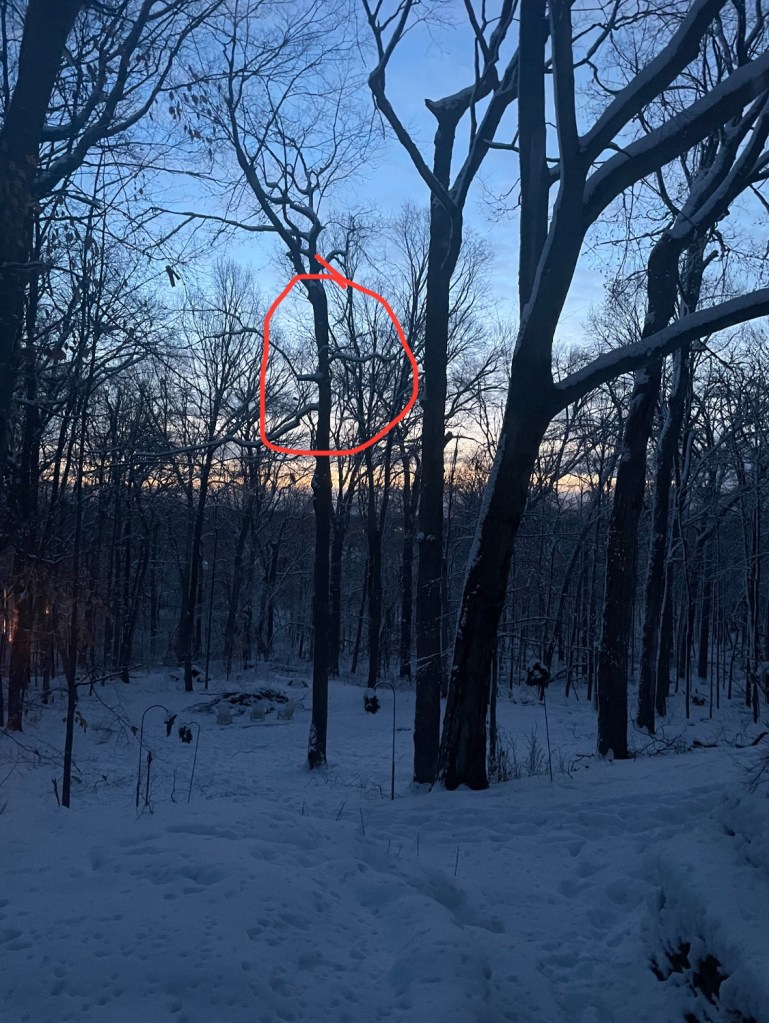
Many of you couldn’t find the turkey in the photos yesterday. That’s because I don’t have a good zoom lens. But here’s the best I can do.
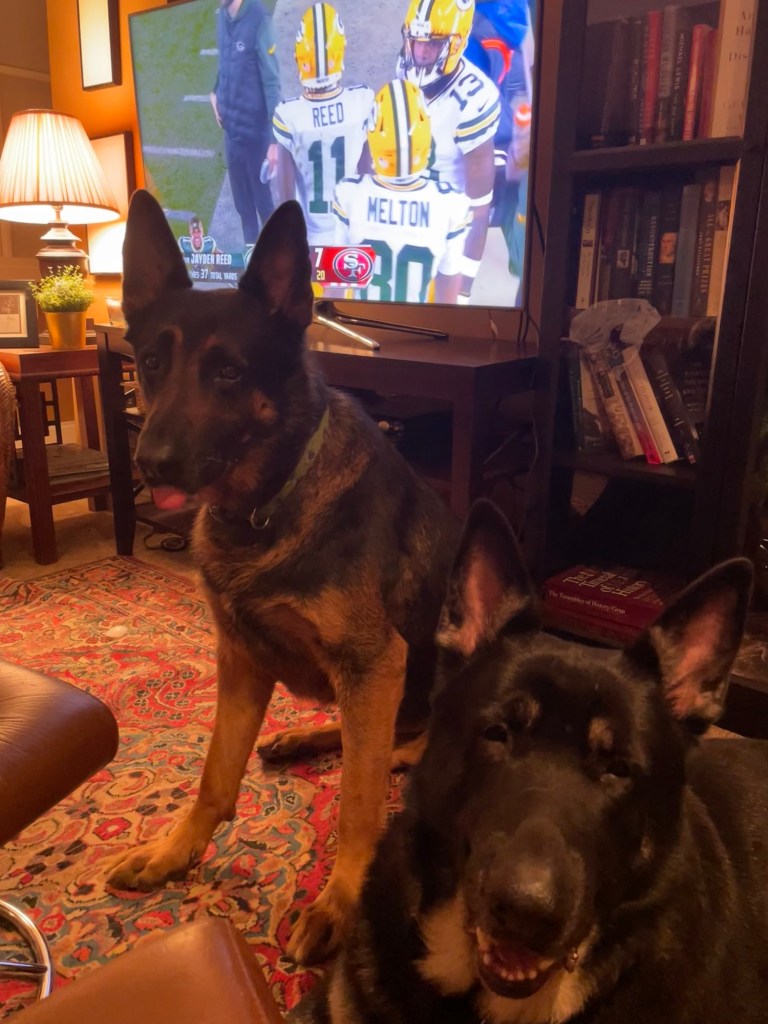
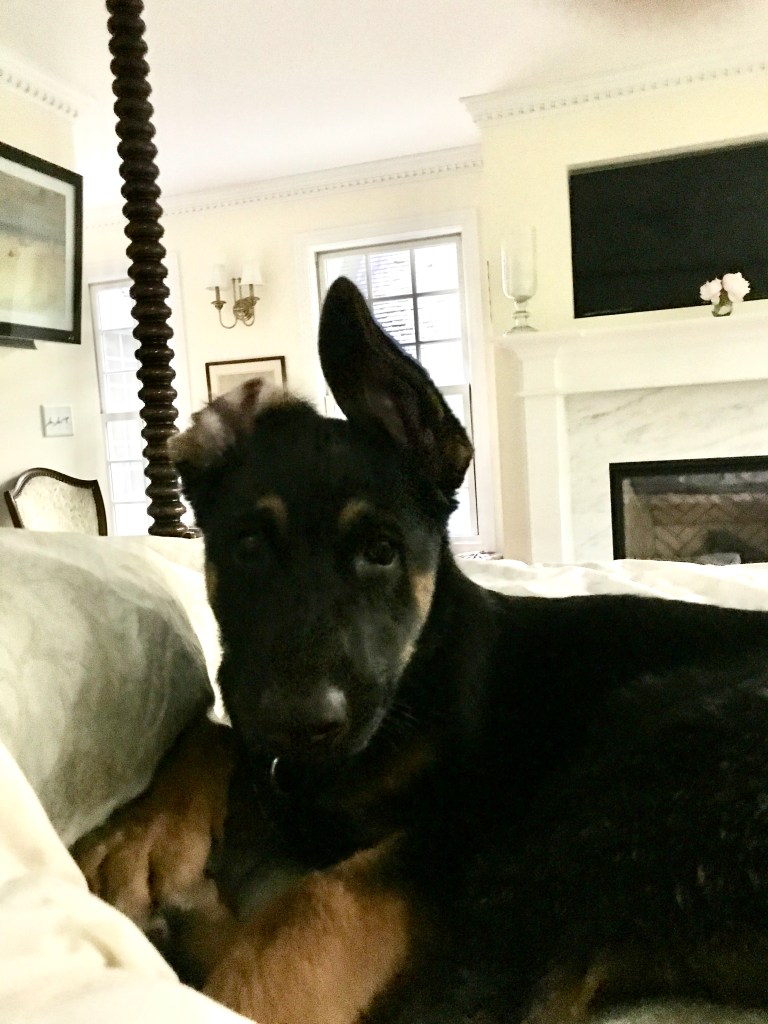
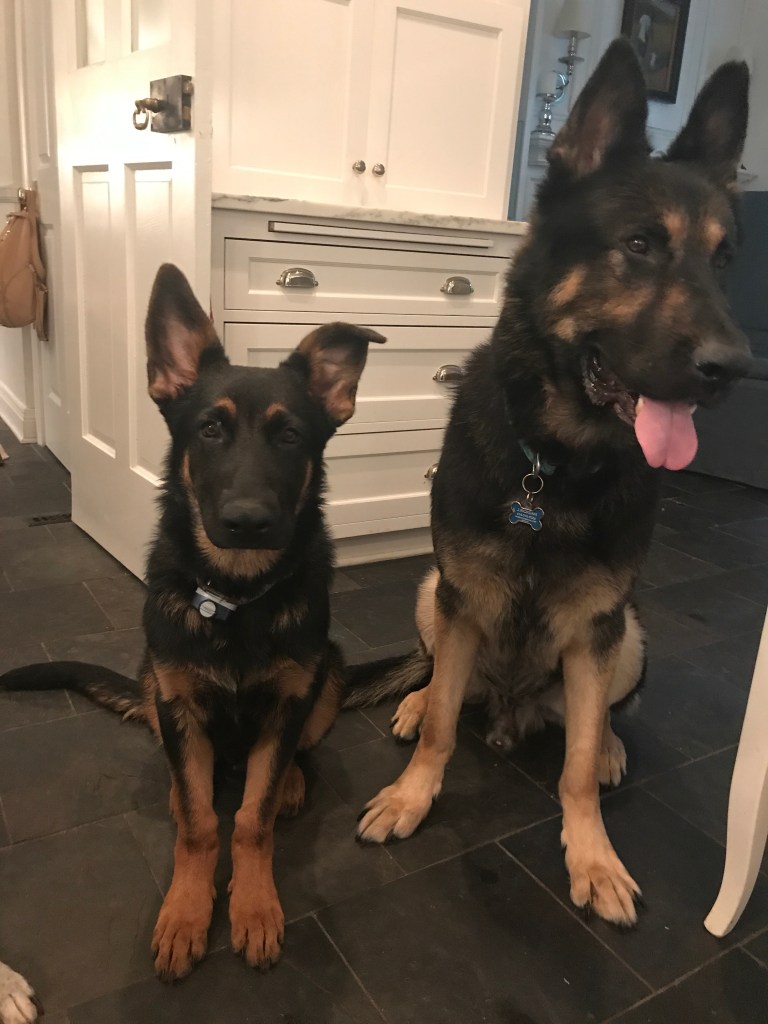
There’s a moment in the life of every German Shepherd puppy when, somewhere around five to eight months old, their ears are permanently up. Until then, they have adorable floppy ears, and for weeks, as they grow, there’s a one-day-up/next-day-down process which is both fun and suspenseful. For some individual dogs, the ears never fully stand. I don’t know if it’s genetics, nutrition, or a lack of ambition. Some owners obsess about whether their dog’s ears will stand straight, but it doesn’t matter to the dog, and it shouldn’t matter to anyone who loves him.
Auggie, two days short of eight weeks old.
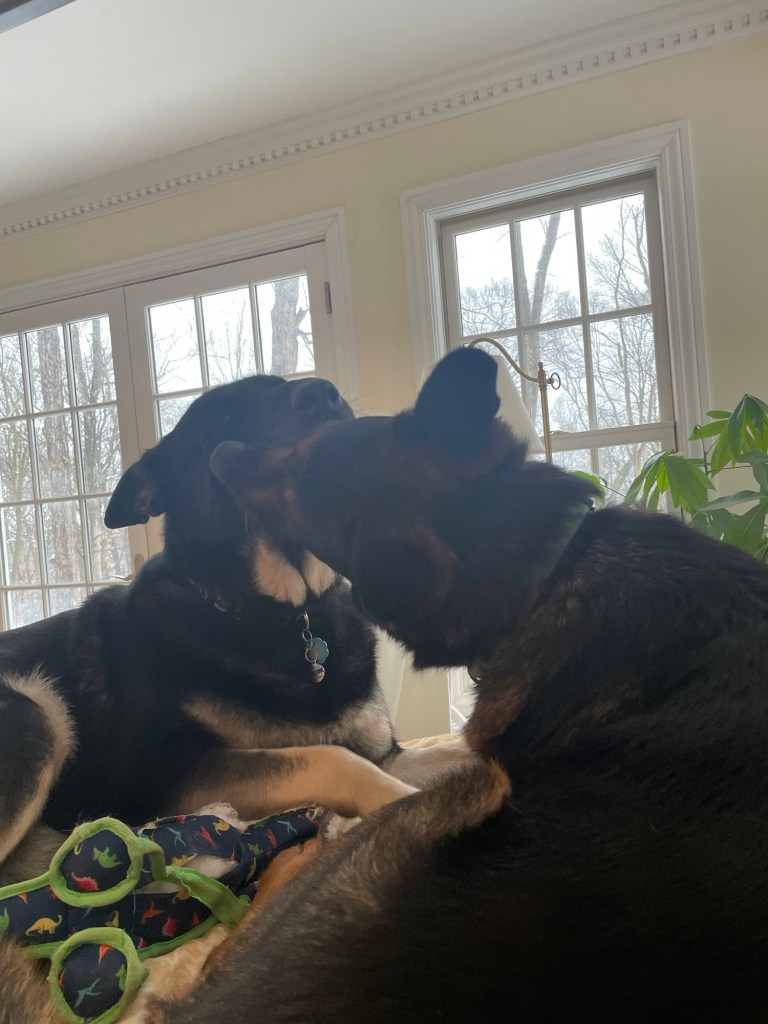
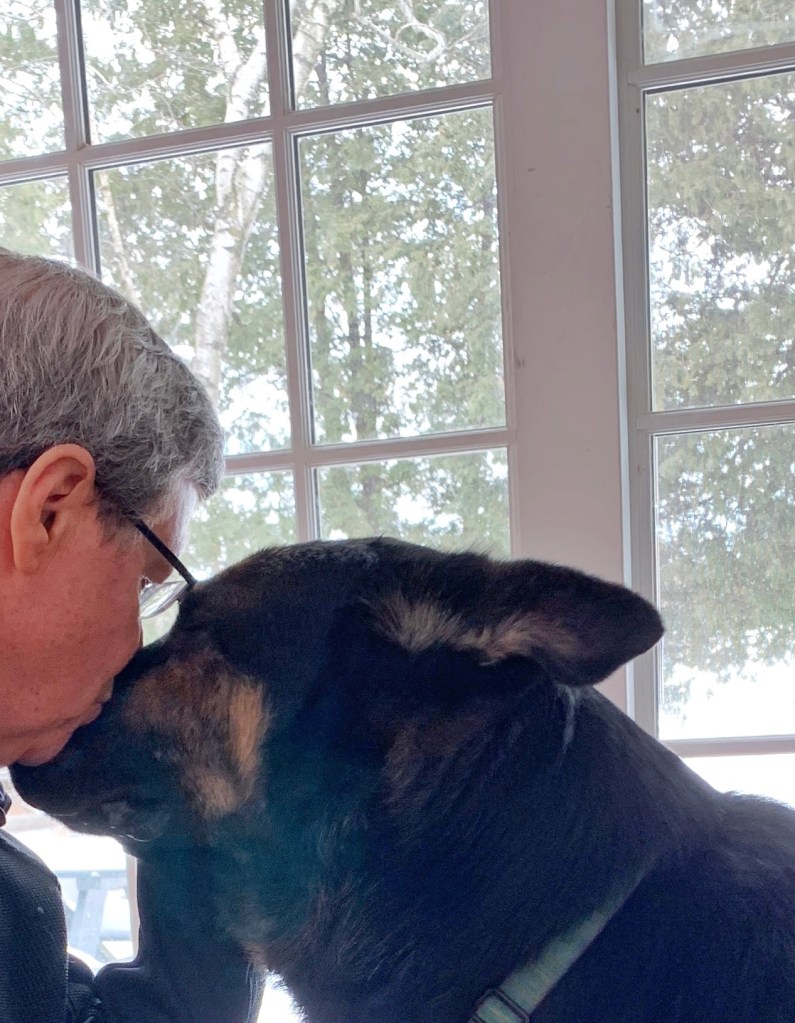
German Shepherd ears are not merely for hearing. They are deeply sensitive instruments of expression and state of mind. If he is showing pride, joy, or dominance, his ears are straight up on the top of his head, slightly rotating to take in data like a space radio telescope. If he is running fast, or swimming, his ears lay flat for aerodynamic advantage. If he is submissive or doubtful, the ears slide down the back of the head. The ears slide back and flatten completely in extreme situations, particularly if he is demonstrating love. A mama GSD will flatten her ears when her puppies approach, perhaps to show she is receptive to their feeding. We call these “love ears,” and we see this daily with our own guys when they want a scratch or a kiss. A fearful German Shepherd will also flatten his ears, and, like any dog, his tail will drop.
Moses, who was the only musical member of my pack, also laid his ears back and stomped his front feet while singing. He loved to sing.
In my experience, no German Shepherd likes his ears touched. Unless you have a deep personal relationship with him, don’t even try. If you belong to a German Shepherd, he may enjoy being touched on his ears, but only when they are flat, or, with my dogs, if they know you are protecting them from a biting insect. German Shepherds will do almost anything to please those they love. But, unless there is life-threatening cold, do not ask them to wear a hat, a hood, or a costume that covers their ears. They will mope and become so depressed you will want to rip your heart right out.
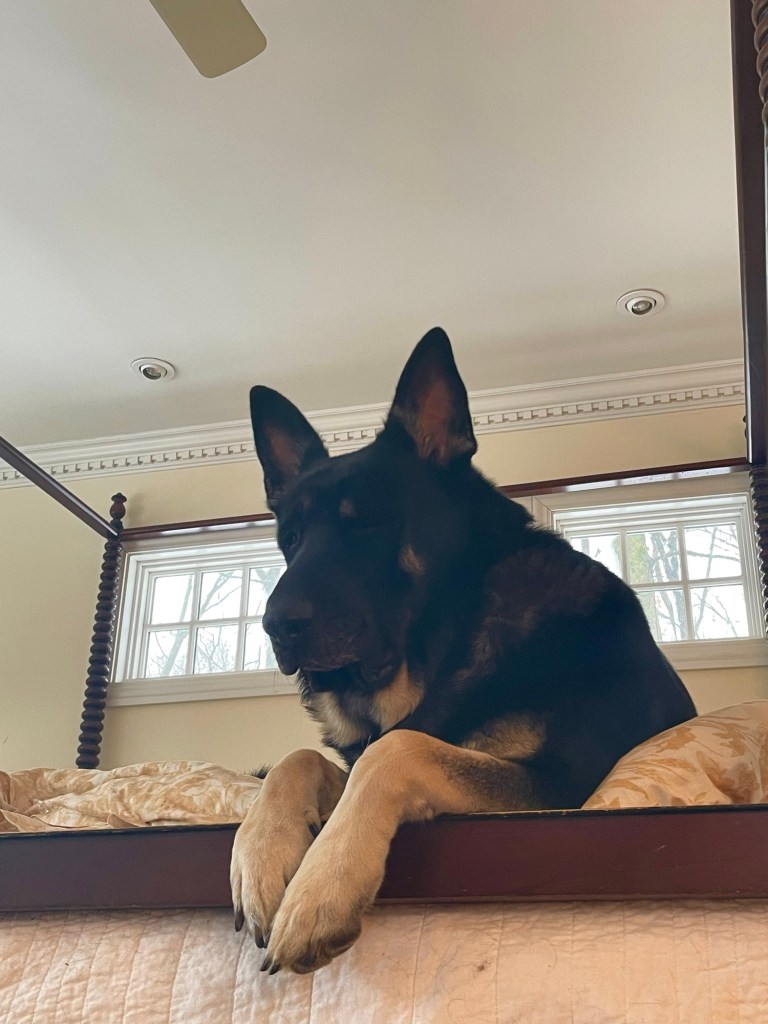
Auggie is a particularly energetic and proud German Shepherd, and has always kept his ears ramrod straight unless in situations as noted above, but also when he plays his favorite charging game. Then, he will wait for my signal to speed toward me at top speed, ears sharply flattened. When he reaches me, growling in mock fury, his eyes sparkle and his ears pop up, straight and tall.
But when he came home from his nearly month-long stay at the veterinary hospital this fall, something had changed. He was cheerful, energetic, and delighted to be home. We had to drug him to keep him from running, and refuse to play his favorite games. “Not now, baby” is a phrase he understands, and he was hearing it an awful lot.
But he was not his usual self in two key respects: his left ear sagged slightly down the side of his head, and his lip on the same side had a droopy spot that caused him to drool continually. I spoke with the vet. Could he have had a minor stroke? Nerve damage? Was his lip just stretched out from having a breathing tube for so long? He didn’t know; it was possible. I felt sad, and slightly confounded by Auggie’s newfound capacity to spread NASA-grade sticky saliva on walls and ceiling (seriously), but I was so grateful that he was alive and home and doing well, that I didn’t care too much. Still, it nagged at me: a signal that he would never be the same.
He’s been home for more than two months now, and he continues to thrive. He is always hungry, and has consequently gained nine pounds. He is still slim, so that’s okay. It’s good, even, because it means he is thriving. Come spring I imagine—unlike me—the weight will fall away. But the ear and lip continued to droop. Until this week. I noticed first that I wasn’t constantly needing to wipe his lip with a paper towel. Then, my husband noticed his ears—perfectly straight and perfectly normal, even when playing Charge.
Had he been he depressed? Was it the crazy regimen of nine different drugs? Had his body been using the calcium to restore something more important, just as when GSD puppy ears flop while they’re teething? I will probably never know.
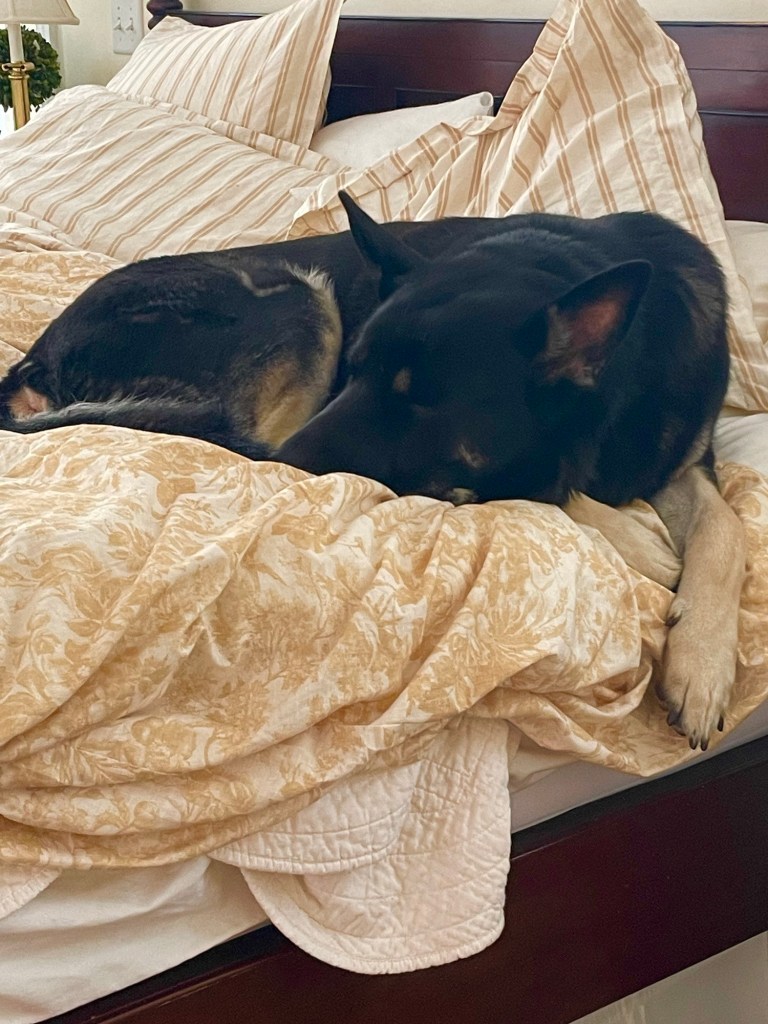
But Auggie’s back to his old self, and that’s all that matters.
Some Apposite Dog Photos
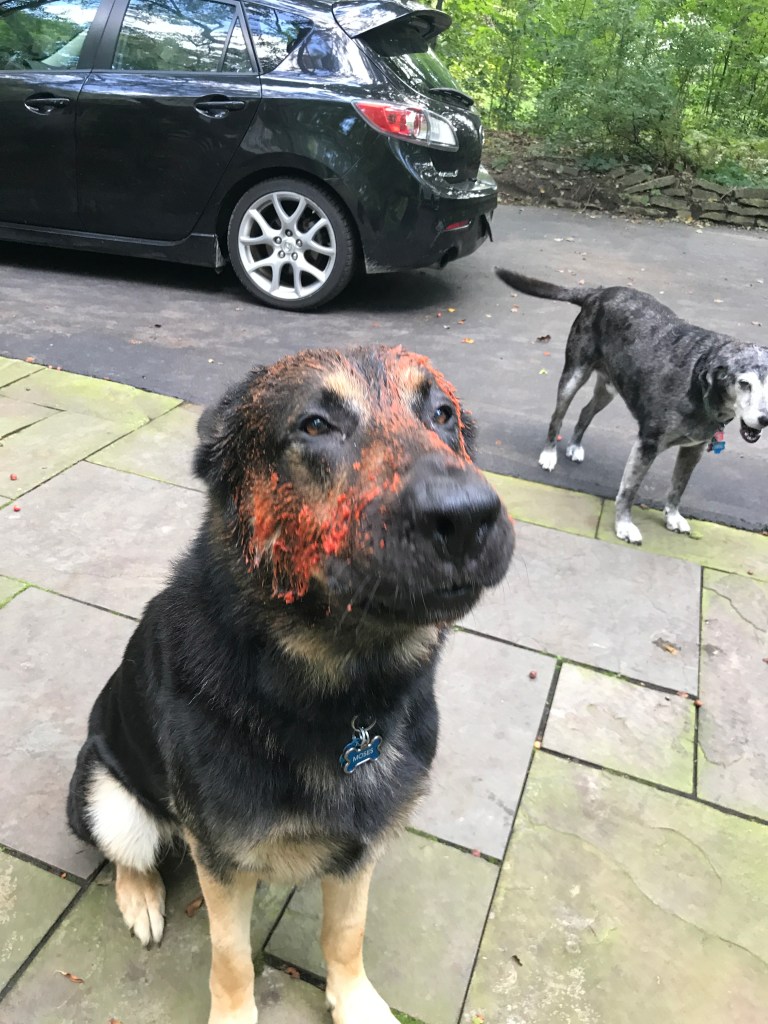
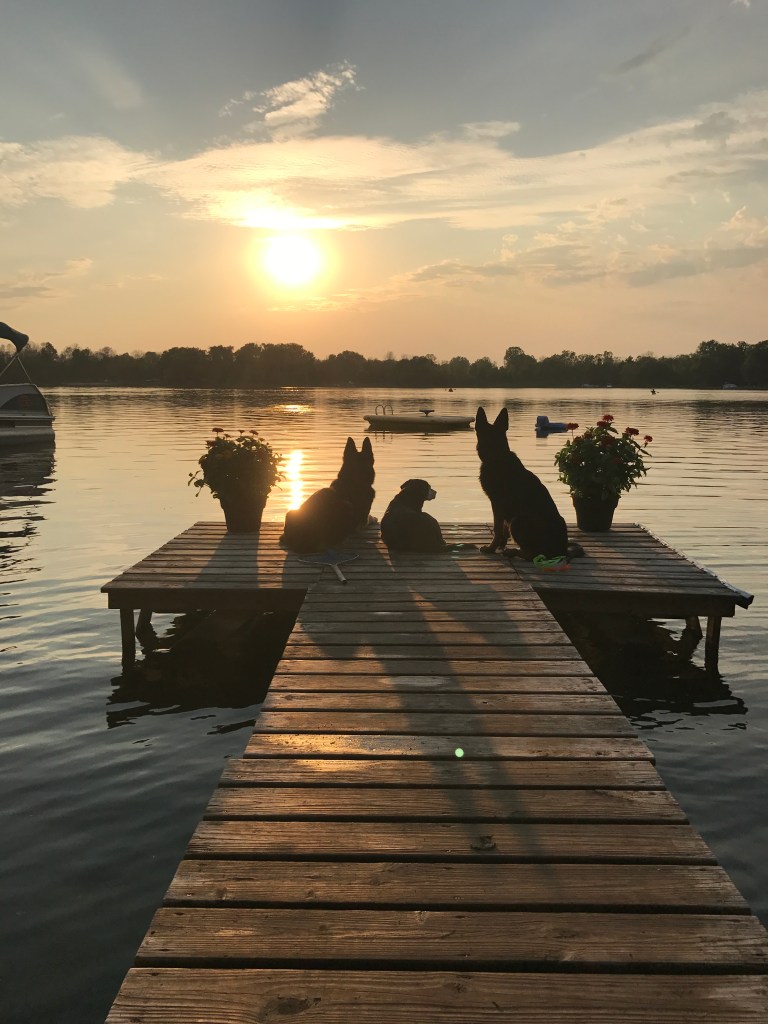
Auggie’s three month ears.Pete, Moses, and four-month-old Auggie.Moses and four-month-old Auggie. Note that his ears are already full-size, even though the rest of him is not. This is the bunny rabbit stage.Moses showing his love ears. You needn’t be fearful approaching a German Shepherd whose ears are low.Moses uses his ears to express his displeasure at being doused with tomato paste (it works!) to mitigate his encounter with an unhappy skunk. He’d gotten sprayed full in the face, and bitten, too. Pete laughs in the background. Moses and Auggie, February 2019. The only time I made them wear hoods was during a polar vortex. It was -25F, and I feared their ears would freeze. You can see their opinion of my decision. The photo made international news.Auggie at five months. Shown here with his brothers, Moses, and Pete. Ears up!







 J.F. Riordan