My brother’s keeper

We’re in the teeth of winter now. The actual temperature is -5F but the wind chill is -15F to -25F, which means the wind sweeps away your body heat at a rapid clip, and flesh freezes in mere minutes. In this bitter cold both animals and humans are suffering. Although we got our power back, not everyone did, and outside in this dangerous weather, there are people working hard to protect the rest of us, restoring power and operating community shelters.

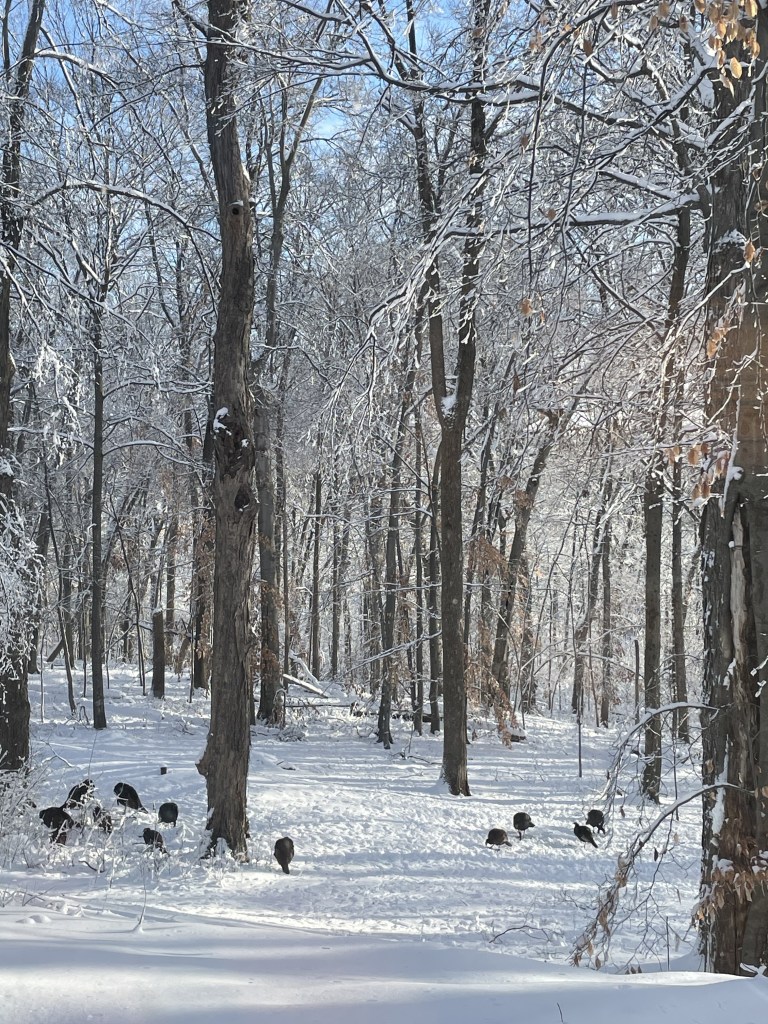
I’m watching the turkeys this morning from my warm, comfortable vantage point on top of the hill, looking down into the woods. We have a flock1 of nineteen this year, somewhat smaller than usual, but always fascinating.

After the deer had finished their morning graze, the turkeys came down from their roosts and spread themselves among the three spots where we have put out seed. As I watched, I saw my one-footed friend—who has been with us for several years now—sit down by himself in the snow, fifteen feet removed from the rest of the flock as they fed. He knew he could not compete with the rough and tumble of the flock’s drive for food. My heart broke for him, because even though the others do seem to look out for him generally, the nature of turkeys seems querulous and wholly intent on individual survival. I told myself he would be able to eat when the rest had finished, but wished I could go out to give him his own little stash. He looked cold and lonely.

As I watched, one of the other turkeys broke off from the flock and walked over to him, nudging him gently. He got up, and together they walked to the pile of seeds, and, shielded by his friend, the injured turkey joined the others and began to feed. For the remainder of breakfast time, the limpy guy ate with all the others.

If I hadn’t seen it myself, I wouldn’t have believed it.

The turkeys are still here, and have been joined by squirrels, junkos, and chickadees. I know from long observation that today, instead of marching off on their usual trek, the turkeys will stay close by, puffing up their down coats, and sitting on logs somewhere out of the wind, preferably under bushes or brush piles. And they will all have eaten enough to fuel their bodies against the cold.

So, who wants to discuss how animals don’t practice altruism?

  1. For domestic turkeys the correct term for a group is rafter. I have been informed, however, that wild turkeys are in flocks. Don’t ask me. ↩︎

It’s a Blizzard

Or close enough.

We woke to steadily falling snow. The wind is whistling through the eaves like the sound effects in a particularly corny old movie, and the predicted snow totals have risen to a minimum of nine inches. We already have at least six, and it’s supposed to snow all day.

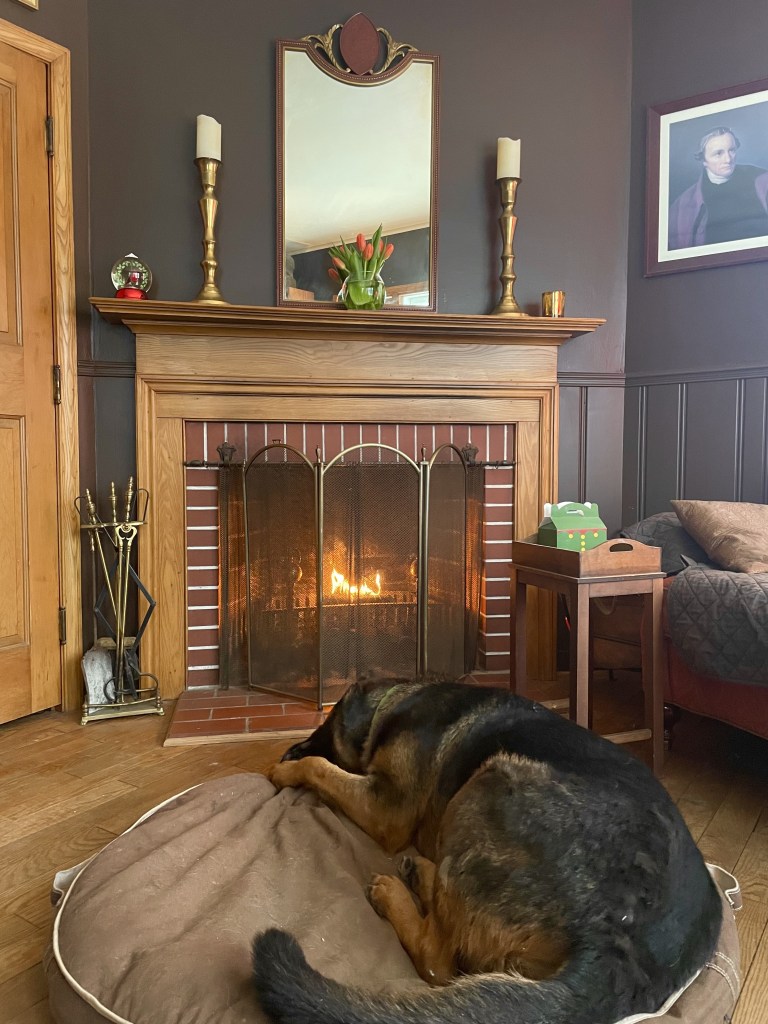
The dogs are in the kitchen, lying on their tummies to better savor their breakfasts of turkey bacon and eggs. There is a fire here, and fresh tulips on the mantel. My cup of coffee steams nearby.

People are stranded on the local highways, and I am betting the blowing snow makes the rural roads impassable. Semis are unable to make their way up minor slopes on the freeways. I hope they will all be merely inconvenienced.

I had planned to run out this morning on a minor errand, but that seems unnecessary. I cancelled the electrician, thinking that standing on a ladder working on light posts seemed unpromising in this weather. He seemed to agree.

Very soon I will need to bestir myself to accompany the dogs on a morning walk. Eli will not go without me, but I don’t mind. I have boots and a good parka, and sufficient inner child to find it fun.

I may have to spread the 160 pounds of bird seed I bought yesterday a bit sooner than planned. I saw the deer chewing on brush yesterday, and things will be harder now. Another child’s adventure.

The local weather guy says we may or may not meet the specific criteria for a blizzard, but why quibble?

Seems like a perfect day to stay home and design new cocktails for Roger.
If you know, you know.

***

Pertinent (as opposed to gratuitous) Dog Photos

Brown Thumb

I suppose I should begin by saying that although my gardens thrive, I am terrible with houseplants. I am so terrible, in fact, that my husband makes little “Help me” voices when I bring one home. My friend, Julie, after yet another botanical demise, recently told me that she would never give me a plant again. But a few years ago, I was inspired by my niece’s spectacular living room trees, and was determined to try once more.

So I bought two of the same variety, and remarkably, after three years, they are not dead. One, in fact, is a beautiful, lush, tree. The other is a pathetic stick with a couple of leaves sticking out.

They live in our sunny bedroom, and in the summer I put them out on the patio to soak up the sun and rain. From the first summer, the one immediately thrived and grew. The other languished. I tried switching their positions outside—no mean task because they are in big, heavy pots—but it made no difference. I brought them in for the winter, and the healthy one kept getting healthier, and the listless one continued its malingering.

Last summer, though, things took a turn. The healthy one grew spectacularly. The wan one kept falling over because it somehow collected water in the pot, and no matter what I did the soil kept turning into a marshy soup. Since they were only about five feet from one another, theoretically receiving the same rainfall and not under a drain pipe or anything, it was puzzling. And since we were mostly at the lake, I lost track, and the poor thing nearly drowned.

By the time I was paying attention again, plant one was spectacular, but plant two was in dire straits. I stood it up, added rocks and more soil, and brought them both inside. They both got fertilizer—probably at the wrong time of year—and as life became busy, I resumed my pattern of neglect.

About three weeks ago, I noticed that plant two had three teeny leaves growing valiantly from its spiral trunk. I was doubtful, so every day I have double-checked. They continue to grow, and so far, seem determined to persist. I am being careful to pay attention, not to over or under water, and I switched positions of the two plants so the desperate one gets the benefit of whatever the healthy one had last winter. The healthy one is…healthy. It’s getting so big, I’m not quite sure what to do with it.

But maybe now the pathetic one will grow, too. My New Year’s resolution is for it to match its boisterous friend.

Hoping for advice, I asked my niece about her beautiful living room trees. They died.

PETE!!! The book is finally here.

A little girl wants a beautiful show dog, but she gets funny little rescue dog, Pete, instead. He’s not beautiful; he’s trouble looking for a place to happen. Based on the story of a real dog, this charmingly illustrated and delightful tale about an unwanted dog ends with love and an unlikely hero, while teaching children not to judge by appearances. Perfect for ages 0-7. Fun for parents.

Now available, a special, limited edition hardcover version of MY DOG PETE, autographed by the author.

Price is $22.00 each, plus shipping.

We have only a small number of these available, and perhaps only for a limited time. You can buy a paperback or ebook version on Amazon for a lower price

To order, go to:

https://mydogpte.shop

Say it with me: PETE!!!

Electronic Narcissism

I like silence. Perhaps it is a commentary on the state of my nerves, or maybe it’s because I’m a former musician and my brain is aurally focused, but I find unwanted noises distracting. I need silence to think and to write, and when I want sound, I prefer to choose whether it’s words or music. So I find the contemporary taste for household appliances that ping, beep, and play tunes extremely annoying. 

If I seem cranky, it’s probably because I have been trying desperately to write a novel amidst continual interruption from household appliances.

I have a notion that devices should A) make your life easier and B) not require distraction from your thoughts, and, come to think of it, C) achieve their purposes in silence while leaving me alone. 

In my quest to break my writing stalemate, I recently packed up and left home for the seclusion of the Island. The house I rent when I go away to write is a place I know well. I have been going there for years, and it’s like a second home. It’s a charming place: roomy, but cozy, with a wonderful property where I can walk in privacy with the dogs, and a lovely landlady who knows the precise formula of solitude and companionship to feed a writer. I have written parts of all my books there, and there’s something about the atmosphere that inspires productivity. My days there are a perfect pattern of writing and walking, and no one disturbs me unless I want to be disturbed. The house is not old, but my landlady had just replaced the range, the refrigerator, and the washer-dryer, all sparkling new and ready to be used. She is a generous woman, and likes to buy quality things.

Throughout my first day, unfortunately, I spent a great deal of time debating when to tell my host that there were red squirrels nesting in the roof. I knew it would upset her, and I also knew it would mean workmen disrupting my writing. The squirrels’ chirping and scratching was irregular but loud, and I feared they were doing damage. It wasn’t until late in the afternoon that I finally realized that it wasn’t squirrels, but the new refrigerator. I have no idea why a refrigerator should make a noise like red squirrels. Maybe someone thought it was cute. Or maybe no one ever spent any time in a room where it was running. I suppose it was companionable, in its way. I mean, at least the noise resembled living things.


The stove however, was much worse than squirrels. Writing can be both lonely and vaguely excruciating, and it is during these moments that I usually take a break to cook something nice for myself. Sometimes the food in my novels is actually something I’ve just made. Food, for me, is comfort, and when I’m alone, I look forward to meals as a way of permitting myself a break, and as a kind of companionship. In some ways, it’s as much about the cooking as it is about the eating. Cooking is a pleasant diversion, and creative, but as I’m chopping onions or browning beef, my mind is able to continue the intellectual rambling necessary for building a story.

So, having grown accustomed to the refrigerator squirrels, after a few hours of work and a long walk in lovely silence, I turned on the oven, and was jolted out of my plot-related reverie by a jaunty little tune. It wasn’t just a beep, but an actual musical phrase, only with tinky-tonk noises. When I set the timer it produced another tune, and like so many electronic devices, instead of one smooth dialing motion to set the temperature, I had to press it each time I added ten degrees, each time producing another beep. When the oven reached the temperature I had laboriously set, it sang yet another tune. Apparently each melody has a specified meaning, but I’m not interested in providing room in my head for determining which is which. I found myself missing my vintage stove at home, whose only noise is the satisfying “whomp” it makes when you light the oven with a match.                                                                          

Then there was the new washing machine. I pack lightly when I go away to write. I mean to say: the car is full of stuff—much of it dog-related, and some of it bourbon—but I don’t bring a lot of clothes, so I’m happy to have a washer dryer in the house, and I often throw something into the washer while I’m writing. This new machine could be featured in a museum as The Loudest Washing Machine in the World, and it makes what I can only describe as a rhythmic mechanical gagging sound for the entire cycle. It’s some sort of water-saving design, which is, I guess, mandatory, but seems a little silly when you’re only steps away from—literally—a quadrillion gallons of water. I found the gagging somewhat less charming than the nesting squirrels.  As if this were not enough, it beeps. Not once, for each time you choose a cycle, or once when it’s finished, but every 30 seconds after the cycle, until you interrupt the sentence you’re writing to get up and open the lid. I have had the care of less demanding puppies. 

Thankfully, I was able to close the door to drown out the worst of the noises, but the beeping penetrated the walls. Not surprisingly, the matching dryer is also an electronic nag. But the thing is, if they make weird gurgling noises and show signs of nausea, how would you know until you got them home? I have a new washer and dryer at home, and they both have the options to turn off the signals. I made sure of that. Of course, I don’t live in the same room with them, either. So there’s that. 

But still.

It used to be that appliances would sit silently and make themselves useful. Now, for reasons I do not understand, they seem to feel a need to call attention to themselves, as if, like electronic toddlers, they are announcing: Look at me! Look what I’ve done!

It strikes me as an indication of a deeply flawed society. What personal failings have led us to develop narcissistic appliances? Is it a reflection of modern life, the electronic equivalent of so-called influencers, who must announce their doings on Twitter, Instagram, Pinterest, and Facebook, or be forced to question the value of their own existences? Have we created appliances like ourselves? Is there anyone who likes this incessant mechanistic signaling? Or is there something about the electronic miasma in which we all exist that assimilates our nerves into a state of noise acquiescence? Is there some consumer movement I need to join to dissuade manufacturers from this evil path?  

The last time I bought a microwave oven I asked the saleswoman which ones beeped only once and stopped. It was clear by her reaction that no one else had ever asked this question, but she dutifully investigated the beeping of each one, no doubt thinking bad words that I am grateful not to have heard. But each time I buy a new appliance, I find that the noise factor has intensified, as if this has become a signal—as it were—of improvement. I believe it is, instead, an instrument of consumer torture.

A few days after I got home and settled into a new appreciation of my quiet appliances, the brand new, very expensive water heater silently burst a valve and unobtrusively leaked water all over the basement floor. 

I felt oddly grateful.

Read the Beginning of J.F. Riordan’s new novel, *A Small Earnest Question*

Book Four in the Award-winning North of the Tension Line series

The telephone rang in the sleek, city office of Victor Eldridge. As he reached to answer the pain came again with a deep, resounding blow that made it difficult to breathe. He braced his hands against his desk, waiting for it to pass as it always did. The ringing phone, mixed in the wake of his agony, was almost beyond bearing.

Victor Eldridge was not a religious man, but what he experienced now was as much of a prayer as he would ever utter. Please, let this be the end of it. Please let the pain stop.

He did not care how.

The ringing and the pain faded at the same moment, and it seemed as if the room echoed with both. He stayed frozen in position, his breathing shallow.

He straightened slowly and leaned back in his chair. There. His breath became deeper and he could feel his heartbeat slowing to its normal pace. His reason returning from the chaos of suffering, he began to think. He had much to do but very little time. The pain was gone. For now. But he knew it would come again.

And again.

***

keep reading on Kindle.