Sometime around 6:30 tomorrow. Moses may make a surprise appearance, but in any case, he’ll be in the studio.
Never try to upstage kids or dogs.
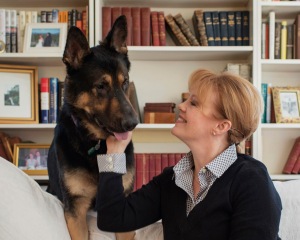
Gratuitous Dog Picture
Sometime around 6:30 tomorrow. Moses may make a surprise appearance, but in any case, he’ll be in the studio.
Never try to upstage kids or dogs.
Gratuitous Dog Picture

I am looking forward to seeing my friends at
1885 Detroit Harbor Road
Washington Island, WI 54246
(Just next to Red Cup Coffee) on
Saturday, July 16 from 2-4 pm.
Stop by to say hello!

I had car trouble yesterday on my way to a signing in Door County. I was tooling along at 70 in the pouring rain, when all of the sudden there was some catastrophic electronic failure. Every dire warning sign flicked on the dashboard. I lost my brakes, I lost my power steering, and the engine began to buck. Fortunately, I was close to an exit in civilization-which for our purposes here means a place with a Mazda dealer only a few miles away–and was able to coast and manhandle the car down a ramp, through a roundabout, and into the parking lot of a minimart.
I hate roundabouts. I mean, I hated them before, but in this case it was lucky I didn’t have to stop. I could just keep coasting.
When I pulled up next to the building out of the way, all the lights in the dashboard went out, and I couldn’t turn off the engine. I had to go inside to figure out where I was so I could tell the tow truck where to come, and normally one doesn’t leave a running car unattended. But what the hell, I thought. It’s not as if anyone could drive it away.
None of this is the point of the story, but I kind of wanted to tell it.
The tow truck showed up in about ten minutes, to my surprise and relief. We were going to be cutting it a little close for me to get to my event, and I was having a hard time figuring out how to explain to the bookstore proprietor–my friend, Peter–that all his planning was going to be for an author-less book signing. I called my husband, who was speeding in my direction to rescue me, and told him he could go back.
Anyway–and now we’re getting to the nub of the thing–the tow truck driver was this young, blond guy with lots of tattoos. He was a kind of classic Wisconsin small town guy, complete with the rural accent: decent, trustworthy, competent, grease on his clothes, dirt under his nails. He hooked up my car, and I climbed into the cab of the truck for the ride to the (mercifully) open car dealer who would loan me a car.
I told him that I was in a bit of a hurry, because there was an event I had to be at. What kind of event? he wanted to know. So I told him I was a writer.
“I love books!” he said. “Harry Potter is my favorite, as you can probably tell by these.” He raised his left arm to indicate his tattoos, which I couldn’t really see, but which must have been representative of this passion. “I listen mostly to audio books, though.” He fumbled in his pocket to get out his I-phone while I hoped that he was looking at the highway. “I’ve listened to…” he looked down at his phone to check the exact figure…”two months and two and a half weeks worth of books this year so far.” He then proceeded to talk about his favorites: after Harry Potter, a series of World War I historical novels by Ken Follet, and some other series in a similar vein. He was knowledgeable about history, and he clearly loved stories of heroism and mysticism. He wanted to know if my books were on audio. I told him not yet, but that we were working on it.
“I read paper books, too,” he said. “But with all the driving around, I do mostly audio.” I kind of doubt that my books are his kind of thing, but so far all my assumptions were being proved false. “Would you like a copy of my book?” I asked. He was enthusiastic.
We got to the dealer, and I dug out a copy of each of my books and signed them for him. We shook hands.
I love thinking about this tow truck driver, wandering around the country roads of Wisconsin, doing this necessary but unglamorous job, the rhythms of different authorial voices accompanying his travels, moved by the heroic acts of protagonists both real and imagined. Along what path will these values take him? How will these stories affect his life and the lives of others? From the seemingly mundane heroism of helping people with broken cars to some other, more dramatic form? Or is it these small daily rescues that give his path meaning?
Maybe he thinks about these things. Or maybe not. Maybe it’s just a job to him, not a mission. But the meanings of our lives may be things we never realize until we’re looking back. Or they could be things we’ll never know.
People are always more interesting than you think.

I will be at Peninsula Bookman tonight, in Fish Creek, to sign books and chat. Peter Sloma, the proprietor, has been a friend and font of wisdom since we first met a few years ago, and I am looking forward to seeing him–and you–there, from 6-8 pm.
I couldn’t find an inn that would take the dogs, though, so I’ll be traveling on my own.
Sigh.
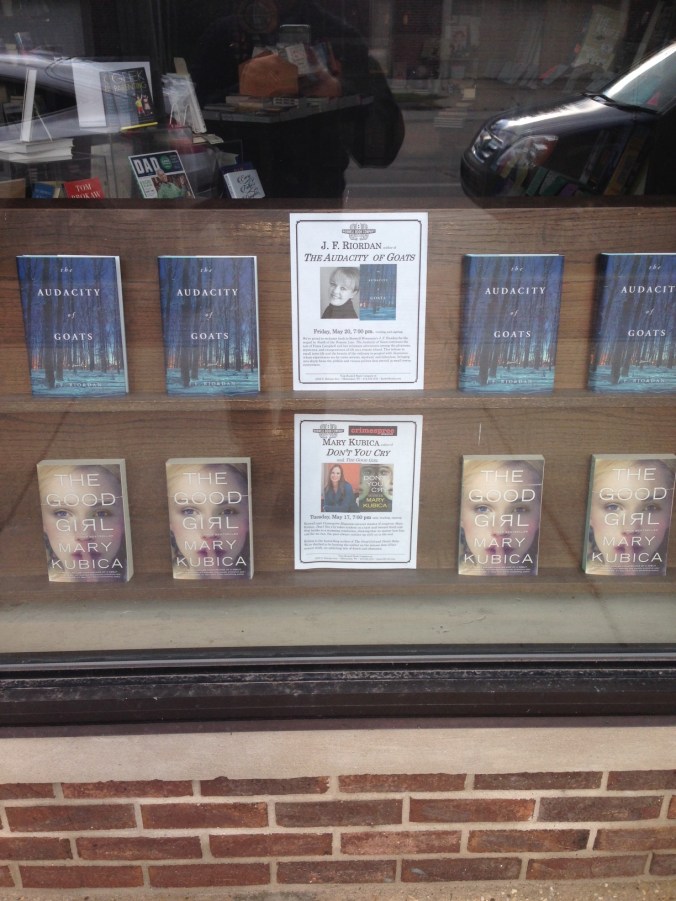
My thanks to everyone who stood in line to speak with me yesterday. I hope you had as much fun as I did.


It’s an amazing thing to find out that the words you put on a page have become a book. And here it is, a beautiful new addition to the set.

Ready to find out what happens next?


[New York, NY] Second in the award-winning North of the Tension Line series, The Audacity of Goats (Beaufort Books, April 2016) is the continuing tale of Fiona Campbell, and her reluctant adventures among the pleasures, mysteries, and exasperations of life on a remote island.
J. F. Riordan has been called “a modern day Jane Austen” for her lyrical prose and rich characters. Her books are a tribute to small town life and the beauty of the ordinary. Peopled with sharply drawn characters whose experiences are by turns serious, mystical, and ridiculous, The Audacity of Goats brings into sharp focus the pitfalls and vicious politics that prevail in small towns everywhere.
In an age of celebrity, this series honors the well-lived life of the common man and woman. Its protagonist, city-bred Fiona Campbell, is a strong-willed, independent woman with an intellectual bent, and a sense of irony that comes in handy during her frequent lapses into public humiliation. Although she doesn’t quite fit into her adopted community, her resolute attempts are wryly observed—and endorsed—by her circle of vaguely eccentric friends.
Elisabeth and Roger are not yet back from their honeymoon when a series of unsettling nighttime incidents leave the islanders uncertain whether they are victims of an elaborate teenage prank, or whether there might be a malevolent stranger lurking on the island. Out-of-state owners of a new goat farm seem to consider themselves the self-proclaimed leaders of the island; Pali, the ferry captain, is troubled by his own unique version of writer’s block; and Ben, the captain’s ten year-old son, appears to be hiding something. But it is only when the imperturbable Lars Olafsen announces his retirement, and Stella announces her candidacy for his office that the islanders realize trouble is brewing. Fiona must decide whether it is time to leave the island for good, or to make another reckless gamble.
The Audacity of Goats is literary escapism that will appeal to both adults and young adults, in a return to characters who feel like old friends amidst the picturesque and mystical way of life North of the Tension Line.
###
ABOUT THE AUTHOR: A transplanted Midwesterner, J. F. Riordan lives in exile from Washington Island with her husband and two and a half dogs. She blogs at http://northofthetensionline.net
The Audacity of Goats By J. F. Riordan $24.95, 5.50” x 8.25” Hardcover 9780825308260 E‐book 9780825307553 Available April 29, 2016 .For more information, a review copy, or to schedule an interview with J. F. Riordan, please contact: Felicia Minerva, (212) 727‐0222, Felicia@midpointtrade.com

Lars Olafsen had been Chairman of the Town of Washington for going on twenty years, and a member of the town board for five years before that. He was a dutiful man, and a public servant in the old fashioned sense. He had earned the respect of his constituents through his fairness, his honesty, and his innate, steady, Scandinavian calm.
But Lars was beginning to feel the wear of so many years at the beck and call of his fellow islanders, and had begun to yearn for a reprieve. His children and grandchildren lived downstate in Milwaukee, and his wife was continually urging that they spend more time there. And Lars, though he was only in his early seventies, was beginning to feel his energy wane, and his enthusiasm for the job with it.
The major consideration, however, was one he would never admit to anyone, not even to his wife. Although his feelings were complicated, secretly Lars still glowed with a feeling of heady triumph after his out-maneuvering of Stella DesRosiers last spring in her mean-spirited attempt to drive her neighbor, Ms. Fiona Campbell, out of town. He had stooped to political blackmail, no doubt about it, and he had suffered many moments of doubt about what he’d done. Had it been a violation of the public trust that disqualified him for continuing in office, or a valiant stroke for the public good? Lars had struggled with this question, but he always returned to the conclusion that it had been no more than Stella deserved, and an act of natural justice. Stella had been bullying her fellow citizens for years without any repercussions other than her unpopularity. And while he continued to wonder whether it was wrong to feel proud of it, his career, Lars felt sure, could reach no greater achievement. “Might as well go out on a high note,” he thought.
And so, one Wednesday night at Nelson’s Hall, when a quorum of his regular circle was in attendance, Lars Olafsen announced his retirement. He was immediately surrounded by a jovial, back-slapping throng, and shots were thrust into his hand in rapid succession.
“Lars,” said Paul Miller, his childhood friend, “you can’t retire. We’re too young.”
“You’ve been an asset to us, Lars,” said another old friend.
“You run a tight ship, Lars. Those meetings will take twice as long without you.”
But the real concern was the one voiced by Jake, who had a reputation for cutting to the heart of every discussion. “You can’t leave. There’s nobody who’ll take your place.”
This was true, as everyone at Nelson’s well knew. Being Chairman was a thankless job, and few people wanted to be bothered with it. There was a slew of paperwork and arrogant State officials to be dealt with, not to mention the unceasing need to wrangle volunteers for committees and other public work, and the inevitable squabbles—both petty and potentially fatal. No, particularly in these days of escalating state bureaucracy, you’d have to be a fool to want the job. And the Island was remarkably short of fools, unless, of course, you counted that new woman, Fiona Campbell.
Fiona would have been shocked to know her reputation. Her intelligence, wit, street savvy, and seriousness of purpose were not things shown to good advantage in a small town. Add into the mix her city polish and lack of practical knowledge of rural life—and the evil rumors that Stella DesRosiers had very particularly and intentionally spread—and an average observer might have an impression of a flighty young woman who wore impractical shoes, was oblivious to the first principles of survival and sensible living, and whose morals were, well, not what one would hope.
Fiona was, in fact, far from being a fool, but this didn’t stop the locals from thinking her one. Many of them—particularly the men—had come to feel a mixture of pity and admiration for her, a circumstance that Stella’s rumors had unwittingly created, and one which frequently worked in Fiona’s favor. In this instance, however, Fiona was exactly as oblivious as her neighbors thought, and it may have been just as well. She went about her business utterly unaware of her many critics, observers, and secret admirers.
Like what you’ve read so far? You can pre-order at your favorite bookstore!
 J.F. Riordan