Big Fur Hat

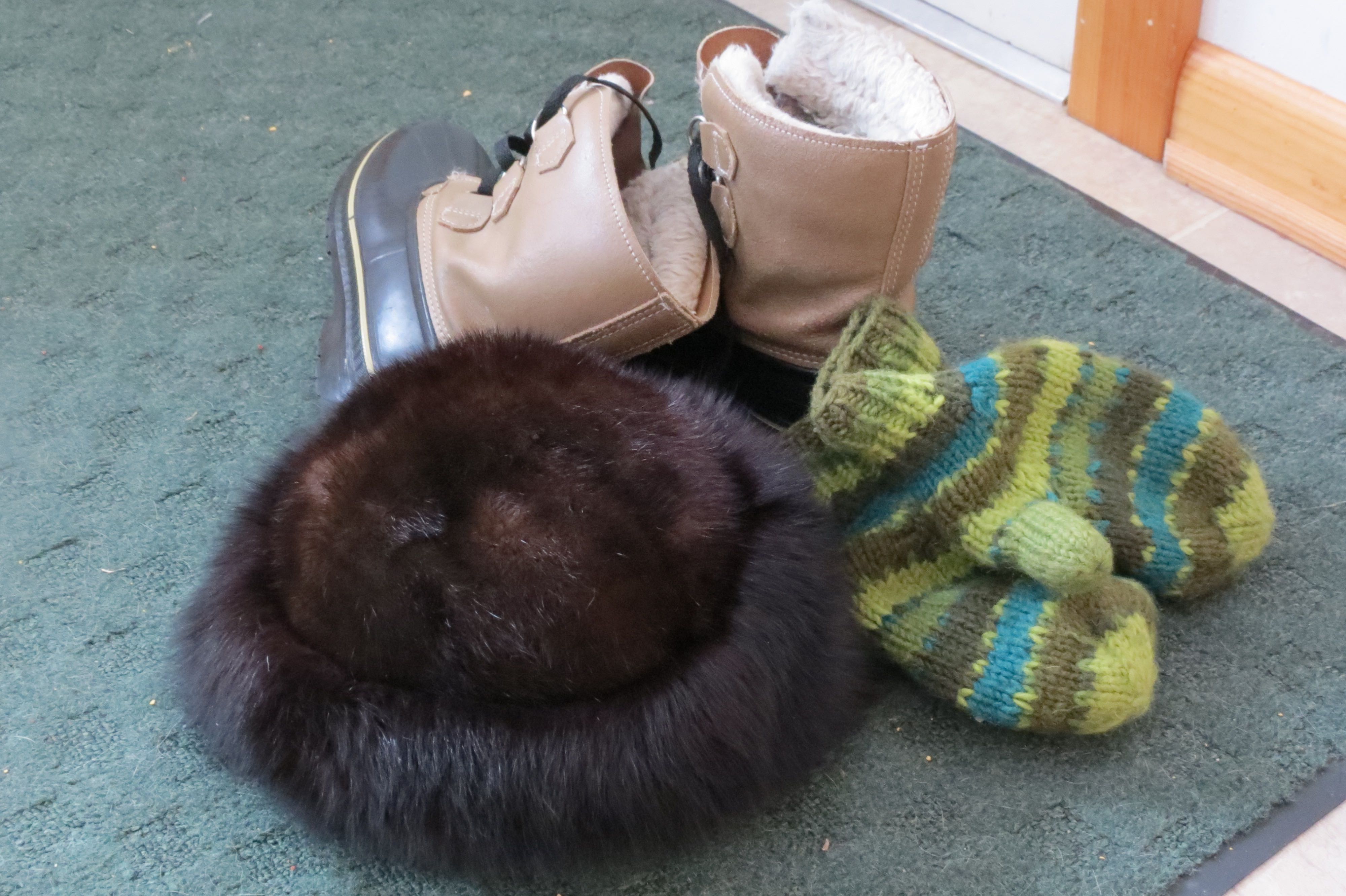
In her last years my mother was always cold, and she complained about it regularly. She always admired ladies she saw with mink hats, and since she rarely asked for anything, a few years ago, I decided to get her one for Christmas.

After some searching I found a company called–Big Fur Hats. I spent a ridiculous amount of money–had she known, my frugal mother would have been horrified–to buy her one. I was pretty pleased with myself when I presented it to her, but I could see instantly that she did not like it. Gamely, she tried it on, and I think she wore it once or twice, but she hated it, I could tell.

The Big Fur Hat (BFH) is mine now, and it is an essential part of my equipment on Washington Island. I don’t care what I look like there–which is part of the fun, I admit–so I wear it when the dogs and I go for our walks. I look ridiculous. Nevertheless, it is a lifesaver, especially when the wind is blowing. Without it, I would be forced to shorten our walks, the source of the dogs’ joy, and my inspiration.

There may be lesson here, but I’m not sure what it is.

Big Fur Hat

A few weeks after blowing all that money on the unloved BFH, I found a vintage mink hat in a consignment store for $12. My mother loved it.

That’s mine now, too.

Last Day North of the Tension Line

January sunset

Today is my last day on Washington Island. The ferry leaves tomorrow at 8 am and we’ll be on it.

Normally I like to walk the deck and chat with the crew, but the dogs are with me, and there’s something about the ferry ride that scares them. So we sit together in the car, and I talk and sing to them. They like that, and they usually sing along. Pete, who is undoubtedly the coward in the family, is mostly unbothered by the motion, but that is enough for Moses. When we hit the ice fields the noise frightens them both and they tremble. It seems to get worse each trip.

Last night I walked home from a dinner party in the dark with the wind screaming from the lake. Its noise and power were awesome–in the old fashioned sense of the word. The dogs leapt with joy to see me, and we went out again to hear the wind and look at the moon and the clouds. They ran ahead of me through the snow, sniffing at deer tracks. The wild remoteness of the Island is oddly comforting to me, and I feel safer here than anywhere else on earth, even when the wind leaps and howls as if it would tear us off the ground and spin us into space.

I like to say I live in exile from Washington Island, and most people think it’s a joke. But leaving this place tears at me, and even though I will be happy to be home again, a part of myself will be missing.

North of the Tension Line’s Publicity Machine

IMG_9009-0.JPG

When people talk to me about North of the Tension Line,, they often mention Rocco, the thoughtful and easy-going German Shepherd who lives with Elisabeth.

When people see Moses-shown above-they assume that Rocco is Moses. But, in fact, the reverse is true: Moses is Rocco. I began writing about Rocco long before Moses came into my life. Opportunism, however, is a new author’s responsibility, and this permits me to bring Moses along to book events.

Children climb on him, people want their pictures taken with him, and, inevitably, when people hesitantly reach out to touch this Big Scary Dog, he rolls over so they can rub his tummy. A dog is a public relations boon.

And also excellent company for the road.

What’s Under My Desk

What's under my desk

There are all kinds of interesting ways for authors to communicate with their readers and with one another, and on one site authors are asked to post photos of where they write and compose a little essay about it. Don’t tell my publicist, but I haven’t done that yet. Still, I couldn’t help feeling as if I should post this edition, not of where I write, but  of what’s under where I write.

At the moment we are in the midst of  post-construction landscaping, and maybe the sound of the bulldozer is scary. For whatever reason, Moses, who is always nearby anyway, is unusually close. I am writing with his head on my feet, and his ears pressed up against my knees. It’s kind of nice, actually.


Love and Grief

IMG_4810

My husband likes to say that Moses is a tuning fork. He is our German Shepherd who loves by pure concentration. His every focus is on those he loves, and he trembles when he senses our stress. The night I left to go to my mother in her last crisis, he fought to be with me where he could not come, even as Charlie lovingly urged him to stay at home.  In his distress, gentle Moses put his teeth on Charlie for trying to stop him from getting in my car. It was a protest, not an attack. But my leaving Moses behind was a betrayal to us both.

As a comfort and a way of drawing out my stillborn sorrow, I have been re-reading Madeline L’Engle’s adolescent novels which are explorations of faith and mortality. They will provoke my grief eventually, if not immediately. My own faith, so relatively new and untested, is approximately the same as the novel series’ teenager as she encounters death for the first time: in a friend’s father, in a friend’s illness,  then in her grandfather. At the same time in the story, a dolphin’s baby dies, and the teenage protagonist writes a poem. Maybe it isn’t great poetry, but I like it because it expresses the value of life and love regardless of the boundaries of species. In it the angels weep because every life matters even in the span of the universe.

I am in a place where I am gathering all the love I can find. And the love of Moses, who sleeps now at my feet, is a treasure as deep as any I can claim.

The devotion of dogs is not new. Homer acknowledges the love of Argos, the dog of Odysseus, who, waiting twenty years for the return of his master, is neglected, flea-ridden, and sleeping on a pile of dung. And yet, when Argos at last sees his master–even though no human creature recognizes him–Argos wags his tail in greeting to the one he has always loved, and dies. Odysseus, who has endured the battle of Troy, Sirens, Circe, the Cyclops, Scylla and Charybdis, the deaths of all his companions, and the wrath of Poseidon, nevertheless weeps for the love of his old dog.

Moses is a dog. And his deep love for me is as real and palpable as any other love I know. He grieves when I grieve, and he is filled with joy when I am. What is love, if not this? And what greater comfort in grief than this deep devotion?

His soul reaches out to me and, gratefully, I answer.


The Most Beautiful Day in the World

One of my favorite writers, the melancholy anthropologist Loren Eiseley, wrote an essay called “The Most Perfect Day in the World”. In it, he describes a day when, utterly impoverished and riding freight trains across the country, he and a friend stopped in a small town on a sunny day, pooled their resources to buy a case of grape soda, and lay on the grass in the shade of a big tree all day, drinking soda and watching the clouds. This notion of perfection would not suit everyone, but it strikes me as a fine expression of the pure enjoyment of living: when time stops and you can live in this one moment, freed from fear and worry.

Today I am home from the office, ostensibly to proof my manuscript. But I have not done much work.  It is a delightfully cool, breezy June morning, the first time that sunshine has combined with the full fresh bloom of early summer. The dogs and I lolled on the grass before attacking the long list of procrastination–I mean errands–on my list. I walked in the garden where the irises are an edible deep purple, the pink roses are in bud, and the peonies are tight balls waiting to burst. I rambled out to the garage to find the loppers to prune the dead branches from the climbing rose on the arbor, and wrestled them to the ground without too many thorn pricks.  It is impossible to breathe in the air on day like this without experiencing a deep sense of wonder and gratitude. This is how I would like to spend my mornings forever.

But the day’s beauty makes a hard contrast to the suffering happening in this moment in other parts of the world, of the people who are terrified, in pain, in fear of horrible deaths, in an agony of despair for their futures. Marcus Aurelius counsels the practice of these contrasts as a method of valuing each moment of life and of inuring the soul against too much dependence on the vagaries of fortune. I read his teachings, and I have tried to absorb them. And I believe that we must all do what we can to make what we touch better, and to broaden our reach to others. But I think that modern angst is the result of our knowing too much about the suffering we cannot control. We are bombarded by war and poverty and natural disasters in every corner of the world, by the sufferings of people and the sufferings of animals. There is no doubt that we are meant to endure the suffering around us. But the suffering of the whole world is not a burden a human being can bear.

And so, Pete, and Moses and I will go out into the orchard and play ball in the sunshine, grateful for our blessings. But I will also offer my prayers for the souls in the dark, knowing that I am helpless to give them any relief. For us, it is the most beautiful day in the world. And that is how it has to be.


Things That Matter: Three Decades of Passions, Pastimes and Politics

I was honored to be able to introduce Dr. Charles Krauthammer at the Milwaukee Public Library in 2014. I feel fortunate to have met him on several occasions, and found him to be soft-spoken and kind, and best of all, a dog lover. The world is a better place with him in it. He and his family are in my prayers today.

In this age of tweeted selfies, twerking and Miley Cyrus, Charles Krauthammer is that rare and essential thing: a public intellectual.

He is, by most estimates, the nation’s leading conservative commentator, noted for his insight, his wit, and his clarity of mind.

An alumnus of McGill, Balliol, and Harvard, trained as a doctor, along the way he re-invented himself as a writer. He has described his life story as improbable and characterized by serendipity and sheer blind luck.

He is the originator of the phrase “The Reagan Doctrine”, and he has been a keen observer of, and indeed, a profound influence on American foreign policy for over three decades.

He is distinguished by being, in his own words, “the only entity on earth, other than rogue states, that has received an apology from the White House.”

And he is a fierce opponent of the errant comma.

His most recent book, Things That Matter: Three Decades of Passions, Pastimes and Politics, is a collection of his columns. It is a wide-ranging demonstration of the breadth of his interests and the fluency of his thinking, all built on the fundamental premise that politics is just a means to an end; That it exists only to make possible the things that matter: friendship, love, art, philosophy, baseball, science, chess, nature.  Politics, for all its banality, is the essential platform for these real things. And if politics goes wrong, all these things—the things that matter—are destroyed.

In reading Dr. Krauthammer’s book you will learn—if you hadn’t already known it—that he is a man of deep feeling. The ringing simplicity of his eulogies to his brother, his mentor, his friend, the subtlety of his humor, and his relish for the ridiculous make his writings both companionable and engrossing.

And if the underlying compassion of his essays is not evidence enough of his character, Dr. Krauthammer is a dog lover. At the passing of his son’s black lab, Chester, he wrote:

Some will protest that in a world with so much human suffering, it is something between eccentric and obscene to mourn a dog. I think not. After all, it is perfectly normal, indeed deeply human to be moved when nature presents us with a vision of great beauty.

Should we not be moved when it produces a vision—a creature—of the purest sweetness?

And should we here tonight not be privileged to encounter a man of such depth and fundamental humanity?

March 6, 2014

Centennial Hall

Milwaukee, Wisconsin
Pete Loses his Wingman-Part 2

I wrote this series of essays two years ago, and I publish them here at the request of a friend who just lost her big dog. My sympathies, Anna. He was such a good, sweet boy.

Pete woke up this morning an only dog. He is an animal with odd pockets of timidity, and has depended on Reggie’s cheerful steadiness for inspiration to leave the warmth of the house. Normally when we get up in the still dark mornings both dogs rush out together, but this morning Pete wouldn’t go. He doesn’t like the wind and he doesn’t like the rain. I put on his coat and told him there were squirrels. He wouldn’t go. There were no squirrels. Pete isn’t stupid, and Reggie wasn’t there to encourage him.

We had a rough night last night. Our kind vet and one of his techs came to the house while Pete was locked away upstairs with a very nice bone. We held Reggie and told him we loved him and used something I learned from the late Barbara Woodhouse, an old-school British dog trainer whose advice was of mixed value, but who said that the phrase “What a good dog” had an electrifying effect on dog morale. It was a term with meaning for Reggie, and we said it repeatedly, along with other endearments that are embarrassing for me to admit, but which Reggie seemed to like. He passed into a deep sleep and was gone. They carried him away. We cried.

Pete wouldn’t come down. Pete is our rescue dog. Part whippet, maybe; part pointer, maybe; part lab maybe. It’s a lot of maybe. We call him an Indiana Spotted Dog, because he came from a kill shelter in Indiana. We were told that he was abused, but he’s never said anything about it. His disposition is a curious mix of Eeyore and Eddie Haskill and he is extremely skillful at gaining love, even from strangers. But his courage—and he actually has a great deal—has always been supplemented by the knowledge that he had a larger, eager comrade who was never as fast, but always right behind him. Anyway, in the end, we went up and sat on the bed with Pete so he wouldn’t be alone.

This morning will be the first of many adjustments for Pete. All the bones that are scattered around the yard are his now. He gets both the squeaky squirrel toy and the squeaky frog. There will be no one to steal the thrown tennis ball from because he’s faster; the ball will be for him. He doesn’t have to nudge his nose in while someone else is being loved; he gets all the love to himself. He gets both windows when we go for a ride. He won’t have to hang around veterinarian waiting rooms to offer moral support. And the two months of gourmet foods: the sautéed chicken livers; the chicken breasts; the raw beef; the Italian sausage will suddenly cease. It will be back to health food, which is boring, as we all know, but important if you have a future.

We did the right thing. It was hard, but it had to be. I found myself thinking of my late father over the long last days, and remembering the agony he was forced to endure from this same disease.

Thank you to all of you who sent us so many words of kindness and support. You can never know how much it meant to Charlie and to me. Pete can’t write a thank you. But I think he would if he could. Maybe.