Letting go; Holding on

I’m keeping my nails ridiculously short these days. It’s partly because I am playing the piano again, and partly because getting my nails done bores me. I am at the point in life when I don’t want to waste my time. And I am not trying to impress anybody.

There is a fairly thin line between feeling free to do what you want and letting yourself go. It’s a much thinner line for women than for men. Gray-haired men look distinguished. Gray-haired women usually just look old. I have a friend who decided to stop coloring her hair, and she looks fabulous. Not everyone does.

Most days, when I am at home writing, I still do my hair, wear mascara, and make an effort to look nice. I partly do it so my husband isn’t horrified (not that he would ever say so, even if he was). But I mostly do it for myself. I feel crummy all day if I don’t make some effort, even if it’s not all that noticeable to anyone else.

I have two particular women I always keep in mind as examples. One is someone I knew quite well. She was a friend of my mother’s who lived to be 108. Her name was Blanche, and I got to know her as an adult when we were both docents at a tiny art museum. Even though we worked together, I never dared call her by her first name; it would have been disrespectful. She was an alert and intelligent nonagenarian, and every time I saw her—even at her own home—she was nicely dressed, wearing a touch of makeup and a little bit of jewelry, and looking nicely pulled together. She was never overdone. But she took care.

The other is someone I never even met. Some years ago I was invited to speak at the opening of a museum exhibit. I only knew the curator and some of the museum staff, so after I did my part, I had the pleasure of carrying a glass of champagne while I wandered alone in a gallery of Dutch masters. This, I confess, is just about my favorite thing to do in the world, and I rarely miss an opportunity to hang out at the National Gallery. It soothes me.

But, as usual, I digress.

On my rambles, I noticed an elderly lady being shown around the gallery by one of the museum staff. He was attentive. She was clearly interested. She looked carefully. She asked questions. She spent more than the polite amount of time with the paintings. She was slim, white-haired, and elegantly dressed in black. She projected both strength and grace, while also being impeccably stylish. I asked who she was. She was Roberta McCain, John McCain’s mother.

Later, as I waited for a cab, I watched as one of the valets brought up a tiny hatchback. He handed the keys to Mrs. McCain, and she drove off alone. I don’t know exactly how old she was then, but she, too, lived to be 108.

I think often of these two women: one a small-town girl in Wisconsin, the other the daughter of an oil tycoon, wife of an admiral, and mother of a war hero and senator. What was their secret? Genetics, no doubt, were a factor. But wealth clearly was not. Nor was a life without worry. What kept them going? Faith? Curiosity? Generosity? Friendship? Or just plain stubbornness?

I can’t help thinking that there is a connection between longevity, having interests in larger things, and a willingness to make an effort. And so, I continue to try. I think it is a signal to yourself that you are worthwhile, and that you are not idling somewhere in a back room. You are prepared to meet the world. You are in the world. That matters a lot, I think.

But I also wonder whether art museums are a wellspring of long life. It’s a theory I am happy to test. Any time.
Sunday, muddy Sunday

Every year I ask for a blizzard for my birthday, which is this week. So far, I have only gotten two, and I think the odds are long for any kind of cold weather this year. The snow is almost gone, it’s warm and damp and muddy, and it’s my least favorite kind of weather.

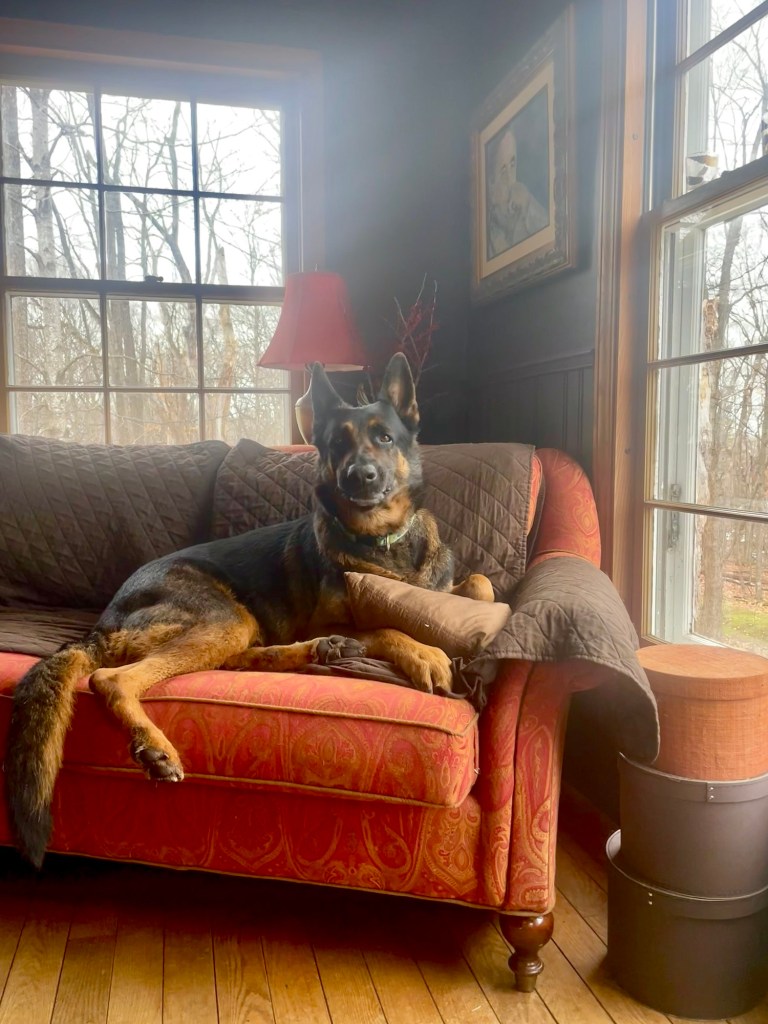
Despite my best efforts, the dogs track in mud, and if I’m not meticulous, leave splatters on the walls and cabinets. If I forget to close the doors to the bedroom, they leave mud on the bed. There are old beach towels spread everywhere in varying stages of dirt and dampness, and it takes time and effort to diminish the squalor.

On top of everything else, it’s too warm for a fire in the fireplace, which doesn’t draw well above 45F.

Complaining about the weather is a human pass time, I suppose, but it annoys me, particularly when I do it myself.

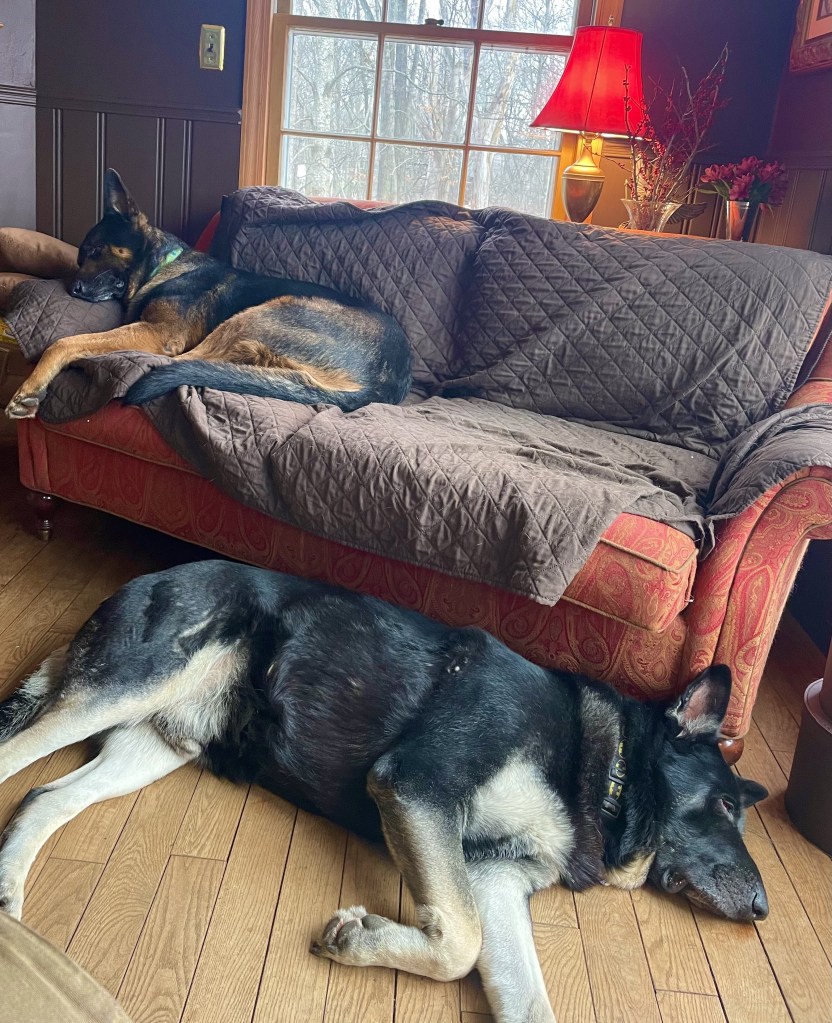
The dogs, blissfully uninterested in the weather—unless it’s raining, in which case they are frustrated when I won’t make it stop—are sound asleep nearby. A pair of red-tailed hawks are on the hunt in the woods, and I do not see a single squirrel or small bird anywhere.
There are worse things in life than bad weather, so we will count our blessings, instead.

Time for more coffee.

Eli’s excellent adventure

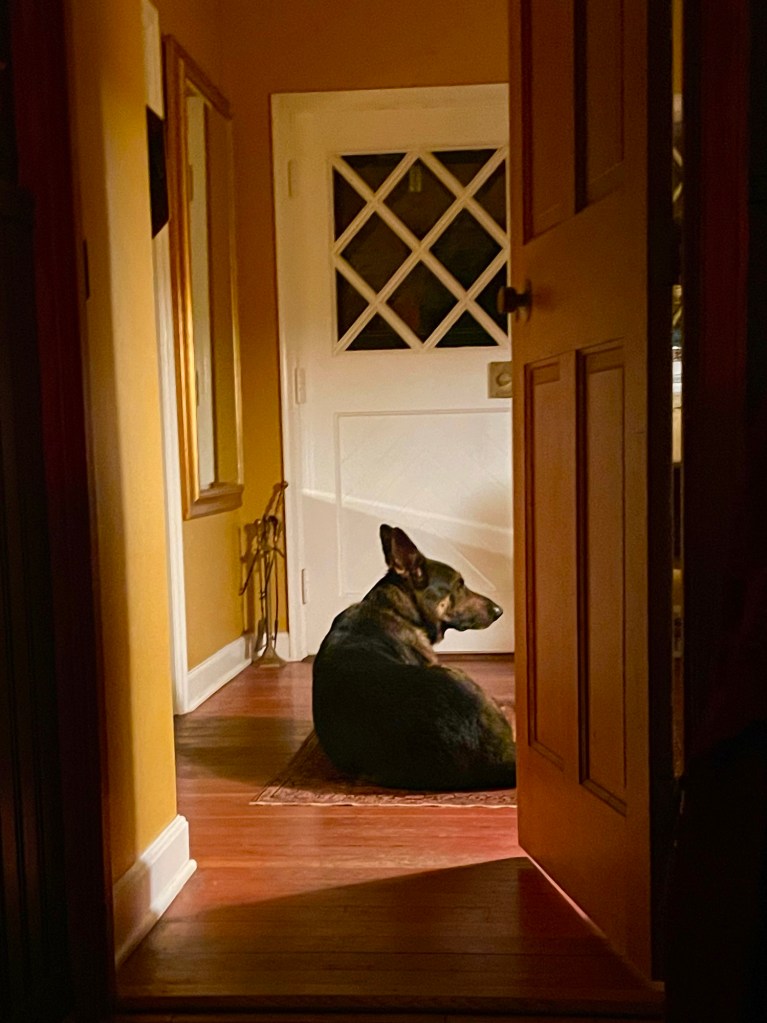
Every morning for many years, our dogs went together into the woods for what we referred to as their morning ramble. Everyone went along: First Reggie and Pete; then Moses and Pete; then Moses, Auggie, and Pete; Then Auggie, Eli, and Pete. They would be gone—usually within sight—for ten or fifteen minutes, and then all return together on the run, jostling happily back into the kitchen smelling of fresh air, or sometimes of some foul thing they had all rolled in, and expecting their treats.

Then one day, it stopped. Why? Because, as we belatedly realized, the rambler was Pete. He was the hound dog, the one with the scenting nose and the wandering impulse. Pete was also the pack leader, even in his dotage. The Germans also seemed to have an instinct to protect him, following him like body guards. For whatever reason, it was a daily ritual. And their rambling was a very good thing. Everyone went off independently, but still together, to smell smells and stake territory, and make their own decisions. I very firmly believe that dogs who have this kind of independence develop a depth of understanding that builds capabilities and personality. Argue if you want.

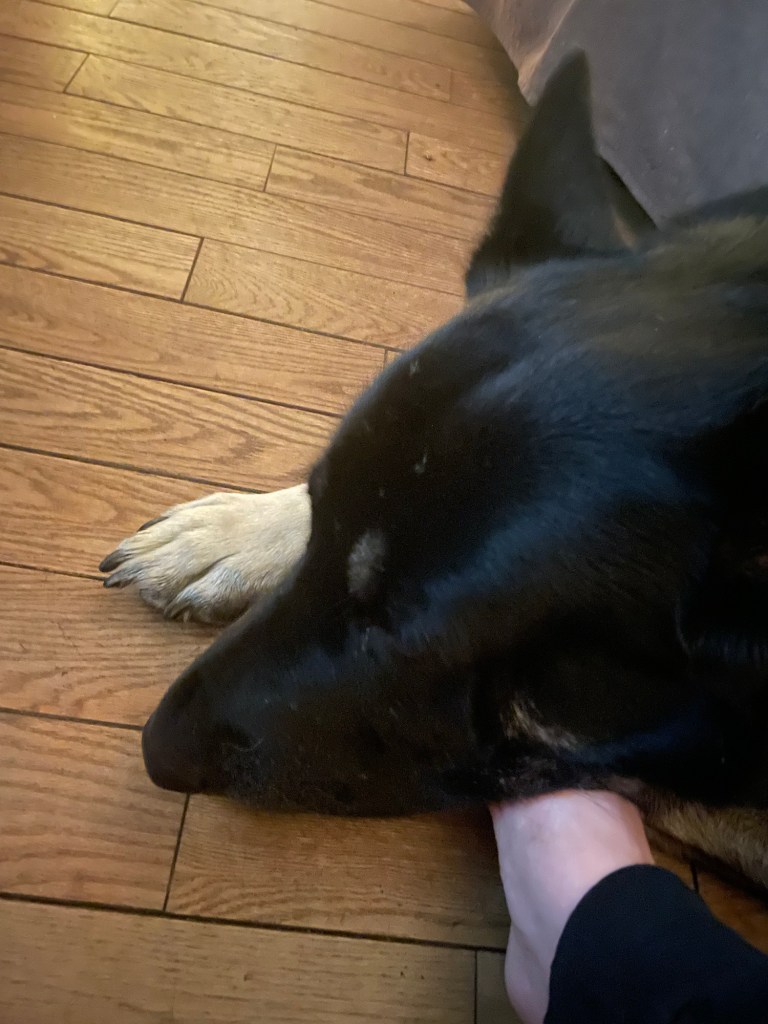
Eli is a particularly unrambly dog. He likes to stay close to home, preferably on the bed or couch. He doesn’t like loud noises. He thinks airplanes are thunder, and runs to hide. He hears distant gunshots and runs to hide. He hears construction noises in the distance and runs to hide. He only shows his shepherd side when strange animals or people approach. Then he stands his ground quite terrifyingly.

So, this morning, after he had interrupted me four times to go out, and I had brought him to the door four times while he simply stood at the door step and looked out, I put on my shoes, walked out six feet, and when he followed me, I turned around and walked back in, leaving him to scratch plaintively at the door. I ignored him and went back to my work.

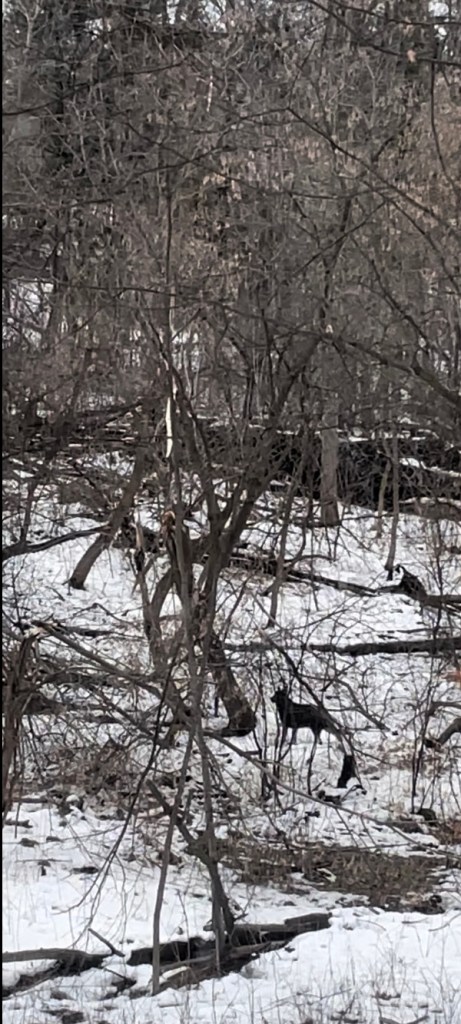
But from the library windows, I could see, to my surprise, Eli, alone, down in the woods, and moving purposefully away from the house. I stood up to watch and followed him from window to window, room to room, as he went deep into the brush, sniffing, looking, investigating logs and holes. I didn’t want to interrupt him, but I didn’t want to lose him, either.

But after ten minutes or so, he paused and put his nose into the air. And then, having made his decision (“‘I smell something,’ said the Poky Little Puppy.”1) he turned and galloped up the hill to the house. Not fearfully, just a happy-to-be-going-home gallop.

I have no idea what inspired this, but I am happy when he’s happy. Maybe he will find it was an experience worth repeating. I hope so.

  1. The Poky Little Puppy is a children’s book written by Janette Sebring Lowrey and illustrated by Gustaf Tenggren. It was one of the famous Golden Books series, and is still in print 82 years after its first publication. ↩︎