The thing I miss about Tw*%^tter is the little pockets of community we built among ourselves. The connection was mostly about animals, and then mostly about dogs, but there were also the writers, photographers, farmers, and scientists whose work you could take interest in, and the neighborly people whose company warmed on a bleak day.
Among the unlikely acquaintances I made was a bookseller in a little town in England, whose job was to comb through estate sales, the ruins of well-loved libraries, and mountains of cardboard boxes dumped like abandoned puppies, rescuing old or even ancient books. At first he would tweet about some intriguing find and I would reply requesting a price. But soon I had given him a hopeful list, and he began keeping an eye out for me.
The arrival of these books was an event. They always came beautifully wrapped in brown paper, or sometimes in the pages of old magazines. There was twine. The packaging suggested to me the perfection one used to expect from a purchase in London: very much not shoved into a bag. There were no plastic bubbles.
Among the purchases I made were a tiny shirt-pocket sized Book of Common Prayer, a 19th century book of beautifully painted pull-out English maps (in an unusual shape, and filled with geographic detail unlike anything I’ve seen elsewhere), first editions of some favorite authors, and other very specific and odd literary delights. One of these is a vintage edition of Beeton’s Complete Letter Writer for Ladies and Gentlemen; Containing Love Letters, Complimentary Notes, Invitations, Business Letters, Applications; With Domestic, Fashionable, Friendly, and Formal Correspondence.

I find it endlessly entertaining.
I can’t find an exact date in it, but it was published in late nineteenth century London, and sold for One Shilling. It is a thing out of time, since letter writing is no longer our primary means of communication, and since we live in such a graceless era, when manners in particular and civilization in general are all up for grabs.
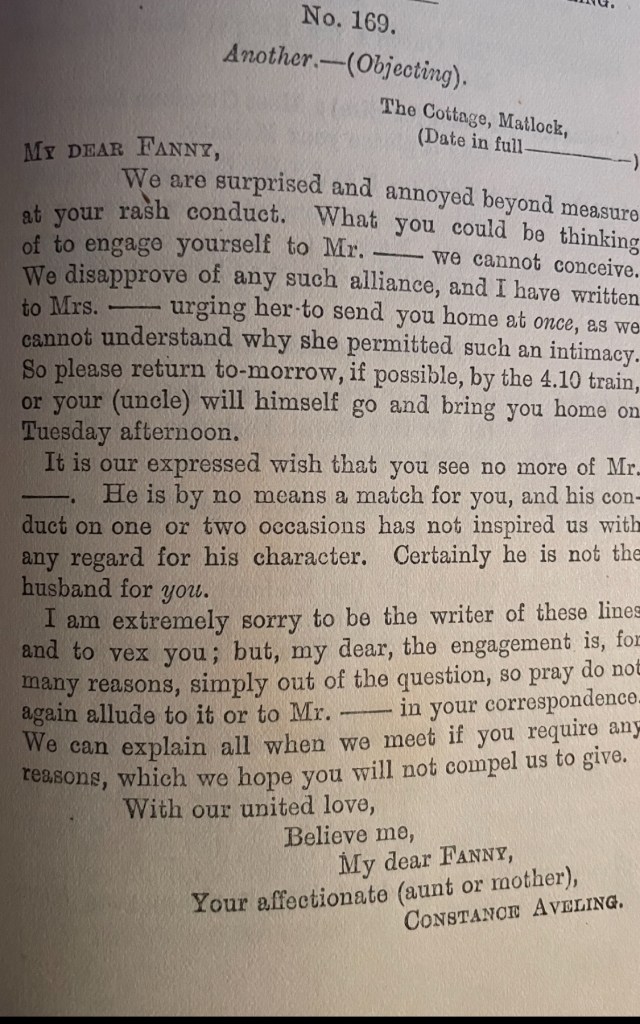
It is amusing, too, in its formality and superannuated language. There is the sharply worded note from a father to a fractious boy at boarding school; the disapproving note from an aunt to a newly-engaged girl; letters enquiring into the character of servants; and, as the title promises, love letters: all earnest, some moving, and some rather improbable (“Answer to a Missionary’s Proposal Negatively”).
I am happy to live in our era, with its science, medical advances, and convenience. But I do wish that along with all our advantages, we still lived among thoughtful, gracious people who understood that formality was an act of respect and dignity, and who had the time to ponder proposals of marriage from well-meaning missionaries.
 J.F. Riordan