Sunday, muddy Sunday

Every year I ask for a blizzard for my birthday, which is this week. So far, I have only gotten two, and I think the odds are long for any kind of cold weather this year. The snow is almost gone, it’s warm and damp and muddy, and it’s my least favorite kind of weather.

Despite my best efforts, the dogs track in mud, and if I’m not meticulous, leave splatters on the walls and cabinets. If I forget to close the doors to the bedroom, they leave mud on the bed. There are old beach towels spread everywhere in varying stages of dirt and dampness, and it takes time and effort to diminish the squalor.

On top of everything else, it’s too warm for a fire in the fireplace, which doesn’t draw well above 45F.

Complaining about the weather is a human pass time, I suppose, but it annoys me, particularly when I do it myself.

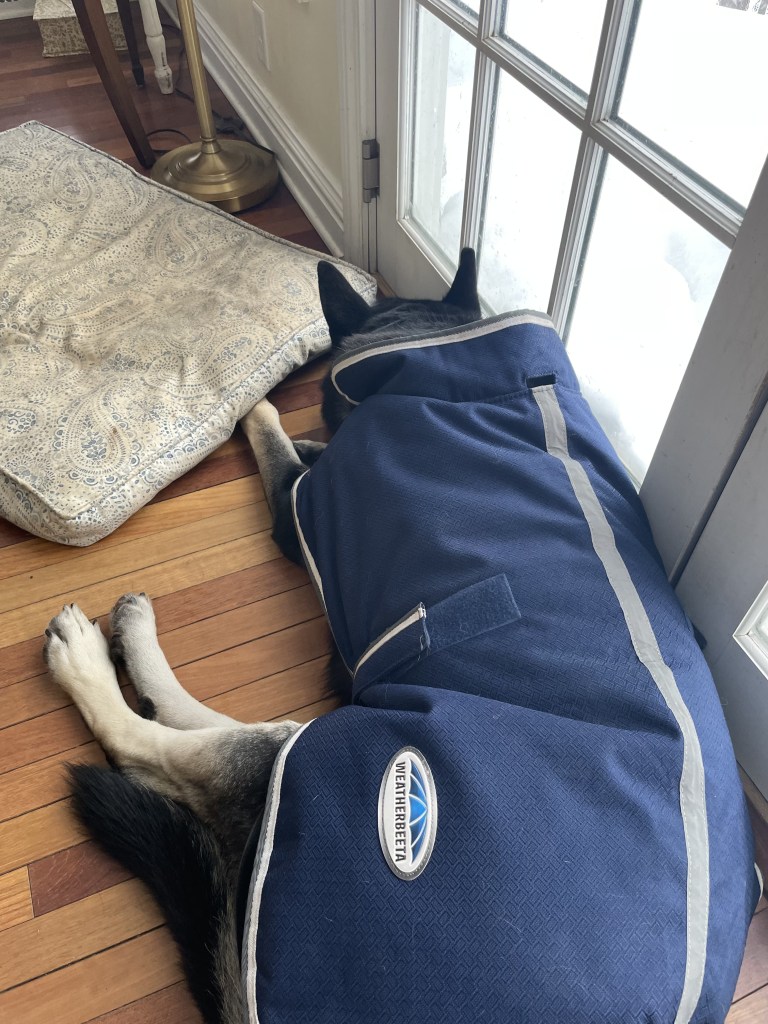
The dogs, blissfully uninterested in the weather—unless it’s raining, in which case they are frustrated when I won’t make it stop—are sound asleep nearby. A pair of red-tailed hawks are on the hunt in the woods, and I do not see a single squirrel or small bird anywhere.
There are worse things in life than bad weather, so we will count our blessings, instead.

Time for more coffee.

It was another world

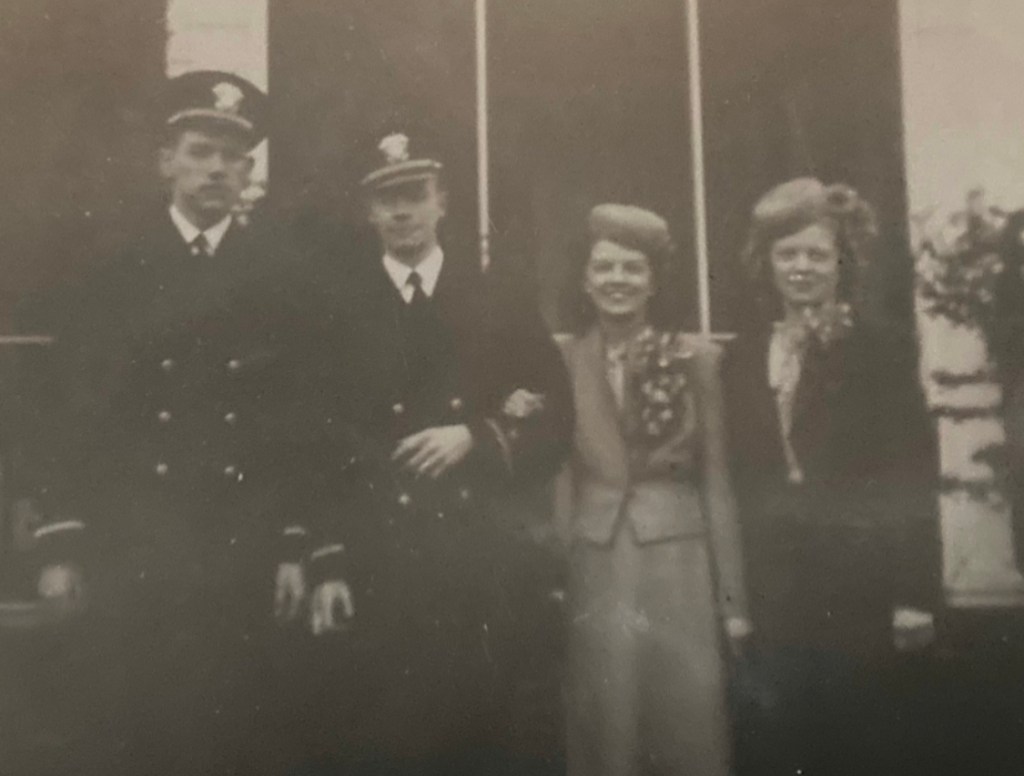
Today would have been my parents’ 79th wedding anniversary. World War ll was coming to its climax, and my dad begged my mom to come to Annapolis to get married before he shipped out. So she, my aunt, and my paternal grandmother—my other grandmother had already died—took an unheated train from upstate New York to Virginia. They were so cold they all snuggled together under my grandmother’s big fur coat.

It was war time, so there were no cabs, and they had to take a trolley to get to the Navy chapel. My mother always said that was the moment she was glad she hadn’t worn a wedding gown. Instead she wore a dove gray suit with a spray of yellow roses. My father always gave her yellow roses for their anniversary.

They all spent the wedding night together in one room. Romance wasn’t really an option in war. My mother said many times how when they kissed good bye she didn’t know if she’d ever see him again. It’s hard to imagine how difficult life was then.

And we all think we are stressed.

My dad and mom are in the middle. My Aunt Ruth was matron of honor. The name of the best man is lost to time.

Cooking from scratches

My mother was an excellent cook. Her meals were complex, flavorful, and creative. She baked her own bread, catered to my father’s sweet tooth with all kinds of amazing desserts: pies, chocolate eclairs, apple crumble, cookies. Her stews and main courses had depth and richness. She cooked with lashings of wine and butter, and although she used recipes, they were merely jumping off points for her creativity.

She was also not a woman much devoted to method. I think you could fairly call her general style slapdash, except for the fact that her results were so wonderful. Her handwriting was distinctive, but often scrawled (much like my own) and such recipe cards as she had—and she had a lot—are often nearly impossible to decipher. My niece very thoughtfully gave me a dishtowel with some of my mother’s recipes reproduced in her own writing, and when people see it they almost always ask: Can you read that? Usually, I can. A lifetime’s experience. But sometimes reading them isn’t enough.

My old friend, Julie, from sixth grade, like so many Wisconsin natives, is German through and through. She was lamenting recently that most of the old restaurants that served Sauerbraten are gone. Sauerbraten is a dish that requires three to five days to marinate the beef, and comes with complicated side dishes. Very German. My mom always made it, and although I have the recipe, I never have. So, back in December when things were hectic I told Julie—who is a treasured friend—that come January I would make Sauerbraten for her husband and her. It was a leap of faith.

Sauerbraten is one of those things that really does require a recipe. The seasonings and details vary regionally: Some versions have raisins, some have crumbled Lebkuchen, some have a chunk of rye bread at the bottom. But the fundamental seasonings are the same: apple cider vinegar, sugar, bay leaf, peppercorns, cloves, onions, lemon. It doesn’t sound good, does it? But it is delicious: the German version of sweet and sour. The beef has been marinating since yesterday, and today I will make potato dumplings—which scare me— and red cabbage. So I am depending heavily upon my mother’s recipe cards.

The funny thing is my mother’s recipes are a bit like that old Far Side cartoon, where the mathematics professor has a long equation with an arrow pointing to the phrase: And then a miracle occurs. Many of the steps are not clearly explained. It makes me laugh. SO like her. For example, the recipe tells me the ingredients for the potato dumplings (Kartoffelklösse), but it’s kind of vague on how to cook them. The Sauerbraten is the same. I inherited her authentic German cookbook, and it, too, assumes that every idiot knows how to cook dumplings. But the Sauerbraten steps are so elaborate and complex that they tell the close reader much about the German mind.

My mother didn’t have a German mind. She had a passionate, fiery and creative Irish mind—which made her an interesting match to my studious, brilliant, but also passionate father. Tomorrow will be their wedding anniversary—79 years ago they were married at the Navy chapel in Anapolis—so it seems appropriate to be making the meal that was my mother’s specialty and my father’s favorite. And I think the best approach for me will be to throw culinary caution to the wind and adopt my mother’s joyful carelessness. If nothing else, it will be more fun.

I will report back.

In which: I am annoyed

I believe I have mentioned here that we had a sort of appliance armageddon in November and December. Since not all of them were amenable to repair, we have some new ones. Aside from the fact that they do actually function, none of them are improvements.

The new dishwasher—which is the equivalent model to the old one— is missing some of the handy features of the other one. The racks are different and less adjustable, and the buttons have fewer choices. It also cost a lot more than the last one, and had to be specially rigged by the installers in order to fit in the same space.

The new microwave is also the latest and greatest version of the old one. But it doesn’t have a one minute button—which I used all the time—or the butter softening/melting feature that I loved so much. How many sticks? How soft? How melted? What are you defrosting? Press 1 for meat; 2 for chicken; 3 for fish. None of that. The machine, with its super fantastico intelligent programming decides. It’s usually wrong. The other day the turkey sausages came out like hockey pucks. Maybe it’s a bit too powerful. I’ll get used to it, I guess. But I don’t want to. I don’t want to spend my increasingly limited brain power thinking about appliances. I want my appliances to do my bidding, not their own. Adding insult to injury, it beeps five times instead of once, a particular pet peeve of mine. (See also: “Electronic Narcissism” in my book of essays But Still They Sing.)

Which brings me to the source for which I reserve most of my animus: the new television we so jauntily installed in the library. It’s a small television, but we thought it might be nice to be able to watch while all snuggled into our coziest room, with the bar cart nearby and the fire going. We were delighted when all we had to do was hold our phones up to the QR codes to install our streaming services. Very cool, we thought.

Lately, my husband has been getting up excessively early, frequently adjusting his bedtime to right after dinner. This leaves me a little bit at a loss. I’m usually too tired to read. Practicing piano would disturb him, and I don’t want to go to bed yet. A perfect time to sit in the library with large dogs and watch something on television.

I was settled in the other night watching a two hour program, when suddenly the television turned off. Nothing I did could turn it back on. Having twigged the eco-settings on the bedroom television, which automatically dims the picture, I had already turned all that off. I changed the batteries in the remote. I reset the wireless. Nothing. Finally I packed it in and went to bed. But my husband found it running in the middle of the night.

“You left the television on.”

“I sooooo did not.”

Last night, same scenario. I wasn’t watching anything I was particularly invested in, but I was beginning to think we would have to embark upon an endeavor that reflects what my husband calls “the asymmetry of power”. You know: when you have a problem with a product and have to contact the enormous monopolistic corporation that has eliminated service from its mission statement. My sister has spent the past three days engaged in such an exercise, which mostly consists of listening to repetitive and annoying hold music while someone on the other end files their nails for hours at a time. But I digress.

One of the most useful aspects of the internet, I find, is being able to look up problems and see whether you’re the only one experiencing it. So this morning I did this, and what did I find? “LG TV keeps turning itself off.”

Apparently, in their (asymmetrical) wisdom, the LG corporation has decided that after a certain period of time without interaction with the remote, the television should turn itself off. The settings say this happens after four hours. I can attest to its being much less than that. Nevertheless, I found the button and turned it off.

Happy Ending. Sort of. But I have questions. What makes electronics companies think we need someone else to turn our devices off? Isn’t that why we have a remote? With a timer we can set? What if I’m watching a David Lean movie? Or a Wagnerian opera? Maybe I don’t want to be interrupted. Why I can’t I turn it right back on? Why do they hide these settings so you have to dig around in the depths of the system like a turkey looking for bug? Why aren’t these “features” listed openly in the manual? Why does it seem we have become the servants rather than the other way around? I have a sneaking suspicion it’s because all these companies know they have us over a barrel, and we will choose to serve in order to have our conveniences. It’s a very strange turn around.

Capitalism isn’t all it’s cracked up to be.
Riches

For many women, chocolate is a passion, but I can take it or leave it. My passion is for flowers. There is not a day in my life when, given the choice, I would not choose flowers over candy, and probably over jewelry, too. (But not over dogs.)

I got my love for flowers from my mother. When I was very tiny, she would take me to the vacant lot next to my Grandmother’s house to pick violets. The property was carpeted in purple, and it was almost frustrating to pick, because I wanted to scoop them up all at once, but instead, had to painstakingly reach beneath the big leaves to find the tender stems, one at a time. I remember not being very good at it, which tells me I was probably three at the most, but together we picked masses of violets. I still feel that same frustration when I pick violets, but I never miss an opportunity to have a bowlful in my house. I allow them to grow even though they spread so recklessly in my garden beds. People say mint is bad, but in my little ecosystem, violets are far more aggressive.

My mother also grew zinnias and big purple and pink asters in her garden. I loved the deep, vibrant colors, and the way they jostled one another in a brilliant haphazard jumble. Later, she grew sweet peas, and they grew in a jungle of coiling stems against a big stone wall. She gave me seeds for them every year, but somehow, I never planted them, and now I regret it deeply. The only plant I have in my garden that came from hers is the centaurea montana, a big purple relative of the bachelor button. She and I picked lilacs together every spring, and when she got older, I would pick them for her, filling a large purple vase with them. I planted her window box with geraniums for her, too. She could sit in her chair by the window and look out at them all summer long, and that gave her a great deal of pleasure.

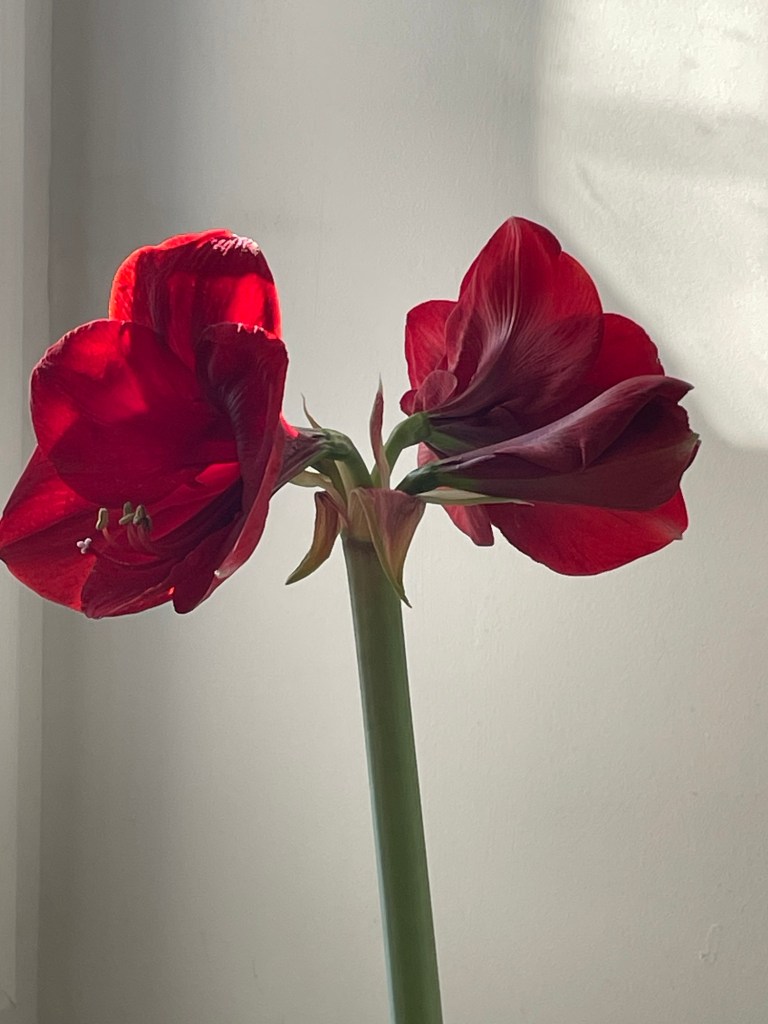
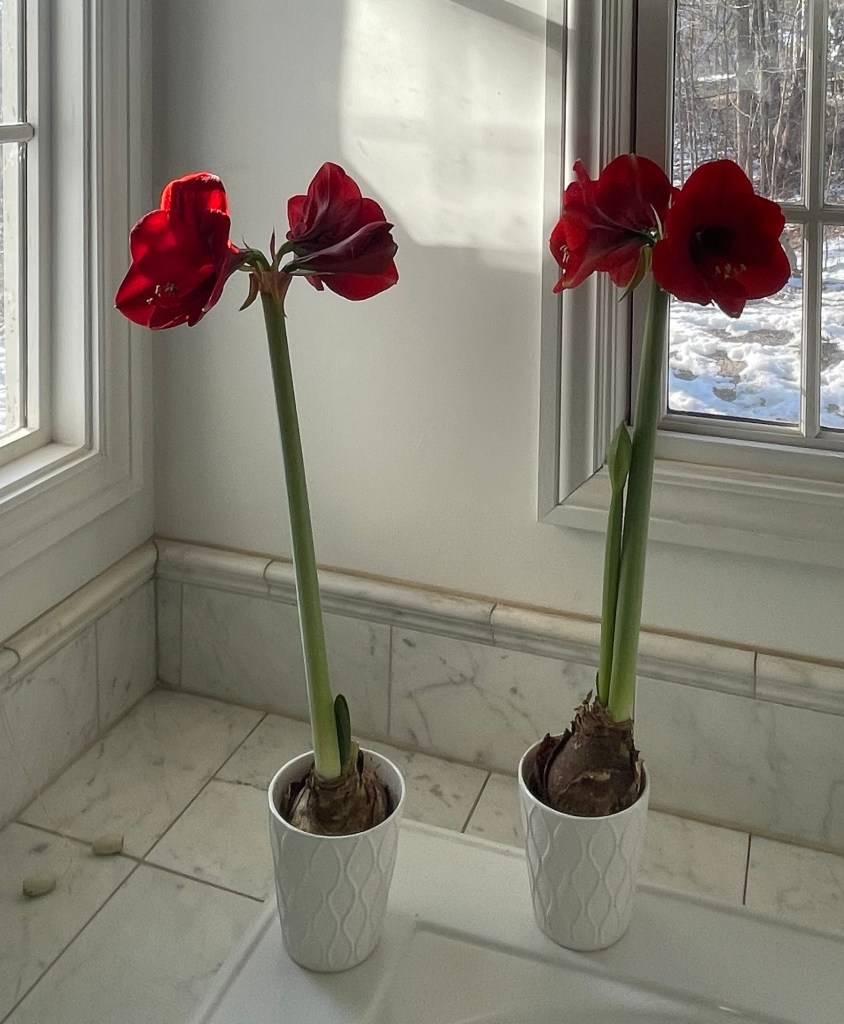
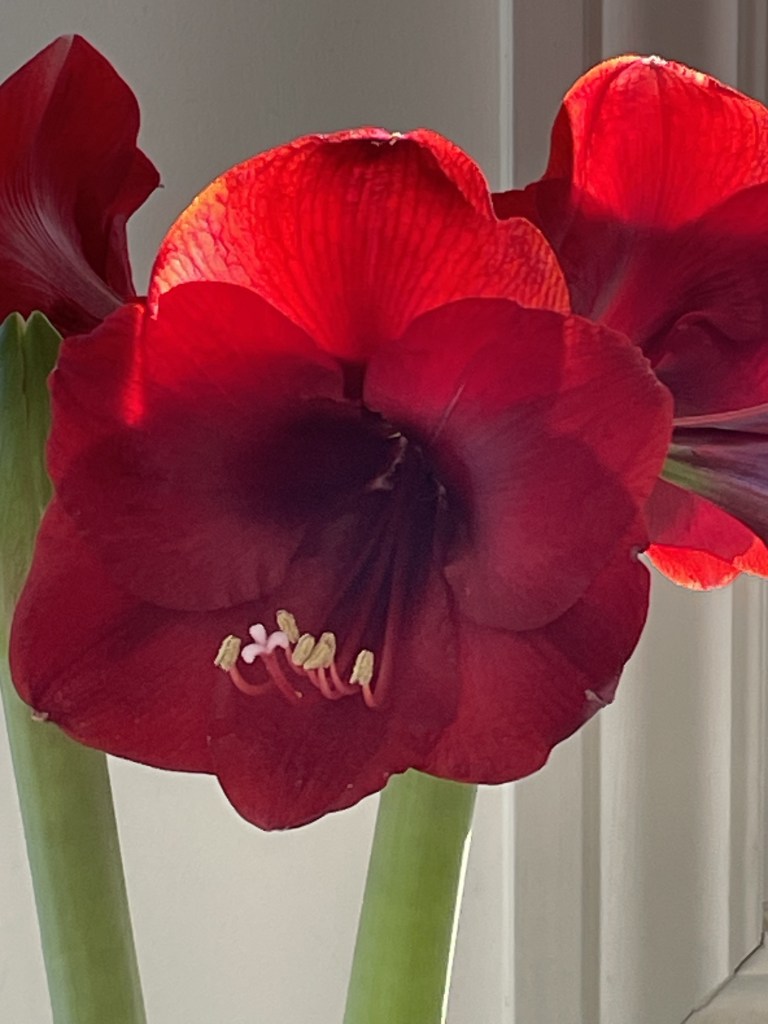
I always have flowers in my house, usually in every room. At the moment I have white amaryllis and hyacinth bulbs growing in a wooden box of moss and ivy on the dining room table; various colors of tulips: orange in the hall and kitchen, purple and white in the living room; orange alstroemeria in the library and purple in the powder room; cut white hyacinths and lilies in the bedroom; and two brilliant red amaryllis on the edge of the bathtub. In the depths of winter I love the contrast of the fragile blooms indoors and the bitter cold outdoors. They make me feel that all is well. I like almost all flowers.

But never give me a poinsettia.

My mother always said that if she were rich she would have fresh flowers and clean sheets every single day. I feel the same way, and I suppose, that–and her tender care for animals—is her legacy to me. Riches, indeed.

I go a little crazy at the farmers’ market.

My brother’s keeper

We’re in the teeth of winter now. The actual temperature is -5F but the wind chill is -15F to -25F, which means the wind sweeps away your body heat at a rapid clip, and flesh freezes in mere minutes. In this bitter cold both animals and humans are suffering. Although we got our power back, not everyone did, and outside in this dangerous weather, there are people working hard to protect the rest of us, restoring power and operating community shelters.

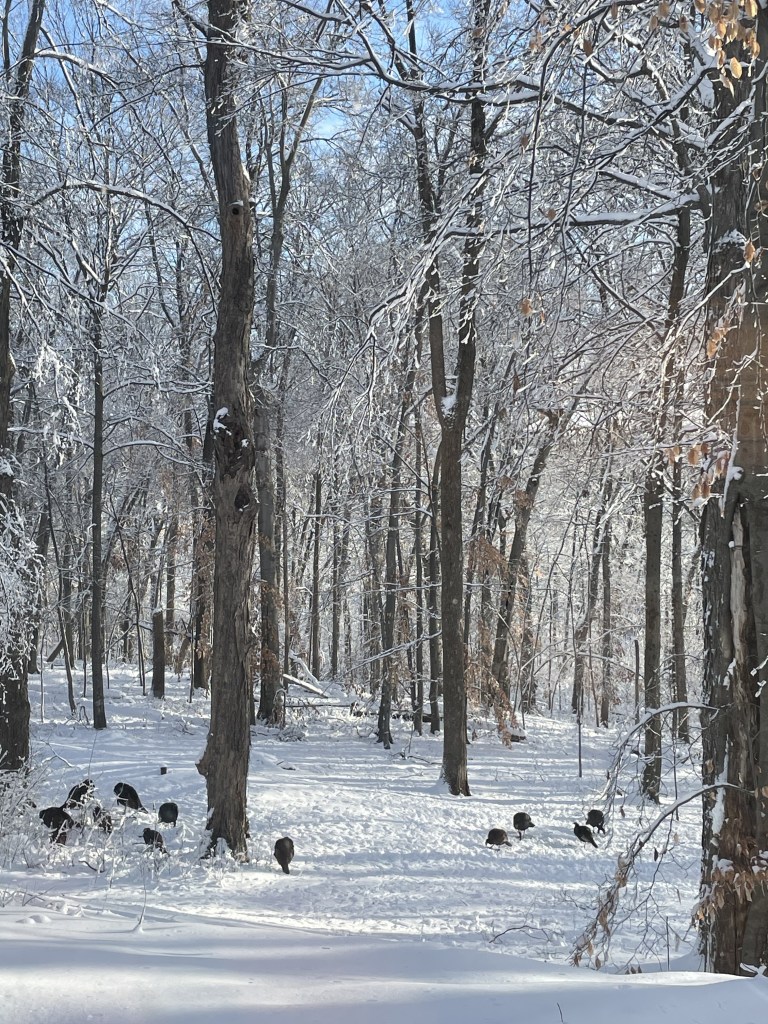
I’m watching the turkeys this morning from my warm, comfortable vantage point on top of the hill, looking down into the woods. We have a flock1 of nineteen this year, somewhat smaller than usual, but always fascinating.

After the deer had finished their morning graze, the turkeys came down from their roosts and spread themselves among the three spots where we have put out seed. As I watched, I saw my one-footed friend—who has been with us for several years now—sit down by himself in the snow, fifteen feet removed from the rest of the flock as they fed. He knew he could not compete with the rough and tumble of the flock’s drive for food. My heart broke for him, because even though the others do seem to look out for him generally, the nature of turkeys seems querulous and wholly intent on individual survival. I told myself he would be able to eat when the rest had finished, but wished I could go out to give him his own little stash. He looked cold and lonely.

As I watched, one of the other turkeys broke off from the flock and walked over to him, nudging him gently. He got up, and together they walked to the pile of seeds, and, shielded by his friend, the injured turkey joined the others and began to feed. For the remainder of breakfast time, the limpy guy ate with all the others.

If I hadn’t seen it myself, I wouldn’t have believed it.

The turkeys are still here, and have been joined by squirrels, junkos, and chickadees. I know from long observation that today, instead of marching off on their usual trek, the turkeys will stay close by, puffing up their down coats, and sitting on logs somewhere out of the wind, preferably under bushes or brush piles. And they will all have eaten enough to fuel their bodies against the cold.

So, who wants to discuss how animals don’t practice altruism?

  1. For domestic turkeys the correct term for a group is rafter. I have been informed, however, that wild turkeys are in flocks. Don’t ask me. ↩︎

You can’t be dry in the dark

Yesterday was a curiously lost day. It was a little bit worrying to realize how much I depend upon technology, and how lost I was without it.

It was a busy day for us, however. There were branches hanging heavily with snow needing to be brushed off or beaten with a broom to keep them from breaking. There was the driveway to clear, along with the two foot high barricade of ice from the snowplow. And there were fallen branches to remove and add to the growing bonfire pile, all to the cheerful accompaniment of playful dogs.

But once we had done what could be done, we came inside to a strangely silent house.

At one point, cold, but too grubby and unshowered to go anywhere other than the hardware store, I just drove around, charging my phone and listening to music, while my exhausted husband napped. The snow was beautiful in the sunshine.

Later, despite my hair—which made me look as if I’d just been released from the local asylum—we went to a nearby restaurant for wifi, and by mutual consent, put Dry January on the ash heap of history. We met our favorite neighbors there, by chance. They had also been caught in the clutches of Dry January, and had thrown it over the night before, when their tree took out everyone’s power line. We traded anxieties about frozen pipes, spoiled food, and what to do if there was still no power on Sunday. They, too, have a pair of big sweet dogs, which we agreed tends to make you unpopular with hotel management. Our conversation was interrupted by several recorded phone calls from the power company, dangling hope with laughable vagueness.

Nevertheless, on the way home, parked alongside the road to our house was an armada of utility trucks, and the big tree that had been leaning perilously on the main lines was gone. The dogs greeted us as if we’d been gone a month, even though it had been little more than an hour. The house was ridiculously dark and growing cold, so we settled into a very early bed, with dogs and the gas fireplace to keep us warm, buckets of snow on the hearth, downloaded movies, and a decanter of Irish whisky.

This morning, the heat is on; hot coffee was waiting when I got up at 3:30; and my computer is up and running. In a little while I will reload the dishwasher and finish restoring the kitchen to its normal cheerful order. Most important: we will be able to watch the Packers game this afternoon.

As with so many life experiences, we have come away with an important lesson learned.

January is no time to give up alcohol.

***

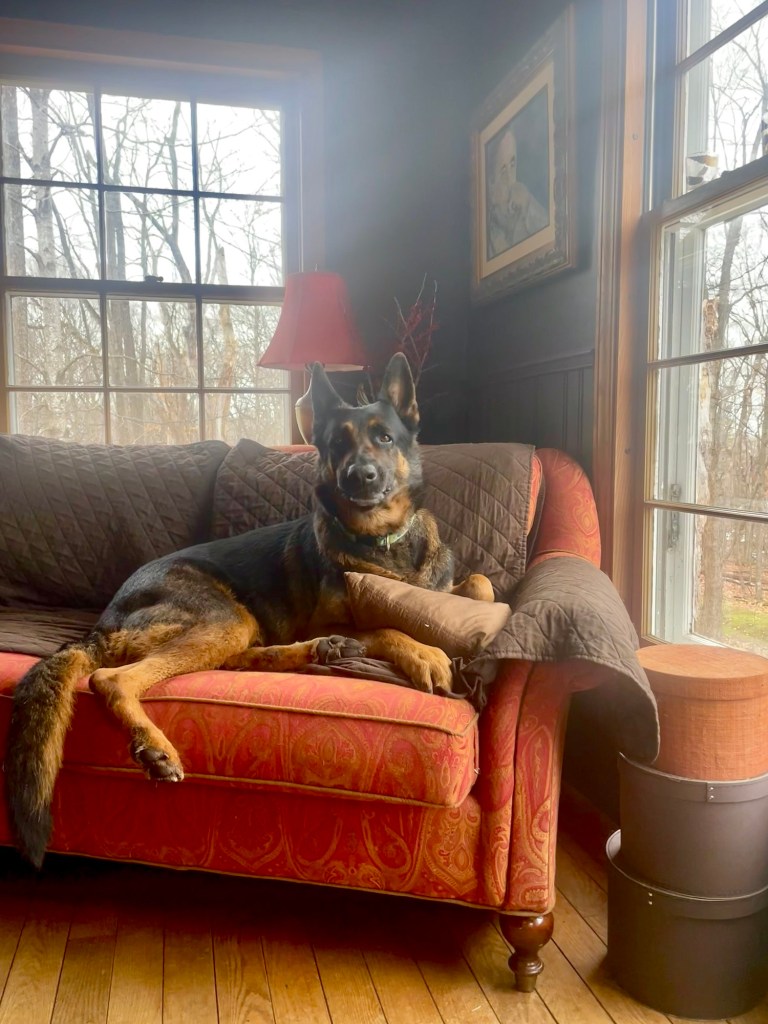
Gratuitous Dog Photo

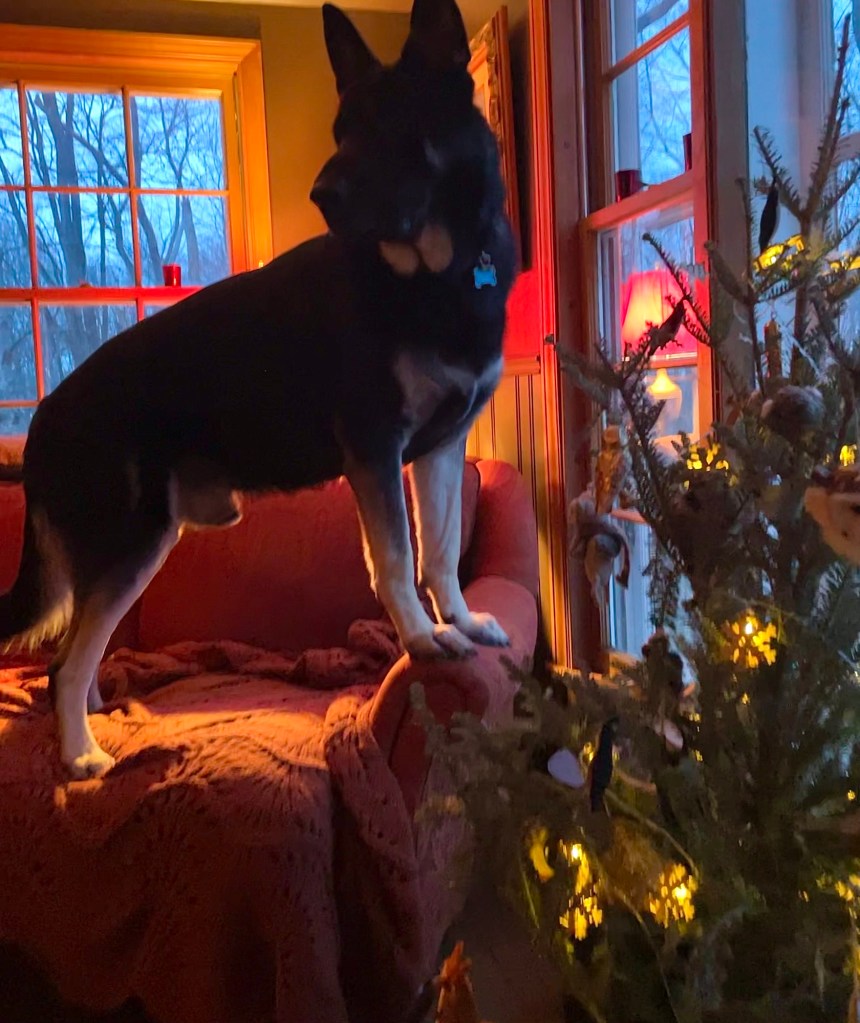
Eli kept his big coat on all day.