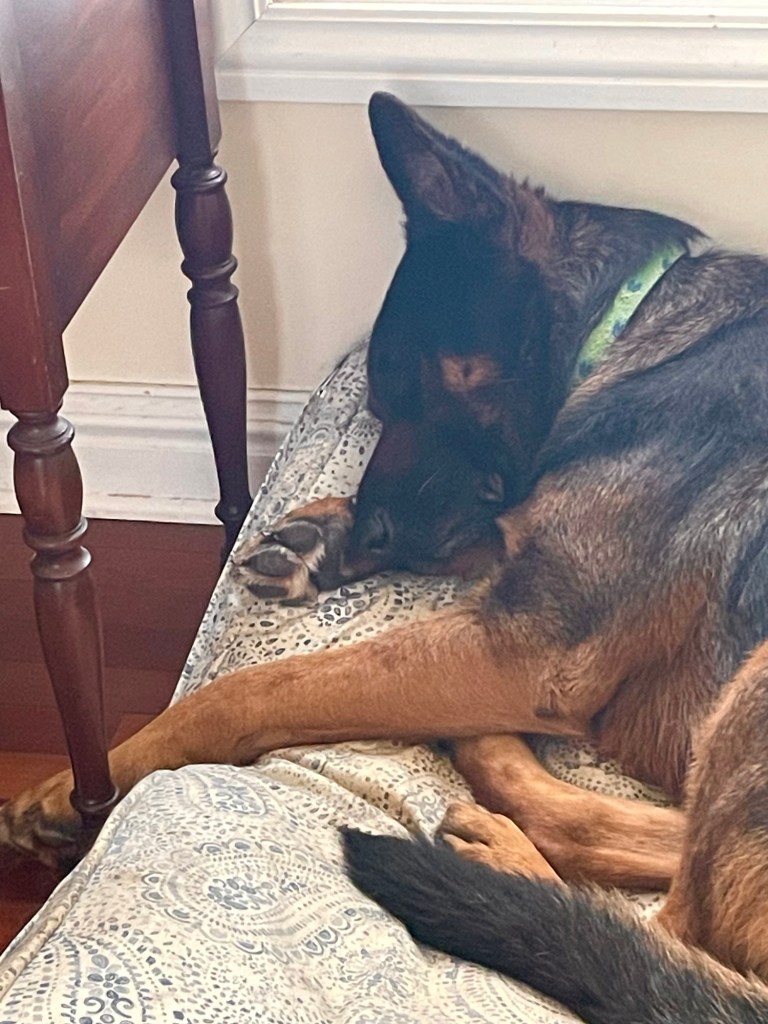
It’s just a snoozy kind of day. Even energetic Auggie is sound asleep.
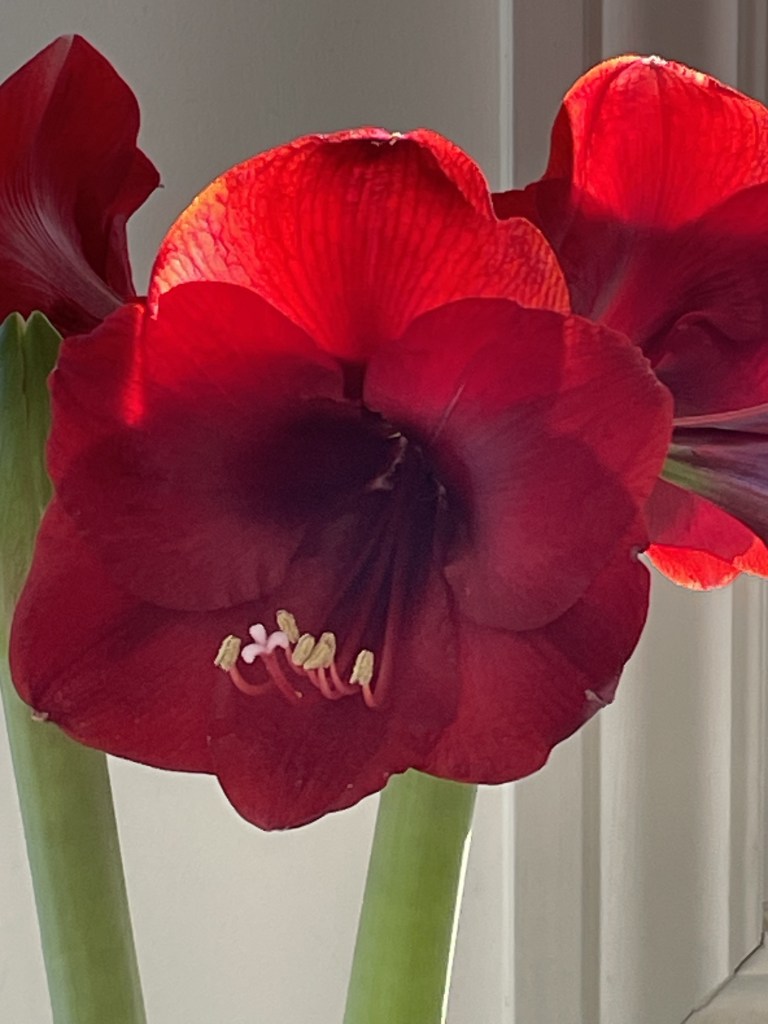
For many women, chocolate is a passion, but I can take it or leave it. My passion is for flowers. There is not a day in my life when, given the choice, I would not choose flowers over candy, and probably over jewelry, too. (But not over dogs.)
I got my love for flowers from my mother. When I was very tiny, she would take me to the vacant lot next to my Grandmother’s house to pick violets. The property was carpeted in purple, and it was almost frustrating to pick, because I wanted to scoop them up all at once, but instead, had to painstakingly reach beneath the big leaves to find the tender stems, one at a time. I remember not being very good at it, which tells me I was probably three at the most, but together we picked masses of violets. I still feel that same frustration when I pick violets, but I never miss an opportunity to have a bowlful in my house. I allow them to grow even though they spread so recklessly in my garden beds. People say mint is bad, but in my little ecosystem, violets are far more aggressive.
My mother also grew zinnias and big purple and pink asters in her garden. I loved the deep, vibrant colors, and the way they jostled one another in a brilliant haphazard jumble. Later, she grew sweet peas, and they grew in a jungle of coiling stems against a big stone wall. She gave me seeds for them every year, but somehow, I never planted them, and now I regret it deeply. The only plant I have in my garden that came from hers is the centaurea montana, a big purple relative of the bachelor button. She and I picked lilacs together every spring, and when she got older, I would pick them for her, filling a large purple vase with them. I planted her window box with geraniums for her, too. She could sit in her chair by the window and look out at them all summer long, and that gave her a great deal of pleasure.
I always have flowers in my house, usually in every room. At the moment I have white amaryllis and hyacinth bulbs growing in a wooden box of moss and ivy on the dining room table; various colors of tulips: orange in the hall and kitchen, purple and white in the living room; orange alstroemeria in the library and purple in the powder room; cut white hyacinths and lilies in the bedroom; and two brilliant red amaryllis on the edge of the bathtub. In the depths of winter I love the contrast of the fragile blooms indoors and the bitter cold outdoors. They make me feel that all is well. I like almost all flowers.
But never give me a poinsettia.
My mother always said that if she were rich she would have fresh flowers and clean sheets every single day. I feel the same way, and I suppose, that–and her tender care for animals—is her legacy to me. Riches, indeed.


We’re in the teeth of winter now. The actual temperature is -5F but the wind chill is -15F to -25F, which means the wind sweeps away your body heat at a rapid clip, and flesh freezes in mere minutes. In this bitter cold both animals and humans are suffering. Although we got our power back, not everyone did, and outside in this dangerous weather, there are people working hard to protect the rest of us, restoring power and operating community shelters.
I’m watching the turkeys this morning from my warm, comfortable vantage point on top of the hill, looking down into the woods. We have a flock1 of nineteen this year, somewhat smaller than usual, but always fascinating.
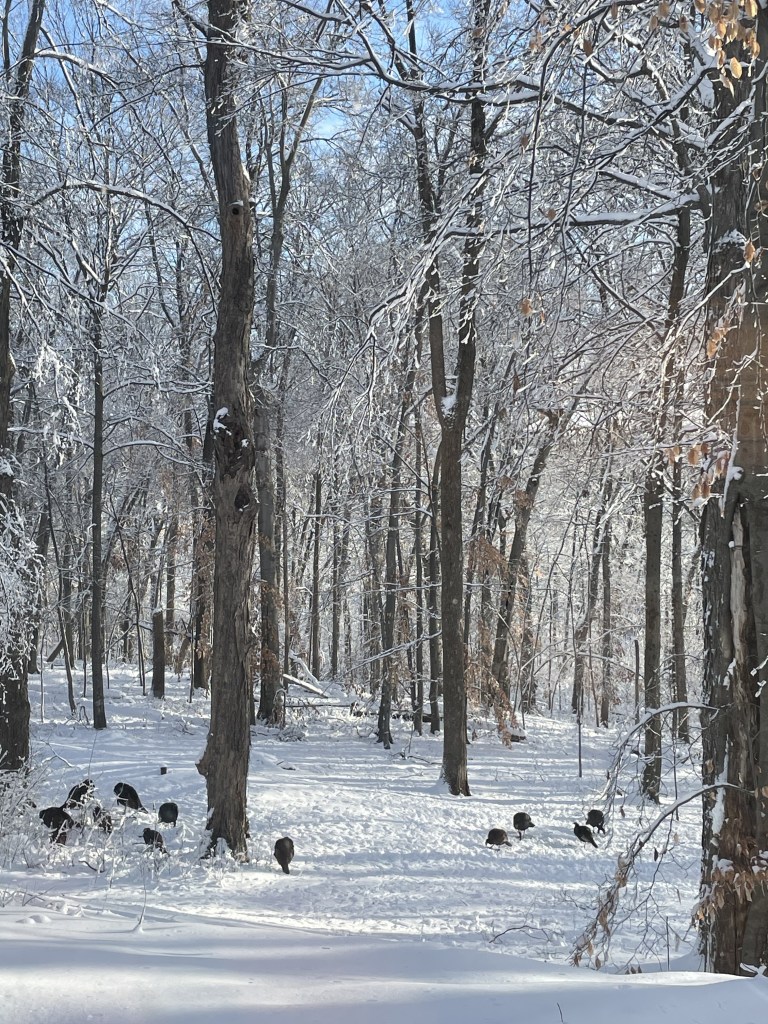
After the deer had finished their morning graze, the turkeys came down from their roosts and spread themselves among the three spots where we have put out seed. As I watched, I saw my one-footed friend—who has been with us for several years now—sit down by himself in the snow, fifteen feet removed from the rest of the flock as they fed. He knew he could not compete with the rough and tumble of the flock’s drive for food. My heart broke for him, because even though the others do seem to look out for him generally, the nature of turkeys seems querulous and wholly intent on individual survival. I told myself he would be able to eat when the rest had finished, but wished I could go out to give him his own little stash. He looked cold and lonely.
As I watched, one of the other turkeys broke off from the flock and walked over to him, nudging him gently. He got up, and together they walked to the pile of seeds, and, shielded by his friend, the injured turkey joined the others and began to feed. For the remainder of breakfast time, the limpy guy ate with all the others.
If I hadn’t seen it myself, I wouldn’t have believed it.
The turkeys are still here, and have been joined by squirrels, junkos, and chickadees. I know from long observation that today, instead of marching off on their usual trek, the turkeys will stay close by, puffing up their down coats, and sitting on logs somewhere out of the wind, preferably under bushes or brush piles. And they will all have eaten enough to fuel their bodies against the cold.
So, who wants to discuss how animals don’t practice altruism?
Yesterday was a curiously lost day. It was a little bit worrying to realize how much I depend upon technology, and how lost I was without it.
It was a busy day for us, however. There were branches hanging heavily with snow needing to be brushed off or beaten with a broom to keep them from breaking. There was the driveway to clear, along with the two foot high barricade of ice from the snowplow. And there were fallen branches to remove and add to the growing bonfire pile, all to the cheerful accompaniment of playful dogs.
But once we had done what could be done, we came inside to a strangely silent house.
At one point, cold, but too grubby and unshowered to go anywhere other than the hardware store, I just drove around, charging my phone and listening to music, while my exhausted husband napped. The snow was beautiful in the sunshine.
Later, despite my hair—which made me look as if I’d just been released from the local asylum—we went to a nearby restaurant for wifi, and by mutual consent, put Dry January on the ash heap of history. We met our favorite neighbors there, by chance. They had also been caught in the clutches of Dry January, and had thrown it over the night before, when their tree took out everyone’s power line. We traded anxieties about frozen pipes, spoiled food, and what to do if there was still no power on Sunday. They, too, have a pair of big sweet dogs, which we agreed tends to make you unpopular with hotel management. Our conversation was interrupted by several recorded phone calls from the power company, dangling hope with laughable vagueness.
Nevertheless, on the way home, parked alongside the road to our house was an armada of utility trucks, and the big tree that had been leaning perilously on the main lines was gone. The dogs greeted us as if we’d been gone a month, even though it had been little more than an hour. The house was ridiculously dark and growing cold, so we settled into a very early bed, with dogs and the gas fireplace to keep us warm, buckets of snow on the hearth, downloaded movies, and a decanter of Irish whisky.
This morning, the heat is on; hot coffee was waiting when I got up at 3:30; and my computer is up and running. In a little while I will reload the dishwasher and finish restoring the kitchen to its normal cheerful order. Most important: we will be able to watch the Packers game this afternoon.
As with so many life experiences, we have come away with an important lesson learned.
January is no time to give up alcohol.
***
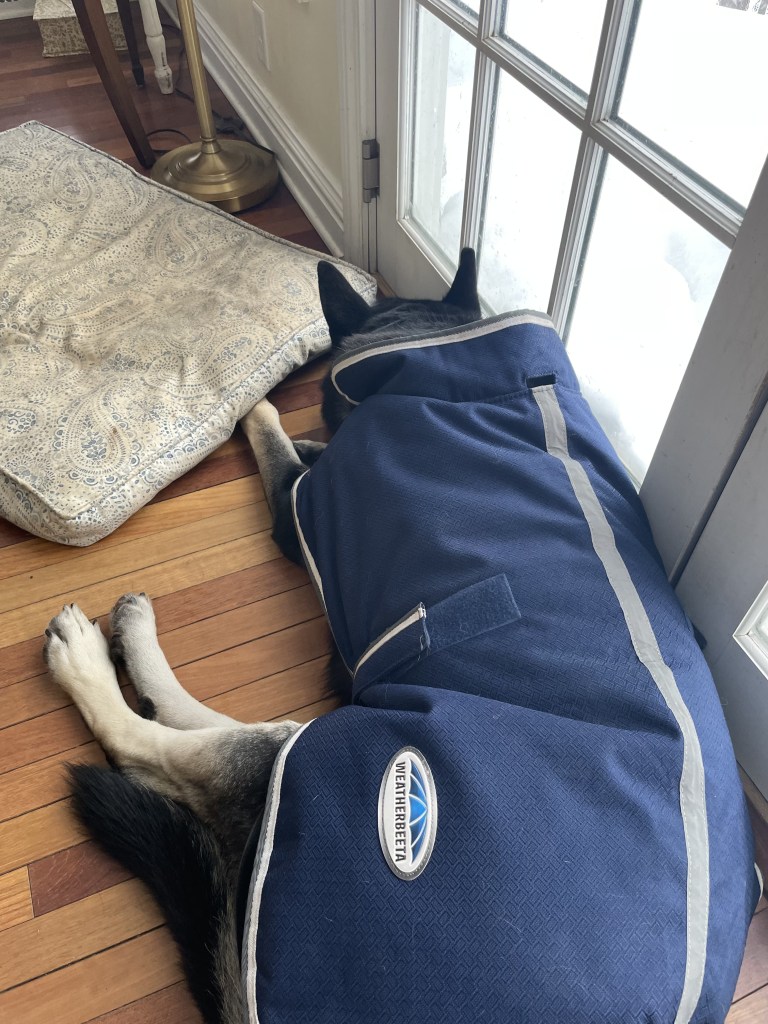

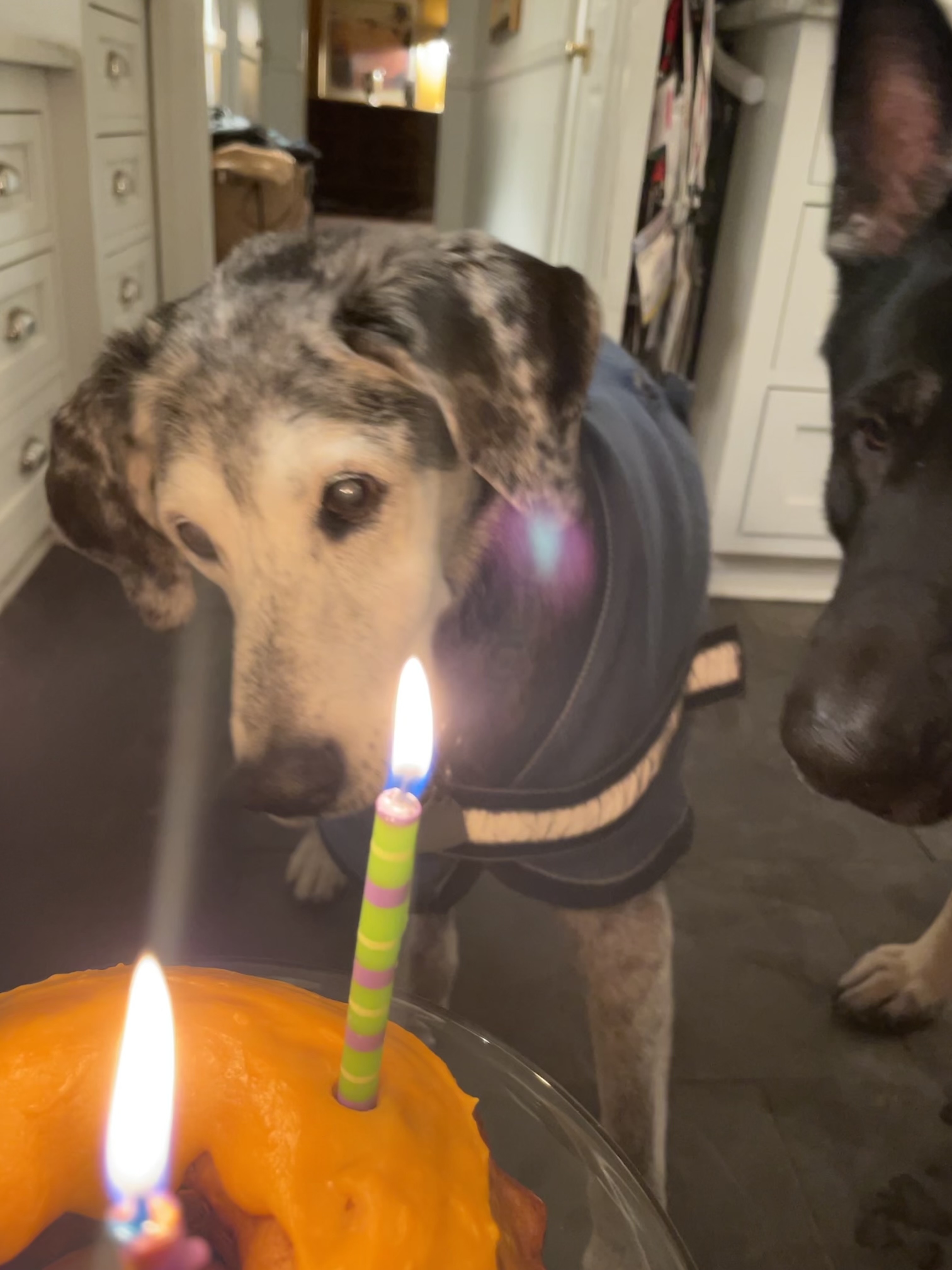
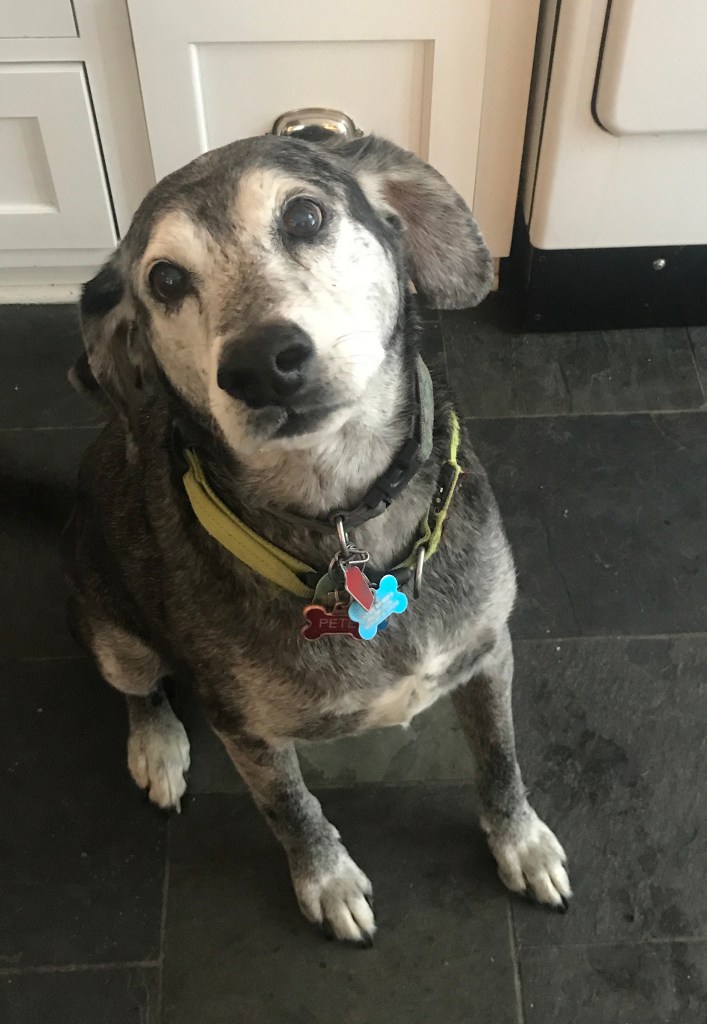
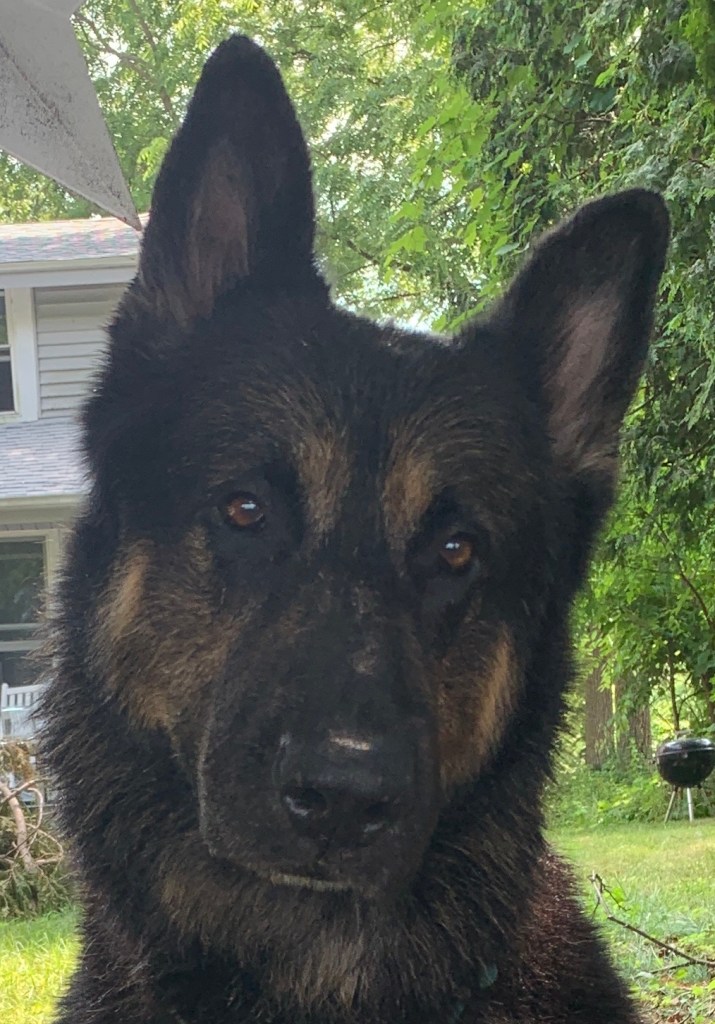
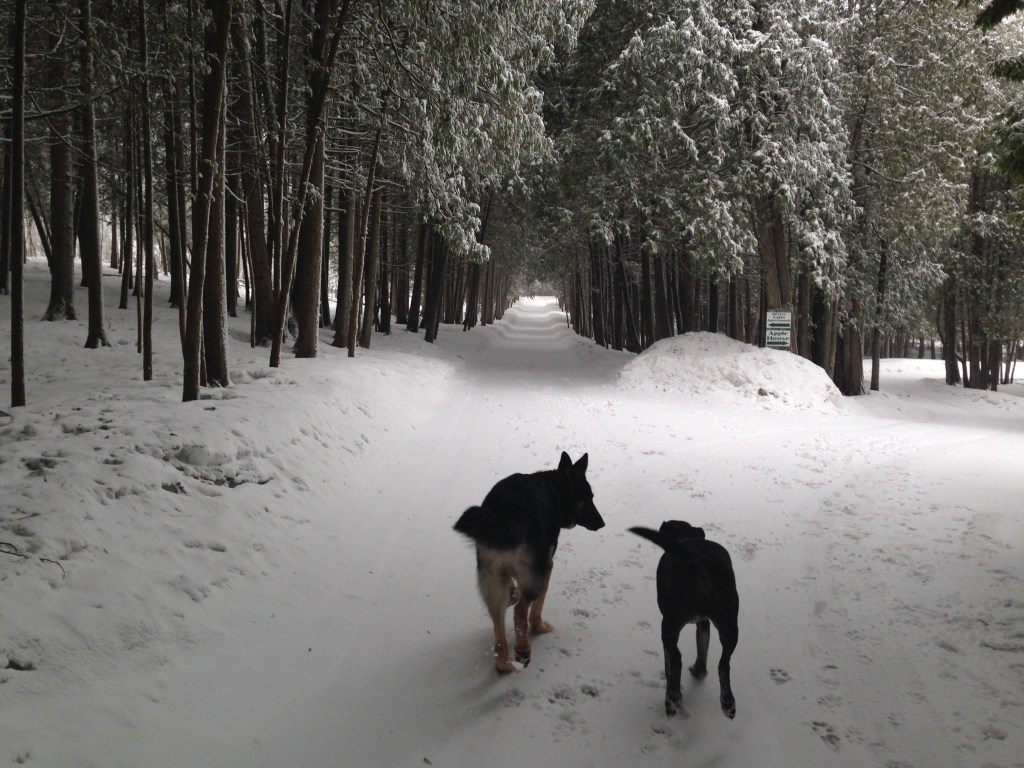
Today was the day we celebrated the birthdays of both Pete and Moses. The date for Moses was precise, but the date for Pete was an approximation. So we made it more festive by putting them together. We remember them with love and joy. (These dog photos are not gratuitous.)


There is a phenomenon I experience which may or may not be common among writers. It is the cultivation of an empty calendar.
This means that when I am trying to get the wheels turning with my writing, I cannot have appointments. I cannot have repairmen coming to the house. (Yes, I know, but in my experience, they’re all men.) I can’t have the cleaning lady. I can’t schedule lunches. I can’t schedule coffees. I only very reluctantly schedule dental appointments and haircuts, but this is mostly only so I don’t lose all my teeth and depress myself looking in the mirror.
This does not mean that I can never do these things. But it means that I can only do them spontaneously—the social things, anyway—after the day’s work is finished and I have exhausted my capacity for further writing. If I schedule something, it haunts me, and even when I try not to allow it, the little voice that plans what to wear and when I should leave interferes with the freedom of mind I need.
Like today, for instance, I have no intention of getting out of my pajamas until I am finished with my work. If I knew I had to go somewhere for lunch, it would ruin my morning. Because by 8 am I would be thinking: I have to stop at 10 so I can wash my hair, and figure out where my black jeans are, and is that new paisley blouse clean. Then I would have to stop, locate the jeans, and most likely dig the blouse out of the hamper to throw it in the fifteen minute cycle of the washer, and set the timer so I remember to put it in the dryer… And by then my concentration is ruined and the day is lost.
This can make friendships difficult, and I’m not sure everyone completely understands. I’m not even sure I understand. But at times like this, I tend to go dark, and although I will respond to texts or emails, and eventually return calls, I don’t cheerfully answer calls. Usually my phone isn’t even anywhere near me.
And I try never to schedule anything. Particularly not on Mondays.
On the other hand, on most writing days, by noon I am ready to venture forth, and I spend a happy afternoon rambling around doing errands, wandering the aisles of the grocery store, then coming home and arranging the new flowers and making something for dinner. If someone is available for a spontaneous something, that’s a bonus. But it’s not essential.
The end result of all this is a somewhat messy house, a somewhat frowsy personal appearance, a long list of needed repairs, and trying the patience of my very lovely friends.
It’s not ideal, but I have learned that writing a book requires several kinds of ruthlessness. And this is only one.

Yesterday I never got out of my pajamas. I walked the dogs in my down coat, so no one could have known it was covering pajamas. I knew, however, and it made me inexplicably happy.
I took a very long scented bath.
I did not put on mascara.
I did not write.
I also did not drink. (Oh, Dry January, get thee behind me.)
I did not cook, other than the avocado toast with poached eggs which we all ate for breakfast. (Except the dogs, who do not like avocado, but just had their poached eggs on toast with rice and ground beef and pumpkin and goat yogurt. They were happy.)
I lay around and read a book.
I searched online for vintage houses in unlikely places and concluded that people who watch HGTV should be prohibited from remodeling any house built before 1970.
I annoyed friends and husband with texted listings of vintage houses in unlikely places. Husband promised to send postcards.
I did not mop the floor.
I did not take down the small tree in the library.
I did not run to the local co-op for any missing pantry item.
I achieved Genius level in a NYTimes word puzzle. Even the venerable NYT has succumbed to grade inflation.
I actually did not nap, but I snuggled my big dogs while they dozed in the sunshine. Auggie purred. Eli snored.
I watched British Antiques Roadshow on the new tv in the library.
I bored myself, which, I think, is something we all need now and then.
This morning I had a full hour more of essential REM sleep than previously, even though I thought I was awake all night.
Oh. And I woke up with a new idea for the book.
 J.F. Riordan