
Now is the time to pre-order your copy of North of the Tension Line at Amazon, Barnes and Noble, or at your local bookseller.
Support your local novelist.
Please.
Now is the time to pre-order your copy of North of the Tension Line at Amazon, Barnes and Noble, or at your local bookseller.
Support your local novelist.
Please.

My husband likes to say that Moses is a tuning fork. He is our German Shepherd who loves by pure concentration. His every focus is on those he loves, and he trembles when he senses our stress. The night I left to go to my mother in her last crisis, he fought to be with me where he could not come, even as Charlie lovingly urged him to stay at home. In his distress, gentle Moses put his teeth on Charlie for trying to stop him from getting in my car. It was a protest, not an attack. But my leaving Moses behind was a betrayal to us both.
As a comfort and a way of drawing out my stillborn sorrow, I have been re-reading Madeline L’Engle’s adolescent novels which are explorations of faith and mortality. They will provoke my grief eventually, if not immediately. My own faith, so relatively new and untested, is approximately the same as the novel series’ teenager as she encounters death for the first time: in a friend’s father, in a friend’s illness, then in her grandfather. At the same time in the story, a dolphin’s baby dies, and the teenage protagonist writes a poem. Maybe it isn’t great poetry, but I like it because it expresses the value of life and love regardless of the boundaries of species. In it the angels weep because every life matters even in the span of the universe.
I am in a place where I am gathering all the love I can find. And the love of Moses, who sleeps now at my feet, is a treasure as deep as any I can claim.
The devotion of dogs is not new. Homer acknowledges the love of Argos, the dog of Odysseus, who, waiting twenty years for the return of his master, is neglected, flea-ridden, and sleeping on a pile of dung. And yet, when Argos at last sees his master–even though no human creature recognizes him–Argos wags his tail in greeting to the one he has always loved, and dies. Odysseus, who has endured the battle of Troy, Sirens, Circe, the Cyclops, Scylla and Charybdis, the deaths of all his companions, and the wrath of Poseidon, nevertheless weeps for the love of his old dog.
Moses is a dog. And his deep love for me is as real and palpable as any other love I know. He grieves when I grieve, and he is filled with joy when I am. What is love, if not this? And what greater comfort in grief than this deep devotion?
His soul reaches out to me and, gratefully, I answer.
My mother died ten days ago and I haven’t cried. What I mean to say is that I have shed some tears, but I haven’t wept. I know that grief has its own path, but it feels wrong that I have been so business-like and dry-eyed. For reasons of my own I am re-reading the Odyssey, and there is in Homeric literature an understanding that weeping and tears are essential tributes to the dead. Not crying is wrong.
People tell me that she was a great age and it is natural. That is true. But death is unwelcome. Someone reminded me yesterday of a happy event a few months past, and my heart went straight to the distinction between now and then: My mother is gone now. Then, she was on this earth, only a phone call or a drive away. Now she is gone forever, unreachable, untouchable, all hurts and old wounds now frozen into permanent scars, all love and tenderness irrelevant.
Our priest asked us at the cemetery whether we wanted to stay to watch her lowered into the earth, and to the dismay of my sister, I said yes, and everyone else felt compelled to stay at my wish. We tucked her in next to my father, the hard edge of his vault visible after six years, a blanket of orange and magenta roses waiting to be laid across her grave.
My tribute, I suppose, is still unpaid. I think it will burst upon me like a sudden storm, splattering innocent passersby whether they are sympathetic or not.
And that is the way of grief.
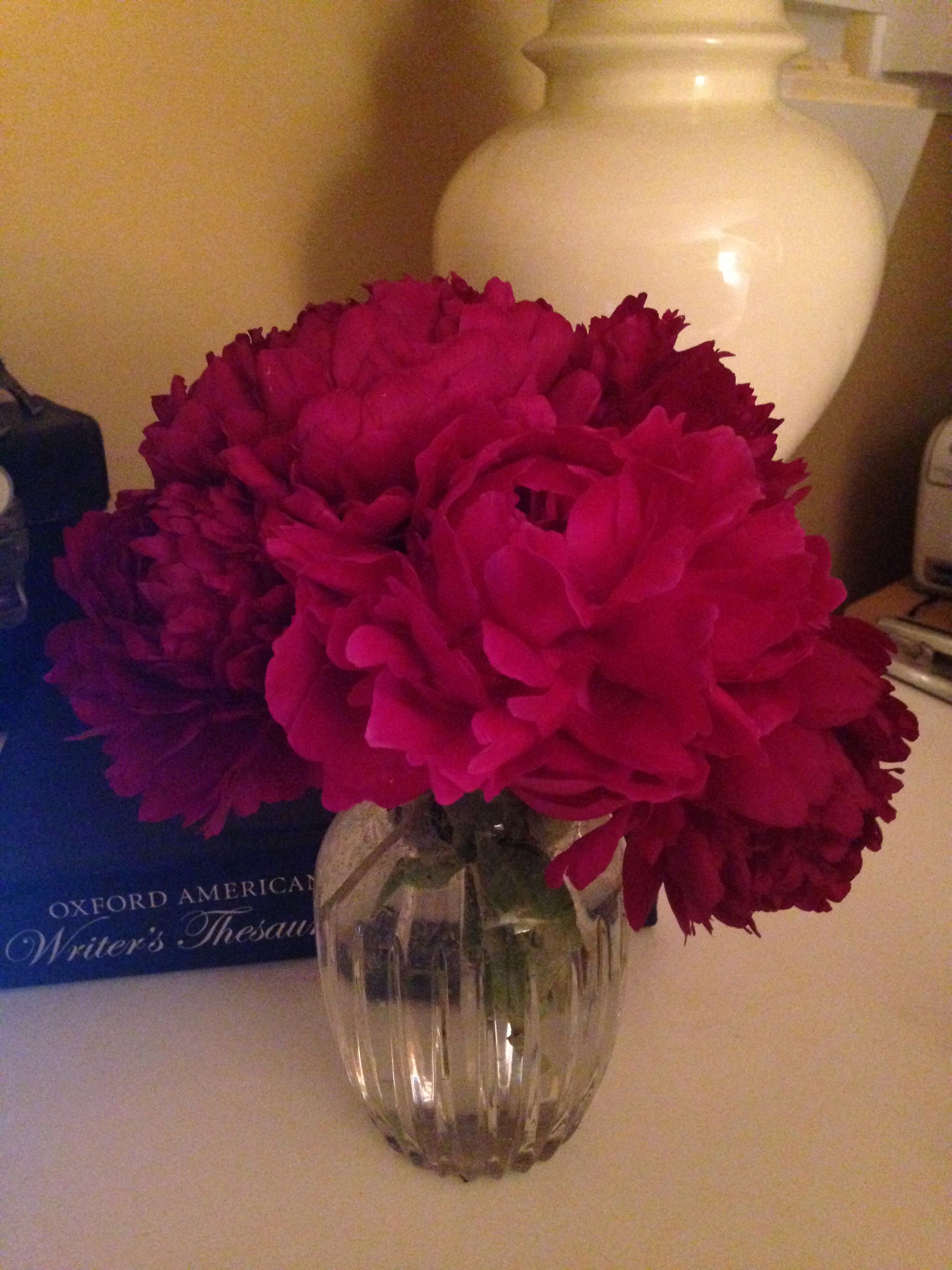
It’s been a lousy spring. I loved the harsh cold and daily snow of the the winter, even while everyone else was complaining. But this spring, even by Wisconsin standards, has been just plain bad: cold, rainy, and miserable, June is nearly gone, and we haven’t yet felt the full bloom of summer. It’s oppressive, and it feels like a year lost from one’s life.
I adore peonies. I recall one summer day, coming into the kitchen of my much-beloved German voice coach to find a full vase of deep red peonies. They took my breath away with their beauty. Noticing my reaction, my coach said to me, “They are like Wagner, aren’t they?”
That was a long time ago, in another lifetime. My peonies, which are abundant and in many colors, are the joy of my every June. I adore their perfume, and their variety, and I pick them extravagantly to fill the house. But this year I have been distracted and busy, and I missed almost all their bloom. This evening, after my early-rising husband had gone to bed, the dogs and I went out into the summer twilight–mercifully dry–and picked the last remaining blossoms. I tried not to notice the petals on the ground, wasted by the rain, and the browning and withered blooms that still remained on the stems. I found a few lovely and fully blossoming flowers, and I cut them all to bring into the house. Despite there being so few, their scent fills the room.
Normally, I am jealous of my flowers, and I find it difficult to part with them. But this time I know that my peonies will sleep only tonight in my house. Tomorrow I will bring them to my mother’s bedside for her to savor their scent and the voluptuousness of their color. However much I try to pretend otherwise, I know she will not be here when they bloom again. I dread to think of seeing peonies for the last time. I hope she doesn’t know.
One of my favorite writers, the melancholy anthropologist Loren Eiseley, wrote an essay called “The Most Perfect Day in the World”. In it, he describes a day when, utterly impoverished and riding freight trains across the country, he and a friend stopped in a small town on a sunny day, pooled their resources to buy a case of grape soda, and lay on the grass in the shade of a big tree all day, drinking soda and watching the clouds. This notion of perfection would not suit everyone, but it strikes me as a fine expression of the pure enjoyment of living: when time stops and you can live in this one moment, freed from fear and worry.
Today I am home from the office, ostensibly to proof my manuscript. But I have not done much work. It is a delightfully cool, breezy June morning, the first time that sunshine has combined with the full fresh bloom of early summer. The dogs and I lolled on the grass before attacking the long list of procrastination–I mean errands–on my list. I walked in the garden where the irises are an edible deep purple, the pink roses are in bud, and the peonies are tight balls waiting to burst. I rambled out to the garage to find the loppers to prune the dead branches from the climbing rose on the arbor, and wrestled them to the ground without too many thorn pricks. It is impossible to breathe in the air on day like this without experiencing a deep sense of wonder and gratitude. This is how I would like to spend my mornings forever.
But the day’s beauty makes a hard contrast to the suffering happening in this moment in other parts of the world, of the people who are terrified, in pain, in fear of horrible deaths, in an agony of despair for their futures. Marcus Aurelius counsels the practice of these contrasts as a method of valuing each moment of life and of inuring the soul against too much dependence on the vagaries of fortune. I read his teachings, and I have tried to absorb them. And I believe that we must all do what we can to make what we touch better, and to broaden our reach to others. But I think that modern angst is the result of our knowing too much about the suffering we cannot control. We are bombarded by war and poverty and natural disasters in every corner of the world, by the sufferings of people and the sufferings of animals. There is no doubt that we are meant to endure the suffering around us. But the suffering of the whole world is not a burden a human being can bear.
And so, Pete, and Moses and I will go out into the orchard and play ball in the sunshine, grateful for our blessings. But I will also offer my prayers for the souls in the dark, knowing that I am helpless to give them any relief. For us, it is the most beautiful day in the world. And that is how it has to be.
We are in the final edits–the galleys–of North of the Tension Line (Beaufort Books, September 2014; Available now for pre-sale on Amazon and Barnes and Noble. Sorry. Had to be done. ) just at the very moment that things are intense at work. Although a professional proofreader and my editor have been through the book, as the author, I, too, need to review it, and time is pretty crunched. My good friend, Mary Beth, aka “Impromptu Librarian”, offered to be an extra set of eyes, and I gratefully accepted. In less than a day she had read the book for probably the third time, and returned the proofed documents for me to pass on to my editor. But the next morning she called and we had an odd conversation.
Mary Beth: “What is hapcedarss?”
Me: “I’m sorry?”
Mary Beth: “Hapcedarss.”
Me: “I hate your bluetooth system.”
Mary Beth: “It’s in your book. Hapcedarss.”
Me: “Hapcedarss? It’s in my book? Are you sure?”
Mary Beth: “I’m sure. The proof reader has many notes about it.”
Me: “In my book?”
Mary Beth: “She had been commenting on it several times, and then pointed out that she had googled the word and checked with OED, but cannot find any such word.”
Me: “That’s hardly surprising. I don’t think there is any such word.”
Mary Beth: “Well, it’s in your book.”
Me: “Hapcedarss is in my book.”
Mary Beth: “Right.”
Me: “Hmmm. Very odd.”
It was a busy day of meetings and preparations for meetings at work, so it wasn’t until quite late that, now having forgotten about hapcedarss, I was able to finally sit down with my manuscript to begin my own proofreading. Not far into the manuscript light finally dawned.
I sold my book much more quickly than I had expected, so submitting my manuscript for fact-checking had therefore also had a much tighter timeline than I had expected. Among the more essential things was sending the book to my friend, Captain Bill, the ferry captain, to make sure that I hadn’t committed any egregious ferrying errors. He called me, and in one of the more delightful moments of this whole process, left a message telling me that he had read the book, and that he had liked it. I still have his voice mail on my phone and listen to it when I’m feeling blue. Anyway, when I called him back, I anxiously enquired whether I had made any mistakes about the ferry, or said anything stupid about the lake or its navigation. He assured me that it was all fine, but he had one correction. The trees at School House Beach, he pointed out, were not pines, as I had written. They were cedars.
Armed with this information, I sat down with my manuscript and created a “find and replace”. Wherever P-I-N-E appeared, it should be replaced with C-E-D-A-R. For some reason, I have rarely used find and replace, even though I have been using Word at home and at work for a pretty long time. What I hadn’t realized was that find and replace doesn’t just find and replace words. It finds and replaces the interiors of words.
It was late in the day, but I called my editor in New York. “I’m so glad you called to tell me this,” she said. “I had a terrible day, and this makes it so much better.”
Apparently, there is a great deal of happiness–or at least the talk of it–in my book. And it’s likely that hapcedarss will forever be a part of Mary Beth’s and my, and my editor’s vocabularies.
Our cups overflow with hapcedarss.
Today was one of those days. Generally, I try to remind myself that all my problems are lucky people problems. But sometimes you have to allow yourself a tiny bit of self pity.
So, I arrived at the office, dressed for the long day of back-to-back meetings. Since I usually start early, I eat my breakfast at my desk. I am fortunate to have a beautiful office in an historic building, with oriental carpet, oil paintings, and a brass chandelier. But underneath my desk, in a concession to practicality, is one of those plastic sheets that allow your office chair to roll on carpet. I should note that for once in my life I was wearing (relatively) sensible shoes, a pair of low-heeled black sandals, but with, as it turns out, very slippery soles. I was carrying my bowl of yogurt and blueberries in one hand, and my cafe au lait in the other, and had just stepped behind my desk when my foot slid from under me. In what seemed like slow motion, I went down, my hands went up, and a cascade of yogurt, blueberries, and cafe au lait went up into the air in a spectacular arcing curve, landing, with rather remarkable accuracy, on my head. My Italian designer suit jacket sleeves were soaked through with coffee, my hair was clinging to my forehead, and there were blueberries kind of mushed into the part of the oriental carpet that wasn’t covered by the plastic sheet thing. The receptionist called from downstairs to ask if we had knocked over a file cabinet. “No,” I said. “That was me.” My colleague from across the hall tried to be helpful by laughing and bringing paper towels. After going through a massive stack of paper towels, in a triumph of optimism over yogurt, I went to one of my female colleagues (assuming that the males would be of little use in this case, since they would have only laughed) and asked her if I were presentable enough. She paused for a moment as she looked me over. “I think you need to change.”
I went home to start again and missed my first meeting.
I suppose, in some respects, it was the highlight of the day.
My publicist has been discussing talking points for North of the Tension Line. In working through my suggestions, I left my notebook on the kitchen table while I cooked dinner, and my husband got his hands on it. In retrospect, I should have foreseen this.
What follows are his ideas for talking points for North of the Tension Line.
1) There is a talking goat.
2) There is a protagonist who is suspected of writing pornography, perhaps involving the goat.
3) Outrageous things happen after a spontaneous dare.
4) There is a male character who quotes Noel Coward but is, oddly enough, apparently not gay.
They are actually all true.
But he’s still a goof ball.
The book business has always been mysterious, but in the turmoil of new media and new distributions, one thing remains the same: Sales Matter. And at my recent visit to BEA, it was made abundantly clear that in a world of many books, it’s difficult to be noticed. One way is to sell a lot of pre-orders. So if you enjoy my blog, may I please urge you to take a little jaunt over to Barnes and Noble, or to Amazon, or to your favorite bookstore, and ask for North of the Tension Line? Thank you!
Pete is our camera-shy smaller, auxiliary dog. And, I should add, at 9 years old and 68 pounds, he is the boss of 115 pound, 2 year old Moses, our sweet-tempered German Shepherd. Moses generally does what Pete tells him, but for some reason the other day, he didn’t feel like it. When Pete bit him, Moses lunged back, and in the scuffle, poor Pete dislocated his elbow. Now he has a cast, and pain pills, and antibiotics, and the most pathetic cry a dog ever made. So I’m sleeping on the library couch so I can be near him. Pete has many talents: among them a knack for drawing sympathy.
This time he really deserves it.
 J.F. Riordan