Electronic Narcissism

I like silence. Perhaps it is a commentary on the state of my nerves, or maybe it’s because I’m a former musician and my brain is aurally focused, but I find unwanted noises distracting. I need silence to think and to write, and when I want sound, I prefer to choose whether it’s words or music. So I find the contemporary taste for household appliances that ping, beep, and play tunes extremely annoying. 

If I seem cranky, it’s probably because I have been trying desperately to write a novel amidst continual interruption from household appliances.

I have a notion that devices should A) make your life easier and B) not require distraction from your thoughts, and, come to think of it, C) achieve their purposes in silence while leaving me alone. 

In my quest to break my writing stalemate, I recently packed up and left home for the seclusion of the Island. The house I rent when I go away to write is a place I know well. I have been going there for years, and it’s like a second home. It’s a charming place: roomy, but cozy, with a wonderful property where I can walk in privacy with the dogs, and a lovely landlady who knows the precise formula of solitude and companionship to feed a writer. I have written parts of all my books there, and there’s something about the atmosphere that inspires productivity. My days there are a perfect pattern of writing and walking, and no one disturbs me unless I want to be disturbed. The house is not old, but my landlady had just replaced the range, the refrigerator, and the washer-dryer, all sparkling new and ready to be used. She is a generous woman, and likes to buy quality things.

Throughout my first day, unfortunately, I spent a great deal of time debating when to tell my host that there were red squirrels nesting in the roof. I knew it would upset her, and I also knew it would mean workmen disrupting my writing. The squirrels’ chirping and scratching was irregular but loud, and I feared they were doing damage. It wasn’t until late in the afternoon that I finally realized that it wasn’t squirrels, but the new refrigerator. I have no idea why a refrigerator should make a noise like red squirrels. Maybe someone thought it was cute. Or maybe no one ever spent any time in a room where it was running. I suppose it was companionable, in its way. I mean, at least the noise resembled living things.


The stove however, was much worse than squirrels. Writing can be both lonely and vaguely excruciating, and it is during these moments that I usually take a break to cook something nice for myself. Sometimes the food in my novels is actually something I’ve just made. Food, for me, is comfort, and when I’m alone, I look forward to meals as a way of permitting myself a break, and as a kind of companionship. In some ways, it’s as much about the cooking as it is about the eating. Cooking is a pleasant diversion, and creative, but as I’m chopping onions or browning beef, my mind is able to continue the intellectual rambling necessary for building a story.

So, having grown accustomed to the refrigerator squirrels, after a few hours of work and a long walk in lovely silence, I turned on the oven, and was jolted out of my plot-related reverie by a jaunty little tune. It wasn’t just a beep, but an actual musical phrase, only with tinky-tonk noises. When I set the timer it produced another tune, and like so many electronic devices, instead of one smooth dialing motion to set the temperature, I had to press it each time I added ten degrees, each time producing another beep. When the oven reached the temperature I had laboriously set, it sang yet another tune. Apparently each melody has a specified meaning, but I’m not interested in providing room in my head for determining which is which. I found myself missing my vintage stove at home, whose only noise is the satisfying “whomp” it makes when you light the oven with a match.                                                                          

Then there was the new washing machine. I pack lightly when I go away to write. I mean to say: the car is full of stuff—much of it dog-related, and some of it bourbon—but I don’t bring a lot of clothes, so I’m happy to have a washer dryer in the house, and I often throw something into the washer while I’m writing. This new machine could be featured in a museum as The Loudest Washing Machine in the World, and it makes what I can only describe as a rhythmic mechanical gagging sound for the entire cycle. It’s some sort of water-saving design, which is, I guess, mandatory, but seems a little silly when you’re only steps away from—literally—a quadrillion gallons of water. I found the gagging somewhat less charming than the nesting squirrels.  As if this were not enough, it beeps. Not once, for each time you choose a cycle, or once when it’s finished, but every 30 seconds after the cycle, until you interrupt the sentence you’re writing to get up and open the lid. I have had the care of less demanding puppies. 

Thankfully, I was able to close the door to drown out the worst of the noises, but the beeping penetrated the walls. Not surprisingly, the matching dryer is also an electronic nag. But the thing is, if they make weird gurgling noises and show signs of nausea, how would you know until you got them home? I have a new washer and dryer at home, and they both have the options to turn off the signals. I made sure of that. Of course, I don’t live in the same room with them, either. So there’s that. 

But still.

It used to be that appliances would sit silently and make themselves useful. Now, for reasons I do not understand, they seem to feel a need to call attention to themselves, as if, like electronic toddlers, they are announcing: Look at me! Look what I’ve done!

It strikes me as an indication of a deeply flawed society. What personal failings have led us to develop narcissistic appliances? Is it a reflection of modern life, the electronic equivalent of so-called influencers, who must announce their doings on Twitter, Instagram, Pinterest, and Facebook, or be forced to question the value of their own existences? Have we created appliances like ourselves? Is there anyone who likes this incessant mechanistic signaling? Or is there something about the electronic miasma in which we all exist that assimilates our nerves into a state of noise acquiescence? Is there some consumer movement I need to join to dissuade manufacturers from this evil path?  

The last time I bought a microwave oven I asked the saleswoman which ones beeped only once and stopped. It was clear by her reaction that no one else had ever asked this question, but she dutifully investigated the beeping of each one, no doubt thinking bad words that I am grateful not to have heard. But each time I buy a new appliance, I find that the noise factor has intensified, as if this has become a signal—as it were—of improvement. I believe it is, instead, an instrument of consumer torture.

A few days after I got home and settled into a new appreciation of my quiet appliances, the brand new, very expensive water heater silently burst a valve and unobtrusively leaked water all over the basement floor. 

I felt oddly grateful.

Pandemic Idyll

It was the most beautiful summer I can remember here. Day after golden day unfolded in rich, scented glory. The sun, the heat, the lushness of the woods and garden, the perfect refreshment of the lake were everything anyone could wish for. But it was an odd summer, too: no picnics with friends, no Memorial Day, no parties at the lake, no baseball in May and June, no Fourth of July, no parade, no fireworks, no farmers market, no family reunion, no Labor Day end of summer celebrations.  There were no markers, no points in time. Just the silent turning of the earth, the move toward the sun and then away from it, the days turning, too, from morning to afternoon to evening. The light lengthening, the light retreating. The restless sleep. Then morning again.

It’s difficult to explain the dreamy quality of life these days. I tell myself it should be a time of joy and productivity, but somehow it isn’t. It’s not a happy dreaminess—I don’t know how it could be—but it’s not unhappy, either. It’s a sense of unreality; as if time is over. 

While the pandemic rages on in the world, I feel a bit like a medieval monk, having raised the drawbridge and retired from the world to write my scrolls. My husband and I work from home at the best of times, and aside from the busy travel schedule we both had, our lives are essentially unchanged.

I am not ungrateful. But I am puzzled by the peculiar—I won’t say lethargy, exactly—but fatigue we both feel. He, in particular, has been working harder than ever. He has demands on him. My own deadlines are mostly self-imposed.  But I have been in a heavy languor, having finished my novel in December, and then almost immediately plunging into grief. For the first three months after Moses died, I was deeply stricken. Then came Eli and the pandemic, which were, I suppose, distractions.

It feels now as if we’re on one long snow day from real life. It’s an illusion, of course. We don’t get to make up the days lost in our lives. They won’t come back. But the sense of being out of time is life-changing, and I sometimes fear I will never have ambition or energy again. I can’t even really say why.

The wheel of days keeps turning, but our lives feel stopped.  I am one of the lucky few. I am living in a dream, away from the world, with the capability of tuning it out almost completely if I choose. Maybe I am numb to keep myself from missing things too keenly, from worrying about the world too much, from feeling there’s more than the usual tragedy and suffering. Or maybe it’s a lack of stimulation. There’s nothing but the weather to help discern one day from another.

Last year in August I came down with a severe case of influenza, picked up while cuddling my sick grandson. He had a mild fever and a cough. But it was the sickest I have ever been in my life, with a terrible, painful, racking cough, and high fever. There are two or three days that I don’t remember. I couldn’t eat. I didn’t want to. I could only cough in agony and sleep for almost ten days. It took me months to recover. Looking back, it feels like a warning. If I was that sick with regular flu, I suspect I would not survive this. 

So when I do go out, every minor activity requires preparation: the mask, the hand sanitizer, the wipes, the gloves—just in case. The stress of being out in the world feels at the moment like a mere nuisance. It isn’t until I get home that I feel the exhaustion of it. But that’s not the source of my daily fatigue.

We have no reason to be out and contributing to the spread of disease, so we stay at home. Very few, limited family visits, no restaurants, no excursions with friends, no shopping. No hugs. The annual summer month with our daughter and French grandchildren was cancelled. By the time we see them two years will have passed. My sister has a new house in another state I haven’t seen. Our granddaughter on the east coast has started walking. My annual trip to Minnesota for a friend’s birthday is cancelled.

These are very small things in the wake of so many larger sacrifices by so many others. But I am ashamed to admit that it can be hard.  For those who have lost their lives, and for those who grieve them, just one more of these slow, languid days would be a prize beyond reach. It is a sin not to be grateful every day for my family’s good fortune. But sometimes even the counting of blessings lies heavily against the heart. Everything seems to require tremendous effort.

The sunrises are coming later and later as autumn approaches. Dawn is marked by the stirrings of the geese, but I realize I haven’t heard a robin in weeks. Auggie lies nearby, waiting impatiently for the signal that I may be ready to take him outside for the first green ball session of the day. Eli snoozes on my foot. He has a softer disposition than Auggie, with less drive and more patience. Pete has already disappeared, without greeting, to lie at my husband’s feet in his office. With limited sight and hearing he moves in an ever decreasing world, but still loved, still happy, still nagging for his dinner.

We all have dreams, and hopes, and longings to color our thoughts, but life consists primarily of how we spend our days. We will go for a walk today, and do some chores, and call my friend for her birthday. I will do a crossword puzzle, with its utterly inexplicable satisfactions. There are pleasures in a clean floor, an orderly room, the first cup of coffee, the scent of clean air, the affection of an animal. We will watch the sunrise, walk in the sunlight, play ball with the dogs, and drink wine in the golden red light of evening, somewhat mitigated by the annoyance of mosquitoes. And then we will go to bed, and to sleep, hoping, in an uneasy world, for the wisdom and grace to appreciate what we have. 

Wisconsin Author J.F. Riordan on the Beauty of the Mundane and Her Life in Exile

By Doug Moe

From Mystery to Me Bookstore’s monthly newsletter.

It was three decades ago when J.F. Riordan discovered the island that would become her muse for four novels and counting.
         “I was in Door County,” she told me recently by phone, “just looking for something to do, and decided why not go see what’s on the island?”
         Washington Island sits some seven miles northeast of the tip of Wisconsin’s Door Peninsula and is reachable by ferry.
         “From the first moment I set foot on that ferry,” Riordan says, “the magic of the place swept over me. And it’s really never gone away.”
         Riordan appeared at a Mystery to Me virtual author event September 10 at 7 p.m. with A Small Earnest Question, her new novel and the fourth in her North of the Tension Line series, which was also the title of Riordan’s 2014 debut. Click here to watch a replay of the event!
         The books have earned praise for their mix of mystery, humor, and the inevitable intrusion of small-town politics into daily island life. Riordan herself says, “The beauty of the mundane is really what my novels are about.” She said it while we were discussing her earlier life as a professional opera singer.
         Riordan was born in New Jersey but moved as a child with her family to Michigan, then Wisconsin. She learned to love music early, from her father, whose mother took him to weekly performances of the famed Metropolitan Opera. Riordan had barely reached her teens when she announced she would be an opera singer.
         “I was probably about 13,” she says. “I started preparing myself quite seriously. It was completely lucky that it turned out I actually had talent. That wasn’t a given.”
         At 16, Riordan left high school to enroll at the University of New Mexico, drawn by a particular teacher to study voice. “A mixed bag,” she says now of the decision. “Sixteen is pretty young.” Still, she fulfilled her goal and became a professional, a life less glamorous than perhaps perceived, with its backstage squabbles and constant travel to opera houses in small European cities.
         “I was lonely,” she says. “Homesick.”
         The experience produced an epiphany: “Your life is really how you spend your days. It’s your everyday life. It’s not some grandiose dream. I was miserable.”
         Riordan moved back, eventually earning a college degree in English and teaching three years in the Milwaukee inner city, where she coached a forensics team.

It was after she began another job, working for a foundation doing philanthropic research, that Riordan began to write, squeezing in time early mornings or late at night. She likes the essay form and considered a nonfiction book on her teaching experience. Slowly, however, the fictional story of former Chicago newspaper reporter turned freelance writer Fiona Campbell and her eccentric cast of friends and adversaries on Washington Island took shape.
“I think it took seven or eight years to write,” Riordan says. “There’s a lot of self-doubt and questioning when you’re writing a first book because you don’t know if anybody wants it. You don’t know if it’s ever going to be read or published.”
Her husband, Charlie, was supportive, laughing in the right places when he read the early chapters, and bluntly counseling her not to think about agents or publishers, when she raised the subject. “None of that is your business right now,” Charlie said. “Go upstairs and write the damn book.”
When the manuscript of North of the Tension Line was finished, Riordan sent it to a few agents, scattershot, uncertain of the process. “I submitted my manuscript to someone who specialized in historic railroads,” she says.
She also sent it to a few trusted friends, one of whom worked in the same office building as a book publisher. This friend’s wife loved the novel, and that was enough for the friend to talk to the publisher, Eric Kampmann of Beaufort Books, who gave Riordan the contact information of his editor-in-chief.
Riordan sent the manuscript that night, a Thursday. Charlie counseled patience. “You know, it will be a month before they look at it. Start another book. It will be a while.”
The following Monday, Riordan was at home checking email after a busy day at work. The editor was back in touch: “Loved the book, couldn’t put it down, read it all weekend. Attached is a contract.” Charlie was in another room. Riordan recalls, “He said I made a noise that made him think there was an animal in the house.”
A life-changing moment. “That never happens,” Riordan says. “I was very fortunate.”
And – clearly – highly-talented. Three more Tension Line novels have followed, and a book of essays, Reflections on a Life in Exile.

Of the new novel, A Small Earnest Question,Riordan says she wrote two endings and didn’t decide which one to put in the book until a week before she submitted the manuscript. The title came out of something her copy editor said in a meeting.
“She is not a hesitant or timid person,” Riordan says of the editor, who nevertheless framed a query by saying, “I have a small earnest question.”
Riordan recalls, “As soon as she said it, I said, ‘Oh, my God. That’s the title of my next book.’”
Riordan’s love of Washington Island – so evident in the novels – is also mirrored in the title of her book of essays.
“When I say I live in exile in Mequon, Wisconsin, people think I’m kidding,” Riordan says. “But I’m not. I mean that quite sincerely. I’d love to live on the island. It’s just not practical. Trying to get your whole family to pull up stakes and live on a remote island in the middle of nowhere is kind of a hard sell.”
She concludes, “The desire to be on the island is part of my impetus to keep writing. I can pretend I’m there.”

***

A note from J. F. Riordan:

Mystery to Me in Madison, Wisconsin is one the most charming bookstores anywhere. and one of my favorites to visit. Help keep our neighborhoods filled with lovely stores like this by buying my books from an independent bookseller.

***

You can support Mystery to Me by buying J.F. Riordan’s books here.

Read the Beginning of J.F. Riordan’s new novel, *A Small Earnest Question*

Book Four in the Award-winning North of the Tension Line series

The telephone rang in the sleek, city office of Victor Eldridge. As he reached to answer the pain came again with a deep, resounding blow that made it difficult to breathe. He braced his hands against his desk, waiting for it to pass as it always did. The ringing phone, mixed in the wake of his agony, was almost beyond bearing.

Victor Eldridge was not a religious man, but what he experienced now was as much of a prayer as he would ever utter. Please, let this be the end of it. Please let the pain stop.

He did not care how.

The ringing and the pain faded at the same moment, and it seemed as if the room echoed with both. He stayed frozen in position, his breathing shallow.

He straightened slowly and leaned back in his chair. There. His breath became deeper and he could feel his heartbeat slowing to its normal pace. His reason returning from the chaos of suffering, he began to think. He had much to do but very little time. The pain was gone. For now. But he knew it would come again.

And again.

***

keep reading on Kindle.

Spring and all

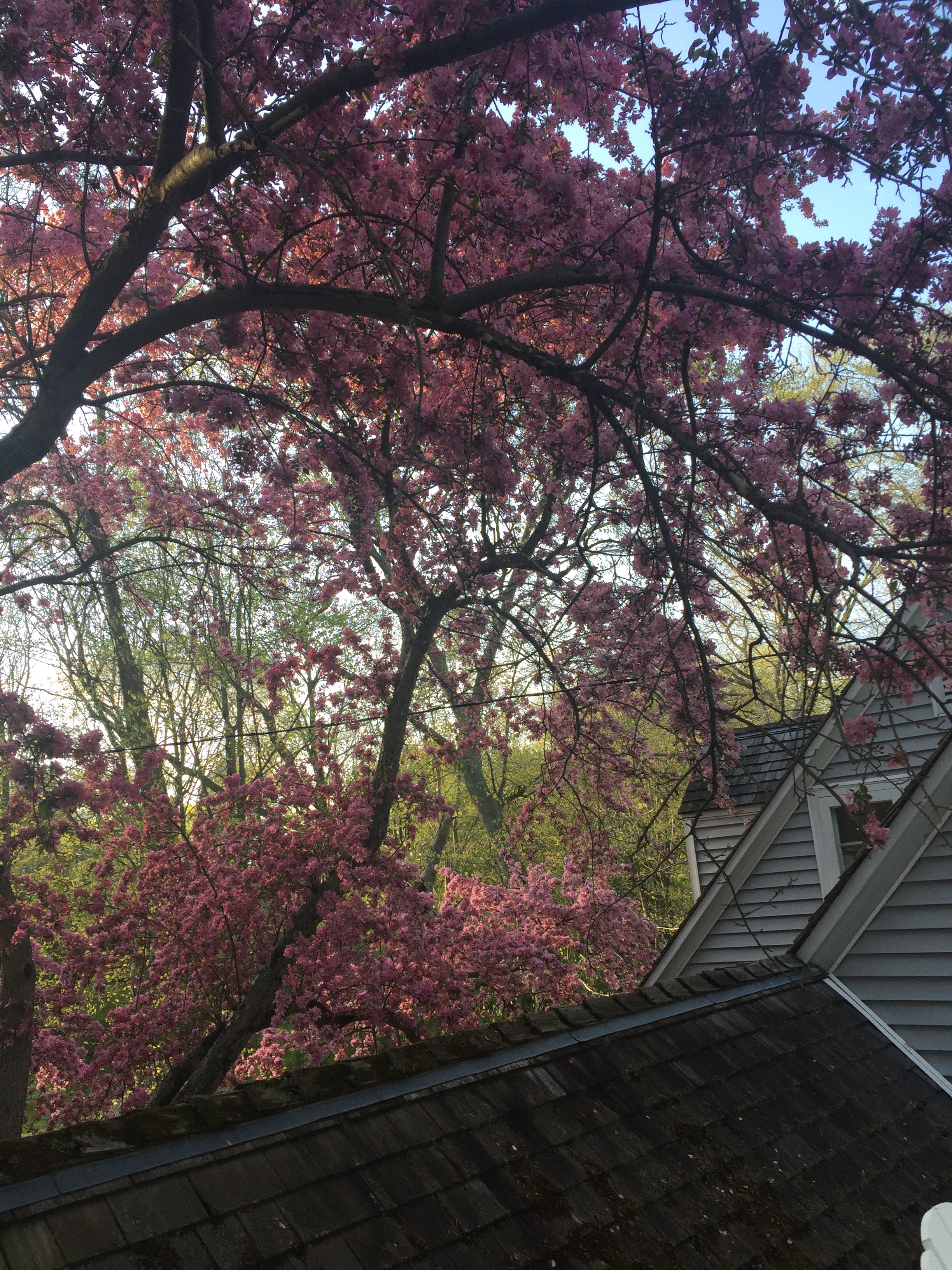
img_1531It is the time of year when life blooms. The frogs are singing, the geese are still flying overhead to the place where they will spend the night. The robins chirrup the call that means, to me, dawn and dusk. But if I stand in my driveway, with the dogs lying still, I can hear things growing. Literally. There is a rustle in the woods that does not come from an animal’s movement. It is the slow, steady creep of leaves and stems and flowers, finding their place in the light and air.
The time of year is nostalgic with memories of childhood spring concerts, graduations, proms, life events. The soft green nacensce of leaves and flowers, the scent of bloom; the memory of love; of longing. Spring smells of all these things.

My job is ending. I don’t know when I will work again, but my husband has declared it a day of liberation. We drink old champagne, the sound of birds and lawn mowers in the background, the birds singing their old, unchanging songs. I hear the robins, the cardinals, the sparrows, the meadow larks; the woodpeckers, and the phoebes. The bird songs are mixed with the soft insistence of puppy Auggie, whining under his breath that I should pay attention to him, to his green ball.

The lilies of the valley are still coiled in tight rolls, waiting to unfold. The bluebells have begun to bloom, but they have not yet burst into riot. The narcissi spill their scent upon the air. The peonies push their red shoots up, and I look for a careful placement of the metal rings that will keep their blooms from lying on the ground a few weeks hence. I dream of them all winter, of their exuberant, joyous explosion.

The turkeys rise up, no longer visible on the ground in the woods, from green bowers into their now hidden roosts. The deer chuff in the woods as they browse, but the green leaves hide their movement. A big raccoon makes her cumbersome way down a tall tree to begin her nighttime rambles.

It is spring. The world is poised. A great writer died last night, and I feel the world’s aftershocks. We are smaller now, without him.

Nevertheless, this old song sings. The frogs, the geese, the robins, the rustling leaves. It is soft-scented and sweet.

The world goes on, beautiful and ruthless. We watch– worn, enchanted, hopeful, but powerless to change the slow, hard progress of life.


BOOK LAUNCH EVENT!

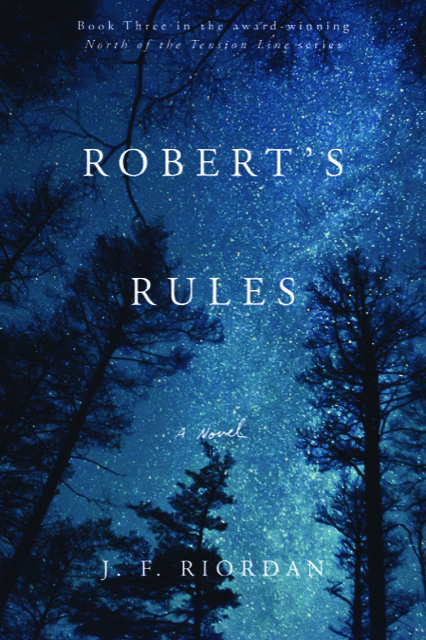
I hope you will join me at the Milwaukee launch of Robert’s Rules, Book Three of North of the Tension Line on Thursday, May 24th at 7 pm, at Boswell Book Company.  For writers like me, operating a bit below the radar, these things are very much group efforts. I need your help to get my book off the ground. That’s why they call it a launch! RobsRules

Here’s a blurb from the book: “Robert’s Rules is Book Three in the award-winning North of the Tension Line series, set on a remote island in the Great Lakes. Called a modern-day Jane Austen, author J.F. Riordan creates wry, engaging tales and vivid characters that celebrate the well-lived life of the ordinary man and woman.”

First of all, please come! I would love to meet you, or if you’re an old friend, to see you again. A big crowd tells the bookstore that my books are worth the effort. Bring your friends, your book club, your Moose lodge, your groupies.

Second, please call or visit Boswell, and pre-order. Pre-orders are a very big deal in the publishing industry, and can make or break a book. If you can’t make it to Boswell, please go to your favorite bookseller, or online. Please let me know that you can join me in giving Robert’s Rules a successful launch.  Let’s boost it so high that everyone can see it!

I hope to see you there!

jan-sidebar-headshot

J.F. Riordan


Lost and Found

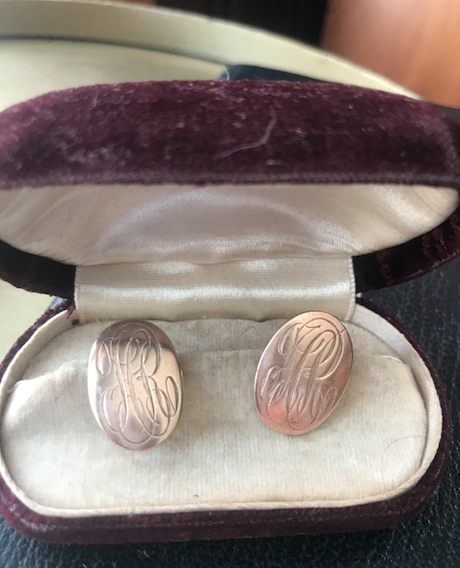
Shortly after my mother’s death, about three years ago, my sister gave me a gift: a pair of earrings she had had made from my father’s monogrammed sterling silver cuff links, still nestled in cream velvet in their original oval purple velvet box. I was touched and delighted by them, excited to wear them, and to have this keepsake.

One winter afternoon, I wore them for the first time, and went shopping with a friend. We had fun, wandering from one shop to the next, and spending a fair amount of time trying on hand-knitted hats. I guess our ears were cold.

It was about an hour later that I realized I was wearing only one earring. The mood of the afternoon was instantly altered. I tried not to show how upset I was, reminding myself that it was just a thing. We retraced our steps, I went through all the hats, gently shaking them, and looking for something caught in them. I crawled on the floor of the shop. Hopefully, I left my name and number with several of the stores we had been in, but I never heard from anyone. It was gone.

I never said anything to my sister. I put the one cufflink/earring away in its ancient purple velvet box, and promised myself that someday I would have it made into a necklace. But I felt sick at the loss.

Yesterday was my birthday, and although I try hard to be grateful to be having a birthday, I spent the day fighting off a case of melancholy. I felt the passing of time, the shortening of the horizon, and a soft, persistent nostalgia for my late parents. Don’t misunderstand: there were cards, and gifts, and flowers, and phone calls, greetings from friends and strangers, a snowstorm, and best of all, an advance copy of my new novel in the mail. Nevertheless, I spent the day in an uncharacteristic lethargy, unable to accomplish much of anything.

Toward the end of the day, though, I bestirred myself to straighten our dark, cozy library for the evening. I had recently redone the room as a surprise for my husband, and had emptied the shelves and cleared all the surfaces before and after I painted. The little brass tables had gotten wiped and polished, and even the bottles on the bar cart had been dusted. I oiled the wood. On Friday, our cleaning lady went over everything again, so it all sparkled.

I lit a fire, and some candles, I put on my favorite Beethoven piano sonata, which reminds me of my father’s last days. Feeling both sorrowful and affectionate, I began stacking the week’s collection of books, papers, to make some room on the table, when something caught my eye. On the table—the table I had emptied and polished twice in the past week—was a small oval silver shape. It was an earring.

Unbelieving, I went to my bureau where the purple box was kept. The one earring was in the box. The other was in my hand.

I immediately texted my cleaning lady. Yes, she had found it in the couch, and forgotten to say anything.

But here’s the thing. In three years, the house has been cleaned many times. The couch has been vacuumed at least every other week. There is a perfectly rational explanation for how the earring got there. But it feels, to me, as if I had a visitation, and I can’t help but believe that on this melancholy birthday, as I listened to the music that brings him so vividly to mind, my father reached through the weave of time. Warmed and happier, I wore the earrings last night, ate cake, and drank champagne.

Wisdom tells us not to put too much value in things, or to choose mysticism over reason. But sometimes when we don’t expect it, everything shifts, the lines can blur, and the momentary mysteries we see instead make life’s realities both rich and beautiful.

It was a happy birthday.

Screen Shot 2018-02-11 at 2.50.57 PM