Writing bad poetry is a pastime shared with youth and age. I will spare you mine, but intense emotion always draws it out of me, and I hide it as if it were an addiction to drink or pornography. I am so grateful that Auggie is home. And he is back. This is not redundant.
His stitches are out; the cone is off; his obsession with balls is unabated; he is romping nearly at full speed, and he seems to have a new appreciation for home, and bed, and snuggles. He is insatiably hungry; all I do is feed him. I don’t even need to tempt him. He is healing and his body needs to rebuild.
We almost lost him more than once, and we are so grateful to have him back, whole in every meaningful sense of the word, and sound. But he seems to have muted just the smallest bit, noticeable only to those who know him, and suddenly he is no longer young and immortal, but middle-aged and vulnerable like the rest of us.
We took him in for a check-up and sat studying the veterinary wall chart on dog sizes and lifespans. At six, Auggie is now well into middle age, and his life may be more than half over. His family have lived to twelve and fourteen. While that makes me vulnerable to hope, those ages are not common for big dogs, and Auggie is a lean 112 pounds. Mortality lingers in the background for all of us, but dogs have those first sparkling years, and then the slow sadness creeps in too quickly.
I used to scoff at people who said they couldn’t endure the pain of losing another dog. Now, I’m starting to get it.
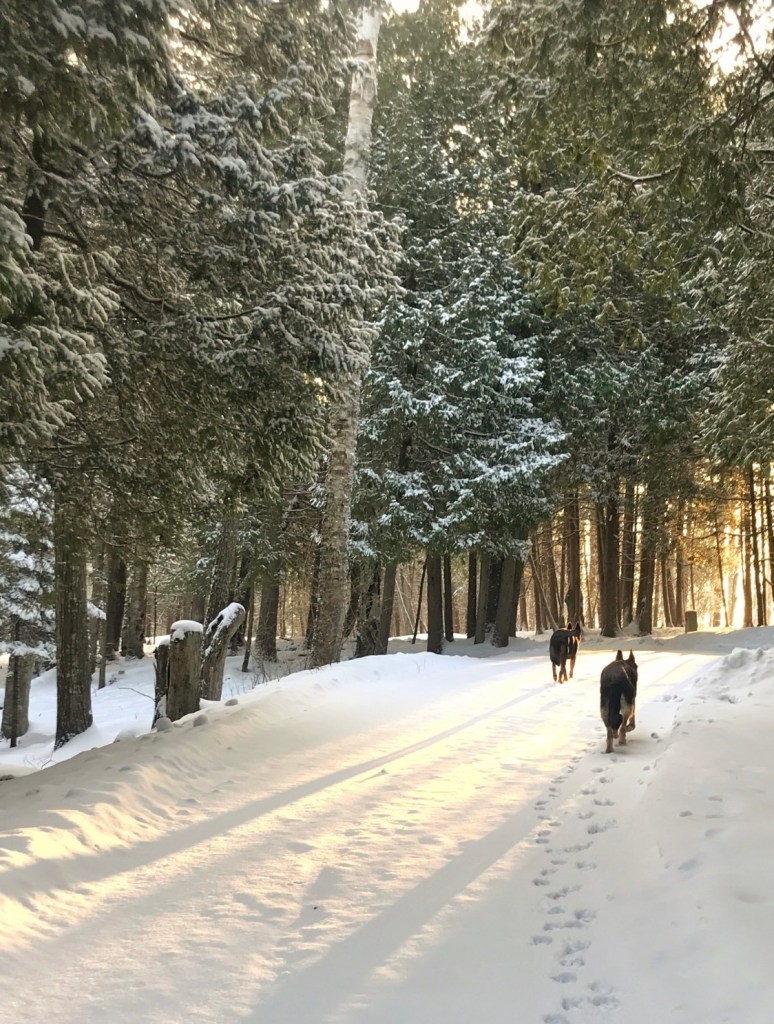
But meanwhile, here they both are: vibrant, restless, and ready to run. I’d better go.
A few months ago a new book came into the world without much notice or fanfare. That’s on me. It came during a month-long houseful of family, amidst all the cheerful jumble and chaos that entails, and also as the final process of signing and shipping and accounting from the previous book was wrapping up. This wasn’t a first book, or a last book; it wasn’t even an author’s first kind of book. And so, like so many middle children, it has had to make its way along with not much help or notice. But now, as I am settling into the coming winter, I look back with clarity at the season past, and there it is: alone, abandoned, but not un-loved.
It is, like my last book of essays, Reflections on a Life in Exile, a very personal book, written mostly amid the ennui of the pandemic. Some of it is funny, some is melancholy, some of it may be slightly mad–a bit like living through the pandemic itself. In whatever mood, I hope you find it companionable.
You can order it from your favorite bookseller ( some of mine are here, here, here, and here ) from Barnes & Noble; from Target; or from the guys in Seattle. Or you can visit your local library and ask them to add it to their shelves.
In any case, I hope you’ll look for it, and if you like it, you’ll leave nice reviews in various places. And if you crave to be the first, no one seems to have ever purchased it from Target.
And, once again, if you still occupy the world formerly known as Twitter, please share with my tag @audacityofgoats.
No, I’m not actually back on the Island. But I do feel that I am back from the brink of grief. We have had a rough month with our six year old German Shepherd, Auggie.
Without getting too gruesome with the medical details, there were times when I left the veterinary hospital sobbing, thinking we would have to let him go. He was in and out of the hospital for the better part of three weeks. Even after his second surgery to remove two enormous cysts, we did not know if he would ever recover. Then he got pneumonia.
We couldn’t explain to him why he was in pain, or why we left him with strangers. The veterinarians didn’t want us to visit because it upset him for hours afterward. It upset us, too.
But…Auggie is nothing if not obstinate…and so are we. We promised each other to do whatever we could to save his life, and we were blessed with a dedicated and relentless team of veterinarians, who studied, and researched, and watched, and consulted, and kissed him, and fed him braunschweiger. He has a neurologist, but not until a week after his surgery could we begin to hope that he did not have a vanishingly rare neurological condition which is, essentially, untreatable, and would have meant he could not go on.
Auggie goes back to the surgeon on Wednesday to get his staples out–he has an incision that must be 20 inches long. He is healing–so far as I can tell–beautifully. I know because we cannot keep him quiet.
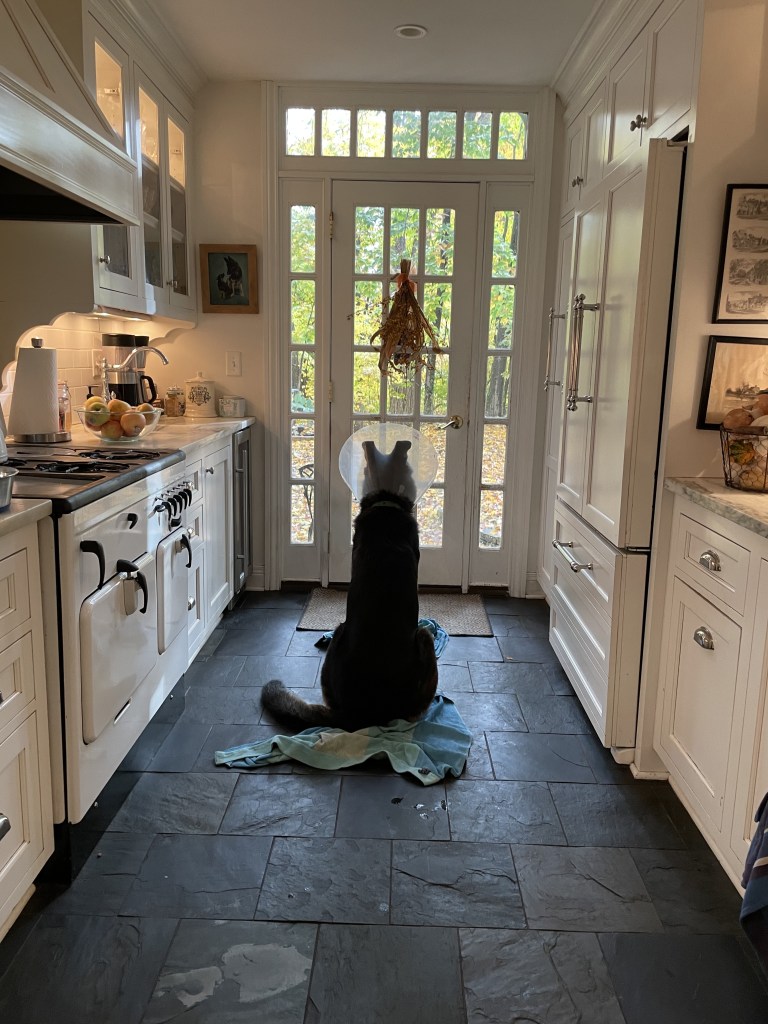
He has blasted through two hard plastic cones (the soft ones were too easy for him to get around) and the one he’s wearing now is patched together with duct tape. He has figured out how to use it as a battering ram to open doors and push past his brother, and also how to position it so he can pick up his beloved green ball. He is not permitted to run with green ball, but carrying it comforts him. I have piles of boxes and baskets on the chest on the foot of our bed so he can’t jump up, but he wants desperately to be cuddled. We have had to keep him tranquilized to prevent him from ripping out his stitches, which are both internal and external. In the process he has had nine separate prescriptions which need to be given at varying intervals of six, eight, and twelve hours, which has meant lots of middle of the night, early morning, and late night alarms. Also lots of braunschweiger, freeze-dried tenderloin, and Secret Cheese.
I haven’t gotten much writing done.
But along the way I have learned once again how much it matters to count your blessings. And since I am inexplicably locked out of Twitter, I will be putting my energy into more blog posts, and more serious writing. Please pass the word for me on twitter with @audacityofgoats so people know to look for me here.
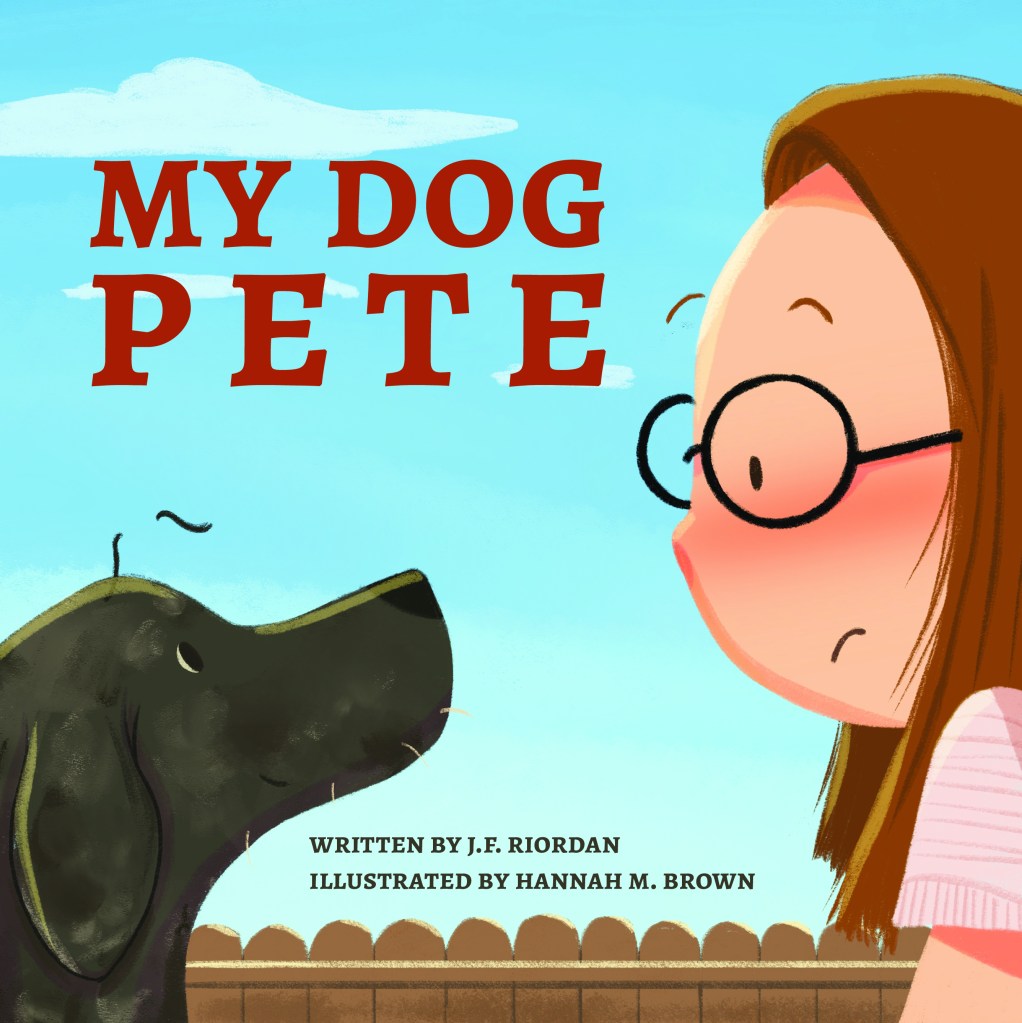
A little girl wants a beautiful show dog, but she gets funny little rescue dog, Pete, instead. He’s not beautiful; he’s trouble looking for a place to happen. Based on the story of a real dog, this charmingly illustrated and delightful tale about an unwanted dog ends with love and an unlikely hero, while teaching children not to judge by appearances. Perfect for ages 0-7. Fun for parents.
Now available, a special, limited edition hardcover version of MY DOG PETE, autographed by the author.
Price is $22.00 each, plus shipping.
We have only a small number of these available, and perhaps only for a limited time. You can buy a paperback or ebook version on Amazon for a lower price
This piece will appear in my new book of Essays And Still They Sing coming soon from Beaufort Books.
There comes a moment in grief when you begin to feel that you are being judged for it. People tell you that life goes on; that you need to stop looking back. I know that, because although I would never say it to anyone, I have often felt impatient with people who get into their problems and lie down in them. I have wanted to tell someone to get over it. In my own life, after various hard blows, including some difficult losses, I have managed to accept, to pick up the pieces of my life, and to move on. But it’s closing in on two years later, and I still have not gotten over Moses.
Life has a way of teaching us our faults.
His full name was Moses, Prince of Egypt. My husband and I argued about the name all the way to Iowa when we went to pick him up for the first time. I was insistent. It had to be Moses. It wasn’t a particularly religious choice. I had just watched too many reruns of The Ten Commandments, and wanted to be able to shake my head sadly at a naughty puppy and say “Oh, Moses, Moses, Moses.”
The name suited him. Despite having been bitten by one as a child, I had wanted a German Shepherd my whole life. I had even made a German Shepherd a character in my novels. Readers who met Moses always assumed that my character Elisabeth’s big dog, Rocco, was based on him. But Rocco was really an expression of longing. He came first. Then came Moses. Sometimes I have the sense that I willed him into being.
And he did, after all, lead us out of the wilderness. Our beloved Golden Retriever had died after a futile battle with lymphoma. Our other dog, Pete, was grieving, and our house felt empty, so we decided to sign up for the twelve to eighteen month waiting list for the perfect German Shepherd. Within twenty minutes we heard back: there had been a cancellation. Did we want a puppy on Saturday? I had the sense that it was meant to be: unplanned, the result of a series of unforeseeable events. And isn’t that what Fate is? The inevitable coming together of paths that seemed intended to diverge? Does it always have to be a human story?
From the beginning, I knew he would break my heart. I loved him too much. I can’t even explain exactly why. All I know is that there was a kind of destiny, an inevitability about him that I always felt. We belonged to each other. He was my soulmate. How to convey how much I loved him? How much I love him still? I know most people won’t think it normal. I can’t help that. It just was. It just is.
When he was only a few months old I sat in our living room, holding him on my lap, hugging him and whispering endearments. He was already too big to really fit, but I had my arms around him like a baby. My husband walked into the room and said casually: “You love that dog too much. You know he’s going to break your heart some day.” To the surprise of us both, I burst into wild sobs.
I was afraid of him at first. I’d never had a German Shepherd before, and I didn’t have confidence in how to handle him. By the time he came along I’d trained four dogs, and felt that I knew what I was doing. But when he chewed a shoe and I slapped the floor with it, scolding to show my displeasure, he avoided that spot in the kitchen for three days. That’s when I realized how delicate his sensibilities were. If I hurt his feelings, I could lose him forever.
But the moment that really frightened me was when, at 9 weeks, I tried to pull him off the bed he had no permission to be on. He growled and snarled at me, and I was struck with fear that I had a dragon in the house I could not control. I called my dog trainer that day, and begged her to let us start early. He earned his first obedience title at six months, and his second not long afterward. It required retrieval and he did not really take to retrieving, but he obliged me because that was what he did.
This is not to say that he was a tamed creature, tied to my will. Quite the contrary. Moses did things because he knew he should, and when I asked him to do something that was wrong for both of us, he would flat out refuse. One night, in the dead of a Wisconsin winter, I had an emergency call about my elderly mother. It was well below zero, and I had to meet the ambulance at the hospital. Moses knew I was upset, and he saw his job as being with me no matter what. But of course, he couldn’t sit outside in the car for hours in sub-zero temperatures. He followed me out to the car, refusing to let me leave without him, and trying to climb onto my lap. My husband gently put his hand on Moses’s collar to pull him away, and Moses turned and very meaningfully put his teeth on my husband’s arm. He did not bite; he nevertheless expressed his feelings very clearly. Moses knew his duty, and he was not easily dissuaded from it. I had to drive away from him, knowing we both felt betrayed by the separation.
I felt so much pride having this magnificent animal walk beside me. Moses loved going to the Fourth of July parade. The parade begins every year with a long line of historic fire engines, followed by the latest and most innovative, as the proud company of volunteer firefighters marches along. Moses would sing with the fire engines, a long, lovely howl that made people turn and smile. He would sit upright and bark at the three gun signal that began the parade, and he would duly accept the admiration of anyone who stopped to see him. When the parade was over, we would walk with the crowds down the street toward the park, and people would reach out their hands to touch him as he walked by, like Aslan in the resurrection.
There was a fierceness about Moses that is not in my other dogs. It lay beneath the surface, but it was right here for anyone to see. People respected Moses. As he deserved.
While we were remodeling our house, a five man insulation team arrived one morning without notice. My husband and I were at work, and only the carpenter, who adored Moses, was there. The insulators opened the door and walked in. According to the carpenter, who laughed while telling the story, Moses chased all five of them “screaming like girls” into the powder room, where they all crowded in, slamming the door behind them.
They called their manager while Moses waited outside the door.
Moses had a passion for butter. When he was young, he would steal whole sticks of it from the plate on a high shelf next to the stove. After we broke that habit, he sang for his butter, his paws dancing as he looked from the butter dish to my face and back, carefully explaining what he wanted.
More than anything else, Moses loved the lake. He was the first of our dogs brought up to swim, and he took to it immediately. But it wasn’t swimming that was his passion; it was splashing. His jumps to catch the water we splashed at him were stupendous. He leapt out of the water like a mythical beast, and his yearning to splash was relentless. If I were lazy and lounging on the dock, he would swim around the edge to me and paddle his paws to splash me, hoping to start a game. If I ignored him, he would urge me with increasingly louder moans of protest and pleading, splashing harder. He was impossible to resist.
There’s a Christina Perry song from a silly vampire movie that I used to sing to Moses. I remember the last time we were at the lake, a few months before he died. The music came on, and I whispered it to him, holding him in my arms, tears rolling down my face.
I’ve loved you for a thousand years.
I’ll love you for a thousand more.
I see now that I knew at some level it would be the last time we splashed together. Somehow, some part of me knew he was dying.
He had been in pain from an injured back, and it was slowing him down. I took him for exams. I asked every medical professional we saw—and there were a few—to reassure me that he would be all right. He’s not going to die, is he? He’ll be okay, won’t he? They all, with varying degrees of patience and curiosity assured me. Why would I even think that? He was only 7 years old. His back hurt. That was all.
But they were wrong. Somehow, in the deep connection Moses and I had with one another, I sensed that something, but it was nothing that showed up on any tests. It was just arthritis pain from a back injury, nothing more, I was told. Of course he didn’t feel well if his back hurt. We did acupuncture, chiropractic, and laser therapy. I took him for swimming therapy. He had varying levels of pain meds.
But he didn’t look right. His eyes were glassy. His fur seemed without luster. And all the while, the tumor was growing unseen, waiting to break his heart, and mine.
What hurts me most is that I wasn’t there. We had slipped away for three precious days to spend Christmas with our new baby granddaughter. While we were away, Moses had an upset tummy, but, like so many German Shepherds, he often did. We used to joke about such a big scary dog having “princess tummy”. We also live in the woods, and the dogs tend to eat things that require periodic doses of antibiotics.
He was sad when we left. He knew what suitcases meant. But we were unconcerned because he would be in his own home with his brothers and someone who cared for him. Over the course of our trip I spoke with the dog sitter multiple times. She was kind and reassuring. He wasn’t sick, but he was moping. He wasn’t eating, but he was drinking a lot of water. I was more worried about reassuring her than I was about Moses. We’d dealt with these tummy troubles before. I called the vet and arranged to pick up some antibiotics on the way home from the airport. We didn’t know he would already be there, cooling on a metal table.
Our dog sitter, never imagining we would go to the vet first, waited at our house, dreading our return. She didn’t want to tell us on the phone.
The one obligation of a soulmate is to be present when you die. But I wasn’t there. Instead, while we were in the air, Moses lay down next to our dog sitter, put his paw on her arm, looked into her eyes, and let out a long sigh. Then he died.
I know it sounds overly-dramatic, but I will never forgive myself. People have tried to tell me that he knew he shouldn’t die in front of me. I don’t buy it. He felt abandoned. He didn’t know where I was. I let him down. I, who sang love songs to him, who loved and trusted him, for whom he would have laid down his life, wasn’t there when he needed me most, and he died not knowing whether I would ever come back.
Looking back on that last year, I almost did the best I could. I didn’t miss his cues. The mistake I made was believing everyone—good people who didn’t know him as I did— who told me he was okay. I should have trusted my own heart. He was telling me, and I didn’t take his word for it.
Grief is one thing that never dies. I will be haunted by his loss forever. My only hope is that those insipid rainbow bridge poems are true, and that someday he will run to me, and I will be able to kneel down, gather him into my arms, and whisper my love into those big fierce ears.
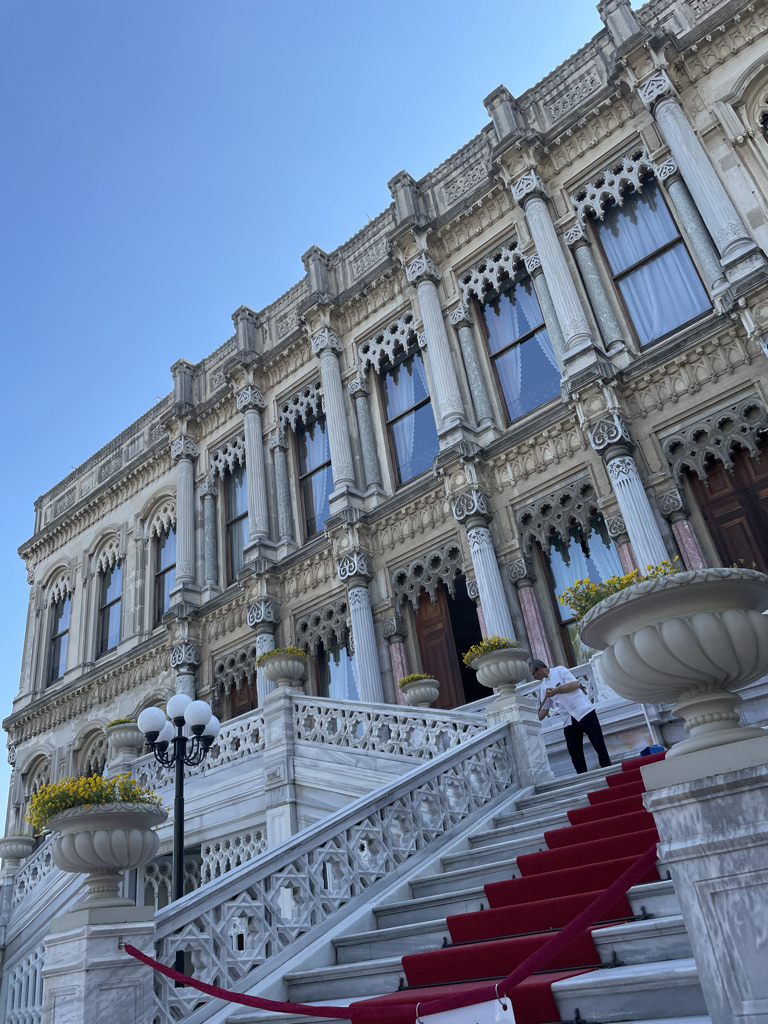
(From my talk as officiant at their wedding in Istanbul)
Anyone can fall in love. And most of us who have been married will acknowledge that it helps if love is the first requirement. The ancient vows that Sahar and Jeff are about to make confirm it: We promise first “to love”.
But, as we here make a commitment to support Sahar and Jeff in their marriage, we understand that love is not enough. I want to say “mere” love, although that would be at odds with every philosophy and theology in the world. But love can be a fleeting emotion. That’s why when we experience real love, most civilizations suggest that we add something more. We want to vow that our commitment is forever, and that we mean more than only how we feel.
Love, Honor, Comfort, and Keep. They are ancient poetic words, and they bear testament to an essential truth: Marriage is hard.
It would seem at first thought that in the commitment that they are making today, the challenges Sahar and Jeff face will be accelerated by their different cultural heritages. But this is only a detail. Because in many ways every marriage is a melding of cultures…of family…of values…of male and female.
Our work, as married people, is to accept the alien nature of the other. And, come to think of it, isn’t that the work of us all?
Because the fundamental requirements of all human relationships are those we practice first at home, and so, the relationship of husband and wife reflects our relationship with the whole world. That is not a coincidence.
We start with the imperative to love, with all that it entails, but there are also these other requirements:
Honor.
Comfort.
Keep.
Together, they form a hierarchy, with each of these actions dependent upon the other.
Honoring…it means we don’t hold one another in contempt…that our familiarity breeds, instead, respect, and generosity, and patience, and understanding.
And we cannot comfort without honoring, because offering comfort requires an essential respect of our beloved’s individual humanity and need.
Comfort requires, too, understanding the value of offering not what we need, but what someone else needs—which is almost never the same thing.
Comfort is an act of solidarity, but also an act of empathy: a moving out of ourselves and our needs, and into the needs of someone else.
If I need solitude, maybe I need to understand that at the same moment my partner needs affection. And the efforts we make to frame the world based on someone else’s needs is key part of marriage, and, indeed, of any relationship.
And “keep”. What does that mean? We keep watch; we keep time; we keep chickens.
But to keep one another….
It’s vigilance, isn’t it. It means we hold one another in esteem, with honor. We comfort. We pay attention. Sometimes at cost to ourselves and our pressing priorities. But…it also means to give shelter. We smoothe paths…we encourage… we understand foibles…we attempt to care, not just for physical, but for emotional requirements.
Come to think of it, it is a bit like chickens.
We nurture.
We protect.
We keep.
Which brings us back to love. These vows are all encompassed in the act of loving; they are the recipe for all human relationships: To Love, Honor, Comfort, and Keep.
It is more than a philosophy. It is an action; an endeavor; our daily work. And it is a challenge.
A healthy marriage—the keeping of these vows—requires fierce dedication, determination, and commitment, all entered into in the endeavor of love.
Sometimes blindly, sometimes fervently. But deliberately, reverently, joyfully, and not just with our whole hearts, but with every fiber of our beings.
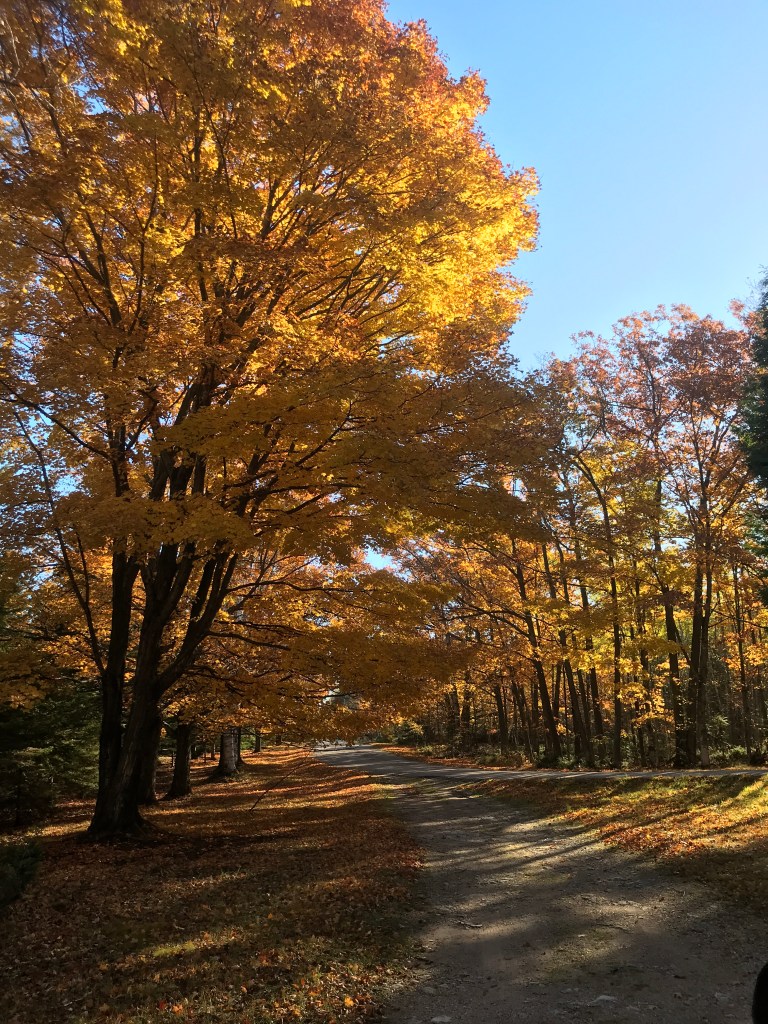
Fall is late this year. It is already mid-October, but for the first time the woods have a tinge of gold, just beginning, and the sunlight’s yellow is intensified when it shines through the trees. These are the kinds of days I count as finite in my life. All our days are finite, of course, but some seem to belong in a category as different as a gemstone to a handsome pebble.
Life hasn’t seemed, really, to have returned to normal for us. The contagion levels are still high where we live, so although we have tentatively dined outdoors a few times—and enjoyed it thoroughly—the cold weather will end that small bit of normality. The world feels smaller.
In pre-COVID times, I would go now to the Island. It is one of the places where the golden light of fall permeates everything. The long, empty roads mean I can walk for miles without seeing a car, and the dogs, who return to me instantly when I call, can run off-leash. We wander through golden lanes, and my brain, usually obsessedly plotting and exhausted by the extraction of writing, is distracted by the resonating vibrancy of the color. I remember these walks repeatedly, and return to them in my dreams, and in my books. They are, I think, how I would spend eternity, if I could.
But we are mistaken if the wet days, the bleak and dreary ones, are not treasured, too. My dogs, who love to swim, but hate the rain, nevertheless run joyfully through wet weeds and brush, shaking themselves with vigor when they come in, smelling of mud. Dogs have a capacity for appreciation that my ideal self would try to emulate, but I am not a dog, and can’t seem to achieve their purity of mind.
My joy ebbs and flows with the seasons. I have never fully understood spring, with its mud, its dirty snowpiles, its cold rains, and its disappointed hopes. For me, joy comes when fall it is at its peak, and even still later, with the stark, purple cold of winter. Once the leaves and crops are stripped away the sculptural shapes of the trees and the shape of the earth is revealed, and the light pours down, undiffused. The world seems a brighter, clearer, purer place. That cold clarity purifies me.
In our mortality, I wonder whether there is, too, a clarity that comes as we can, at last, see the end. There is no need for the extraneous, just the focus of comfort, where we can; of love, if we are blessed with it; and the firm hope that when the seasons pass, the essence of what we are will always be.
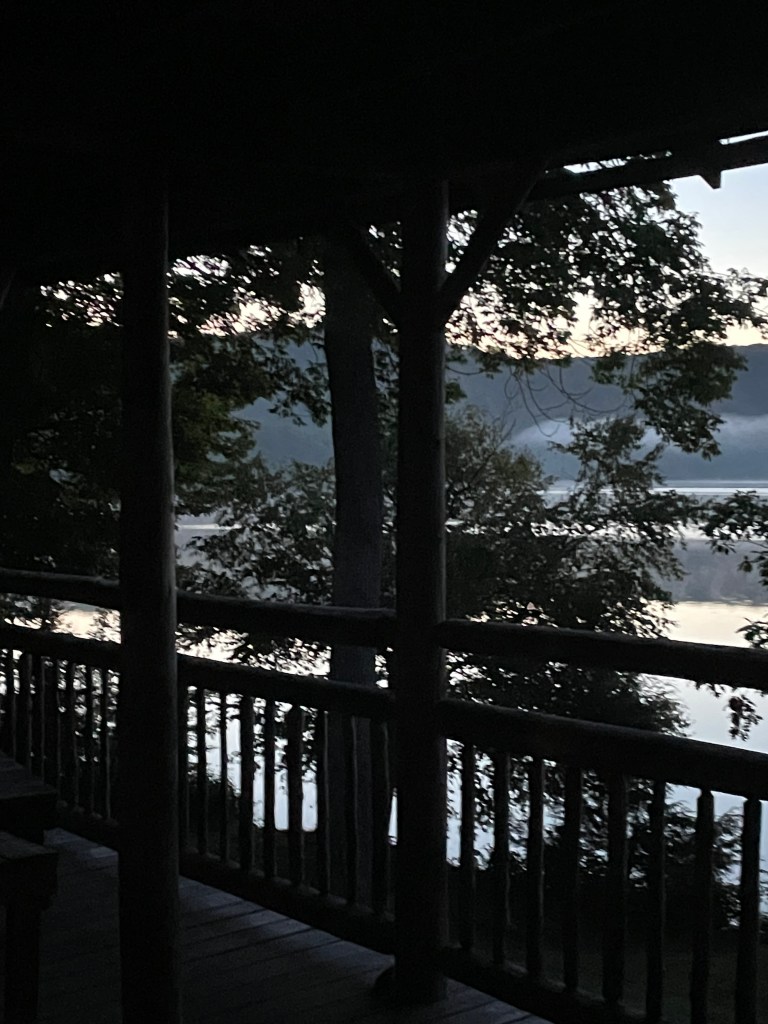
It was pre-dawn and I had been working for hours. I had just stepped out onto the porch at the house we’re renting in Maine, and was enjoying the calm, when I heard a soft, rhythmic noise. Tock-tock-whoosh, tock-tock-whoosh. I thought at first that it was drops from the eaves after all the rain we’d had, but that wasn’t quite right. I stopped, listening, trying to identify it. The sound grew louder, and I realized it was moving and coming from the water. I leaned against the railing to look out at the lake, waiting for a craft to come into view.
It was a shell with one rower. Elegantly thin, moving at a great clip, and leaving geometric designs in the water that widened and faded in its wake. The sound of the oars reverberated across the lake. I thought about the rower’s early morning, rising to be on the water before the sun rose, and felt a bit of envy at the pleasures of deep exercise, alone, with the sun just hidden behind the mountains at the east side of the water. I rise in the dark, too, but depend on hot coffee—although, perhaps, the same combination of joy and willpower—to sit comfortably on a chair, my legs crossed under me, pressing toward my writing deadline. I count words every morning, gauging my progress. Only two months left.
As he rowed back twenty minutes later, his pace was still strong, but just barely slower. Tock-tock-whoosh. The sound rose and fell as he approached, then moved off into the distance, fading into the morning’s birdsong.
It was a moment of deep and unexpected beauty.
It’s surprising sometimes the things that can make life magical.
The house we rented in Maine is very old and very large. It has history. Perched on a small hill above the lake, it has sprawling porches, front and back, and lovely views. There’s a spacious kitchen, a laundry room, and five roomy bedrooms with four baths. There’s a massive stone fireplace in the living room. But it does not have wi-fi, and the cell signal is only one elusive bar, which seems to flit from room to room like a butterfly, and then disappear.
It has been a long time since I have left my phone sitting on the night stand, turned off, and walked away for the day. I feel released from electronic bondage. The impulse, in an idle moment, to look down at the phone is gradually being replaced by a willingness to look up, to think, to let my brain idle. That’s how writing happens.
I had become increasingly aware of the way my phone had taken over my life. I am continually scrolling through my messages. There’s not a scene that passes before my eyes that doesn’t make me reach for the camera. There’s not a drive that isn’t accompanied by a podcast. It’s too much. It’s too many voices. It’s too much externality. And none of those things are good for a writer.
This week I wrote in the mornings. I hung around with my family. We did a complicated puzzle. I sat on the dock and dangled my feet, and thought about things. I jumped into the cold lake. I cuddled children. I drank cocktails. I went to bed with a book.
It was a kind of detox, and it has put me on the path to getting my brain back.
The temptations to return to my old habits will be strong, and I imagine there will be a gradual regression toward over-use. But I have a plan to keep it in check, and at the moment, it doesn’t even seem appealing to go back to my old ways.
Back in the pre-covid days of festivals and conferences, my husband used to travel a lot, and my closet overflowed with tote bags. This essay appeared in the now defunct Weekly Standard September 26, 2018.An article in today’s NYTimesbrought tote bags and all their environmental baggage once again to the fore.
***
I seem to recall an essay by Ralph Waldo Emerson in which he predicts that the world will be subsumed not by fire or flood, but by an overwhelming mound of common pins. It hasn’t happened so far, but that may be because we have shifted the cultural weight, as it were, to a far more voluminous enemy: the tote bag.
My husband is on the festival circuit. He goes to exotic and beautiful places like Maui and Aspen, cavorting with celebrities and beautiful people, while I stay home with the dogs. It’s not as bad as it sounds, really, and it has the advantage of enhancing spousal appreciation, but it does have a curious byproduct. Every time he returns, he presents me with a tote bag.
Tote bags are nothing new. They have been the mainstays of museum gift shops and the low-cost premium for subscriptions to magazines and public television for decades. Environmentalists made them important by urging us to pile our groceries into their bacteria-infested depths week after week, rather than wounding the earth with the clean, fresh, disposability of plastic or paper grocery bags.
I love the earth. But I have questions about tote bags.
I have never had a statement handbag, but then, I live in the Midwest where things like that are considered ostentatious. I do find, however, almost against my will, that I have begun to select the tote bag I want depending on where I’m going and who I will be seeing. There is a hierarchy to tote bags that is more subtle than the kind of car you drive. Tote bags can brag without your ever having to say a word. They are signaling mechanisms to announce your affiliations.
The local grocery store gives out a flimsy, paper-thin canvas wine bag when you purchase more than one bottle. It’s okay if you leave that one behind at your friend’s house. I have a beautiful well-made canvas bag with a painting of the Flatiron Building that I purchased in a museum gift shop. It is sturdy enough to carry books and signals my cultural sophistication. This may have slightly more cachet than the thin fabric WNYC tote that seems to suggest that I am a donor (I am not) or that I am part of the East Coast intelligentsia (I am most definitely not). I have a bag from the American Enterprise Institute, proving that I am “Fighting for Freedom, Opportunity, Enterprise.” That sounds nice. The TaxPayers’ Alliance signals my support for fiscal restraint, and the Hoover Institution is a nice way of encouraging people to enquire whether I have met Milton Friedman or George Shultz. I have bags from book conferences that suggest my writing bona fides. I have one that declares “We Can Change the World,” a claim whose sincerity I don’t doubt, but about whose particulars I am somewhat skeptical. Perhaps my favorite is my niece’s gift, a utilitarian lightweight “Totes Ma Goats” bag in which I carry my own books (especially my novel The Audacity of Goats) for publicity events.
But of all the tote bags, the most exclusive are those presented as swag to attendees of various high-level conferences, like the Aspen Ideas Festival. We now have three or four Aspen tote bags. One is beautifully made from military grade canvas with leather handles and represents philanthropy to a veterans group. A bag from an exclusive corporate philanthropic retreat has a lovely insulated pocket underneath to carry your properly chilled bottle of New Zealand sauvignon blanc or possibly a can of bug spray that wouldn’t mix well with the potato salad.
Does Davos have a tote bag, I wonder? Do Davos attendees ever do anything that requires the use of a tote bag? Or do they bring them home as a bonus gift to their nannies?
As my husband’s spoils of conquest accumulate in the hall closet, and the door becomes harder to close, I have begun to feel the need for some form of triage. How many tote bags does one family require? I ought to sort through, choose the most exclusive, and chuck the rest, but I’ll probably keep the nice plastic one from the now-defunct local bookstore. It’s easy to disinfect.




 J.F. Riordan