My friends, Evelyn and Rose, are twin sisters, age 93. I have known them all my life. They have their share of challenges, as do we all, but they are utterly undiminished by age in any meaningful sense, and carry on with rare gallantry.
Today, for my birthday, they sent me not one, but two bottles of Veuve Clicquot, all beautifully packaged in a big box with excelsior that feels like a beautiful and elegant difference from plastic bubble wrap.
I think it will be a a very happy night. Or possibly afternoon.
When I wrote to say thank you, Evelyn said, “We know what you like.”
What would a year of your life be worth? Is there any amount of money you would accept to shorten your time on earth? What if the money offered would give you everything you dream of having? What if it would save the life of a child? When the payment came due, and your time was up, what would you pay to have it back?
This is a version of the Faustian bargain, although Faust wanted youth and love, not money, and the price he paid was eternal damnation. Most jobs are not the Inferno (although I bet we all have stories). But it is, in concentrated form, a question we all grapple with in one way or another when we work. It is the question I asked every single morning when I stood at my picture window, dressed for the office or the classroom, and looked out at the sun rising through the trees. My office was on the bluffs above Lake Michigan, and sometimes, before I pulled into the parking lot, I would stop to watch the sun and the mists rising over the water, hear the gulls crying, and feel what I now realize was a form of grief. But then I got out of the car and went into the building and went to work. And that was not a bad thing.
Most of us have to work for a living. If we are lucky we find work that is meaningful, that makes the world better in some way. But for most of us, even the best job takes time away from things we care about.
I have been very lucky these past few years, because now my work is my writing, and I can do it in my own house with my husband nearby and my dogs on my feet. I choose what and when to write, and sometimes I play hooky. But that’s because I have the freedom to make choices about my priorities.
It is a luxury I appreciate every single day. I do not look back on my years at a job as wasted. I do sometimes look back with regret, but I also know that each step I took was a step toward who I am. Besides, anyone with no regrets hasn’t been trying hard enough.
The theologian Frederick Buechner wrote something I try to think of every day:
One life on this earth is all we get, whether it is enough or not enough. And the obvious conclusion would seem to be that, at the very least, we are fools if we do not live it as fully, and bravely, and beautifully as we can.
No one has a perfect life. No one has a life without grief or loss. But I think happiness is about gathering in the small beauties all around us Right. Now.
But increasingly, after centuries of human conceit about our moral superiority, science is being forced to acknowledge that animals do demonstrate care for their communities, sometimes even for other species. Today’s New York Times story about a male elephant seal rescuing a drowning pup is another example of an animal’s taking action that was not necessarily in its own interest.
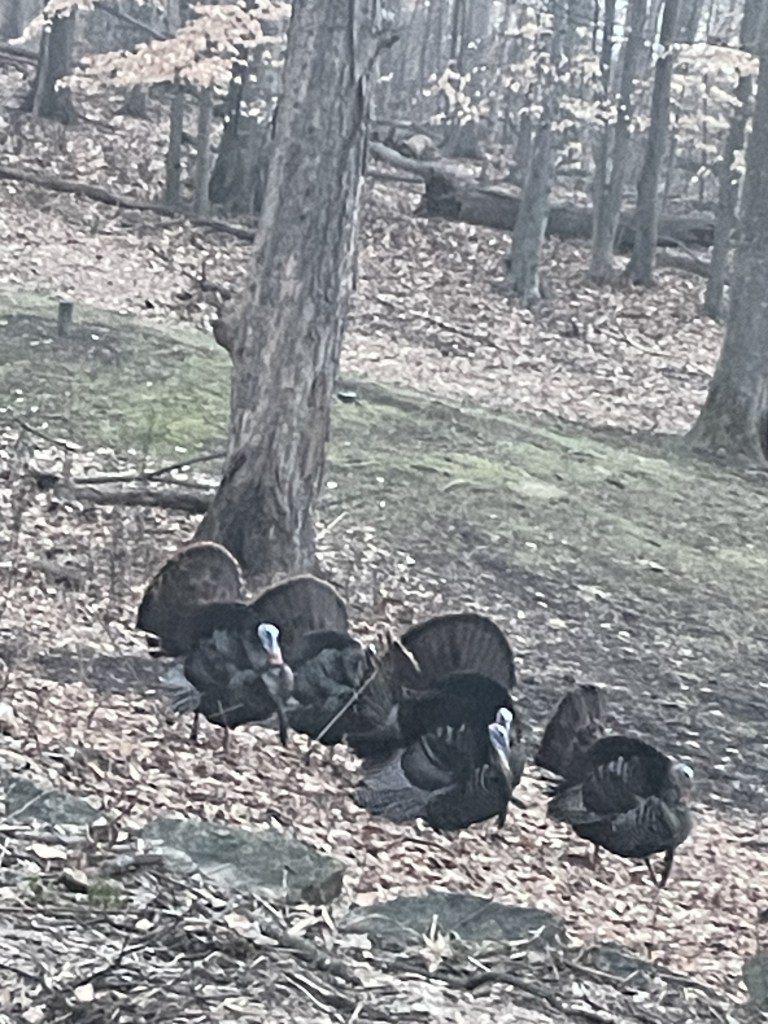
This past fall I saw another incident of turkey community action. The turkeys were on their daily march back to our woods to roost. The big toms were in front, and there were several groups of hens, surrounded by eleven scrambling poults—I counted—following about forty feet behind. Herding cats has nothing on herding turkey poults.
Our ravine is a water conservancy, which means there are some fairly deep holes that are usually dry, but fill with leaves in autumn. They seem like solid ground, but you can sink pretty deeply (and turn your ankle) if you accidentally step in the wrong place.
As I watched—seeing the babies is rare— the poults, one by one, managed to just barely avoid the biggest hole, scattering around it. Holding my breath, I could see what was about to happen: one took the wrong line, and promptly disappeared deep into the leaves. Its frantic peeping was terrible to hear.
Instantly the line stopped, and the toms turned and raced back to the sound of the crying poult. Soon the whole flock was surrounding the area—not in an orderly way at all—but homing in on the baby. I turned my head at exactly the wrong moment—dogs, you know—but suddenly the peeping stopped, and when I looked back, the adults were reassembling into the line, and I counted: one, two, three…all eleven poults were there. Counting turkeys can be tricky, so I counted three times. Everyone moved back into line, and on to the assembly grounds to carry on with their evening routine.
I still don’t know how they got the poult out of the hole.
It’s completely normal for parents to risk all for their offspring, and in this case, the poult was likely genetically linked to the adults who sped to its rescue. But to see the entire flock work together like that was another lesson to me. We humans have to learn a thing or two, and meanwhile, maybe we should stop being so smug about ourselves.
The toms think they’re pretty important. They’re not wrong.
I had a little meeting with a local book club yesterday. They are all old friends, and did more talking than I did, and mostly on topics unrelated, but I’m not in a position to criticize digressions.
I almost always enjoy meetings with my readers, because by definition we have something in common, and people who don’t like my books generally don’t come to hear me speak. There was one notable exception: a book club on Washington Island shortly after my first novel came out.
It was a luncheon meeting, just before Easter, and after a pleasant lunch we all sat down for the meeting. One woman spent the entire discussion rapidly paging through the book to find things she didn’t like. She found many. Another pointed out that the map in the front was inaccurate. Another remarked how unrealistic the book was, since in her thirty years of living on the Island, she had never been invited to sit in the ferry’s pilot house. I wish I had had the nerve to say I could see why. Nor did I point out that my book was a work of fiction, only loosely based on reality. Until then, I hadn’t imagined it would be necessary.
It was an excruciating hour, and I was longing for a stiff drink. As the ladies filed out, I sat, somewhat shell-shocked. One leaned over to whisper as she went out.
“I liked it.”
Afterward, in need of some fresh air, I headed down to the ferry office to pick up a package. As I was leaving, there were some guys down at the dock calling and waving at me. “He’s mad at you for not telling him you were here,” the crewman joked, pointing at the captain. I went over to chat with them, relieved to see some friendly faces. “We’re heading out. Want to come for the ride?”
So we did a little round trip on the ferry, while I sat in the pilot house with the crew, entertaining them with the story of the book club meeting. They were able to identify everyone who was there by my descriptions, laughed about the surliness of the book-paging woman, and told stories of her rudeness. The conversation progressed to some fascinating stories about life on the Island. By the time we returned, I was in a much better mood.
So, I did say I don’t mind digressions. But my actual point is: if you live within a reasonable drive of Milwaukee, and would like to host a book talk, you can contact me here.
Every year I ask for a blizzard for my birthday, which is this week. So far, I have only gotten two, and I think the odds are long for any kind of cold weather this year. The snow is almost gone, it’s warm and damp and muddy, and it’s my least favorite kind of weather.
Despite my best efforts, the dogs track in mud, and if I’m not meticulous, leave splatters on the walls and cabinets. If I forget to close the doors to the bedroom, they leave mud on the bed. There are old beach towels spread everywhere in varying stages of dirt and dampness, and it takes time and effort to diminish the squalor.
On top of everything else, it’s too warm for a fire in the fireplace, which doesn’t draw well above 45F.
Complaining about the weather is a human pass time, I suppose, but it annoys me, particularly when I do it myself.
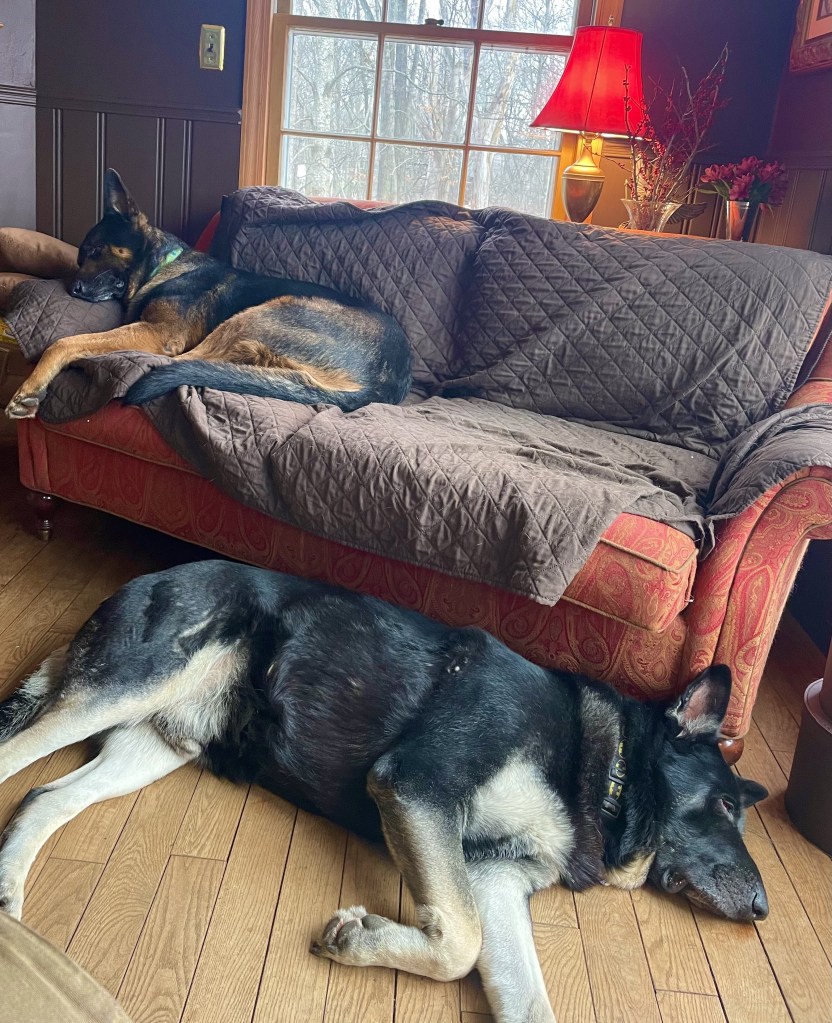
The dogs, blissfully uninterested in the weather—unless it’s raining, in which case they are frustrated when I won’t make it stop—are sound asleep nearby. A pair of red-tailed hawks are on the hunt in the woods, and I do not see a single squirrel or small bird anywhere. There are worse things in life than bad weather, so we will count our blessings, instead.
Every morning for many years, our dogs went together into the woods for what we referred to as their morning ramble. Everyone went along: First Reggie and Pete; then Moses and Pete; then Moses, Auggie, and Pete; Then Auggie, Eli, and Pete. They would be gone—usually within sight—for ten or fifteen minutes, and then all return together on the run, jostling happily back into the kitchen smelling of fresh air, or sometimes of some foul thing they had all rolled in, and expecting their treats.
Then one day, it stopped. Why? Because, as we belatedly realized, the rambler was Pete. He was the hound dog, the one with the scenting nose and the wandering impulse. Pete was also the pack leader, even in his dotage. The Germans also seemed to have an instinct to protect him, following him like body guards. For whatever reason, it was a daily ritual. And their rambling was a very good thing. Everyone went off independently, but still together, to smell smells and stake territory, and make their own decisions. I very firmly believe that dogs who have this kind of independence develop a depth of understanding that builds capabilities and personality. Argue if you want.
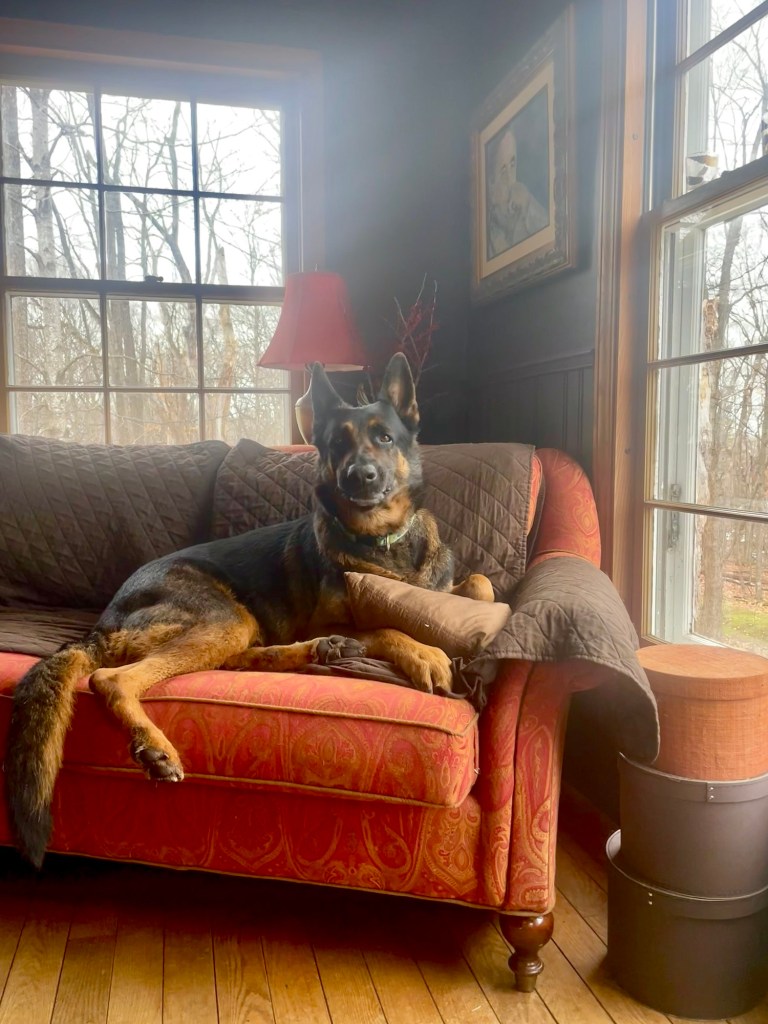
Eli is a particularly unrambly dog. He likes to stay close to home, preferably on the bed or couch. He doesn’t like loud noises. He thinks airplanes are thunder, and runs to hide. He hears distant gunshots and runs to hide. He hears construction noises in the distance and runs to hide. He only shows his shepherd side when strange animals or people approach. Then he stands his ground quite terrifyingly.
So, this morning, after he had interrupted me four times to go out, and I had brought him to the door four times while he simply stood at the door step and looked out, I put on my shoes, walked out six feet, and when he followed me, I turned around and walked back in, leaving him to scratch plaintively at the door. I ignored him and went back to my work.
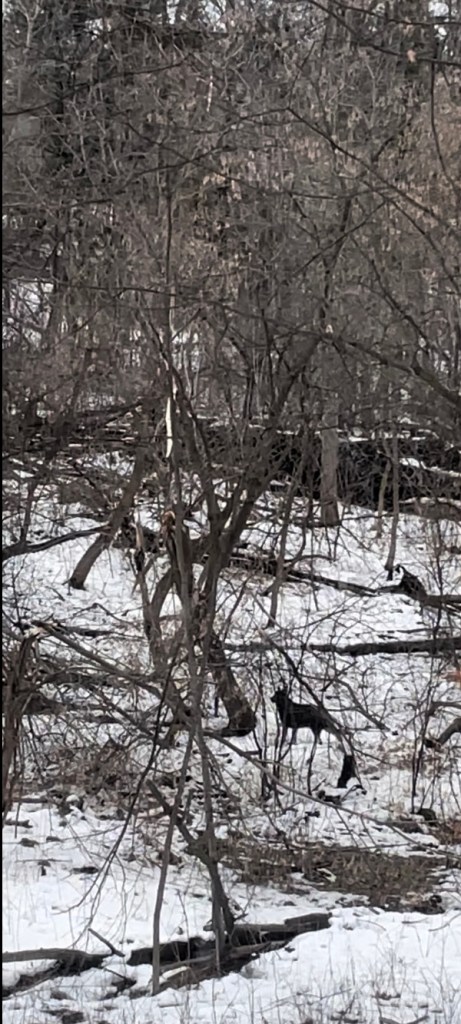
But from the library windows, I could see, to my surprise, Eli, alone, down in the woods, and moving purposefully away from the house. I stood up to watch and followed him from window to window, room to room, as he went deep into the brush, sniffing, looking, investigating logs and holes. I didn’t want to interrupt him, but I didn’t want to lose him, either.
But after ten minutes or so, he paused and put his nose into the air. And then, having made his decision (“‘I smell something,’ said the Poky Little Puppy.”1) he turned and galloped up the hill to the house. Not fearfully, just a happy-to-be-going-home gallop.
I have no idea what inspired this, but I am happy when he’s happy. Maybe he will find it was an experience worth repeating. I hope so.
The Poky Little Puppy is a children’s book written by Janette Sebring Lowrey and illustrated by Gustaf Tenggren. It was one of the famous Golden Books series, and is still in print 82 years after its first publication. ↩︎
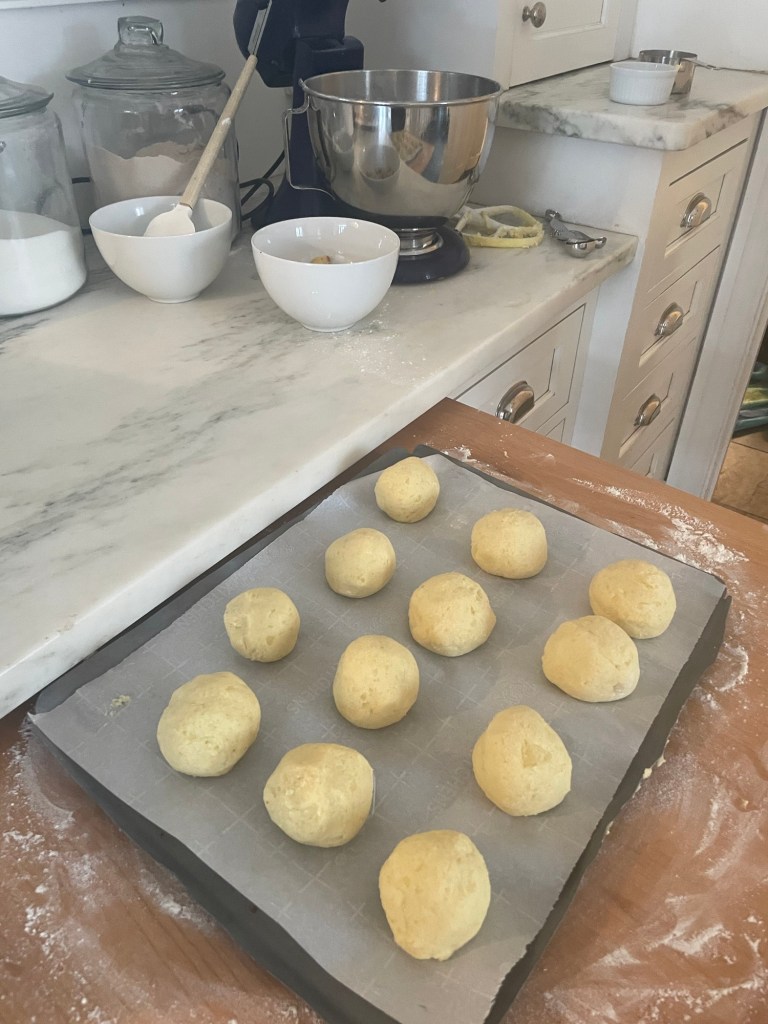
Mainly because I had never made any before. But they were easy and kind of fun to make. I could tell they were done when they floated to the surface of the boiling water.
This was one of those meals with lots of last minute preparation that can be daunting, particularly because all the recipes were new to me. But dinner was a success.
I sent all the leftovers home with my friends. I really don’t enjoy heavy meals like that anymore.
But I could eat a lot of dumplings: so chewy and dense and delicious. I sent them home, too.
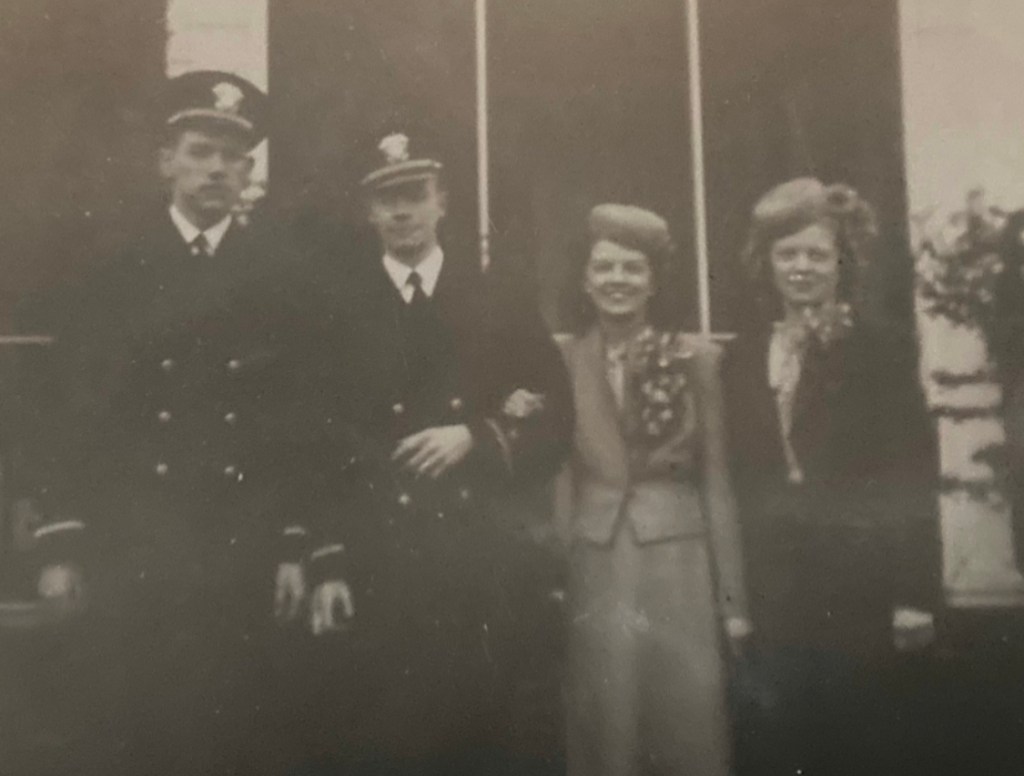
Today would have been my parents’ 79th wedding anniversary. World War ll was coming to its climax, and my dad begged my mom to come to Annapolis to get married before he shipped out. So she, my aunt, and my paternal grandmother—my other grandmother had already died—took an unheated train from upstate New York to Virginia. They were so cold they all snuggled together under my grandmother’s big fur coat.
It was war time, so there were no cabs, and they had to take a trolley to get to the Navy chapel. My mother always said that was the moment she was glad she hadn’t worn a wedding gown. Instead she wore a dove gray suit with a spray of yellow roses. My father always gave her yellow roses for their anniversary.
They all spent the wedding night together in one room. Romance wasn’t really an option in war. My mother said many times how when they kissed good bye she didn’t know if she’d ever see him again. It’s hard to imagine how difficult life was then.
And we all think we are stressed.
My dad and mom are in the middle. My Aunt Ruth was matron of honor. The name of the best man is lost to time.

 J.F. Riordan