A few weeks ago, I wrote about a turkey I saw helping another turkey. Some readers were skeptical—which I might be, too, if I hadn’t seen it myself—about whether animals demonstrate altruism.
But increasingly, after centuries of human conceit about our moral superiority, science is being forced to acknowledge that animals do demonstrate care for their communities, sometimes even for other species. Today’s New York Times story about a male elephant seal rescuing a drowning pup is another example of an animal’s taking action that was not necessarily in its own interest.
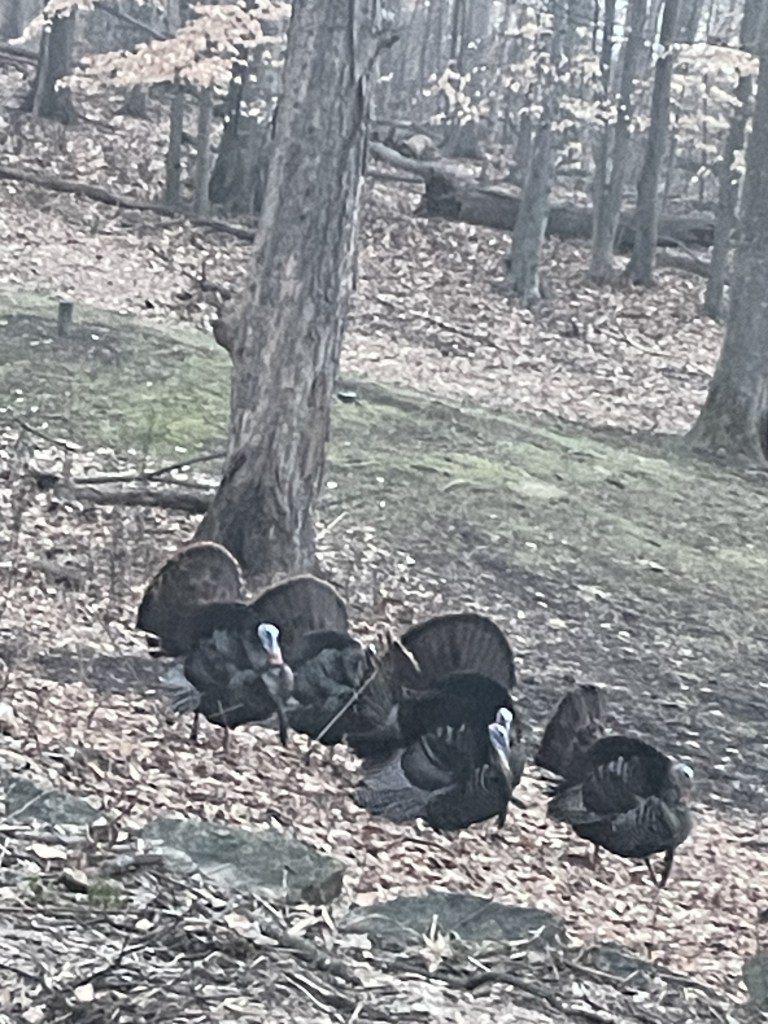
This past fall I saw another incident of turkey community action. The turkeys were on their daily march back to our woods to roost. The big toms were in front, and there were several groups of hens, surrounded by eleven scrambling poults—I counted—following about forty feet behind. Herding cats has nothing on herding turkey poults.
Our ravine is a water conservancy, which means there are some fairly deep holes that are usually dry, but fill with leaves in autumn. They seem like solid ground, but you can sink pretty deeply (and turn your ankle) if you accidentally step in the wrong place.
As I watched—seeing the babies is rare— the poults, one by one, managed to just barely avoid the biggest hole, scattering around it. Holding my breath, I could see what was about to happen: one took the wrong line, and promptly disappeared deep into the leaves. Its frantic peeping was terrible to hear.
Instantly the line stopped, and the toms turned and raced back to the sound of the crying poult. Soon the whole flock was surrounding the area—not in an orderly way at all—but homing in on the baby. I turned my head at exactly the wrong moment—dogs, you know—but suddenly the peeping stopped, and when I looked back, the adults were reassembling into the line, and I counted: one, two, three…all eleven poults were there. Counting turkeys can be tricky, so I counted three times. Everyone moved back into line, and on to the assembly grounds to carry on with their evening routine.
I still don’t know how they got the poult out of the hole.
It’s completely normal for parents to risk all for their offspring, and in this case, the poult was likely genetically linked to the adults who sped to its rescue. But to see the entire flock work together like that was another lesson to me. We humans have to learn a thing or two, and meanwhile, maybe we should stop being so smug about ourselves.
 J.F. Riordan
We humans can definitely learn a lot from our animals & the wild ones, too. We really do need to pay better attention to the details.
LikeLiked by 1 person
Glad the baby survived thanks to his caring family. Nature is beautiful and amazing. People not so much sometimes. You’re one of the good ones. Have a great day!
LikeLike
Very kind. Thank you.
LikeLike
So wise.
LikeLiked by 1 person
Never one of her biggest fans but she was correct, it takes a village.
LikeLiked by 1 person
In a world of insanity give me a story about dogs, or turkeys , any day. Thank you.
LikeLiked by 1 person
You are making me forgive turkeys for the $3,500 of damage a wayward one once did to our van.
LikeLike
Imagine the damage the van did to the turkey.
LikeLike
Thank you for sharing an event most of us will never be fortunate enough to witness. ❤️
LikeLiked by 1 person
This is a beautiful story. I’ve seen videos showing how animals come to another animal’s rescue, sometimes even a different species. We humans could learn a lot about kindness and compassion from animals. I had a crazy thought while reading this. Would you have considered rescuing the poult yourself if its family had not heard it crying for help? And only if there was no chance of danger to yourself. I know there’s a lot to consider; the depth of the hole, the size of the poult, if it could harm you and would the other turkeys reject it if touched by a human. I warned you it sounded crazy. But knowing your empathy toward these woodland creatures, the thought occurred. Kisses to Auggie and Eli.
LikeLiked by 1 person
I absolutely would, but was very relieved I didn’t have to.
LikeLiked by 1 person
It costs nothing to be kind to and care for others. Thank you for your exquisite and vibrant essays. This one brings a smile and hope!
LikeLiked by 1 person
I believe it. Altruism is most certainly found
LikeLike
What a wonderful way to start the morning with a story that has a happy ending and so heartwarming how animals care for one another.
LikeLiked by 1 person
Thank you for sharing this. Personally, I donate to several animal sanctuaries. I’ve seen turkeys, cows and pigs respond just like you wrote. Pigs, in particular, are extremely smart and respond almost like dogs. At one sanctuary there is a baby pig that escaped a slaughter transport truck. It survived the jump but is blind. The chickens at the sanctuary have adopted this sweetie. At night he chooses to sleep with them, and they surround him like feathered bodyguards. Humans have a lot to learn.
LikeLiked by 1 person
We could learn a great deal from observing animals.
LikeLike
Love this! And I count several times when all ages of turkeys stop here. Sometimes we have 30 larger turkeys, we also have a younger group of about 7, and also we get a loner. Thank you.
LikeLike
They move around a lot!
LikeLike
I am fascinated by our local turkeys. They have a tendency to cross at crosswalks on busy streets and I once saw the tom turkey walk out into the street first, turn to traffic and spread out his tail while his flock crossed safely behind him. I have also seen some sort of ritualistic turkey fight training in our local park. It was a few old birds and a bunch of half-grown birds and the older ones were just standing around while the younger ones did what looked like practice fighting. They would grab their opponents by the lower beak and twist. It looked quite cruel but they didn’t seem to be picking on any one bird, they just seemed to be working on their technique on each other.
LikeLike
They are endlessly fascinating.
LikeLike